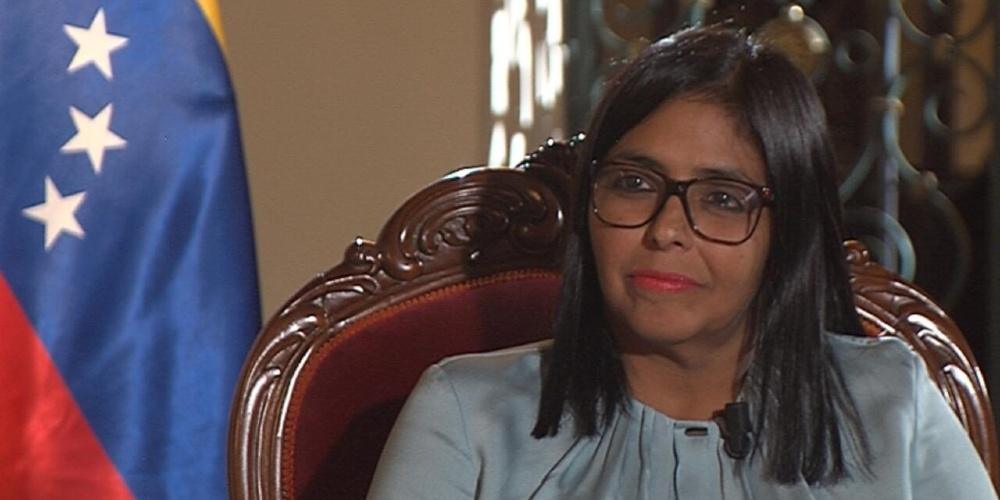
After the United States executed a precise military operation to capture Venezuelan leader Nicolás Maduro, the socialist regime in Caracas moved quickly to install his vice president, Delcy Rodríguez, as the new head of state. Rodríguez, a longtime ally of Maduro and a key figure in the Chavista movement, took the oath of office on January 3, 2026, amid widespread confusion in the capital. President Donald Trump acknowledged the development during a press briefing, noting that Rodríguez had “just been sworn in” following Maduro’s removal. This swift handover raises serious questions about whether the change truly disrupts the grip of socialism on Venezuela or simply reshuffles the deck.
Rodríguez, often referred to in opposition circles as a hardline ideologue, has deep ties to the Marxist roots of the Bolivarian Revolution started by Hugo Chávez. As Maduro’s vice president since 2017, she has overseen economic policies that deepened Venezuela’s reliance on state control, while facing U.S. sanctions for her role in undermining democratic institutions.
Her brother, Jorge Rodríguez, serves as president of the National Assembly, further entrenching family influence within the regime. Critics argue this transition maintains the same oppressive system that has driven millions into poverty and exile, with Rodríguez vowing to continue the fight against “imperialist aggression” in her inaugural address.
The U.S. intervention, dubbed Operation Absolute Resolve, involved over 150 aircraft and elite Delta Force units that neutralized key defenses and extracted Maduro and his wife, Cilia Flores, from their compound. No American fatalities occurred, though Venezuelan state media reported civilian casualties and infrastructure damage.
Defense Secretary Pete Hegseth praised the mission as a clean break from past entanglements, emphasizing its focus on dismantling narcoterrorism networks tied to the regime. Yet with Rodríguez now at the helm, some wonder if the operation has inadvertently empowered another architect of the same failed policies.
Trump outlined plans for American oversight during the transition, stating, “We’re going to run the country until such time as we can do a safe, proper and judicious transition.”
He hinted at direct involvement in rebuilding Venezuela’s vast oil reserves, the world’s largest, to benefit U.S. interests and global markets. Secretary of State Marco Rubio has already engaged with Rodríguez, suggesting negotiations are underway to stabilize the nation. However, opposition leader María Corina Machado, who won overwhelming support in a disputed 2024 primary, remains sidelined, with Trump dismissing her as lacking broad backing.
Skeptics point to deeper machinations, whispering that Rodríguez’s ascension might stem from backroom deals allowing U.S. access to Venezuelan resources while preserving a facade of continuity. Maduro’s regime had long courted alliances with Russia, China, and Iran, turning the country into a hub for anti-Western activities. With Rodríguez in power, those ties could persist under the radar, potentially laundering influence through global networks that profit from instability. Reports from Infowars speculate on hidden motives, including elite interests in controlling oil flows to undercut American energy independence.
Venezuelans in exile celebrated Maduro’s fall with street parties in Miami and elsewhere, but back home, the mood is tense. Protests erupted in Caracas as loyalists rallied behind Rodríguez, clashing with those demanding free elections. The new president’s defiant stance—”Venezuela will not be anyone’s colony”—echoes Maduro’s rhetoric, fueling fears of prolonged unrest. As one expatriate said, “We escaped one tyrant, only to see his shadow take the throne.”
This development tests the limits of U.S. resolve in the hemisphere. While removing Maduro strikes a blow against narcoterrorism flooding American streets with fentanyl, installing a successor from the same ideological mold could prolong the suffering.
Patriots watching from afar see potential in Trump’s bold approach, but the real measure will be whether Venezuela emerges as a free nation or remains mired in socialist decay. As oil infrastructure revives under U.S. guidance, the benefits could flow, but only if the regime’s remnants are fully dismantled. For now, the world waits to see if this change is genuine or just another chapter in a long saga of tyranny.
She’s had a ‘heads-up’ on her possible ‘future’. She only gets ONE CHANCE.