

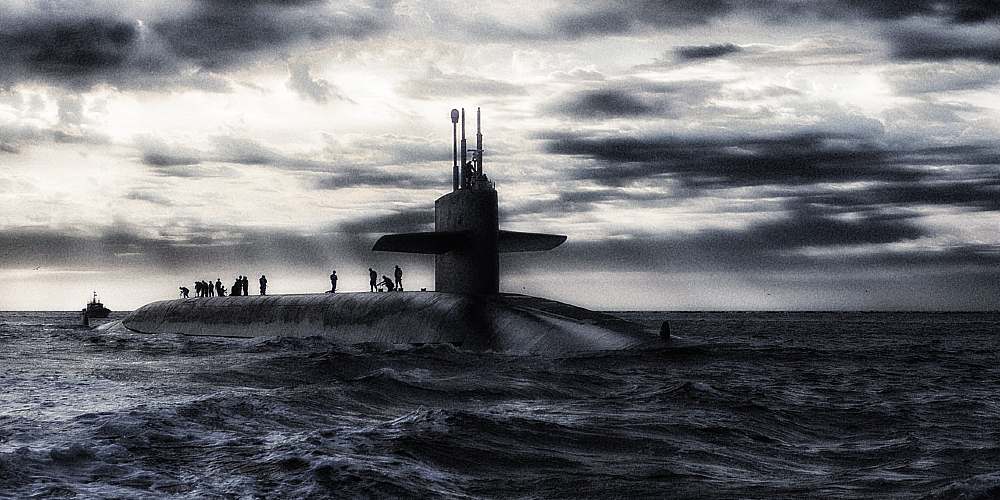
(End of the American Dream)—A Russian submarine and a Russian frigate that are both capable of nuking U.S. cities were both spotted traveling approximately 25 miles from the coast of Florida, but most of the U.S. population did not receive the message that the Russians were trying to send. By sending these warships along the coast of Florida, the Russians are warning that they will use nuclear weapons if they are pushed too far, but hardly anyone seems to care.
The mainstream media insists that these vessels are “no threat” and that there is no risk that a full-blown nuclear conflict will erupt any time soon. But while our experts are assuring us that everything will be just fine, the Russians are feverishly preparing for a worst case scenario.
In recent days, a flotilla of four Russian war vessels has been practicing “the use of high precision weapons in the Atlantic ocean”…
Russian warships are practising the use of high precision weapons in the Atlantic ocean, Russia’s defence ministry said on Tuesday, putting the US on alert.
Vladimir Putin’s most modern frigate Admiral Gorshkov, a hypersonic missile carrier, is accompanying nuclear submarine Kazan and two other naval vessels.
The drills involve hitting targets from a distance of more than 370 miles, Russia’s defence ministry said in a statement, and follow an exercise in anti-aircraft fire.
All four vessels are set to arrive in Havana on Wednesday and will pass 25 miles from the coast of the United States on their journey, according to reports.
On their way to Havana, they were expected to get quite close to the coast of Florida, and that is precisely what happened on Tuesday…
Three Russian Navy ships and a nuclear-powered submarine seem to be passing the Florida coast Tuesday, June 11, on the way to Cuba for a military exercise, according to open-source intelligence analysts on social media. A tweet on X, formerly known as Twitter, said that the US Coast Guard Cutter Stone may be shadowing the Russian flotilla off the east coast of Florida abeam of Cape Canaveral.
On Wednesday, June 5, a U.S. official told the media that Russia planned to conduct naval exercises with combat vessels in the Caribbean region. The United States did not see the expected arrival of the flotilla to the Western Hemisphere to be threatening, but the official told Reuters the U.S. Navy will monitor the exercises. The officials spoke on the condition of anonymity to provide details that had not been made public yet.
The Kazan and the Admiral Gorshkov are both capable of carrying nuclear weapons, and they are both considered to be “key vessels in Putin’s nuclear strike force”…
Despite this, both the Admiral Gorshkov and the Kazan are normally key vessels in Putin’s nuclear strike force.
Russia has not stated what firepower is being carried by his flotilla.
Of course the Russians do not intend to attack us at this time.
And Cuban authorities are openly telling us that even though they are capable of doing so, “none of the vessels is carrying nuclear weapons”…
Kazan and three other Russian naval vessels – missile frigate Admiral Gorshkov, fleet replenishment tanker Pashin and a salvage tug Nikolai Chiker – will dock in the Cuban capital from June 12 to 17, Cuba’s Ministry of Foreign Affairs said in two statements on Jun. 6, 2024. “None of the vessels is carrying nuclear weapons, so their stopover in our country does not represent a threat to the region,” it added.
But everyone agrees that having these vessels travel so close to the coast of Florida was about sending us a message.
We are being told that the Admiral Gorshkov is armed with highly advanced hypersonic missiles that have a range of over 1,000 kilometers…
The Admiral Gorshkov is armed with new Zircon hypersonic missiles. The weapon has been designed to arm Russian cruisers, frigates and submarines and could be used against both enemy ships and ground targets.
Russian President Vladimir Putin has touted Zircon as a potent weapon capable of penetrating any existing anti-missile defenses by flying nine times faster than the speed of sound at a range of more than 1,000 kilometers (over 620 miles).
Even though the Admiral Gorshkov is not carrying nukes at the moment, Zircon hypersonic missiles are capable of delivering nuclear payloads.
If Zircon hypersonic missiles are launched from a Russian warship positioned just off the east coast, they would start hitting targets inside the U.S. in just a matter of moments.
And we would have no way to defend against that.
CBS News is also telling us that the Russians are about to conduct a military exercise in the Caribbean that will involve “Russian long-range bombers flying along the U.S. East Coast”…
The announcement came a day after U.S. officials said that Washington had been tracking Russian warships and aircraft that were expected to arrive in the Caribbean for a military exercise. They said the exercise would be part of a broader Russian response to the U.S. support for Ukraine.
Those exercises will likely include Russian long-range bombers flying along the U.S. East Coast, according to CBS News national security correspondent David Martin.
The Russians are clearly trying to get our attention.

They are telling us that we are pushing things in Ukraine too far.
Just this week, it was being reported that a Ukrainian warplane has hit targets inside Russian territory for the first time…
A Ukrainian warplane has for the first time fired a weapon that struck a target inside Russia, a Ukrainian military source has told Sky News.
The source said a “Russian command node” was hit on Sunday in the area of Belgorod, western Russia.
Belgorod is close to the border with northeastern Ukraine.
If the Ukrainians decide to get really bold and start hitting Moscow with long-range weapons provided by western powers, there is no telling what the Russians might do.
I strongly recommend that we try to find a peaceful way out of this mess while we still can.
Meanwhile, the head of US Indo-Pacific Command is warning that he intends to create a “hellscape” for the Chinese if they pull the trigger on an invasion of Taiwan…
The US military is planning to create a “hellscape” of drones in the Taiwan Strait if China moves to attack Taiwan, the top US military commander in the region has told The Washington Post.
Adm. Samuel Paparo, the head of US Indo-Pacific Command, told Post columnist Josh Rogin that the idea would be to send thousands of drones, unmanned submarines, and drone boats into the Strait to buy time for the US and Taiwan to prepare a defense of the island.
“I want to turn the Taiwan Strait into an unmanned hellscape using a number of classified capabilities,” Paparo said. “So that I can make their lives utterly miserable for a month, which buys me the time for the rest of everything.”
A decade ago, talk of a major war between the U.S. and China was considered to be nonsense. But now we are almost there.

In the Middle East, exchanges of fire between the IDF and Hezbollah have “grown from daily to almost hourly”…
The mountain villages and rolling valleys along Israel’s border with Lebanon already feel like a war zone.
The booms of intercepted rockets and drones regularly shake the air. Plumes of smoke rise from hillside explosions as firefighters race to keep blazes from engulfing residential neighborhoods. The pace of Hezbollah and Israeli strikes has grown from daily to almost hourly, according to the civilians, local officials and soldiers who remain in the area.
“Each week it’s becoming more frequent and more intense,” said Liron, the deputy commander of an army squad that was crowded into a shelter during an air raid alert Thursday. He spoke on the condition that he be identified by his first name because he was not authorized to talk to the media.
It is just a matter of time before the Middle East erupts in flames.
There are 60,000 Israelis that cannot return to their homes in northern Israel until the threat that Hezbollah poses is neutralized, and one recent survey discovered that the Israeli people are overwhelmingly in favor of a military campaign against Hezbollah…
U.S. negotiators are trying to head off an escalation, but Israel is under growing domestic pressure to halt the Hezbollah launches and allow more than 60,000 displaced civilians to return to their homes after eight months of living in hotels and shelters around the country. A poll Friday by the Hebrew-language daily Maariv found that 62 percent of Israelis support the idea of a decisive attack on Hezbollah.
There is just one problem.
The moment that the IDF goes into southern Lebanon, it will mean all-out war with Hezbollah and thousands of highly advanced missiles will start raining down on Israeli cities.
Israel could easily handle Hamas.
Hezbollah is another matter entirely.
The three wars that I have discussed in this article are the exact same three wars that I have been warning my readers about for years.
War in the Middle East is here, war with Russia is here, and war with China is rapidly approaching.
But the vast majority of the population is still sleeping, and most of them won’t understand what is happening until it is too late.
Michael’s new book entitled “Chaos” is available in paperback and for the Kindle on Amazon.com, and you can subscribe to his Substack newsletter at michaeltsnyder.substack.com.
Two Storms, One Harvest

Every food crisis in living memory has been a one-shock event. The 2008 price spike was a commodity bubble. The 2020 shortages were a logistics failure. The 2022 grain scare was a war on one exporter’s ports. Each time, the system bent, adjusted, and recovered, and each time the experts assured us afterward that global markets are simply too big and too diversified to fail.
What nobody in Washington seems eager to discuss is that 2026 is shaping up to be something the modern food system has never actually faced. Two independent shocks, one climatic and one geopolitical, are converging on the same harvest cycle at the same time. Not sequentially. Simultaneously.
Start with the weather. The Pacific Ocean is currently building toward what forecasters now openly call a record event. NOAA’s Climate Prediction Center puts the odds of at least a strong El Niño near 88 percent, with roughly two in three odds it reaches “very strong” status, the tier reserved for perhaps three or four events in the entire satellite era. Every major global model now projects a median peak in Super El Niño territory, and most of them project it exceeding the 2015-16 event, which until now held the modern record. Sea surface anomalies were already brushing the super threshold in mid-July, months before these events normally peak. The atmosphere has already shifted into El Niño mode, and the event is forecast to crest in late fall and early winter.
This is not about “climate change.” It’s about the standard cycles of weather, and the cycle we’re currently in is one that has likely devastated societies in the past. We’re better prepared as a society today, but not all Americans are equally prepared.
Serious households have started doing the quiet math on their own. Grocery bills tell part of the story, and the forecast maps tell the rest, which is why long-term food storage has moved from fringe hobby to mainstream line item in the family budget, with established suppliers like Heaven’s Harvest seeing demand from people who five years ago would have rolled their eyes at the idea. That instinct is not paranoia. It is pattern recognition, and the pattern is worth walking through carefully.
Editor’s Note: Heaven’s Harvest IS a sponsor, but the warnings of this article are real and would be written even if we didn’t have a survival food sponsor. With that said, those who take advantage of what they offer can use promo code “Patriot” for 15% off.
The Fertilizer Clock Is Already Running
While the Pacific warms, the second shock has been unfolding in the Strait of Hormuz. The conflict with Iran turned the world’s most important energy chokepoint into a contested waterway, and the consequences reach far beyond the gas pump. Roughly a third of global fertilizer trade moves through Hormuz, and the disruption sent urea prices up 86 percent year over year by March, with a 53 percent jump in a single month.
The World Bank projects energy prices rising about 24 percent in 2026 and fertilizer about 31 percent. By its own accounting, fertilizer prices ran 35 percent higher in the first five months of this year than the same period last year.
Here is the mechanism the nightly news will not explain. Fertilizer is not a grocery item. It is a time-delayed input. The nitrogen a farmer in Iowa or Punjab could not afford to apply this spring does not show up as a problem this spring. It shows up as a thinner harvest six to twelve months later.
The World Bank’s own food security brief concedes that the effects of reduced applications earlier this season “are likely to become visible only later in harvest outcomes.” Translate that from institutional language into plain English and it means this. The damage is already done, it is already in the ground, and we are simply waiting for it to arrive on the shelf.
Now check the calendar. Six to twelve months from the spring planting season lands us squarely in late 2026 and early 2027. Which is precisely when the strongest El Niño in the instrumental record is forecast to peak, bringing its signature droughts to Southeast Asia, Australia, southern Africa, northern Brazil, and South Asia, the very regions that grow the world’s rice, sugar, and oilseeds.
The World Bank warns openly that a strong El Niño “could disrupt multiple crop belts simultaneously” on top of the conflict-driven input costs. Their baseline projection assumes the Middle East disruptions ease by autumn. What in the last two years of Middle East history suggests that assumption is safe?
The System Has No Slack Left
The comfortable answer is that global markets always adjust. But adjustment requires slack, and the slack is gone. Global cereal production is expected to decline from last year’s records even before El Niño does its work. The UN World Food Programme, hardly a den of right-wing preppers, is calling this the most significant disruption to its supply chains since Covid and the invasion of Ukraine, and its supply chain director put the stakes bluntly.
Today’s supply chain challenges are tomorrow’s hunger crisis.
There is also a political dimension that markets cannot price. When food gets scarce, governments do not behave like economists. They behave like politicians. Export bans, hoarding mandates, and panic buying at the national level turned the modest rice shortfall of 2008 into a global crisis, and analysts are already warning that import-dependent nations are the first dominoes.
The 2015-16 Super El Niño, a far weaker event than what is now forecast, threw tens of millions into food stress across Africa and Asia. This one is projected to be stronger, and it arrives with fertilizer already rationed by price and shipping lanes already contested by missiles.
What Joseph Knew
Scripture does not treat preparation for lean years as faithlessness. It treats it as wisdom delivered in advance to those willing to act on it.
Behold, there come seven years of great plenty throughout all the land of Egypt: And there shall arise after them seven years of famine; and all the plenty shall be forgotten in the land of Egypt.
Joseph did not respond to that warning with a hashtag or a committee. He stored grain during the years of abundance, and when the famine came, Egypt stood while its neighbors begged. The lesson is not that famine is certain. It is that the time to prepare is precisely when preparation still looks optional.
Nobody who filled a pantry in a year of plenty has ever regretted it, and nobody standing in an empty aisle has ever been glad he waited for certainty.
None of this calls for panic, and panic is the enemy of sound judgment anyway. It calls for the same unglamorous prudence our grandparents considered ordinary. Keep some cash margin, know your local growers, and put real food in deep storage while it is cheap and available, because the entire arc of this story is that cheap and available is a closing window.
Families looking for a straightforward place to start can visit Heaven’s Harvest and use promo code Patriot for 15 percent off long-term storable food. The forecasts may yet soften, the strait may yet reopen, and we should pray they do. But hope is a fine thing to hold and a foolish thing to eat.

“Of course the Russians do not intend to attack us at this time.” What nitwit wrote that line? Did the Russians say they were play acting when prepping for the invasion of Ukraine? Did they go right up to the sovereign property lines with their war games? The Russians are testing us to see how asleep we are so that they can get into the 12 mile zone and make sure that their missiles will hit within 12 inches of their targets. We are led by pure unadulterated idiots. Do any of you reading this have any idea if Hitler had any plans to take Latin America or the U.S. during World War Two? I’m not going to give you the answer. Look it up.