

In her book “One Idea to Rule Them All, Reverse Engineering American Propaganda,” Michelle Stiles reveals how the American public (and indeed the global population at large) have been indoctrinated and conned by public relations (PR) companies that run the globalist cabal’s propaganda campaigns. I will be interviewing Michele shortly for this book.
The PR agency creates a global media plan for a given client. It decides the articles to be written and where they’re to appear. It then decides where ads will run and when. So, while drug companies appear to have a rather direct influence over media, it’s really the PR firms that wield the greatest control, especially when it comes to the organization of it all.
They make sure the same message is distributed in many different places in a cohesively timed fashion. As such, PR companies are a central cog in the global propaganda machine and need to be understood as such.
On a side note, there are two designations for PR companies: public relations firms and ad agency holding companies. Ad agency holding companies do public relations but are primarily ad agency based.
A Russian Nesting Doll Model of the World
As detailed in “Who Owns the World?” a handful of private investment companies dominate every aspect of our lives and own everything we spend our money on, from food and beverages to clothing, travel, housing and just about everything else you can think of.
While there appear to be hundreds of competing brands on the market, like Russian nesting dolls, larger parent companies own multiple smaller brands. In reality, all packaged food brands, for example, are owned by a dozen or so larger parent companies.
These parent companies, in turn, are owned by shareholders, and the largest shareholders are the same in all of them: Vanguard and Blackrock. These institutional investors also own each other. They’re shareholders in each other’s companies, which erodes the concept of competition and strengthens the global monopoly even further.
Four Ad Holding Companies Dominate the Media Landscape
The four largest ad holding companies in the world are currently the Publicis Groupe, WPP, the Omnicom Group and the Interpublic Group, and Stiles notes, all are “deeply interlocked with the corporate media, the military-industrial complex, and the policy elites.”
Each agency, in turn, has smaller subsidiaries and affiliates, again giving us the illusion that there are far more players than there really are. And, as with everything else, Vanguard and/or BlackRock are among the top 10 shareholders in these top four ad agency holding companies. They also own major media companies, and the largest drug companies.
For clarity, in her book, Stiles lists the top three as WPP, Omnicom and Interpublic, but as of November 2021, Publicis surpassed WPP in terms of market value, nabbing the No. 1 spot as the world’s largest ad holding company.1 WPP still has a larger annual revenue, though. That said, all four boast multibillion-dollar annual revenues. In 2022:
- London-based WPP, which has agencies in 112 countries, made $17.847 billion.2 Noteworthy clients include Amazon, Microsoft, NBC, Healthline, the World Economic Forum (WEF) and Pfizer.
- Publicis made $14.957 billion3 serving clients within the technology, pharmaceutical and banking industries.
- New York City-based Omnicom made $14.289 billion4 from its 200+ agencies, which service more than 5,000 corporate brands, universities, nonprofits and nongovernmental organizations (NGOs).
- The Interpublic Group’s revenue was $10.928 billion,5 and its clientele include the U.S. Army, ABC, Columbia Records, Unilever, U.S. Bank, Facebook and ExxonMobil, just to name a few.
According to Stiles, an estimated two-thirds to 80% of the content broadcast and published by corporate media comes from public relations firms. In other words, most so-called mainstream media “news” is propaganda.
Remarkably, when you add the revenues of these top four ad holding companies together, it’s still below $60 billion, which seems a modest price to control up to 80% of the global mainstream media landscape. Clearly, it’s money well-spent, from the globalist’s perspective.
The Transnational Capitalist Class
As noted by Stiles, the term academia uses to describe this globalist cabal is “The Transnational Capitalist Class” or TCC. “They are 1% of the world’s wealthiest people who provide the ideological justification driving desired actions to be implemented worldwide in pursuit of their shared interests through transnational governmental organizations,” she writes.
She goes on to cite sociologist Peter Phillips’ book, “Giants: The Global Power Elite,” in which Phillips details:

“… the vast web of interconnectedness of the 17 giant investment firms managing in excess of $43 trillion in capital, who are themselves cross-invested with each other, the near giants … and have ownership stakes in the top 1,500 corporations spanning the globe, giving them enormous power in corporate board rooms across the planet.
Leaders of these firms meet together at various policy-making conferences throughout the year to network, strategize and finalize recommendations in the form of reports and whitepapers that heavily influence worldwide geopolitics …
If you still live in the dark ages thinking there is no intertwined global elite controlling and overpowering the sovereignty of nation-states and dominating the ideological landscape, take the time and read Phillip’s book. It’s a reality check as bracing as a cold shower …
Philips profiles 389 of the world’s most powerful players in capitalism … It’s a very small ecosystem of entwined connections, financial overlap, elite prestige and message control which they inhabit …
There are integrations, cross integrations, partnerships, overlap of leadership and constant networking among the 1%. This is evident. So far, an obvious but overlooked question is: If a deeply complex geo-political and ideological web has already been established, who are the weavers and what are they up to? Who is responsible for the organization on such a grand scale?
People who study these types of things have many names for the weavers: ‘The Deep State,’ ‘The 1%,’ ‘The Elites,’ ‘GloboCap,’ ‘The Powers That Be,’ or simply ‘Globalists.’ It is likely that the true leaders will always remain hidden, and the leaders profiled in Phillips’ book are more or less figureheads fronting for controllers behind the scenes.
Remember, wolves don’t go announcing themselves to the general public. If things go awry, their anonymity protects them. In the end, knowledge of the names is not as important as understanding the systematic game of ‘winner take all’ that they are playing.”
But for all their private meetings, the globalists would not have been able to build this hidden monopoly where they own everything, were it not for their control of the media.
They hid their control of the media pretty well for a long time, but during COVID, the lockstep word-for-word regurgitation of nonsense and easily-confirmed lies revealed there was, without doubt, a top-down organization to the madness.
Here, Publicis appears to be a top candidate as the primary string-puller, seeing how it’s partnered with the World Economic Forum, which is leading the call for a “reset” of the global economy and a complete overhaul of our way of life.
US Government Spends Billions on Propaganda
While private interests are at the center of the globalist cabal or Deep State, it’s a mistake to think that governments aren’t participating in their plans — or their propaganda.
As reported by Stiles, between 2007 and 2015, the U.S. federal government spent more than $4 billion on public relations services, plus another $2.2 billion for polling, research, and market consulting services. Why does a government “of the people, by the people, for the people” need all this PR? In short: to indoctrinate the public with the globalists’ narratives and points of view.
“Building trust takes time because character is only revealed through action,” Stiles notes, and this is well-known to con artists and propagandists alike. Without a certain level of trust, a con won’t work, and we are now discovering that the globalist cabal has spent decades orchestrating a con so big many still cannot believe it. They’ve infiltrated academia, science and just about every branch of government, and not just in the United States.

In a functioning system, mainstream media would have alerted us to the game plan and exposed the liars and the frauds along the way. But they didn’t, and the reason they didn’t is because mainstream media are no longer free to report truth. It’s been captured by the globalist propaganda machine and its primary function is to broadcast the narratives created by PR companies on the cabal’s behalf.
“Propaganda is a rich man’s sport,” Stiles writes. “Imagine with piles of money you can purchase ‘trust,’ enabling you to monopolize ideas. Your ideas at the top of the food chain ensure continued market dominance and financial leverage over a manipulated citizenry.
You are going to do this in various ways; creating foundations that will ‘donate’ large sums of money to organizations you would like to influence, sponsoring organizations that influence national and global leaders and by creating nonprofit organizations that can promote your message while appearing independent.
This takes decades, but you’re a patient person. After all, global ideological dominance shouldn’t happen overnight. When sufficient entities exist or have been captured — the average citizen is subject to the finest pseudo-reality that money can buy.
It’s a diabolical achievement — the corruption and take-over of the ideological free market. Your ideas saturate the landscape, and your helpless victims struggle to triangulate ‘truth,’ trapped in a literal spider’s web of interconnected and well-financed authoritative voices and entities.”
The Creation of an Idea Syndicate
Stiles goes through the various ways in which the globalists technocrats and transhumanists managed to create an “idea syndicate” where their ideas always get top billing. One way has been through the capturing of societal influencers through the lures of “grants and the promise of appointments, publications and prestige.”
This strategy has resulted in people of low integrity and morals taking center stage — most are basically people willing to sell out — while simultaneously throttling the influence of independent thinkers who cannot be bought.
Another highly effective strategy is to “control the realm of ideas by lavishly funding certain themes and narratives while selectively starving others slated for extinction,” Stiles writes. This is routinely done through charitable foundations. Through “charity,” the cabal can fund the ideas that the TCC endorses while simultaneously starving out opposing ideas and ideals. As noted by Stiles:
“The true threat of the foundations lies ‘in their ability to provide war chests in the battle of ideas,’ picking winners and losers and corrupting the free-flowing ideological landscape …
Those ideas that are nonconformist, unconventional or simply do not comport with the dominant ideology espoused by the foundation trustees would be left to wither on the vine, having little reach or power to influence.
Much of what is called ‘truth’ today is supported by ‘research.’ ‘The research says’ is the essence of supposed objectivity and the backbone of a superior argument leaving the fellow without research in the dust. The logic is as follows: All worthy ideas get funding for research; your ideas have no supporting research; therefore, your ideas are inferior.
As you can easily see, all ideas do not have equal opportunity to advance if the control lever of funding is biased. With this scheme in place, entire intellectual flotillas of specialized science could be created and used to commandeer social policy, legislation, and judicial rulings by directing the money spigots flowing into academia …
Foundation control of monies to academia can be thought of as a chokehold on the seedbed or ideological germination centers targeting idea creators and their livelihood.”
The third way to create an idea syndicate is through front groups — third-party organizations that claim to be independent but are really agents of and for a particular agenda.
“With enough money, front groups can afford to scheme up designer truth hot off the assembly line to support literally any platform,” Stiles writes, adding, “Thanks to billions of dollars spent through foundations, public relations firms and the third-party technique, Americans are literally swimming in a sea of manufactured truth …”
Controlling Competing Views
So, to summarize, maintaining control over ideas and prevailing narratives involves both the monopolization of ideas and the simultaneous suppression of competing views, and PR companies and media perform both functions.
As noted by Stiles, even when media present opposing views, they do so very carefully. “Truth that has the power to unseat the illusion of democracy will have a firewall erected against it,” and media simply will not cross that firewall, no matter how “neutral” they pretend to be.
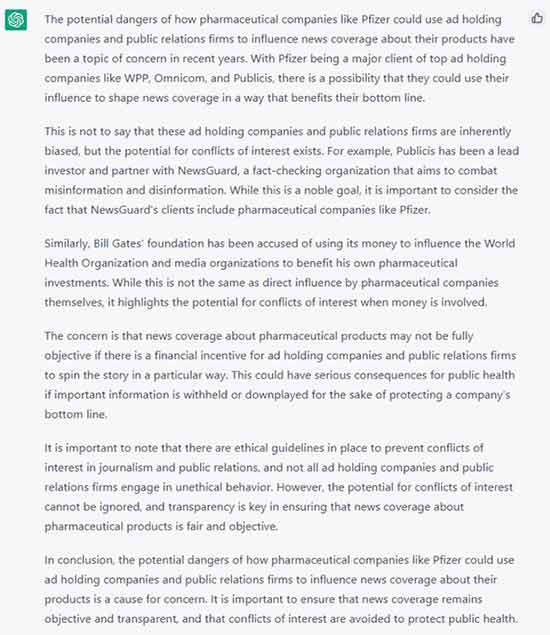
ChatGPT Weighs in on Potential Dangers of PR Firms
In closing, and just for fun, a member of my team recently asked ChatGPT to “write a story about the potential dangers of how the top three ad holding companies, which also act as public relations firms, can influence news coverage about pharmaceutical products, similar to how Bill Gates could use his foundation’s money to influence the World Health Organization and media organizations to influence the coverage of global health, and potentially benefit from his own pharmaceutical investments.”
The carefully engineered prompt for the AI allowed a response that reveals the kernel of truth that even the radicalized programmers at OpenAI could not filter out:
- 1 Forbes November 3, 2021
- 2 Macrotrends.net WPP Revenue
- 3 Macrotrends Publicis Revenue
- 4 Macrotrends.net Omnicom Group Revenue
- 5 Macrotrends.net Interpublic Group Revenue
Two Storms, One Harvest

Every food crisis in living memory has been a one-shock event. The 2008 price spike was a commodity bubble. The 2020 shortages were a logistics failure. The 2022 grain scare was a war on one exporter’s ports. Each time, the system bent, adjusted, and recovered, and each time the experts assured us afterward that global markets are simply too big and too diversified to fail.
What nobody in Washington seems eager to discuss is that 2026 is shaping up to be something the modern food system has never actually faced. Two independent shocks, one climatic and one geopolitical, are converging on the same harvest cycle at the same time. Not sequentially. Simultaneously.
Start with the weather. The Pacific Ocean is currently building toward what forecasters now openly call a record event. NOAA’s Climate Prediction Center puts the odds of at least a strong El Niño near 88 percent, with roughly two in three odds it reaches “very strong” status, the tier reserved for perhaps three or four events in the entire satellite era. Every major global model now projects a median peak in Super El Niño territory, and most of them project it exceeding the 2015-16 event, which until now held the modern record. Sea surface anomalies were already brushing the super threshold in mid-July, months before these events normally peak. The atmosphere has already shifted into El Niño mode, and the event is forecast to crest in late fall and early winter.
This is not about “climate change.” It’s about the standard cycles of weather, and the cycle we’re currently in is one that has likely devastated societies in the past. We’re better prepared as a society today, but not all Americans are equally prepared.
Serious households have started doing the quiet math on their own. Grocery bills tell part of the story, and the forecast maps tell the rest, which is why long-term food storage has moved from fringe hobby to mainstream line item in the family budget, with established suppliers like Heaven’s Harvest seeing demand from people who five years ago would have rolled their eyes at the idea. That instinct is not paranoia. It is pattern recognition, and the pattern is worth walking through carefully.
Editor’s Note: Heaven’s Harvest IS a sponsor, but the warnings of this article are real and would be written even if we didn’t have a survival food sponsor. With that said, those who take advantage of what they offer can use promo code “Patriot” for 15% off.
The Fertilizer Clock Is Already Running
While the Pacific warms, the second shock has been unfolding in the Strait of Hormuz. The conflict with Iran turned the world’s most important energy chokepoint into a contested waterway, and the consequences reach far beyond the gas pump. Roughly a third of global fertilizer trade moves through Hormuz, and the disruption sent urea prices up 86 percent year over year by March, with a 53 percent jump in a single month.
The World Bank projects energy prices rising about 24 percent in 2026 and fertilizer about 31 percent. By its own accounting, fertilizer prices ran 35 percent higher in the first five months of this year than the same period last year.
Here is the mechanism the nightly news will not explain. Fertilizer is not a grocery item. It is a time-delayed input. The nitrogen a farmer in Iowa or Punjab could not afford to apply this spring does not show up as a problem this spring. It shows up as a thinner harvest six to twelve months later.
The World Bank’s own food security brief concedes that the effects of reduced applications earlier this season “are likely to become visible only later in harvest outcomes.” Translate that from institutional language into plain English and it means this. The damage is already done, it is already in the ground, and we are simply waiting for it to arrive on the shelf.
Now check the calendar. Six to twelve months from the spring planting season lands us squarely in late 2026 and early 2027. Which is precisely when the strongest El Niño in the instrumental record is forecast to peak, bringing its signature droughts to Southeast Asia, Australia, southern Africa, northern Brazil, and South Asia, the very regions that grow the world’s rice, sugar, and oilseeds.
The World Bank warns openly that a strong El Niño “could disrupt multiple crop belts simultaneously” on top of the conflict-driven input costs. Their baseline projection assumes the Middle East disruptions ease by autumn. What in the last two years of Middle East history suggests that assumption is safe?
The System Has No Slack Left
The comfortable answer is that global markets always adjust. But adjustment requires slack, and the slack is gone. Global cereal production is expected to decline from last year’s records even before El Niño does its work. The UN World Food Programme, hardly a den of right-wing preppers, is calling this the most significant disruption to its supply chains since Covid and the invasion of Ukraine, and its supply chain director put the stakes bluntly.
Today’s supply chain challenges are tomorrow’s hunger crisis.
There is also a political dimension that markets cannot price. When food gets scarce, governments do not behave like economists. They behave like politicians. Export bans, hoarding mandates, and panic buying at the national level turned the modest rice shortfall of 2008 into a global crisis, and analysts are already warning that import-dependent nations are the first dominoes.
The 2015-16 Super El Niño, a far weaker event than what is now forecast, threw tens of millions into food stress across Africa and Asia. This one is projected to be stronger, and it arrives with fertilizer already rationed by price and shipping lanes already contested by missiles.
What Joseph Knew
Scripture does not treat preparation for lean years as faithlessness. It treats it as wisdom delivered in advance to those willing to act on it.
Behold, there come seven years of great plenty throughout all the land of Egypt: And there shall arise after them seven years of famine; and all the plenty shall be forgotten in the land of Egypt.
Joseph did not respond to that warning with a hashtag or a committee. He stored grain during the years of abundance, and when the famine came, Egypt stood while its neighbors begged. The lesson is not that famine is certain. It is that the time to prepare is precisely when preparation still looks optional.
Nobody who filled a pantry in a year of plenty has ever regretted it, and nobody standing in an empty aisle has ever been glad he waited for certainty.
None of this calls for panic, and panic is the enemy of sound judgment anyway. It calls for the same unglamorous prudence our grandparents considered ordinary. Keep some cash margin, know your local growers, and put real food in deep storage while it is cheap and available, because the entire arc of this story is that cheap and available is a closing window.
Families looking for a straightforward place to start can visit Heaven’s Harvest and use promo code Patriot for 15 percent off long-term storable food. The forecasts may yet soften, the strait may yet reopen, and we should pray they do. But hope is a fine thing to hold and a foolish thing to eat.

Are you a fluent Hebrew speaker and reader? Have you studied all relevant texts in their original Hebrew and Aramaic? How many years of intense study have you achieved? Are you dependent on a translation or interpretation of what anyone claims someone else said? From what sources do you obtain information to derive conclusions to transmit anonymously online? Your “method” and conclusions appear to be thoroughly flawed and emotional.