
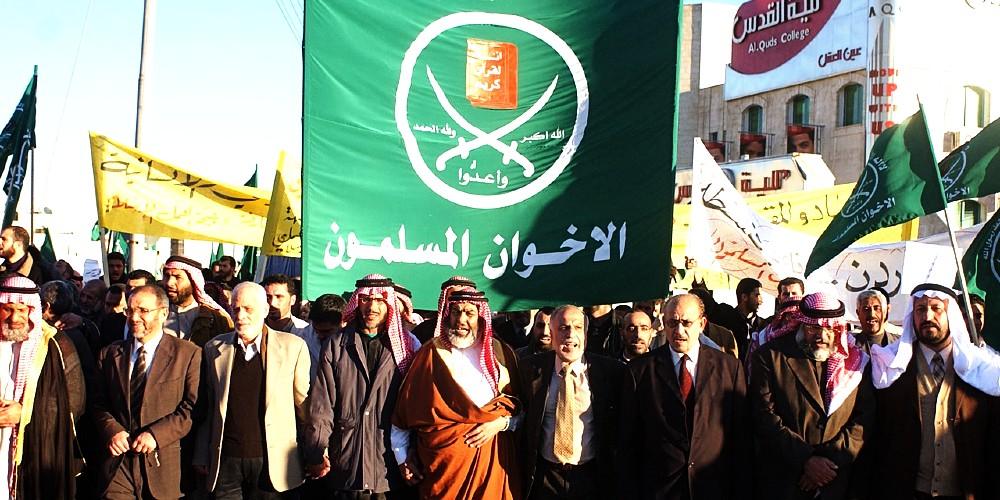
(Daily Signal)—The Muslim Brotherhood has engaged in a century-long project to “Islamify” modern countries through gradual, lawful, multisector action. Across Europe and now the United States, the Brotherhood builds institutions, exploits rights language, and forges “red-green” alliances. In this way, it prepares ground for jihadist violence while avoiding overt illegality.
This “Brotherism,” as I call it in a new special report, is an ideology coupled with a method. It advocates a political and social project organized around the primacy of the Islamic way of life in the public sphere.
Its method favors nonviolent, patient, generational transformation of the host society. Brotherists first build parallel institutions like mosques, community centers, and schools using the host country’s support to gain footholds. Then they enter established educational, media, associative, and political fields en route to capturing institutions.
The Brotherhood, founded in Egypt in 1928 by Hassan al-Banna, aims to convert a strict reading of Islam into an organized, patient, and transnational political project to make Islam the fundamental law of the land in modern countries.
Al-Banna set out successive stages for this project: forming the Muslim individual, building the Muslim family, constructing a Muslim society with an Islamic government, restoring the caliphate, and ultimately achieving what Muslims call ustādhiyyat al-‘ālam or “mastership of the world.” He aspired to establish an Islam in which the religious would order every sphere; a supremacist identity of a chosen community destined to prevail; and a gradual, adaptable plan would advance with the balance of power. Under this framework, nothing would be beyond Islam’s reach.
Everywhere in Europe—Belgium, Germany, the United Kingdom, Austria, the Netherlands, Italy—the same kinds of networks embed themselves at the national level. Germany’s domestic intelligence agency has called this “Islamization from below.” The Dutch conclude that the ultimate aim of its national association is “to create, then implant and expand, an ultra-orthodox Muslim bloc inside Western Europe.”
Chakib Benmakhlouf, a senior figure in a European organizational network that is linked with the Muslim Brotherhood, stated: “We do not want to draw attention to the fact that we are Islamizing the West.”
European governments have promoted Brotherhood goals, often unwittingly. Many began by backing organizations that they believed were moderate promoters of a peaceful form of Islam. These organizations often turned out to be Brotherhood front groups.
In Britain, according to a government report, the Brotherhood “shaped the new Islamic Society of Britain (ISB), dominated the Muslim Association of Britain,” and helped run the Muslim Council of Britain. In France, the Brotherhood-linked Union of Islamic Organizations of France (now “Muslims of France”) became an official partner.
The next step in the Brotherist approach is to accumulate property and build durable institutions, often with the approval of the state.
Groups and individual actors linked with or sympathetic to the Brotherhood have then entered and oriented schools, associations, and local governments from within, converting ordinary civic spaces into vehicles for its project.
They have made life difficult for law enforcement and investigators by turning scrutiny into litigation and public accusation. Groups have covered their methods with a shield of legal immunity, invoking freedom of religion and anti-discrimination rules to roll back neutrality and gain official status.
In these later stages, so-called red-green alliances with leftist parties develop, along with educational and media investment, institutional recognition, and a communal economy of halal certification and Islamic finance.
In France, there were about 100 Islamic places of worship around 1970. There are roughly 2,600 today.

Brotherism has anchored itself through mosques and cultural centers, alongside schools and media, which have diffused its norms. It has then captured institutions, gaining recognition in part through its influence on the French Council of the Muslim Faith and local bodies.
The same advance produced the red-green alliance with the radical Left, which supplies an electorate for both and exploits antiracist vocabulary that shields the project from criticism. Socialist presidential candidate François Hollande received 86% of the Muslim vote in the 2012 runoff, and the radical leftist La France Insoumise presidential candidate Jean-Luc Mélenchon got nearly 70% of the Muslim vote in the first round in 2022.
In Britain, groups linked with or sympathetic to the Brotherhood have put down roots and gained public respectability from Britain’s multicultural establishment.
British failures to handle Islamic issues are legion. Successive governments treated the Muslim Council of Britain as the de facto voice of British Muslims until 2009. The 2014 Trojan Horse affair revealed coordinated efforts to introduce an intolerant Islamic ethos into schools. Authorities in several cities gravely failed victims of grooming gangs, sometimes ignoring evidence for years.
What happens in Europe does not stay in Europe.
In the United States, the Brotherhood and its sympathizers have gradually built an institutional ecosystem of national groups. After the Muslim Student Association was founded in 1963, a network of legacy organizations emerged. The North American Islamic Trust held property. The International Institute of Islamic Thought focuses on institutional reform. The Islamic Society of North America builds youth coalitions. The Council on American-Islamic Relations is a public interest firm.

None of these are formal American affiliates of the Egyptian Brotherhood. Yet, as scholars show, they make for a durable ecosystem capable of shaping how Islam is organized and represented in the United States. Key figures such as Jamal Barzinji, Ahmad Totonji, and Hisham al-Talib helped build the infrastructure. Gulf donors at times supplied substantial funding.
The same pattern appeared in Britain and France. The global war on terrorism elevated “moderate” partners who condemned violence. These then gained access, credibility, and funding as seemingly dependable Islamic allies.
Whether formally connected with the Brotherhood or not, American Islamic groups use the same tactics as European advocates. In the United States, a red-green political alliance has grown around figures such as New York City Mayor Zohran Mamdani, whose support for the Palestinian cause and BDS drew backing from CAIR Action. One CAIR official described the New York mayor’s election as a “referendum” on Palestinian resistance.
Territorial implantation is seen in the proposed EPIC City project in Texas, which aims to combine housing, mosque, school, and commerce into a single community.
Islamic groups engage in strategic litigation under civil rights law. After Texas Gov. Greg Abbott designated CAIR and the Muslim Brotherhood as foreign terrorist and transnational criminal organizations under state law in November 2025 and ordered investigations, CAIR sued, framing the action as discriminatory.
Brotherism is a project with flexible but identifiable methods. It can survive the disappearance of its accidental structures and can exist without formal affiliation. If one federation is dissolved, another constitutes itself. If one source of funding closes, others open. The men, the funding, the doctrine, and the aim of Islamifying modernity remain.
Too many attempted remedies attack the visible forms rather than the matrix that produces them. This is the system that has been built in Europe and is coming to the United States. This is what we are up against.
We publish a variety of perspectives. Nothing written here is to be construed as representing the views of the Daily Signal.

Two Storms, One Harvest

Every food crisis in living memory has been a one-shock event. The 2008 price spike was a commodity bubble. The 2020 shortages were a logistics failure. The 2022 grain scare was a war on one exporter’s ports. Each time, the system bent, adjusted, and recovered, and each time the experts assured us afterward that global markets are simply too big and too diversified to fail.
What nobody in Washington seems eager to discuss is that 2026 is shaping up to be something the modern food system has never actually faced. Two independent shocks, one climatic and one geopolitical, are converging on the same harvest cycle at the same time. Not sequentially. Simultaneously.
Start with the weather. The Pacific Ocean is currently building toward what forecasters now openly call a record event. NOAA’s Climate Prediction Center puts the odds of at least a strong El Niño near 88 percent, with roughly two in three odds it reaches “very strong” status, the tier reserved for perhaps three or four events in the entire satellite era. Every major global model now projects a median peak in Super El Niño territory, and most of them project it exceeding the 2015-16 event, which until now held the modern record. Sea surface anomalies were already brushing the super threshold in mid-July, months before these events normally peak. The atmosphere has already shifted into El Niño mode, and the event is forecast to crest in late fall and early winter.
This is not about “climate change.” It’s about the standard cycles of weather, and the cycle we’re currently in is one that has likely devastated societies in the past. We’re better prepared as a society today, but not all Americans are equally prepared.
Serious households have started doing the quiet math on their own. Grocery bills tell part of the story, and the forecast maps tell the rest, which is why long-term food storage has moved from fringe hobby to mainstream line item in the family budget, with established suppliers like Heaven’s Harvest seeing demand from people who five years ago would have rolled their eyes at the idea. That instinct is not paranoia. It is pattern recognition, and the pattern is worth walking through carefully.
Editor’s Note: Heaven’s Harvest IS a sponsor, but the warnings of this article are real and would be written even if we didn’t have a survival food sponsor. With that said, those who take advantage of what they offer can use promo code “Patriot” for 15% off.
The Fertilizer Clock Is Already Running
While the Pacific warms, the second shock has been unfolding in the Strait of Hormuz. The conflict with Iran turned the world’s most important energy chokepoint into a contested waterway, and the consequences reach far beyond the gas pump. Roughly a third of global fertilizer trade moves through Hormuz, and the disruption sent urea prices up 86 percent year over year by March, with a 53 percent jump in a single month.
The World Bank projects energy prices rising about 24 percent in 2026 and fertilizer about 31 percent. By its own accounting, fertilizer prices ran 35 percent higher in the first five months of this year than the same period last year.
Here is the mechanism the nightly news will not explain. Fertilizer is not a grocery item. It is a time-delayed input. The nitrogen a farmer in Iowa or Punjab could not afford to apply this spring does not show up as a problem this spring. It shows up as a thinner harvest six to twelve months later.
The World Bank’s own food security brief concedes that the effects of reduced applications earlier this season “are likely to become visible only later in harvest outcomes.” Translate that from institutional language into plain English and it means this. The damage is already done, it is already in the ground, and we are simply waiting for it to arrive on the shelf.
Now check the calendar. Six to twelve months from the spring planting season lands us squarely in late 2026 and early 2027. Which is precisely when the strongest El Niño in the instrumental record is forecast to peak, bringing its signature droughts to Southeast Asia, Australia, southern Africa, northern Brazil, and South Asia, the very regions that grow the world’s rice, sugar, and oilseeds.
The World Bank warns openly that a strong El Niño “could disrupt multiple crop belts simultaneously” on top of the conflict-driven input costs. Their baseline projection assumes the Middle East disruptions ease by autumn. What in the last two years of Middle East history suggests that assumption is safe?
The System Has No Slack Left
The comfortable answer is that global markets always adjust. But adjustment requires slack, and the slack is gone. Global cereal production is expected to decline from last year’s records even before El Niño does its work. The UN World Food Programme, hardly a den of right-wing preppers, is calling this the most significant disruption to its supply chains since Covid and the invasion of Ukraine, and its supply chain director put the stakes bluntly.
Today’s supply chain challenges are tomorrow’s hunger crisis.
There is also a political dimension that markets cannot price. When food gets scarce, governments do not behave like economists. They behave like politicians. Export bans, hoarding mandates, and panic buying at the national level turned the modest rice shortfall of 2008 into a global crisis, and analysts are already warning that import-dependent nations are the first dominoes.
The 2015-16 Super El Niño, a far weaker event than what is now forecast, threw tens of millions into food stress across Africa and Asia. This one is projected to be stronger, and it arrives with fertilizer already rationed by price and shipping lanes already contested by missiles.
What Joseph Knew
Scripture does not treat preparation for lean years as faithlessness. It treats it as wisdom delivered in advance to those willing to act on it.
Behold, there come seven years of great plenty throughout all the land of Egypt: And there shall arise after them seven years of famine; and all the plenty shall be forgotten in the land of Egypt.
Joseph did not respond to that warning with a hashtag or a committee. He stored grain during the years of abundance, and when the famine came, Egypt stood while its neighbors begged. The lesson is not that famine is certain. It is that the time to prepare is precisely when preparation still looks optional.
Nobody who filled a pantry in a year of plenty has ever regretted it, and nobody standing in an empty aisle has ever been glad he waited for certainty.
None of this calls for panic, and panic is the enemy of sound judgment anyway. It calls for the same unglamorous prudence our grandparents considered ordinary. Keep some cash margin, know your local growers, and put real food in deep storage while it is cheap and available, because the entire arc of this story is that cheap and available is a closing window.
Families looking for a straightforward place to start can visit Heaven’s Harvest and use promo code Patriot for 15 percent off long-term storable food. The forecasts may yet soften, the strait may yet reopen, and we should pray they do. But hope is a fine thing to hold and a foolish thing to eat.
