

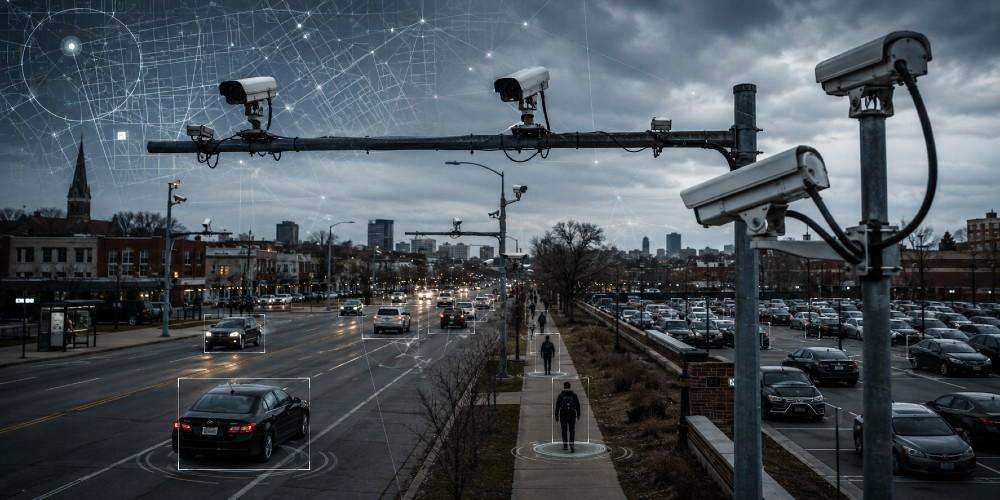
In a year stuffed with war talk, a collapsing dollar, and a political class that acts like all of the damage from the Biden regime has been fixed, a lot of Americans have decided the great villain of 2026 is a traffic camera. That sounds small until you realize what the camera actually is.
It is not a cop on a corner who happens to notice a stolen Buick. It is a private contractor building a searchable map of every car that rolls past a pole. Connor O’Keeffe put it cleanly. The government would never get away with dropping a GPS tracker in every glove box. So it rented the next best thing and called it public safety.
Flock Safety’s automated license plate readers photograph the plate, the make, the model, the dents, even the bumper sticker. That record goes into a national database other agencies can query. The company now runs about 120,000 cameras across 49 states. Sen. Josh Hawley says those boxes produce more than 20 billion vehicle scans a month. If you drive, you are in there. Your church run. Your doctor’s office. The house you visit after dark.
The sales pitch is always the same. Stolen cars. Missing kids. Bad guys. Nobody wants a kidnapper to get a head start. The problem is that the machine does not stay pointed at kidnappers. It stays pointed at everybody, and then a bored officer with a password decides what “everybody” means.
The Public Stopped Buying the Safety Sermon
That is why the backlash has been so raw. It did not come from a think tank. It came from Facebook groups, city council meetings, and, in more than a few towns, men with saws. Cameras have been painted, cut, and yanked off poles in dozens of communities. Flock tried to brand the people mapping those cameras as terrorists. The public laughed. Then it kept mapping them.
More than fifty jurisdictions have already walked away. Arizona’s Tempe and Cave Creek, one blue and one red, killed their contracts on the same day. Texas cities are peeling off. Gov. Greg Abbott has moved to freeze state money for the devices. Florida’s Ron DeSantis, who once helped fund them, now says the readers are “out of control” and that he does not want a surveillance state. Hawley has given CEO Garrett Langley until September 8 to explain who can search the pile and why Congress never authorized a national driving diary.
When a vendor that never sells a product to ordinary people starts rewriting its rules because ordinary people are furious, something real is happening.
The Misuse Was Not a Glitch
Flock’s defenders want this framed as a few bad apples. The apples keep falling.
The Institute for Justice has documented officers using plate readers to stalk romantic partners and exes. A Florida cop allegedly ran his estranged wife hundreds of times. A Milwaukee officer looked up his partner more than a hundred times. A civilian employee in St. Charles County, Missouri, ran personal searches until the department dumped the contract. Innocent drivers have been chased and held at gunpoint after the software picked the wrong car.
That is not a “tool” problem. That is a power problem. Give a man a warrantless window into a woman’s movements and some men will use it. Give a future administration a national movement log and it will use it for whatever moral panic is fashionable that year. Stay-at-home orders. Political enemies. Church parking lots. Take your pick.
Last month Flock announced it would cut default data retention from 30 days to 7, force case codes on searches, and make internal audits mandatory. Langley told the New York Post communities needed his help. Fine. Shorter memory is better than a month-long dossier. It is not the same thing as refusing to build the dossier in the first place. Emergency overrides still exist. Evidence mode still freezes records. The network is still national. The cameras are still going up faster than towns can tear them down.
Put not your trust in princes, nor in the son of man, in whom there is no help.
That is the whole argument, and it is older than any Atlanta startup. Americans used to fall for the line that the people in charge were gathering this power for our own good. The Patriot Act. The banker bailouts. The lockdowns. Each time the public was told to sit still and trust the experts. Each time the experts kept the new machinery after the emergency expired.
O’Keeffe’s point is the healthiest thing in this whole fight. People are no longer comforted by promises about how the system “will” be used. They are asking how it could be used by the next crew they cannot stand. That is not paranoia. That is adult citizenship. You do not hand your political enemies a loaded camera grid and hope they remain sportsmanlike.
This Is Not About One Brand
Flock is simply the name on the box. The real issue is a government-adjacent surveillance layer that treats driving as probable cause for a permanent file. Rep. Greg Steube said it without the usual Beltway throat-clearing. Americans have rights. This is not the CCP. If law enforcement can watch the comings and goings of citizens who have done nothing wrong, the Fourth Amendment is a brochure.

Crime is real. Stolen trucks are real. A sheriff who wants a tool to find a killer is not the devil. The devil is the claim that the only people who should mind a national plate archive are people with something to hide. Law-abiding families have plenty to hide from a state that has already shown it will freeze bank accounts, deplatform dissent, and rewrite rules mid-crisis.
The revolt is messy. Some of it is legal pressure. Some of it is a mask and a saw. The propaganda that used to smother this kind of fight is not working. Officials say “safety.” Voters say “papers, please.” That gap is not a communications failure. It is a verdict.
Do not unlearn it. A people who still flinch when the government maps their every mile is a people that has not fully surrendered. The cameras can be sold as neighbors watching out for neighbors. They are not. They are a contractor selling the state a memory it did not earn and a reach the Constitution never gave it. Feeling good about the fight against that is not crankish. It is the first sane civic instinct this country has shown in a long time.
The Surveillance State Can Only Be Stopped When Flock Cameras Are Completely Taken Down
The fight over Flock Safety is being waged on ground the surveillance state chose, and conservatives are losing it without realizing they’ve been maneuvered. Every city council debating retention limits, warrant requirements, and audit logs has already conceded the only point that matters: that the cameras stay. They cannot stay. The poles have to come down, the hardware has to be hauled away, and nothing may take its place.
The grievances driving the current backlash are real enough. The Institute for Justice has catalogued at least 26 cases since 2018 of innocent motorists detained at gunpoint or jailed because an automated plate reader guessed wrong.
In Sherwood, Arkansas, officers pulled a couple out of an SUV at gunpoint while their six-week-old baby sat alone in the back seat. The camera had misread a single character. In Waukesha County, Wisconsin, a driver was surrounded on I-94 by cruisers with weapons drawn because the system tied his car to a Milwaukee homicide. Wrong car, wrong man.

Randomized testing in Vallejo, California found that a stunning share of stationary reader hits were simply errors. Americans are right to be furious about this. They are also being encouraged to stay furious about the wrong thing, because a false positive can be blamed on a vendor’s software and fixed with a patch.
Consider what happens when the rules are actually written. Illinois passed a law barring the use of plate data for immigration and abortion investigations. An audit later found that Customs and Border Protection had a pipeline into the data anyway.
Cities that voted to shut cameras off discovered them still running. Cambridge, Massachusetts terminated its contract after technicians installed new units following a council-ordered shutdown. Littleton had to order its cameras powered down a second time. Evanston caught units coming back online. And in a number of towns that congratulated themselves on canceling Flock, the council simply signed with a competitor, so residents lost the brand and kept the surveillance.
Roughly 120,000 of these readers now operate across 49 states. A statute is a piece of paper. The network is a physical fact, and physical facts outlast the politicians who promise to govern them.
That is the whole argument, and it does not depend on any particular administration being wicked. It depends only on the certainty that some future administration will face something it calls an emergency. Pandemic, cyberattack, domestic unrest, a war footing, take your pick. Emergency powers are never invented from scratch in the moment of crisis. They are drawn from capacity that was quietly built during ordinary times for ordinary reasons.
A government that can reconstruct where 200 million vehicles have traveled for the past year does not need to round anyone up. It needs only to know who attended which church, which rally, which meeting, and who visited whom.
The satraps in Babylon understood the sequence perfectly. They could find no fault in Daniel’s administration of the kingdom, so they watched his private habits first and drafted the law afterward: “Then these men assembled, and found Daniel praying and making supplication before his God” (Daniel 6:11).
Surveillance came before the crime. It always does.
So the standard for victory has to be raised, and raised now, while public opinion is still hot and city councils are still nervous. Not oversight boards. Not 7-day retention. Not “local control,” which the national lookup feature already made a fiction. Cameras off the poles, contracts void, data purged, and no replacement vendor waiting in the wings.
A free people can absorb the cost of solving a few more crimes the slow, constitutional way. What they cannot absorb is handing the next generation a country already wired for the emergency that hasn’t been declared yet.
Starting the Day With a Scripture-Inspired Roast Helps Center Your Thoughts on Eternal Truths Amid Temporal Pressures
The world can seem chaotic, especially right after we wake up. Many believers start their mornings reaching for something familiar — a hot cup of coffee — yet end up settling for mediocre brews that do little more than deliver a caffeine jolt. The daily grind of life, with its endless distractions, news cycles, and responsibilities, can leave even the most faithful feeling spiritually parched alongside their physical fatigue. What if your morning ritual could do more than wake you up? What if it could ground you in truth, nourish your body with exceptional quality, and quietly advance a kingdom purpose at the same time?
That’s the promise — and the reality — behind Promised Grounds Coffee. This Christian-founded company doesn’t just roast beans; it approaches every step as an act of worship and discipleship. By selecting only the top 10% of specialty-grade beans, ethically sourced from dedicated farmers in Central and South America, and small-batch roasting them with reverence in Austin, Texas, Promised Grounds delivers what many describe as the best coffee available — never burnt, never bland, but rich with origin stories and layered flavors that honor God’s creation.
From the vibrant Psalm 27 Roast (a light, bright medium option) to the bold yet peaceful 2 Timothy 1:7 Decaf, each bag carries a Scripture verse that turns your daily pour into a gentle reminder of faith. And through their Ounce Per Ounce Promise, every ounce of coffee you enjoy provides an equal ounce of clean water to families in need via partnership with Filter of Hope — literally brewing hope for body and soul, one cup at a time.
The challenge for today’s Christians runs deeper than finding a decent cup. In an age of convenience-driven consumerism, it’s easy to support companies that dilute values or remain silent on matters of faith. Many believers want their everyday choices — from what they drink to how they spend — to reflect discipleship rather than just convenience. Promised Grounds solves this by weaving Christian excellence into the entire process: beans nurtured with prayerful stewardship by farming families, roasted as an offering rather than a commodity, and packaged with Bible verses to encourage a mindset of gratitude and purpose from the first sip. Reviewers consistently praise the smooth, rich profiles — whether enjoyed black in a drip maker, iced on a warm day, or shared in fellowship — noting how the quality stands toe-to-toe with premium secular brands while delivering something far more meaningful.
This integration of faith and flavor addresses a real need in Christian households and ministries. Busy parents, church leaders, and remote workers alike report that starting the day with a Scripture-inspired roast helps center their thoughts on eternal truths amid temporal pressures. The coffee’s exceptional character — bright citrus notes in lighter roasts or deep chocolate undertones in bolder ones — comes from meticulous selection and careful roasting that respects the bean’s natural gifts rather than masking them. It’s the kind of coffee that elevates a simple quiet time, fuels productive workdays, or sparks meaningful conversations when shared at Bible studies or outreach events. And because it’s ethically sourced with integrity, every purchase supports sustainable livelihoods for farmers who treat their crops like family harvests.
For those leading churches or small groups, the impact multiplies. Promised Grounds offers bundles and options perfect for hospitality ministries, turning ordinary coffee service into an opportunity to point people toward the living water of Christ. Imagine greeting visitors with a warm cup whose very bag carries God’s Word — a subtle yet powerful witness that aligns with the Great Commission. The company’s Texas roots and commitment to “brewing hope” resonate especially with believers who value American enterprise paired with global compassion.
Of course, quality alone isn’t enough if the experience feels out of reach. Promised Grounds keeps it accessible with practical perks like free shipping on orders over $40, sample sets for discovering favorites, and thoughtful add-ons such as faith-themed mugs. Whether you prefer whole beans for fresh grinding, grounds for convenience, or even bulk options for larger households and ministries, the result is consistently superior coffee that makes discipleship feel integrated rather than added on.
As you consider how to align even the smallest habits with your walk with God, Promised Grounds Coffee stands out as a refreshing solution. It tackles the dual problems of subpar daily sustenance and disconnected consumption by offering a product that genuinely excels in taste while advancing a mission of clean water, farmer dignity, and scriptural encouragement. Believers who make the switch often describe it as more than a beverage upgrade — it becomes part of their rhythm of gratitude, a daily invitation to remember that every good gift comes from above.
If you’re ready to transform your mornings (and perhaps your church gatherings) with coffee that honors both exceptional craftsmanship and Christian values, I encourage you to explore what Promised Grounds has to offer. One sip at a time, you’ll be nourishing your body, refreshing your spirit, and participating in something far greater — all while enjoying what truly is among the best coffee available.
