

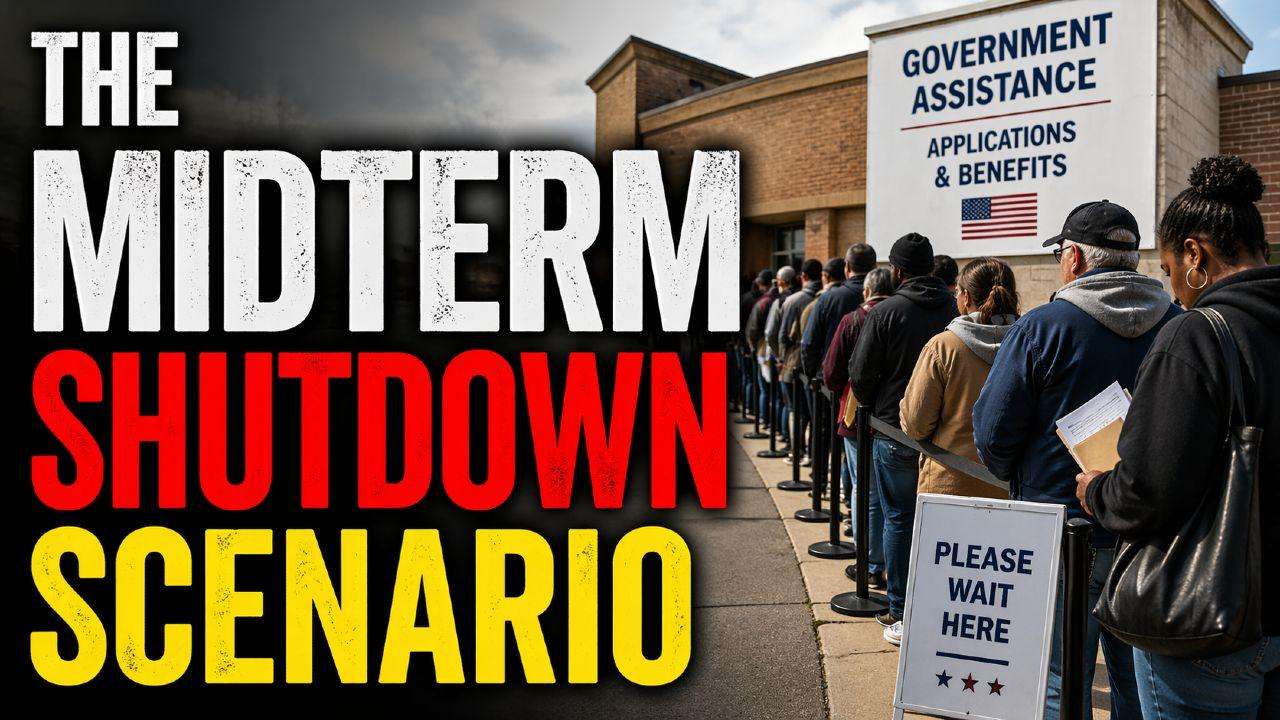
Every two years, without fail, some pundit or politician solemnly declares that the upcoming midterm election is “the most important of our lifetime.” It has become a ritual — the political equivalent of a car alarm nobody looks up for anymore. The phrase has been so thoroughly cheapened by overuse that most voters now tune it out on instinct. That reflex is understandable. It is also, at this particular moment in American history, potentially catastrophic.
This is not a column built on that familiar hyperbole. It is built on a specific scenario — one first outlined in a speculative piece at Conservative Playlist — that deserves far wider attention than it has received. I didn’t actually like the article itself, but the shutdown scenario was compelling.
The argument is straightforward: if Democrats retake the House and Senate in November 2026, they possess a constitutional mechanism capable of strangling the Trump agenda without passing a single piece of legislation. They do not need to govern. They only need to obstruct — and the federal budget is the perfect weapon.
The strategy writes itself. A Democrat-controlled Congress sends budget after budget to the President’s desk, each one loaded with the full wish list of the progressive movement — USAID restored, DEI mandates reinstated, open-border funding expanded, gender ideology embedded in federal agencies at every level. Trump vetoes them, as any president committed to the mandate he received would. The government shuts down. And then it stays shut.
The saddest part is Democrats wouldn’t get blamed for the chaos that would ensue. They would be passing budgets and sending them to the President. He would veto them. Legacy media would paint it as “Trump’s Shutdown” as a result, giving Democrats power to continue it knowing they may be destroying tens of millions of Americans’ lives, but Democrats wouldn’t get blamed.
We have already lived through a preview of what this looks like. The 2025 government shutdown — the longest in American history at 43 days — cost the economy an estimated $11 billion in permanently lost GDP, according to the Congressional Budget Office. The White House Council of Economic Advisers put the weekly damage at roughly $15 billion. Goldman Sachs estimated the shutdown knocked 1.5 percentage points off of GDP growth in the fourth quarter alone. Treasury Secretary Bessent said, “They tried to stop him in the courts. They tried to stop him in the media. Then they went to the extreme — we had the longest government shutdown in history. It was a hit to GDP.”
That was 43 days. Now imagine six months. Or twelve. The economic logic of a sustained, deliberate, politically-weaponized shutdown is not complicated. Every additional week costs approximately $7 billion in GDP, according to EY-Parthenon. Two months of shutdown would push the cumulative economic drag to nearly two full percentage points of quarterly growth — before accounting for disruptions to SNAP benefits for 42 million Americans, millions of government workers going unpaid and thereby seeking private sector employment, chaos that ensues causing external harms, and cascading private-sector contraction as businesses lose access to federal permits, loans, and certifications.
The scenario ends in one of two ways, and there is no third door. Either the President refuses to sign despite the full weight of legacy media, the Democrat Party, and no small number of spineless Republicans demanding he “just open the government” — in which case the country accelerates toward a full-blown crisis well before the 2028 election.
The other scenario is that he signs after an extended shutdown, in which case the left’s agenda, freshly laundered through the language of fiscal necessity and “compromise,” walks back through the front door. USAID reopens. DEI offices are refunded. The rogue bureaucratic apparatus that DOGE spent two years dismantling gets quietly reassembled, piece by piece, agency by agency, bill by bill. The death of the America First agenda would not come all at once. It would come through a thousand budget line items, dressed up as governance.
The prophet Ezekiel warned of a watchman who sees the sword coming and fails to sound the trumpet — and of a people who perish not from ignorance, but from inattention. “If the watchman see the sword come, and blow not the trumpet, and the people be not warned; if the sword come, and take any person from among them, he is taken away in his iniquity; but his blood will I require at the watchman’s hand.”
The sword, in this case, is not invisible. Democrats are not hiding their intentions as another consequence of a lost midterms has been made crystal clear.
Speaker Johnson said on Fox News, “Imagine if the Democrats took over the House — they’d impeach him.”
Trump himself has warned the same. And the record confirms it. Articles of impeachment have already been introduced against Trump twice in his second term, even with Democrats in the minority. The Washington Post reported in March that House Democrats are already charting a post-midterm strategy that includes subpoenaing the President and launching impeachment proceedings against Cabinet members — beginning with Homeland Security Secretary Kristi Noem. Give them the majority, and the plans sitting in desk drawers today become votes on the House floor by January 2027.
So what can be done? The answer is sitting in the Senate right now, waiting.

The SAVE America Act — the Safeguard American Voter Eligibility Act — passed the House on February 11, 2026, by a vote of 218 to 213. The bill requires proof of citizenship to register to vote in federal elections and a valid photo ID to cast a ballot. These are not radical provisions. A Harvard CAPS/Harris poll found that 71% of registered voters support the legislation, including 91% of Republicans, 69% of independents, and even 50% of Democrats. Eighty-one percent of voters support the photo ID requirement specifically. The White House has been direct about why the bill matters beyond its election-integrity merits.
“The Save America Act is one of the most IMPORTANT and CONSEQUENTIAL pieces of legislation in the history of Congress, and America itself,” Trump wrote on Truth Social.
Critics will recite their familiar objections — that the bill disenfranchises minorities, that noncitizen voting is already rare, that 21 million Americans lack ready access to citizenship documents. These arguments deserve the scrutiny they rarely receive. Every nation that takes its sovereignty seriously requires proof of who its voters are. India ties voter ID to a biometric database. Germany requires paper ballots. The United States, uniquely, has operated largely on the honor system — and the left would like to keep it that way.
One does not need to be a conspiracy theorist to understand why a party dependent on ambiguity in the voter rolls would fight tooth and nail to preserve it.
For decades, the “most important midterm of our lifetime” has been a rhetorical device — useful for fundraising, largely hollow in consequence. 2026 is different, and the difference is structural, not emotional. The shutdown weapon is real. The impeachment machinery is warmed up. The Democrat Party’s leadership has telegraphed the plan with remarkable candor. What remains to be seen is whether Republicans — and the voters who sent them to Washington — are paying close enough attention to stop it.
Unfortunately, Senate Majority Leader John Thune lacks the skill and desire necessary to get it passed.

The midterms are seven months away. The SAVE America Act needs sixty votes in the Senate. Those two facts, taken together, define the entire political challenge of this moment. Everything else is noise.

Starting the Day With a Scripture-Inspired Roast Helps Center Your Thoughts on Eternal Truths Amid Temporal Pressures
The world can seem chaotic, especially right after we wake up. Many believers start their mornings reaching for something familiar — a hot cup of coffee — yet end up settling for mediocre brews that do little more than deliver a caffeine jolt. The daily grind of life, with its endless distractions, news cycles, and responsibilities, can leave even the most faithful feeling spiritually parched alongside their physical fatigue. What if your morning ritual could do more than wake you up? What if it could ground you in truth, nourish your body with exceptional quality, and quietly advance a kingdom purpose at the same time?
That’s the promise — and the reality — behind Promised Grounds Coffee. This Christian-founded company doesn’t just roast beans; it approaches every step as an act of worship and discipleship. By selecting only the top 10% of specialty-grade beans, ethically sourced from dedicated farmers in Central and South America, and small-batch roasting them with reverence in Austin, Texas, Promised Grounds delivers what many describe as the best coffee available — never burnt, never bland, but rich with origin stories and layered flavors that honor God’s creation.
From the vibrant Psalm 27 Roast (a light, bright medium option) to the bold yet peaceful 2 Timothy 1:7 Decaf, each bag carries a Scripture verse that turns your daily pour into a gentle reminder of faith. And through their Ounce Per Ounce Promise, every ounce of coffee you enjoy provides an equal ounce of clean water to families in need via partnership with Filter of Hope — literally brewing hope for body and soul, one cup at a time.
The challenge for today’s Christians runs deeper than finding a decent cup. In an age of convenience-driven consumerism, it’s easy to support companies that dilute values or remain silent on matters of faith. Many believers want their everyday choices — from what they drink to how they spend — to reflect discipleship rather than just convenience. Promised Grounds solves this by weaving Christian excellence into the entire process: beans nurtured with prayerful stewardship by farming families, roasted as an offering rather than a commodity, and packaged with Bible verses to encourage a mindset of gratitude and purpose from the first sip. Reviewers consistently praise the smooth, rich profiles — whether enjoyed black in a drip maker, iced on a warm day, or shared in fellowship — noting how the quality stands toe-to-toe with premium secular brands while delivering something far more meaningful.
This integration of faith and flavor addresses a real need in Christian households and ministries. Busy parents, church leaders, and remote workers alike report that starting the day with a Scripture-inspired roast helps center their thoughts on eternal truths amid temporal pressures. The coffee’s exceptional character — bright citrus notes in lighter roasts or deep chocolate undertones in bolder ones — comes from meticulous selection and careful roasting that respects the bean’s natural gifts rather than masking them. It’s the kind of coffee that elevates a simple quiet time, fuels productive workdays, or sparks meaningful conversations when shared at Bible studies or outreach events. And because it’s ethically sourced with integrity, every purchase supports sustainable livelihoods for farmers who treat their crops like family harvests.
For those leading churches or small groups, the impact multiplies. Promised Grounds offers bundles and options perfect for hospitality ministries, turning ordinary coffee service into an opportunity to point people toward the living water of Christ. Imagine greeting visitors with a warm cup whose very bag carries God’s Word — a subtle yet powerful witness that aligns with the Great Commission. The company’s Texas roots and commitment to “brewing hope” resonate especially with believers who value American enterprise paired with global compassion.
Of course, quality alone isn’t enough if the experience feels out of reach. Promised Grounds keeps it accessible with practical perks like free shipping on orders over $40, sample sets for discovering favorites, and thoughtful add-ons such as faith-themed mugs. Whether you prefer whole beans for fresh grinding, grounds for convenience, or even bulk options for larger households and ministries, the result is consistently superior coffee that makes discipleship feel integrated rather than added on.
As you consider how to align even the smallest habits with your walk with God, Promised Grounds Coffee stands out as a refreshing solution. It tackles the dual problems of subpar daily sustenance and disconnected consumption by offering a product that genuinely excels in taste while advancing a mission of clean water, farmer dignity, and scriptural encouragement. Believers who make the switch often describe it as more than a beverage upgrade — it becomes part of their rhythm of gratitude, a daily invitation to remember that every good gift comes from above.
If you’re ready to transform your mornings (and perhaps your church gatherings) with coffee that honors both exceptional craftsmanship and Christian values, I encourage you to explore what Promised Grounds has to offer. One sip at a time, you’ll be nourishing your body, refreshing your spirit, and participating in something far greater — all while enjoying what truly is among the best coffee available.
