

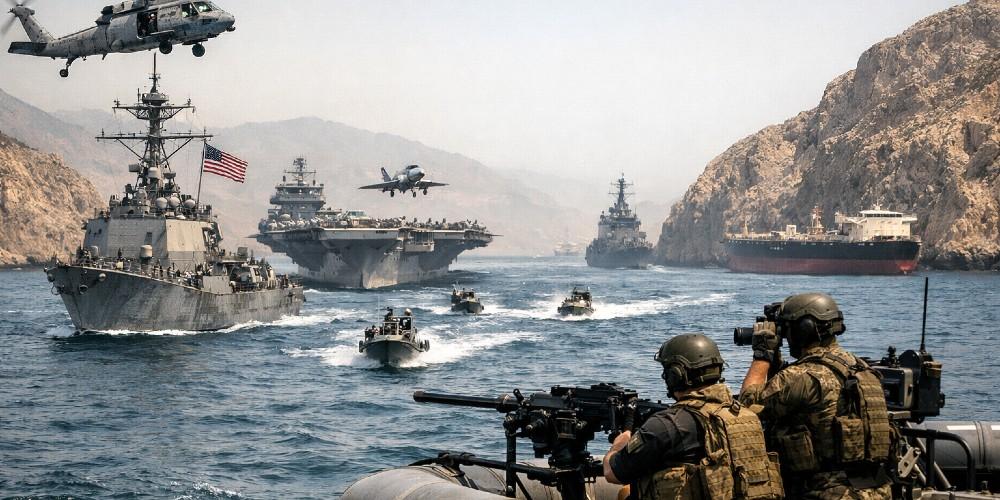
(Alt-Market)—In March I published an article titled “Global Energy Crisis Or Iranian Surrender In Five Weeks?” in which I outlined the “worst case” and “best case” scenarios for the war in Iran. In my best case scenario I argued in favor of a specific plan to end the conflict quickly: A US naval blockade of the Strait of Hormuz, flipping the tables on Iran by blocking or seizing any oil tankers or gas tankers which exit Iranian ports.
Two weeks later, the Trump Administration has implemented this exact strategy.
The effectiveness of the blockade is already apparent; the propaganda bots on social media are scrambling to find a narrative to counter it, but they are failing. Why? Because Iran already tried to lock down the strait (which is an international waterway), and any government cheering (or secretly cheering) for Iran’s actions is now unable to make a rational argument against the US doing the same thing to Iran. As I noted in March:
“We constantly hear about international exposure to the Hormuz shutdown, but the media rarely mentions that Iran is the MOST exposed economy of all. For now, Iranian oil ships continue to pass through the strait and these vessels are Iran’s economic lifeline. Strategic estimates suggest that without the steady passage of these oil tankers, the Iranian economy would completely collapse within five weeks…”
I then summarized what I believed was the simplest solution to end the war:
“Iranian cargo ships can be targeted for seizure by a US blockade of the Persian Gulf well away from the narrow waters of the Hormuz. The ships could be destroyed, but I suspect the Department of Defense will try to avoid oil spills and ecological disasters. Instead, the best option is to capture Iran’s tankers and then redirect the oil to countries in danger of shortages.
Iran has the option of shutting off GPS tracking for their vessels (shadow fleet), but this would not help them maneuver past a comprehensive US blockade. In other words, I argue that the US could turn the tables on Iran and use their reliance on the Hormuz against them.
With Iran’s economy in shambles, they will no longer be able to purchase missiles or drones for resupply from Russia and China. They won’t be able to pay for logistic resources for their military and they won’t be able to contain public unrest. The Iranians would be forced to negotiate and the war would be over quickly with minimal risk to US troops.”
For now, the US is not seizing Iran’s tankers and is merely sending them back to where they came from. However, it would seem that the Trump Administration and their military advisers have come to the same basic conclusions I did.
For years I have expressed my concerns about a potential conflict in Iran, largely because of the precarious global economic risks associated with mass energy shortages caused by a closure of the Hormuz, which transits around 25% of the world’s energy exports. That said, I do not care about “picking sides” when it comes to Israel or Iran.
This debate is irrelevant and designed, I think, to divide US conservatives over ancient tribal vendettas that do not involve us. I don’t care about the Israeli government or “Zionism” and I certainly don’t care what happens to the theocratic and tyrannical Muslim regime in Iran. We have much more important things to think about.
What matters to me is how the US and the American people are affected by geopolitical events. There has been endless debate on what the war is really about, whether it be Iranian nukes, Israeli schemes, Saudi schemes, control of global oil markets, etc. (I think every action the Trump Administration has take so far from Venezuela to Iran has largely been designed to contain China). In any case, a long term closure of the Hormuz will eventually result in market cascades and a stagflationary crisis.
What matters now is ending the war as quickly and decisively as possible without leaving the Homuz and 25% of global energy exports under Iran’s control. After that, people can wrestle over the “moral and constitutional” quandary to their heart’s content.
First, I think it’s vitally important to address some lies and disinformation being spread by propagandists and foreign agents online about the US blockade, so let’s quickly go down the list…

Lie #1: The US Is Blocking All Ships Traveling Through The Strait
This is false. The US is only blocking ships coming from Iranian ports. All other ships have been allowed to pass without incident. This lie is being spread by disinfo agents all over social media and it is also being spread by foreign governments from the UK to France to China. This, to me, says A LOT about the true agenda of these countries, given that they said little or nothing about Iran locking down the strait.
Lie #2: Chinese Vessels Have Broken The Blockade And The US Is Afraid
Nope. All Chinese vessels coming from Iranian ports have been turned away and any vessels coming from alternative ports have been allowed to pass. At the time this article is being published, only one ship from an Iranian port has allegedly slipped through the blockade, though the story on this ship might be fabricated. All other Iranian ships have been repelled.
Lie #3: The Blockade Puts US Naval Ships At Serious Risk
No, it does the opposite. US ships have no need to traverse the narrow Hormuz to blockade it. All they have to do is wait outside of it and turn back Iranian tankers that approach. No mines, no missiles, no drones, no tiny attack boats, nothing Iran has the ability to deploy has much of a chance of harming the US Navy. In fact, reports indicate ships like the USS Abraham Lincoln (an aircraft carrier) have already been targeted hundreds of times by Iran with no damage taken.

There is nothing Iran can do about a comprehensive blockade.
Lie #4: Iran Is Used To Sanctions And Can Hold Out Longer Than The US
No, they can’t. Only 7% of energy exports going to the US travel through the Hormuz. Iran’s entire economy hangs by a thin thread and that thread is oil exports to countries like China or Vietnam.
Iran is reportedly losing around $430 million each day that their ships remain stuck in the strait, and they have already taken around $270 billion in infrastructure damages. Iran pays for new weapons and military logistics with oil revenues. Their soldiers are paid in part with oil revenues. They mitigate civil unrest with oil revenues.
I suspect that the blockade will force Iran back into negotiations within a couple weeks. That’s how little time they have left.
Lie #5: Iran Has Alternative Ways To Bypass The Blockade
No, they don’t. Overland routes without ample pipelines are no substitute for the ease of oil tanker shipments. Even if they did have such pipelines, those lines could be easily destroyed.
By extension, as Iran’s oil exports stack up they will quickly run out of storage space, which means they will have to shut down drilling. This would cause significant damage to their oil infrastructure within weeks due to pressure differentials.
Recent news indicates that Iran has already halted all petrochemical exports until further notice. If true, this proves that the blockade is highly effective.
Lie #6: The Chinese Will Intervene And Force The Strait To Reopen
As noted, the strait is not closed. Only Iranian ports are closed. Furthermore, China has stayed away from direct intervention in the Hormuz because they simply don’t have the naval capacity to square off with the US even if they wanted to.
Keep in mind, only a week ago the Chinese government vetoed a UN resolution to reopen the strait when they thought Iran was going to control it. The CCP is impotent and they can do nothing.
Lie #7: The US Is Losing All Its Allies Over The Blockade
Wrong. What the blockade (and the war in general) is doing is exposing the countries which were pretending to be our allies when it was convenient. I examined this problem in my last article “The US Separation From Europe And NATO Is Long Overdue”, and this brings me to my final point on the war.
The fact that the European elites are suddenly so concerned with the US blockade, enough to call for a “coalition” to reopen the strait and “circumvent” the US, tells us all we need to know. I continue to believe that the globalists in these nations have been feeding off the US while at the same time organizing a “multicultural alliance” behind the scenes – A socialist new world order to supplant western civilization and leave the US behind as a husk.
Part of this agenda clearly involves a partnership with Islamic fundamentalists as a goon squad to oppress native western populations. This is why the elites have flooded Europe with third world migrants – Ignoring the concerns of citizens and even arresting people who speak out.
This is also why the Pope is so adamant to call for a Muslim/Christian pact (while he blatantly ignores the fact that Europeans have been terrorized by Muslim immigrants for over a decade). Let’s not forget that during the pandemic lockdowns, the Vatican joined with the globalists to form the Council for Inclusive Capitalism (run by Lynn Forester de Rothschild). Modern-era Popes are not friends to conservatives or Christians, but I plan to go into that problem in my next article.
The blockade, I believe, is so effective that it has struck fear in Iran, fear in China, and fear in the liberal order in Europe which was counting on the war to drag on for months or years. Look at how angry they all are that Trump flipped the script on the Hormuz? Why all the emotion and irrational hand wringing after the strait has been opened to MORE ships and oil traffic? Why all the panic when oil prices are falling? It doesn’t make sense unless they WANT the US to fail.
Regardless of how you might feel personally about the Iran war, it is undeniable that the situation has revealed many of our supposed allies as enemies. In reality, they were always enemies. The only thing that has changed is that the truth is finally out in the open.
If you would like to support the work that Alt-Market does while also receiving content on advanced tactics for defeating the globalist agenda, subscribe to our exclusive newsletter The Wild Bunch Dispatch. Learn more about it HERE.

Two Storms, One Harvest

Every food crisis in living memory has been a one-shock event. The 2008 price spike was a commodity bubble. The 2020 shortages were a logistics failure. The 2022 grain scare was a war on one exporter’s ports. Each time, the system bent, adjusted, and recovered, and each time the experts assured us afterward that global markets are simply too big and too diversified to fail.
What nobody in Washington seems eager to discuss is that 2026 is shaping up to be something the modern food system has never actually faced. Two independent shocks, one climatic and one geopolitical, are converging on the same harvest cycle at the same time. Not sequentially. Simultaneously.
Start with the weather. The Pacific Ocean is currently building toward what forecasters now openly call a record event. NOAA’s Climate Prediction Center puts the odds of at least a strong El Niño near 88 percent, with roughly two in three odds it reaches “very strong” status, the tier reserved for perhaps three or four events in the entire satellite era. Every major global model now projects a median peak in Super El Niño territory, and most of them project it exceeding the 2015-16 event, which until now held the modern record. Sea surface anomalies were already brushing the super threshold in mid-July, months before these events normally peak. The atmosphere has already shifted into El Niño mode, and the event is forecast to crest in late fall and early winter.
This is not about “climate change.” It’s about the standard cycles of weather, and the cycle we’re currently in is one that has likely devastated societies in the past. We’re better prepared as a society today, but not all Americans are equally prepared.
Serious households have started doing the quiet math on their own. Grocery bills tell part of the story, and the forecast maps tell the rest, which is why long-term food storage has moved from fringe hobby to mainstream line item in the family budget, with established suppliers like Heaven’s Harvest seeing demand from people who five years ago would have rolled their eyes at the idea. That instinct is not paranoia. It is pattern recognition, and the pattern is worth walking through carefully.
Editor’s Note: Heaven’s Harvest IS a sponsor, but the warnings of this article are real and would be written even if we didn’t have a survival food sponsor. With that said, those who take advantage of what they offer can use promo code “Patriot” for 15% off.
The Fertilizer Clock Is Already Running
While the Pacific warms, the second shock has been unfolding in the Strait of Hormuz. The conflict with Iran turned the world’s most important energy chokepoint into a contested waterway, and the consequences reach far beyond the gas pump. Roughly a third of global fertilizer trade moves through Hormuz, and the disruption sent urea prices up 86 percent year over year by March, with a 53 percent jump in a single month.
The World Bank projects energy prices rising about 24 percent in 2026 and fertilizer about 31 percent. By its own accounting, fertilizer prices ran 35 percent higher in the first five months of this year than the same period last year.
Here is the mechanism the nightly news will not explain. Fertilizer is not a grocery item. It is a time-delayed input. The nitrogen a farmer in Iowa or Punjab could not afford to apply this spring does not show up as a problem this spring. It shows up as a thinner harvest six to twelve months later.
The World Bank’s own food security brief concedes that the effects of reduced applications earlier this season “are likely to become visible only later in harvest outcomes.” Translate that from institutional language into plain English and it means this. The damage is already done, it is already in the ground, and we are simply waiting for it to arrive on the shelf.
Now check the calendar. Six to twelve months from the spring planting season lands us squarely in late 2026 and early 2027. Which is precisely when the strongest El Niño in the instrumental record is forecast to peak, bringing its signature droughts to Southeast Asia, Australia, southern Africa, northern Brazil, and South Asia, the very regions that grow the world’s rice, sugar, and oilseeds.
The World Bank warns openly that a strong El Niño “could disrupt multiple crop belts simultaneously” on top of the conflict-driven input costs. Their baseline projection assumes the Middle East disruptions ease by autumn. What in the last two years of Middle East history suggests that assumption is safe?
The System Has No Slack Left
The comfortable answer is that global markets always adjust. But adjustment requires slack, and the slack is gone. Global cereal production is expected to decline from last year’s records even before El Niño does its work. The UN World Food Programme, hardly a den of right-wing preppers, is calling this the most significant disruption to its supply chains since Covid and the invasion of Ukraine, and its supply chain director put the stakes bluntly.
Today’s supply chain challenges are tomorrow’s hunger crisis.
There is also a political dimension that markets cannot price. When food gets scarce, governments do not behave like economists. They behave like politicians. Export bans, hoarding mandates, and panic buying at the national level turned the modest rice shortfall of 2008 into a global crisis, and analysts are already warning that import-dependent nations are the first dominoes.
The 2015-16 Super El Niño, a far weaker event than what is now forecast, threw tens of millions into food stress across Africa and Asia. This one is projected to be stronger, and it arrives with fertilizer already rationed by price and shipping lanes already contested by missiles.
What Joseph Knew
Scripture does not treat preparation for lean years as faithlessness. It treats it as wisdom delivered in advance to those willing to act on it.
Behold, there come seven years of great plenty throughout all the land of Egypt: And there shall arise after them seven years of famine; and all the plenty shall be forgotten in the land of Egypt.
Joseph did not respond to that warning with a hashtag or a committee. He stored grain during the years of abundance, and when the famine came, Egypt stood while its neighbors begged. The lesson is not that famine is certain. It is that the time to prepare is precisely when preparation still looks optional.
Nobody who filled a pantry in a year of plenty has ever regretted it, and nobody standing in an empty aisle has ever been glad he waited for certainty.
None of this calls for panic, and panic is the enemy of sound judgment anyway. It calls for the same unglamorous prudence our grandparents considered ordinary. Keep some cash margin, know your local growers, and put real food in deep storage while it is cheap and available, because the entire arc of this story is that cheap and available is a closing window.
Families looking for a straightforward place to start can visit Heaven’s Harvest and use promo code Patriot for 15 percent off long-term storable food. The forecasts may yet soften, the strait may yet reopen, and we should pray they do. But hope is a fine thing to hold and a foolish thing to eat.
