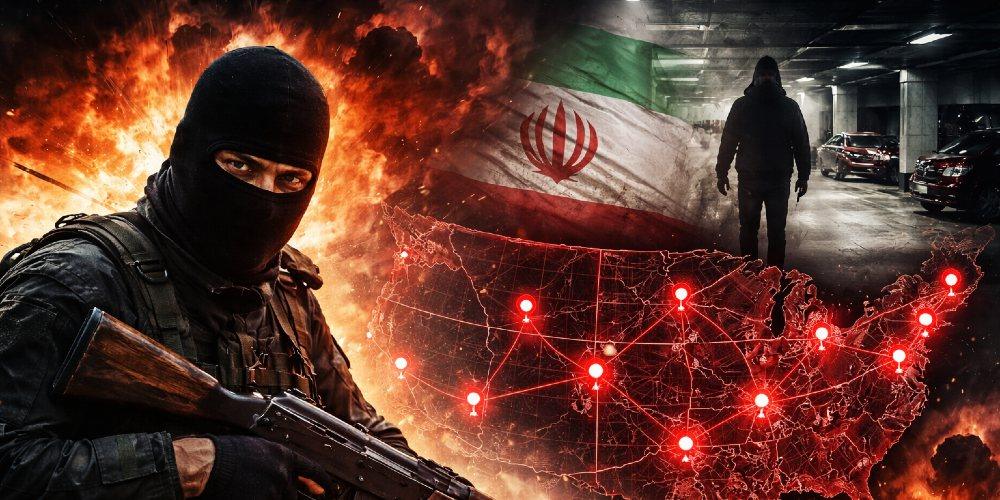

- Approximately 1,500 Iranians were intercepted at the U.S. southern border during the Biden administration, with roughly half released into the country pending court hearings.
- Officials express deep concern over the unknown number of Iranians who evaded detection entirely, known as “gotaways,” amid heightened fears of Iranian retaliation following U.S. and Israeli strikes on Iran.
- Federal alerts have warned of possible encoded communications from Iran intended as “operational triggers” for prepositioned sleeper assets on American soil.
- Senators from both parties, including Bill Hagerty, Ron Wyden, James Risch, and Rick Scott, have voiced alarms about the potential presence of sleeper cells and the need for vigilance.
- Recent incidents, such as a car attack on a Michigan synagogue and a shooting at Old Dominion University, have intensified homeland security worries even as no direct link to Iranian direction has been confirmed in every case.
- President Trump has stated that authorities are monitoring individuals who entered during the previous administration’s border policies and that most are being tracked.
- Iran remains designated as a state sponsor of terrorism, with a history of using proxies and covert networks for asymmetric attacks.
- The combination of border encounters, intercepted signals, and ongoing military conflict has prompted increased scrutiny by the FBI, CIA, and Department of Homeland Security.
Mounting concerns about potential Iranian sleeper cells inside the United States have surged in recent weeks, driven by the scale of Iranian nationals encountered at the southern border in prior years and fresh intelligence warnings tied to escalating conflict abroad.
Roughly 1,500 Iranians were stopped at the U.S.-Mexico border during the Biden administration, according to data referenced by lawmakers and border officials. Of those intercepted, about half were released into the interior of the country while awaiting immigration proceedings. The true scope of the risk, however, lies in those who were never caught.
Sen. Bill Hagerty, a Tennessee Republican and former U.S. ambassador to Japan, described the figures as deeply concerning. “We have no idea how many people got around obviously,” he told the New York Post. “The numbers are deeply concerning.”
Hagerty noted that many of the encounters involved individuals who traveled through hubs such as Sao Paulo, Brazil, a known corridor for passport fraud and irregular migration.
Customs and Border Protection data cited by the Niskanen Center indicate the number of intercepted Iranians climbed to approximately 1,650 between 2022 and 2025. These encounters occurred against the backdrop of Iran’s long-standing designation as a state sponsor of terrorism, a regime that has repeatedly demonstrated its willingness to strike through proxies, lone actors, and covert operatives rather than direct conventional confrontation.
A federal security alert issued in recent weeks warned law enforcement of possible efforts by Iran to contact “prepositioned sleeper assets” inside the United States. Intelligence officials reported detecting encoded transmissions—potentially using shortwave radio methods reminiscent of Cold War-era number stations—that could serve as operational triggers for dormant networks. Such communications are difficult to intercept and even harder to attribute in real time, leaving authorities to operate with incomplete visibility.
President Trump addressed the issue directly on March 11, acknowledging the vulnerabilities created by earlier border policies while expressing confidence in current monitoring efforts.
“A lot of people came in through Biden with his stupid open border, but we know where most of them are: We’ve got our eye on all of them, I think,” he said.
His administration has faced the challenge of sorting through legacy cases while confronting an active threat environment shaped by sustained U.S. and Israeli military actions against Iranian leadership and infrastructure.
Bipartisan voices in the Senate have echoed the gravity of the situation. Senate Intelligence Committee Vice Chair Sen. Ron Wyden, a Democrat from Oregon, noted the moment carries “a lot of safety challenges” without disclosing classified details.
Republican senators, including James Risch of Idaho and Rick Scott of Florida, stressed the need for constant vigilance. “I don’t think there’s any question they’re here,” Scott said. “We’ve got to be so vigilant … it just takes one person.”
Recent domestic incidents have added urgency to the warnings. In mid-March, a Lebanese American man drove a car packed with explosives into a synagogue in West Bloomfield, Michigan. Around the same time, an ISIS-linked gunman opened fire at Old Dominion University in Virginia, killing an ROTC instructor. While not every event has been conclusively tied to Iranian direction, the timing amid strikes on Iran has heightened scrutiny of any attack involving individuals with Middle Eastern ties or expressed sympathies.
FBI Director Kash Patel and CIA Director John Ratcliffe have engaged with lawmakers on Capitol Hill to discuss surveillance authorities and emerging threats. These briefings occur as federal agencies weigh the balance between protecting civil liberties and disrupting potential plots before they materialize. The challenge is compounded by the diffuse nature of modern terrorism, where state actors like Iran can inspire or direct lone wolves and small cells without leaving clear command-and-control footprints.
Iran’s strategy has long relied on asymmetric tools precisely because it lacks the conventional military reach of a superpower. Sleeper cells—operatives who embed quietly, often for years, maintaining normal lives until activated—represent one such tool. Historical precedents include Hezbollah-linked networks uncovered in the United States and Latin America, as well as Iran’s support for proxy militias across the Middle East that have targeted American personnel.

The unknown number of “gotaways” from the southern border during the 2021–2024 period remains a central point of contention. Even if only a small fraction of those who crossed carried hostile intent, the absolute numbers involved in special interest alien encounters from terrorism-prone regions raise legitimate questions about exposure. Law enforcement in border states, particularly Texas, has repeatedly flagged the influx of individuals from countries like Iran as requiring heightened vetting and monitoring.
President Trump’s team has moved to tighten enforcement and review prior releases, yet the reality of millions of encounters and releases under the previous administration means the work of identification and neutralization is ongoing. Officials emphasize that presence alone does not prove imminent threat, but the combination of opportunity, capability, and motivation from a cornered regime creates a risk profile that cannot be ignored.
Broader patterns reinforce the concern. Iran has a documented history of plotting attacks on U.S. soil and against American allies, ranging from assassination attempts to cyber operations. The regime’s leadership, significantly degraded by recent strikes, may calculate that domestic terrorism offers a low-cost way to impose costs on the United States without risking further direct military losses.
Americans have every reason to expect their government to treat this threat with the seriousness it demands. That means rigorous vetting at the border, robust intelligence sharing, targeted surveillance where legally justified, and swift action against any confirmed operatives or networks. Complacency is not an option when the stakes involve potential mass casualty events on home soil.
The coming months will test the nation’s ability to deter and defend against this shadow war. With Iran’s conventional power diminished but its ideological reach intact, the focus must remain on disrupting pathways of infiltration and activation before they yield tragedy. Vigilance, informed by hard lessons from the recent past, remains the surest safeguard.