

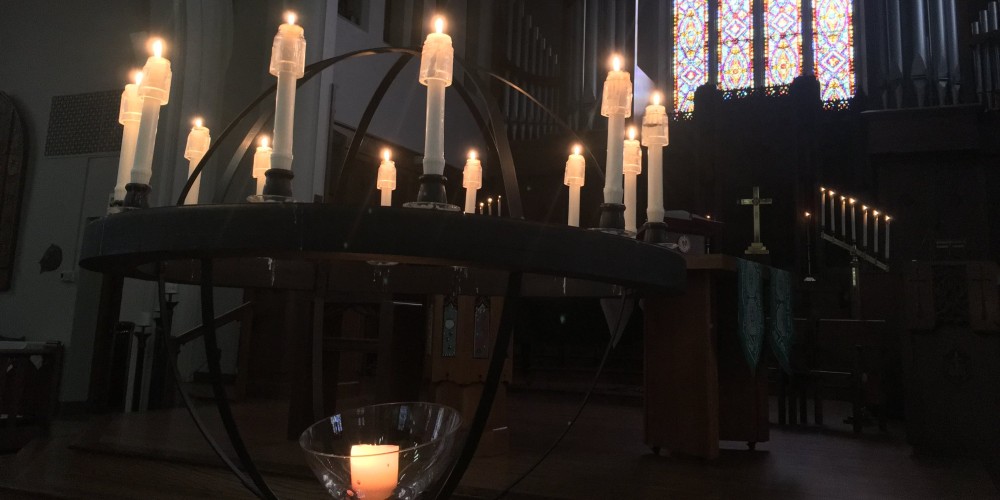
(Daily Signal)—Vice President Kamala Harris selected Gov. Tim Walz, D-Minn., as her running mate on Tuesday, and many Americans are naturally curious to know more about him, including his religious beliefs. Walz does not often discuss his faith, but he occasionally mentions that he attends Pilgrim Lutheran Church in St. Paul, Minnesota, (both instances are from 2020).
Here are nine facts about Walz’s church.
-
Pilgrim Lutheran Church in St. Paul is a member of the Evangelical Lutheran Church in America (ELCA), a liberal offshoot of the Lutheran Church-Missouri Synod (LCMS).
In 1976, Pilgrim Lutheran left the LCMS to join what would become the ELCA over “views on the inerrancy of the Bible,” the church explains on its website. “The Missouri Synod was quite firm in the belief that the Bible was without error. Others—pastors, scholars, and lay persons—felt that the Bible, while inspired, had portions where informed people could have differing opinions.”
-
The lead pastor of Pilgrim Lutheran Church is Jen Rome.
According to the church website, Jen Rome (“she/her”) “received her Masters of Divinity Princeton Theological Seminary in 2000” and “has 17 years of experience in bringing people of all generations to deeply experience and creatively connect with God, the world, and each other.” She is married with two daughters, and the family lives “inter-generationally” in a duplex with her in-laws.
On Sunday, Aug. 4, Rome delivered a homily based on a reading from John 6, in which, after feeding the 5,000, Jesus teaches that he is the bread of life. “Jesus goes on and on forever, it seems,” said Rome, but “what Jesus is talking about is setting aside or being healed from what causes you and the ones around to perish, to receive what is life-giving.”
Drawing an object lesson from a fictional, young-adult book series in which a young girl studies dragon science in defiance of societal expectations, Rome urged all her hearers to free themselves from the “garbage” of societal norms. She discussed her struggle with aging, saying her body no longer attains what she believes society expects from the female figure, adding that “it is amazing garbage that can go through this feminist’s head.”
“We humans love to make systems or hierarchies, whether that’s government, or religion, or gender, or race. We just live in all that stuff. We breathe it in, and the dynamics just circulate around in ourselves,” she said. But she imagined that Jesus would deliver quite a different message: “You, with the sick body, you are important. You, who do something for a living that others don’t appreciate, you are my child. You, who have been excluded by society for simply being who you are, whatever shape your body took, you are God’s child.”
-
Pilgrim Lutheran Church pursues a ‘varied and creative’ liturgy, particularly at evening services
“Evening worship at Pilgrim is varied and creative, focusing particularly on contemplation and a sense of calm mindfulness, most notably in the music, readings, use of silences, and lighting,” the website explains. “There is no sermon, so the Celtic Contemplative Communion and Contemplative Prayer from Nordic and Other Lands services use a unique style of ‘Word Weavings.’” The church website lists multiple staff experienced in Celtic and Nordic music, led by Composer-in-Residence Dick Hensold (“he/him”).
The church’s “word weaving” aims to “combine scripture and poetry in a way that is inspired by the ancient practice of ‘Lectio Divina.’ These ‘weavings’ juxtapose phrases from the readings in new ways to inspire deeper experience with the texts.”
While most deliberate in its evening services, Pilgrim Lutheran also embraces an open-ended worship liturgy in its Sunday morning gatherings. In the most recent service on Aug. 4, for example, Rome announced a “U-pick hymn sing” after the conclusion of her homily and prayer, inviting attendees to select their favorite hymns out of the hymnal.
-
At Pilgrim Lutheran Church, anyone may partake in the Lord’s supper.
“All people are ALWAYS welcome to receive Holy Communion,” announced the church newsletter. Rome confirmed this at the most recent service, declaring, “You are all welcome at this table. Whatever your age, wherever you are at in your life of doubt and faith … you are welcome at Christ’s table.”
This differs from the practice of many churches that restrict the Lord’s table to baptized believers, based on Paul’s warning to the Corinthians:
Whoever, therefore, eats the bread or drinks the cup of the Lord in an unworthy manner will be guilty concerning the body and blood of the Lord. Let a person examine himself, then, and so eat of the bread and drink of the cup. For anyone who eats and drinks without discerning the body eats and drinks judgment on himself. That is why many of you are weak and ill, and some have died (1 Corinthians 11:27-30).
-
Pilgrim Lutheran Church recites a modified version of the Lord’s prayer.
After reciting Jesus’ instructions about the Lord’s supper from Matthew 26:26-28, Rome led the congregation in a modified version of the Lord’s prayer. “And now,” she said, “we pray together the prayer that Jesus taught us, saying, ‘our guardian, our mother, our father in heaven, hallowed by thy name …’”
According to the gospel of Matthew, Jesus said, “Pray then like this: ‘Our Father in heaven, hallowed be your name …’” (Matthew 6:9). The gospel of Luke contains a similar, but slightly abbreviated, teaching, in which Jesus says, “When you pray, say: ‘Father, hallowed be your name …’” (Luke 11:2).

-
Pilgrim Lutheran Church welcomes and affirms people who identify as LGBTQ+ and follow those lifestyles.
“Pilgrim is a Reconciling in Christ church,” its website states, “which includes a partnership with Reconciling Works, a ministry devoted to welcoming, celebrating, and advocating for the full inclusion of LGBTQIA+ individuals in Lutheran faith communities.”
“Reconciling Works advocates for the acceptance, full participation, and liberation of all sexual orientations, gender identities, and gender expressions within the Lutheran Church,” according to its website.
Reconciling Works offers trainings with titles such as “Lutheran Introduction to Sexual Orientation, Gender Identity, & Gender Expression [SOGIE],” and “Let’s talk SOGIE.” It directs youth and families to PFLAG, an LGBTQ+ activist group that lobbies for explicit books in school libraries and against legislation to protect minors from gender-transition procedures.
All six members of the Reconciling Works Board of Directors identity as LGBTQ+, not including their nonbinary chaplain. The current chair of the board has three children, two of whom (ages 9 and 14) also identify as LGBTQ+, while she considers the youngest, age 4, to be “he/him until otherwise declared.”
In addition to its partnership with Reconciling Works, Pilgrim Lutheran also incorporates LGBTQ-inclusivity throughout its church culture. Its staff page lists the preferred pronouns of every team member, including one, a kindergarten teacher, who identifies as “she/they.” The church also hosts a trans-friendly, monthly event for mothers, advertising, “All those who identify themselves as mamas from Pilgrim are invited to a Pilgrim Mamas get together approximately once a month in the later evening.”
-
Pilgrim Lutheran Church promotes at least five anti-racism initiatives.
On its “ministries” page, Pilgrim Lutheran Church lists an Advocates for Racial Equity (ARE) team, which works “to overcome white supremacy by aligning with Pilgrim’s ‘Mission of Outreach and Welcome’ and ‘Doing Justice’ as we live out the counterculture values of the gospel through education, relationship building and advocacy.”

The ARE team developed a land acknowledgement statement “to acknowledge the traditional Indigenous inhabitants of the land we are on, inspiring us towards ongoing awareness and action. The full land acknowledgment is below (the ARE team also approved a shortened version that omits the bracketed material):
“This land is not just this address. From time immemorial the Dakota people’s lives and stories have been woven together with this land. [They were forcibly exiled from their land starting with the treaties of 1837 and 1851 and were nearly exterminated after the 1862 US Dakota war. We acknowledge the Dakota people, past and present, for their ongoing story and care of this land. We condemn and lament the way colonialism pillaged both the land and the Dakota way of life. Pilgrim Lutheran Church commits to ongoing efforts to recognize, support, and advocate for the Dakota and other Indigenous peoples.] Let us take a moment of silence to honor the Dakota people, their heritage and resiliency.”
Additionally, Pilgrim Lutheran Church maintains a reparations fund “directed specifically to respond to inequities in homeownership for BIPOC families.” The ARE team has led the church in a “process of making reparations for its tacit participation in the system of housing segregation.”
Pilgrim Lutheran Church also participates in a Joint Church Anti-Racism Team (JCART), “a collaborative effort of study and action” of four local mainline churches. JCART studies varied topics and is currently engaged in studying “Indigenous/Native understanding and issues.”
Most broadly, Pilgrim Lutheran Church participates in “a multi-racial, state-wide, nonpartisan coalition” called ISAIAH, which is “fighting for racial and economic justice in Minnesota” through “activism, organizing, and political action.” ISAIAH celebrated the “bold, progressive agenda” that passed the Minnesota Legislature in 2023 and laid out its 2024 legislative priorities: expansion of green energy, publicly funded day care, publicly funded health care, rent control, and trimming down voting requirements.
Pilgrim Lutheran Church also offers a Pilgrims Caring for Creation group, which aims “to reduce material and energy waste on our church campus” and sponsors “education and public events on issues of environmental justice.” The Environmental Justice Movement battles “environmental racism” by working “to improve and maintain a clean and healthful environment, especially for communities of color.” Pilgrim Lutheran has been designated a “Caring for Creation” Congregation by Minnesota Interfaith Power & Light.
-
Pilgrim Lutheran Church emphasizes social issues in its prayer requests.
On the penultimate page of its church newsletter, Pilgrim Lutheran Church lists concerns for prayer. The lower half of the page lists ongoing health concerns, those mourning the loss of loved ones, and ministry partners. The upper half of the page reads as follows:
“We pray for God’s loving presence for these Pilgrims who need healing, hope, comfort, and care:
“We pray for the people of areas torn by war and violence, including Gaza and Ukraine, for peace and safety. We also pray for those who are refugees fleeing violence seeking help and hope.
“We pray for the loved ones and communities of all victims of gun violence across our country.
“We pray for our governor and all elected officials and public servants. Guide them and support them in their work to care for our cities, our state, and our nation.
“We pray for those whose lives are altered by climate events. We pray for creation and for an increased will to care for it.
“We pray for all in the LGBTQIA+ community who face bias, rejection, and violence. We pray that we may all grow in acceptance and each become a voice for acceptance, advocacy, and support as an expression of Pilgrim’s status as a Reconciling in Christ community of faith.
“We keep in prayer our Native, Asian, Latino, and Black siblings who continue to face the legacy of racism. We pray for change in systems of oppression and injustice, and that we all may learn to follow the path of anti-racism, and each become a voice for inclusion, equity, and justice.
“We pray for our Muslim and Jewish siblings, as well as our siblings of other religions, in our country, state, and community facing prejudice, threats, and destruction of their places of worship.”
-
Pilgrim Lutheran Church maintains a partnership with a Lutheran congregation in Tanzania.
Pilgrim Lutheran has maintained a partnership with the Luganga Lutheran congregation, of the Iringa Diocese of Tanzania, since 2002. Luganga Lutheran is part of the Evangelical Lutheran Church in Tanzania (ELCT).
In contrast to its mainline American counterpart, the ELCT prominently displays on its website its mission, “To make people know Jesus Christ and have life in [his] fullness by bringing to them the Good News through words and deeds based on the Word of God as it is in the Bible and the Lutheran teachings guided by the ELCT Constitution.”
Originally published by The Washington Stand

Two Storms, One Harvest

Every food crisis in living memory has been a one-shock event. The 2008 price spike was a commodity bubble. The 2020 shortages were a logistics failure. The 2022 grain scare was a war on one exporter’s ports. Each time, the system bent, adjusted, and recovered, and each time the experts assured us afterward that global markets are simply too big and too diversified to fail.
What nobody in Washington seems eager to discuss is that 2026 is shaping up to be something the modern food system has never actually faced. Two independent shocks, one climatic and one geopolitical, are converging on the same harvest cycle at the same time. Not sequentially. Simultaneously.
Start with the weather. The Pacific Ocean is currently building toward what forecasters now openly call a record event. NOAA’s Climate Prediction Center puts the odds of at least a strong El Niño near 88 percent, with roughly two in three odds it reaches “very strong” status, the tier reserved for perhaps three or four events in the entire satellite era. Every major global model now projects a median peak in Super El Niño territory, and most of them project it exceeding the 2015-16 event, which until now held the modern record. Sea surface anomalies were already brushing the super threshold in mid-July, months before these events normally peak. The atmosphere has already shifted into El Niño mode, and the event is forecast to crest in late fall and early winter.
This is not about “climate change.” It’s about the standard cycles of weather, and the cycle we’re currently in is one that has likely devastated societies in the past. We’re better prepared as a society today, but not all Americans are equally prepared.
Serious households have started doing the quiet math on their own. Grocery bills tell part of the story, and the forecast maps tell the rest, which is why long-term food storage has moved from fringe hobby to mainstream line item in the family budget, with established suppliers like Heaven’s Harvest seeing demand from people who five years ago would have rolled their eyes at the idea. That instinct is not paranoia. It is pattern recognition, and the pattern is worth walking through carefully.
Editor’s Note: Heaven’s Harvest IS a sponsor, but the warnings of this article are real and would be written even if we didn’t have a survival food sponsor. With that said, those who take advantage of what they offer can use promo code “Patriot” for 15% off.
The Fertilizer Clock Is Already Running
While the Pacific warms, the second shock has been unfolding in the Strait of Hormuz. The conflict with Iran turned the world’s most important energy chokepoint into a contested waterway, and the consequences reach far beyond the gas pump. Roughly a third of global fertilizer trade moves through Hormuz, and the disruption sent urea prices up 86 percent year over year by March, with a 53 percent jump in a single month.
The World Bank projects energy prices rising about 24 percent in 2026 and fertilizer about 31 percent. By its own accounting, fertilizer prices ran 35 percent higher in the first five months of this year than the same period last year.
Here is the mechanism the nightly news will not explain. Fertilizer is not a grocery item. It is a time-delayed input. The nitrogen a farmer in Iowa or Punjab could not afford to apply this spring does not show up as a problem this spring. It shows up as a thinner harvest six to twelve months later.
The World Bank’s own food security brief concedes that the effects of reduced applications earlier this season “are likely to become visible only later in harvest outcomes.” Translate that from institutional language into plain English and it means this. The damage is already done, it is already in the ground, and we are simply waiting for it to arrive on the shelf.
Now check the calendar. Six to twelve months from the spring planting season lands us squarely in late 2026 and early 2027. Which is precisely when the strongest El Niño in the instrumental record is forecast to peak, bringing its signature droughts to Southeast Asia, Australia, southern Africa, northern Brazil, and South Asia, the very regions that grow the world’s rice, sugar, and oilseeds.
The World Bank warns openly that a strong El Niño “could disrupt multiple crop belts simultaneously” on top of the conflict-driven input costs. Their baseline projection assumes the Middle East disruptions ease by autumn. What in the last two years of Middle East history suggests that assumption is safe?
The System Has No Slack Left
The comfortable answer is that global markets always adjust. But adjustment requires slack, and the slack is gone. Global cereal production is expected to decline from last year’s records even before El Niño does its work. The UN World Food Programme, hardly a den of right-wing preppers, is calling this the most significant disruption to its supply chains since Covid and the invasion of Ukraine, and its supply chain director put the stakes bluntly.
Today’s supply chain challenges are tomorrow’s hunger crisis.
There is also a political dimension that markets cannot price. When food gets scarce, governments do not behave like economists. They behave like politicians. Export bans, hoarding mandates, and panic buying at the national level turned the modest rice shortfall of 2008 into a global crisis, and analysts are already warning that import-dependent nations are the first dominoes.
The 2015-16 Super El Niño, a far weaker event than what is now forecast, threw tens of millions into food stress across Africa and Asia. This one is projected to be stronger, and it arrives with fertilizer already rationed by price and shipping lanes already contested by missiles.
What Joseph Knew
Scripture does not treat preparation for lean years as faithlessness. It treats it as wisdom delivered in advance to those willing to act on it.
Behold, there come seven years of great plenty throughout all the land of Egypt: And there shall arise after them seven years of famine; and all the plenty shall be forgotten in the land of Egypt.
Joseph did not respond to that warning with a hashtag or a committee. He stored grain during the years of abundance, and when the famine came, Egypt stood while its neighbors begged. The lesson is not that famine is certain. It is that the time to prepare is precisely when preparation still looks optional.
Nobody who filled a pantry in a year of plenty has ever regretted it, and nobody standing in an empty aisle has ever been glad he waited for certainty.
None of this calls for panic, and panic is the enemy of sound judgment anyway. It calls for the same unglamorous prudence our grandparents considered ordinary. Keep some cash margin, know your local growers, and put real food in deep storage while it is cheap and available, because the entire arc of this story is that cheap and available is a closing window.
Families looking for a straightforward place to start can visit Heaven’s Harvest and use promo code Patriot for 15 percent off long-term storable food. The forecasts may yet soften, the strait may yet reopen, and we should pray they do. But hope is a fine thing to hold and a foolish thing to eat.

I’ll bet she’s really packing them in on Sunday. In a way that’s ok because when God takes his retribution on these heretics the lightning bolt won’t kill as many while incinerating this affront to God Almighty.
Your first point is incorrect. The ELCA IS NOT a liberal offshoot of the LCMS. The ELCA was formed when the LCA, or Lutheran Church of America, and the ALC, the American Lutheran Church, merged. The LCMS is a completely different synod.