

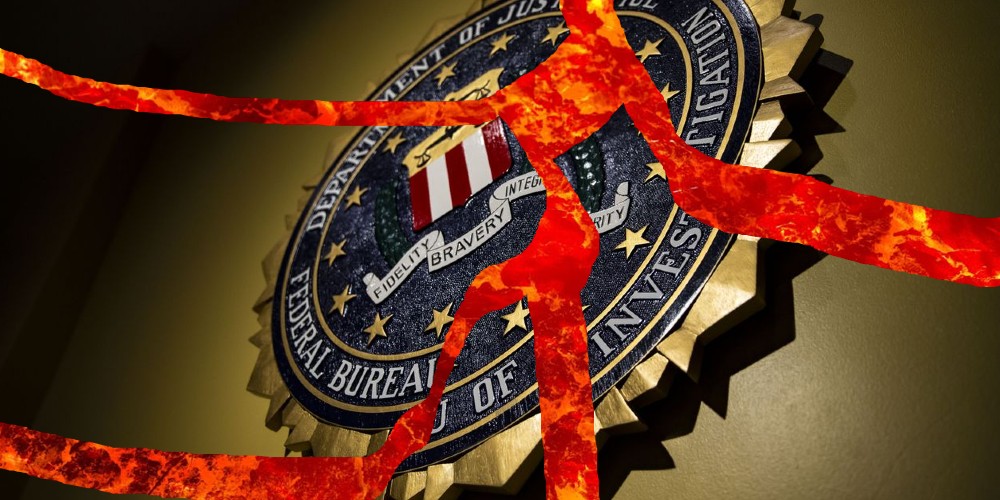
The Federal Bureau of Investigations is not the national law enforcement agency that most Americans believe it to be. It is a Deep State strongarming group that views American citizens as the enemy. They do the bidding of the globalist elites, protecting politicians and organizations who align with their agenda while going after anyone they see as a threat to that agenda.
Some say they are purely supportive of Democrats, but this is not completely accurate. They’re aligned with the Deep State’s agenda, and while 9 times out of 10 that means Democrats, there are many Republicans (well, RINOs) who are also under the protective wing of the FBI. Their true enemy is not the GOP but America First patriots, most of whom happen to be in the GOP.
RINOs generally get a pass from the FBI.
It is time to enact a plan to disband the FBI. Some may argue that we should reform the organization but I believe the rot is too well-developed to make reforms practical. We can fill any gaps in law enforcement with a combination of U.S. Marshals and interstate cooperation between local law enforcement agencies. Today’s police and sheriff’s departments often have the technological sophistication to put them on par with the FBI, a status that was not common just a couple of decades ago.
On today’s episode of The JD Rucker Show, I was joined by my wife to discuss several stories pointing to the need to get rid of the FBI. That video and show notes are below, but first I wanted to list seven reasons I believe it is time to disband the FBI for good. We’ve seen nothing but bad news from them in recent years. I don’t recall the last major bust they had that actually protected American citizens. Instead, their actions have been working against Americans, just as Ron Paul declared over three decades ago.
- Zero Transparency in Affidavit: This is the last straw in my book. Their unwillingness to explain their actions to a very interested public with yesterday’s ridiculously redacted affidavit demonstrates they don’t just hate us. They also lack any respect for us.
- Mar-a-Lago Raid: This was the last straw for many other Americans. They raided a former president for a “crime” that has been committed by every president in modern history. Donald Trump’s “crime” was far less concerning to national security than what the past three presidents at the very least have done. Also, knowing that they raided Donald Trump before Hunter Biden is an absolute joke.
- Gretchen Whitmer Fednapping: Entrapment is a very serious offense, yet Americans are being prosecuted for acting on the prompting of the FBI. We have to ask ourselves if the men who planned to kidnap Gretchen Whitmer would have made such plans if the FBI never infiltrated them.
- January 6th: We now know that dozens of agents and operatives participated in prompting attendees of the mostly peaceful process to enter the Capitol Building. This, perhaps more than anything else, tells us their true targets are not criminals but America First patriots.
- Hunter Biden’s Laptop: The FBI had the laptop from hell in 2019. They didn’t just ignore it. They willfully and aggressively covered it up. This makes one wonder if the Deep State and the powers-that-be had plans for Joe Biden to be installed long before the first Democrat primary. Otherwise, why wouldn’t they have just let Joe go down for Hunter’s many offenses and then pick someone else to install? Then, there are the recent revelations that the FBI ordered Big Tech companies and likely corporate media to suppress the laptop story when it broke a month before the 2020 election.
- Russiagate: Many articles and a few books have been written about the massive malfeasance committed by multiple FBI agents to manufacture the Russiagate hoax. That particular piece of work demonstrated corruption from bottom to top, leading me to my conclusion that they simply cannot be reformed.
- Hillary Clinton Let Off: It’s funny how in the affidavit they list the numbers of confidential, secret, and top secret documents they got from Mar-a-Lago. The reason it’s funny is because it’s reminiscent of what James Comey said about Hillary Clinton’s emails when he declared he was letting her off the hook. Being locked away at Mar-a-Lago is exponentially more secure than Clinton blasting sensitive documents out through an unsecured email server. None of what they took from Mar-a-Lago has ever been seen by foreign agents, while EVERYTHING Clinton sent out was likely intercepted one way or another.
There are good FBI agents. We know this because of the dozens of whistleblowers coming forward now. But the bad greatly outweighs the good within the bureau so anything positive they’ve done in recent years is moot. To say the FBI should be kept because they occasionally do good work is like defending Nazis because they built roads. The evil is far greater than the good.
Here’s today’s show.
Here are my show notes:
- What Released Affidavit Reveals About FBI’s Mar-a-Lago Raid
- To Help Biden, FBI Interfered With 2020 Election
- FBI Targeting Project Veritas Over Ashley Biden’s Diary
- New Poll Reveals Just How Much Damage FBI Sustained in Public Trust After Raid on Trump
- FBI’s Former Intel Chief on Raid of Trump Home: ‘I Think They Are Going to Regret This’
Leave a comment for this story on our new Substack.
Starting the Day With a Scripture-Inspired Roast Helps Center Your Thoughts on Eternal Truths Amid Temporal Pressures
The world can seem chaotic, especially right after we wake up. Many believers start their mornings reaching for something familiar — a hot cup of coffee — yet end up settling for mediocre brews that do little more than deliver a caffeine jolt. The daily grind of life, with its endless distractions, news cycles, and responsibilities, can leave even the most faithful feeling spiritually parched alongside their physical fatigue. What if your morning ritual could do more than wake you up? What if it could ground you in truth, nourish your body with exceptional quality, and quietly advance a kingdom purpose at the same time?
That’s the promise — and the reality — behind Promised Grounds Coffee. This Christian-founded company doesn’t just roast beans; it approaches every step as an act of worship and discipleship. By selecting only the top 10% of specialty-grade beans, ethically sourced from dedicated farmers in Central and South America, and small-batch roasting them with reverence in Austin, Texas, Promised Grounds delivers what many describe as the best coffee available — never burnt, never bland, but rich with origin stories and layered flavors that honor God’s creation.
From the vibrant Psalm 27 Roast (a light, bright medium option) to the bold yet peaceful 2 Timothy 1:7 Decaf, each bag carries a Scripture verse that turns your daily pour into a gentle reminder of faith. And through their Ounce Per Ounce Promise, every ounce of coffee you enjoy provides an equal ounce of clean water to families in need via partnership with Filter of Hope — literally brewing hope for body and soul, one cup at a time.
The challenge for today’s Christians runs deeper than finding a decent cup. In an age of convenience-driven consumerism, it’s easy to support companies that dilute values or remain silent on matters of faith. Many believers want their everyday choices — from what they drink to how they spend — to reflect discipleship rather than just convenience. Promised Grounds solves this by weaving Christian excellence into the entire process: beans nurtured with prayerful stewardship by farming families, roasted as an offering rather than a commodity, and packaged with Bible verses to encourage a mindset of gratitude and purpose from the first sip. Reviewers consistently praise the smooth, rich profiles — whether enjoyed black in a drip maker, iced on a warm day, or shared in fellowship — noting how the quality stands toe-to-toe with premium secular brands while delivering something far more meaningful.
This integration of faith and flavor addresses a real need in Christian households and ministries. Busy parents, church leaders, and remote workers alike report that starting the day with a Scripture-inspired roast helps center their thoughts on eternal truths amid temporal pressures. The coffee’s exceptional character — bright citrus notes in lighter roasts or deep chocolate undertones in bolder ones — comes from meticulous selection and careful roasting that respects the bean’s natural gifts rather than masking them. It’s the kind of coffee that elevates a simple quiet time, fuels productive workdays, or sparks meaningful conversations when shared at Bible studies or outreach events. And because it’s ethically sourced with integrity, every purchase supports sustainable livelihoods for farmers who treat their crops like family harvests.
For those leading churches or small groups, the impact multiplies. Promised Grounds offers bundles and options perfect for hospitality ministries, turning ordinary coffee service into an opportunity to point people toward the living water of Christ. Imagine greeting visitors with a warm cup whose very bag carries God’s Word — a subtle yet powerful witness that aligns with the Great Commission. The company’s Texas roots and commitment to “brewing hope” resonate especially with believers who value American enterprise paired with global compassion.
Of course, quality alone isn’t enough if the experience feels out of reach. Promised Grounds keeps it accessible with practical perks like free shipping on orders over $40, sample sets for discovering favorites, and thoughtful add-ons such as faith-themed mugs. Whether you prefer whole beans for fresh grinding, grounds for convenience, or even bulk options for larger households and ministries, the result is consistently superior coffee that makes discipleship feel integrated rather than added on.
As you consider how to align even the smallest habits with your walk with God, Promised Grounds Coffee stands out as a refreshing solution. It tackles the dual problems of subpar daily sustenance and disconnected consumption by offering a product that genuinely excels in taste while advancing a mission of clean water, farmer dignity, and scriptural encouragement. Believers who make the switch often describe it as more than a beverage upgrade — it becomes part of their rhythm of gratitude, a daily invitation to remember that every good gift comes from above.
If you’re ready to transform your mornings (and perhaps your church gatherings) with coffee that honors both exceptional craftsmanship and Christian values, I encourage you to explore what Promised Grounds has to offer. One sip at a time, you’ll be nourishing your body, refreshing your spirit, and participating in something far greater — all while enjoying what truly is among the best coffee available.

On point 7, the difference was the FBI’s assumption of intent. Clinton was assumed to have no ill intent. Trump is assumed to have ill intent. Most likely for no other reason than one’s a democrat and the other’s a republican.
When laws are unspecific, with much of their enforcement left to law enforcement’s discretion, as if they have the ability to read minds, those laws are guaranteed to be abused. The espionage act is a perfect example. The individual must have “reason to believe,” which is purely subjective. The sad truth of the matter is that assumed intent is basically written into the law. Congress basically handed the DOJ and FBI a license to abuse. And you can’t hold them accountable for it. All they have to say is that they genuinely believed the individual had ill intent. You can’t prove they didn’t genuinely believe there was ill intent, any more than they can prove the ill intent. At that point it’s little more than a contest to see which mind reader will the judge believe. Congress could fix a lot of the problem by not creating massive, generic, obfuscated laws that delegate their responsibility to the discretion of other agencies, unnecessarily leaving large openings for the prospect of abuse. That’s a significant part of the problem.
Another huge gaping hole is Congress’ failure to enact law that can feasibly be equally applied. The law may be very specific, but can it realistically be equally and fairly applied. Equal protection sounds nice, it should naturally limit discretion, and it is a great goal, but the application of it must be realistically feasible. If laws cannot be realistically equally applied, then the corrupt individuals can just say, “Well, we’re doing our best. We got a few, but not all,” when the reality is that those few they prosecuted were specifically targeted. They’ve got an easy out.
You have to take away the leeway to abuse. Take away the excuses. Take away plausible deniability. Remove the room for it, and so on, as much as possible. There are many things congress could do to address the problem. But it’s important to remember that even if we did abolish the FBI, the huge gaping holes for abuse that currently exist in the law could and would still be utilized.