

The world is a confusing place. People do things that don’t make any sense, think things that aren’t supported by facts, endure things they do not need to endure, and viciously attack those who try to bring these things to their attention.
If you’ve ever wondered why, you’ve come to the right place. Any casual reader of the alternate media landscape will eventually come up with a reference to Stanley Milgram, or Philip Zimbardo, the “Asch Experiment” or maybe all three.
“Cognitive Dissonance”, “Diffusion of Responsibility”, and “learned helplessness” are phrases that regularly do the rounds, but where do they come from and what they mean?
Well, here are the important psycho-social experiments that teach us about the way people think, but more than that they actually explain how our modern world works, and just how we got into this mess.
1. THE MILGRAM EXPERIMENT
The Experiment: Let’s start with the most famous. Beginning in 1963, Yale psychologist Stanley Milgram conducted a series of experiments now referred to as the Milgram Obedience Experiments.
The setting is simple, Subject A is told to conduct a memory test on Subject B, and administer electric shocks when he makes mistakes. Of course, Subject B does not exist, and the electric shocks are not real. Instead, actors would cry, ask for help or pretend to be unconscious, all the while Subject A would be encouraged to carry on administering the shocks.
The vast majority of subjects carried on with the test and gave the shocks, despite the distress of “Subject B”.
The Conclusion: In his paper on this experiment Stanley Milgram coined the term “diffusion of responsibility”, describing the psychological process by which a person can excuse or justify doing harm to someone if they believe it’s not really their fault, they won’t be held accountable, or they do not have a choice.
The Application: Almost literally endless. All institutions can use this phenomenon to pressure people into acting against their own moral code. The army, the police, hospital staff – wherever there is a hierarchy or perceived authority, people will fall victim to the diffusion of their own responsibility.
NOTE: They made a decent film about Milgram, and the backlash his experiments caused called Experimenter. In recent years there has been a major pushback on this experiment, with articles in the MSM attacking the findings and methodology and new “researchers” claiming “it does not prove what you think it does.”
2. THE STANFORD PRISON EXPERIMENT
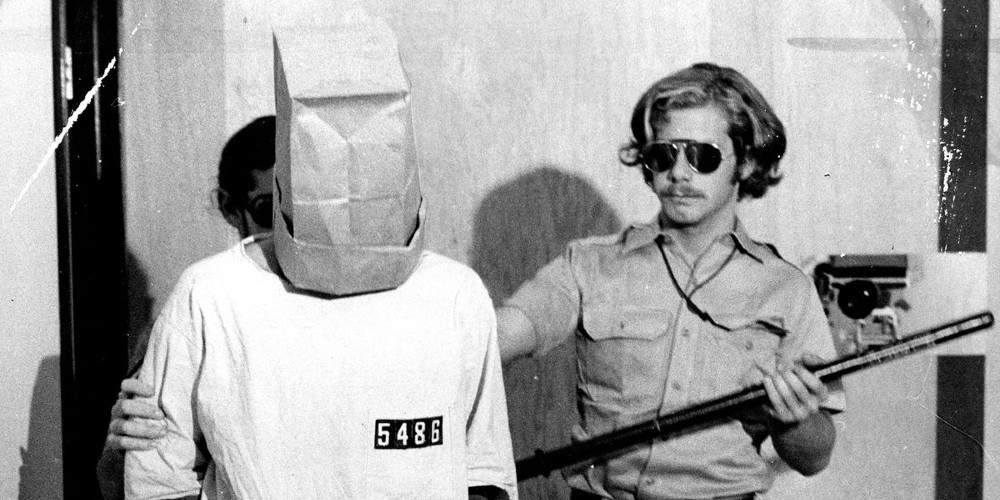
The Experiment: Only slightly less famous than Milgram’s work is Philip Zimbardo’s Prison Experiment, carried out at Stanford University in 1971. The experiment set up a mock-prison for a week, with one group of subjects designated “guards” and the other “prisoners”.
Both sides were provided uniforms, and prisoners were given a number. The guards were ordered to only ever address prisoners by their number, not their name. There were a number of other rules and procedures, detailed here.
In brief, over the course of the week, guards became increasingly sadistic, dealing out punishments to disobedient prisoners and rewarding “good prisoners” in order to try and divide them. Many of the prisoners simply took the abuse, and in-fighting began between “trouble makers” and “good prisoners”.
Though technically not an “experiment” in the purest sense (there was no hypothesis to test, and no control group), and perhaps impacted by “demand characteristics”, the study does reveal interesting patterns of behaviour in its subjects.

The Conclusion: Prison guards became sadistic. Prisoners became obedient. All this despite no real laws being broken, no real legal authority, and no real requirement to stay. If you give people power and dehumanise those below them, they will become sadistic. If you put people in prison they will act like they are in prison. In short, people will act the way they are treated.
The Application: Again, endless. We’ve seen it all through Covid, if you start treating people a certain way, the majority will go along with it and blame the minority who refuse to cooperate. Meanwhile, police forces around the world were suddenly granted new powers, and promptly abused them because the maskless and unvaxxed had been dehumanised in their eyes. Those reactions were engineered, not accidental.
3. THE ASCH EXPERIMENT
The Experiment: Another experiment in conformity, not as brutal as Milgram or Zimbardo, but perhaps more unsettling in its findings. First conducted by Solomon Asch in the 1950s, the setup is a simple one. You put together a panel of subjects, one real subject and a handful of fake subjects.
One by one the subjects are asked a series of multiple-choice questions to which the answer is always obvious, and all the fake subjects will get every answer wrong. The question is whether or not the real subject will maintain his own correct answer, or begin to conform with the group.
The Conclusion: While most people maintained their right answers, the “error rate” in the experiment group was 37% versus less than 1% in the control group. Meaning 36% of subjects eventually began to change their answers to align with the consensus, even though they knew they were wrong.
Around one-third of people will either pretend to change their minds for the sake of conformity or, more alarmingly, will actually alter their beliefs if they find themselves in the minority.

The Application: Staged or invented polls, falsified vote counts in elections, bot accounts on social media, astroturfing campaigns. Media headlines proclaiming “everyone knows X” or “only 1% of people think Y”. There are a great many tools you can use in order to create the impression of a fake “consensus”, a manufactured “majority”.
NOTE: The experiment has been done a million times in dozens of variations, but perhaps the most interesting finding is that putting just one other person in the panel who agrees with the test subject seemed to reduce conformity by 87%. Essentially, people hate being a lone voice but will tolerate being in the minority if they have some support. Good to know.
4. FESTINGER’S COGNITIVE DISSONANCE EXPERIMENT
The Experiment: The least well-known experiment on the list, but in some ways the most fascinating. In 1954 Leon Festinger created an experiment to evaluate the phenomenon of cognitive dissonance, his setup was again quite simple.
A subject is given a repetitive and dull physical task to do (originally turning wooden pegs, but other variations use other tasks).
After the task is complete, the subject is instruced to go and prepare the next subject (actually a lab assistant) for the task, by lying and telling him/her how interesting the task was.
It’s at this point the subjects are divided into two groups, one group is offered $20 to lie, the other only $1. This is the real experiment.
The Conclusion: After lying to the fake subjects, and being paid their money, the real subjects take part in a post-experiment interview and record their genuine thoughts on the task.
Interestingly, the 20-dollar generally told the truth, that they found the task dull and repetitive. While the one-dollar group, more often than not, claimed to have genuinely enjoyed the task. This is cognitive dissonance in action.
Essentially, for the $20 group, the money was a good reason to lie to their fellow test subject, and they could justify their own behaviour in their head. But, for the $1 group, the meagreness of the reward made their dishonesty internally unjustifiable, so they had to unconsciously create their own justification by convincing themselves they weren’t lying at all.
In summary, if you offer people a small reward for doing something, they will pretend to enjoy it, or be otherwise invested, to justify only making a small profit.
The Application: Casinos, computer games and other interactive media use this principle all the time, offering players very little pay off knowing they will convince themselves they are enjoying playing. Big corporations and employers can likewise rely on this phenomenon to keep wages down, knowing that low paid workers have a psychological mechanism that may convince them they enjoy their jobs.
NOTE: A variation on this experiment introduces a third group, who are paid nothing to lie. This group is not affected by cognitive dissonance, and will honestly appraise the task just as the well-paid group do.
5. THE MONKEY LADDER
The Experiment: Now this is a somewhat controversial addition to the list, but we’ll get to that later. It’s a very famous experiment you’ve probably heard cited dozens of times.
In the 1960s scientists at Harvard put five monkeys in a cage with a stepladder in the middle. Atop the stepladder is a bunch of bananas, however each time a monkey tries to climb the ladder they are all sprayed with ice-cold water. Eventually, the monkeys learn to avoid the ladder.
Then one monkey is removed and a new monkey is introduced. He naturally goes straight for the ladder and is set upon by the other four monkeys. Then a second monkey is removed, and another new monkey is introduced. He naturally goes straight for the ladder and is set upon by the other four monkeys…including the one who was never sprayed.
They continue to replace each monkey in turn, until no monkeys are present who were ever sprayed with water, and yet they all refuse to go near the stairs and prevent all the new monkeys from doing so. Now, the obvious conclusion here is that people can be conditioned to mindlessly follow rules they do not understand. The only problem with that is that none of this ever happened.
Yes, that’s the controversy I mentioned earlier. Despite being easily found on every corner of the internet, despite magazine articles explaining it and animations recounting it…it never happened. The experiment appears to be entirely apocryphal. No ladder, no monkeys, no cold water.
So while this supposed experiment doesn’t actually teach us about herd mentality, it does explain the modern world, because it shows us how easily a myth can be worked into a reality through sheer dint of repetition.
BONUS: MONKEY LADDER REDUX
That’s right, it doesn’t stop there, there’s another twist. National Geographic did actually recreate the fictional monkey ladder experiment using people:
One subject walks into a doctor’s waiting room filled with fake patients. When a bell sounds, all the fake patients stand up for a second and then retake their seats.
After this process repeats a few times, the fake patients are slowly removed one-by-one until only the subject of the experiment remains. Then secondary real subjects are introduced one at a time.
The experiment seeks to answer the following questions:
- Will the original subject stand up at the bell without knowing why?
- Will they will continue to stand up when they are alone in the room?
- Will they then teach this behaviour to the new subjects?
The answer to all three appears to be “yes”.
Now, while far less scientific than the other four experiments, I include this here for a very specific reason. The above video of the experiment doesn’t just record the conforming behaviour but describes it as possibly beneficial. Adding that herd behaviour saves lives in the wild and is “how we learn to socialise”.
A very interesting take, don’t you think?
So, while the fake monkey experiment that never happened was used to teach us about the perils of herd mentality, its nonexistence actually teaches us about the perils of non-primary sources and the group consciousness’s ability to confabulate.
Meanwhile, the real monkey experiment is used to sell us the idea that herd mentality does exist but is potentially a good thing. Raising the possibility the whole thing could have been staged, simply to promote conformity.
…Isn’t the world a strange and confusing place?
So, there they are. Five of the most critical pieces of psychological research ever done, hopefully going forward nobody will be left in the dark when these concepts or experiments are referenced.
But the point of this article is not to just make you, the reader, understand these experiments…it is also meant to remind you that they do.
The people in charge, the elite, the 1%, “The Party”. The powers that be – or shouldn’t be – whatever you want to call them.
They know these experiments. They have studied them. They’ve probably replicated them countless times on grand scales and in unethical ways we can barely imagine. Who knows exactly what takes place in the dank dark dungeons of the deep state?
Just remember, they know how the human mind works.
- They know they can make people do anything if they reassure them they won’t be held responsible.
- They know that they can rely on people to abuse any power they’re given, OR believe they are powerless if they’re treated that way.
- They know that peer pressure will change a lot of people’s minds even in the face of undeniable reality, especially if you make them feel completely alone.
- They know that if you offer people only a small reward for completing a task, they will make up their own psychological justification for taking it.
- They know that people will mindlessly do whatever everyone else is doing without ever asking for a reason.
- And they know that people will happily believe something that never happened if it is repeated often enough.
They know all of this. And they use that knowledge all the time – All. The. Time.
Every commercial you see, every article you read, every movie they release, every item on the news, every “viral” social media post, every trending hashtag.
Every war. Every pandemic. Every headline.
All of them are constructed with these principles in mind to elicit specific emotional reactions that steer your behaviour and beliefs. That’s how the media works, not to inform you, not to entertain you…but to control you.
And they have it down to a science. Always remember that.
Article cross-posted from Off-Guardian.

Two Storms, One Harvest

Every food crisis in living memory has been a one-shock event. The 2008 price spike was a commodity bubble. The 2020 shortages were a logistics failure. The 2022 grain scare was a war on one exporter’s ports. Each time, the system bent, adjusted, and recovered, and each time the experts assured us afterward that global markets are simply too big and too diversified to fail.
What nobody in Washington seems eager to discuss is that 2026 is shaping up to be something the modern food system has never actually faced. Two independent shocks, one climatic and one geopolitical, are converging on the same harvest cycle at the same time. Not sequentially. Simultaneously.
Start with the weather. The Pacific Ocean is currently building toward what forecasters now openly call a record event. NOAA’s Climate Prediction Center puts the odds of at least a strong El Niño near 88 percent, with roughly two in three odds it reaches “very strong” status, the tier reserved for perhaps three or four events in the entire satellite era. Every major global model now projects a median peak in Super El Niño territory, and most of them project it exceeding the 2015-16 event, which until now held the modern record. Sea surface anomalies were already brushing the super threshold in mid-July, months before these events normally peak. The atmosphere has already shifted into El Niño mode, and the event is forecast to crest in late fall and early winter.
This is not about “climate change.” It’s about the standard cycles of weather, and the cycle we’re currently in is one that has likely devastated societies in the past. We’re better prepared as a society today, but not all Americans are equally prepared.
Serious households have started doing the quiet math on their own. Grocery bills tell part of the story, and the forecast maps tell the rest, which is why long-term food storage has moved from fringe hobby to mainstream line item in the family budget, with established suppliers like Heaven’s Harvest seeing demand from people who five years ago would have rolled their eyes at the idea. That instinct is not paranoia. It is pattern recognition, and the pattern is worth walking through carefully.
Editor’s Note: Heaven’s Harvest IS a sponsor, but the warnings of this article are real and would be written even if we didn’t have a survival food sponsor. With that said, those who take advantage of what they offer can use promo code “Patriot” for 15% off.
The Fertilizer Clock Is Already Running
While the Pacific warms, the second shock has been unfolding in the Strait of Hormuz. The conflict with Iran turned the world’s most important energy chokepoint into a contested waterway, and the consequences reach far beyond the gas pump. Roughly a third of global fertilizer trade moves through Hormuz, and the disruption sent urea prices up 86 percent year over year by March, with a 53 percent jump in a single month.
The World Bank projects energy prices rising about 24 percent in 2026 and fertilizer about 31 percent. By its own accounting, fertilizer prices ran 35 percent higher in the first five months of this year than the same period last year.
Here is the mechanism the nightly news will not explain. Fertilizer is not a grocery item. It is a time-delayed input. The nitrogen a farmer in Iowa or Punjab could not afford to apply this spring does not show up as a problem this spring. It shows up as a thinner harvest six to twelve months later.
The World Bank’s own food security brief concedes that the effects of reduced applications earlier this season “are likely to become visible only later in harvest outcomes.” Translate that from institutional language into plain English and it means this. The damage is already done, it is already in the ground, and we are simply waiting for it to arrive on the shelf.
Now check the calendar. Six to twelve months from the spring planting season lands us squarely in late 2026 and early 2027. Which is precisely when the strongest El Niño in the instrumental record is forecast to peak, bringing its signature droughts to Southeast Asia, Australia, southern Africa, northern Brazil, and South Asia, the very regions that grow the world’s rice, sugar, and oilseeds.
The World Bank warns openly that a strong El Niño “could disrupt multiple crop belts simultaneously” on top of the conflict-driven input costs. Their baseline projection assumes the Middle East disruptions ease by autumn. What in the last two years of Middle East history suggests that assumption is safe?
The System Has No Slack Left
The comfortable answer is that global markets always adjust. But adjustment requires slack, and the slack is gone. Global cereal production is expected to decline from last year’s records even before El Niño does its work. The UN World Food Programme, hardly a den of right-wing preppers, is calling this the most significant disruption to its supply chains since Covid and the invasion of Ukraine, and its supply chain director put the stakes bluntly.
Today’s supply chain challenges are tomorrow’s hunger crisis.
There is also a political dimension that markets cannot price. When food gets scarce, governments do not behave like economists. They behave like politicians. Export bans, hoarding mandates, and panic buying at the national level turned the modest rice shortfall of 2008 into a global crisis, and analysts are already warning that import-dependent nations are the first dominoes.
The 2015-16 Super El Niño, a far weaker event than what is now forecast, threw tens of millions into food stress across Africa and Asia. This one is projected to be stronger, and it arrives with fertilizer already rationed by price and shipping lanes already contested by missiles.
What Joseph Knew
Scripture does not treat preparation for lean years as faithlessness. It treats it as wisdom delivered in advance to those willing to act on it.
Behold, there come seven years of great plenty throughout all the land of Egypt: And there shall arise after them seven years of famine; and all the plenty shall be forgotten in the land of Egypt.
Joseph did not respond to that warning with a hashtag or a committee. He stored grain during the years of abundance, and when the famine came, Egypt stood while its neighbors begged. The lesson is not that famine is certain. It is that the time to prepare is precisely when preparation still looks optional.
Nobody who filled a pantry in a year of plenty has ever regretted it, and nobody standing in an empty aisle has ever been glad he waited for certainty.
None of this calls for panic, and panic is the enemy of sound judgment anyway. It calls for the same unglamorous prudence our grandparents considered ordinary. Keep some cash margin, know your local growers, and put real food in deep storage while it is cheap and available, because the entire arc of this story is that cheap and available is a closing window.
Families looking for a straightforward place to start can visit Heaven’s Harvest and use promo code Patriot for 15 percent off long-term storable food. The forecasts may yet soften, the strait may yet reopen, and we should pray they do. But hope is a fine thing to hold and a foolish thing to eat.
