

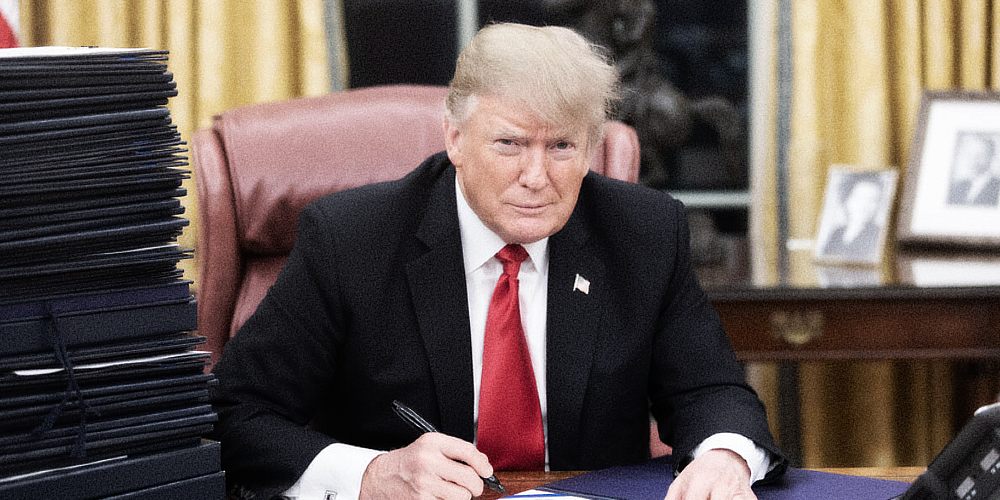
(WND)—WND recently published my article “The top elites want Trump to run their pending war” in which I further elaborated on my theory that Donald Trump forced them to dismantle their barriers to his second term and let him back in the White House. What they’ve surrendered to is letting Trump take on the challenge of preserving the American Empire in his own way – which is dramatically different from their own Ukraine-centered, Russian scapegoating, global bullying strategy. Trump and the top tier elites share the goal of preserving U.S. military and economic global dominance but are polar opposites on Cultural Marxism and the battle between nationalism and “one world” globalism.
Trump’s win means he gets the chance to roll back socialism and restore constitutionalism against their will on the domestic front while pursuing their common priority internationally. This was the same general trade-off Reagan had, but, importantly, Trump’s agenda adds the component of anti-“one world” globalism. In this context, Trump’s “nationalism” might better be termed “international federalism” because it clearly presumes an international order in which nations remain cooperating independent sovereigns and not mere components of single global Marxist conglomerate like the neo-Soviet European Union strives to be.
They surrendered to Trump not just because he beat them politically, but because Vladimir Putin beat them militarily in Ukraine. When their military failure became so obvious in 2023 that they could no longer contain the situation with war propaganda, they fell back to Plan B: the much riskier Israel/Hamas gambit, which is mostly limited to the Iran problem and related Middle East objectives. I have contended since it happened that the all-too-real Oct. 7, 2023, massacre was allowed to happen for that purpose. I believe they let slip the rabid dogs of Hamas deliberately to shift the “Eye of Sauron” media focus away from Ukraine (which I disapprove), and create the justification for de-nuking Iran (which goal I endorse, if not the duplicitous staging.)
Are the elites truly that evil? Ask the hundred million plus innocent unborn babies they’ve slaughtered worldwide (including in Israel) by normalizing abortion as a population-reduction tactic. Or maybe we should ask the entire generation of dead and maimed Ukrainian men sacrificed as cannon fodder proxies in a 100% preventable NATO- orchestrated war.
Let’s review what’s really happening in the world of geopolitics – as seen from outside the bubble of neocon propaganda constantly being spewed by the corporate media of the U.S., U.K. and European Union.
Massive corruption and abuse of power by the Bush/Clinton/Obama/Biden tag-team cabal over the past several decades has bankrupted America, poisoned much of the world against us and driven a growing alliance of would-be competitors to formalize and implement a plan to end our global hegemony. The greatest threat their BRICS network represents is to the U.S. dollar’s dominance as the world’s reserve currency. If BRICS develops a way to dethrone the dollar, we will (supposedly) collapse like a house of cards under an avalanche of debt we have no ability to pay – some $36 trillion worth – or higher by some accounts. Our fall would be swift and spectacular – creating a political vacuum into which the BRICS nations would flow to replace us with their vision of a new multi-polar order.
Obviously, that existential threat has – in the warped minds of the elite megalomaniacs who rule us – warranted extreme measures, which included the anti-Trump color revolution and coup of 2020, facilitated by the global deployment of their COVID bio-weapon and imposition of de facto medical martial law. In one fell swoop they intended to crush the rapidly growing worldwide populist uprising that threatened their grip on the levers of national and international power AND at the same time intimidate the BRICS nations into submission in classic Mafia style.
To invoke the old Chinese idiom, they intended to “kill the chicken to scare the monkey.” But to their shock, the populist chicken (led by the MAGA movement in the U.S.) didn’t die. Instead it got stronger and began pushing back even harder, not just against the fake vaccine but also against government-coerced censorship, manipulative fake-news narratives, forced DEI lunacy and child-grooming … and the proxy war in Ukraine. That was only possible because MAGA’s champion, Donald Trump, did not retreat after J6 but redoubled his efforts.
So now we’ve all been rewarded with front-row seats to the greatest show on earth as a greatly wiser and fully unshackled President-elect Trump begins the process of draining the swamp and restoring America’s greatness – not just domestically, but internationally.
I think President Trump can prevent World War III during his delayed second term by doing three things:
First, by embracing some form of the BRICS multi-polar vision on the condition that the dollar remains the sole world currency for international trade. This would further his goal of withdrawing the United States from the roles of international policeman, babysitter and financial sugar-daddy, while earning the appreciation and respect of those BRICS nations being entrusted as true partners in international matters, no longer treated as mere vassals of the U.S. This would mean ending the top-down divide-and-conquer polarization model for international relations established long ago by the British Empire and replacing it with the model of international federalism mentioned above.
Second, by developing a partnership with Putin and Russia based upon our mutual Christian history and cultural foundations to 1) fully drain the swamp of Marxism globally, starting with the European Union; and 2) constrain Islamist expansion everywhere, starting with Islamist-targeted Christian nations like Nigeria. In my view the only reason Russia is militarily allied with Shiite Iran is to counter the U.S. alliance with the Sunni majority headed by Saudi Arabia. A U.S./Russia alliance on Islam and Middle East policy would completely transform the geopolitical dynamics, provide the opportunity to compel Iran to de-nuke without resort to military force, and protect Israel from destruction by the Islamic world by removing Russia’s incentive to ally with Israel’s enemies as a tactic of self-defense. Russia instead would be an ally of Israel, which I believe Putin would prefer.
Three, the lynchpin making the prior elements possible would be NATO and the Russian Federation entering into a mutual non-expansion agreement. What’s really driving all these currently failing international policies is the Mackinder theory of geopolitics held forever by the British (and by extension the Americans) that if Russia gains control of the Eurasian plateau it would become an unstoppable world power. If Russia formally abandoned any dream of a restored Soviet Union (which I don’t think it wants) and NATO ended its encroachment/encirclement strategy for containing Russia, then the threat of WWIII would fade dramatically.
All this, of course, assumes that the elites won’t start WWIII before Trump’s inauguration. I’ll address that issue in my next column.

Two Storms, One Harvest

Every food crisis in living memory has been a one-shock event. The 2008 price spike was a commodity bubble. The 2020 shortages were a logistics failure. The 2022 grain scare was a war on one exporter’s ports. Each time, the system bent, adjusted, and recovered, and each time the experts assured us afterward that global markets are simply too big and too diversified to fail.
What nobody in Washington seems eager to discuss is that 2026 is shaping up to be something the modern food system has never actually faced. Two independent shocks, one climatic and one geopolitical, are converging on the same harvest cycle at the same time. Not sequentially. Simultaneously.
Start with the weather. The Pacific Ocean is currently building toward what forecasters now openly call a record event. NOAA’s Climate Prediction Center puts the odds of at least a strong El Niño near 88 percent, with roughly two in three odds it reaches “very strong” status, the tier reserved for perhaps three or four events in the entire satellite era. Every major global model now projects a median peak in Super El Niño territory, and most of them project it exceeding the 2015-16 event, which until now held the modern record. Sea surface anomalies were already brushing the super threshold in mid-July, months before these events normally peak. The atmosphere has already shifted into El Niño mode, and the event is forecast to crest in late fall and early winter.
This is not about “climate change.” It’s about the standard cycles of weather, and the cycle we’re currently in is one that has likely devastated societies in the past. We’re better prepared as a society today, but not all Americans are equally prepared.
Serious households have started doing the quiet math on their own. Grocery bills tell part of the story, and the forecast maps tell the rest, which is why long-term food storage has moved from fringe hobby to mainstream line item in the family budget, with established suppliers like Heaven’s Harvest seeing demand from people who five years ago would have rolled their eyes at the idea. That instinct is not paranoia. It is pattern recognition, and the pattern is worth walking through carefully.
Editor’s Note: Heaven’s Harvest IS a sponsor, but the warnings of this article are real and would be written even if we didn’t have a survival food sponsor. With that said, those who take advantage of what they offer can use promo code “Patriot” for 15% off.
The Fertilizer Clock Is Already Running
While the Pacific warms, the second shock has been unfolding in the Strait of Hormuz. The conflict with Iran turned the world’s most important energy chokepoint into a contested waterway, and the consequences reach far beyond the gas pump. Roughly a third of global fertilizer trade moves through Hormuz, and the disruption sent urea prices up 86 percent year over year by March, with a 53 percent jump in a single month.
The World Bank projects energy prices rising about 24 percent in 2026 and fertilizer about 31 percent. By its own accounting, fertilizer prices ran 35 percent higher in the first five months of this year than the same period last year.
Here is the mechanism the nightly news will not explain. Fertilizer is not a grocery item. It is a time-delayed input. The nitrogen a farmer in Iowa or Punjab could not afford to apply this spring does not show up as a problem this spring. It shows up as a thinner harvest six to twelve months later.
The World Bank’s own food security brief concedes that the effects of reduced applications earlier this season “are likely to become visible only later in harvest outcomes.” Translate that from institutional language into plain English and it means this. The damage is already done, it is already in the ground, and we are simply waiting for it to arrive on the shelf.
Now check the calendar. Six to twelve months from the spring planting season lands us squarely in late 2026 and early 2027. Which is precisely when the strongest El Niño in the instrumental record is forecast to peak, bringing its signature droughts to Southeast Asia, Australia, southern Africa, northern Brazil, and South Asia, the very regions that grow the world’s rice, sugar, and oilseeds.
The World Bank warns openly that a strong El Niño “could disrupt multiple crop belts simultaneously” on top of the conflict-driven input costs. Their baseline projection assumes the Middle East disruptions ease by autumn. What in the last two years of Middle East history suggests that assumption is safe?
The System Has No Slack Left
The comfortable answer is that global markets always adjust. But adjustment requires slack, and the slack is gone. Global cereal production is expected to decline from last year’s records even before El Niño does its work. The UN World Food Programme, hardly a den of right-wing preppers, is calling this the most significant disruption to its supply chains since Covid and the invasion of Ukraine, and its supply chain director put the stakes bluntly.
Today’s supply chain challenges are tomorrow’s hunger crisis.
There is also a political dimension that markets cannot price. When food gets scarce, governments do not behave like economists. They behave like politicians. Export bans, hoarding mandates, and panic buying at the national level turned the modest rice shortfall of 2008 into a global crisis, and analysts are already warning that import-dependent nations are the first dominoes.
The 2015-16 Super El Niño, a far weaker event than what is now forecast, threw tens of millions into food stress across Africa and Asia. This one is projected to be stronger, and it arrives with fertilizer already rationed by price and shipping lanes already contested by missiles.
What Joseph Knew
Scripture does not treat preparation for lean years as faithlessness. It treats it as wisdom delivered in advance to those willing to act on it.
Behold, there come seven years of great plenty throughout all the land of Egypt: And there shall arise after them seven years of famine; and all the plenty shall be forgotten in the land of Egypt.
Joseph did not respond to that warning with a hashtag or a committee. He stored grain during the years of abundance, and when the famine came, Egypt stood while its neighbors begged. The lesson is not that famine is certain. It is that the time to prepare is precisely when preparation still looks optional.
Nobody who filled a pantry in a year of plenty has ever regretted it, and nobody standing in an empty aisle has ever been glad he waited for certainty.
None of this calls for panic, and panic is the enemy of sound judgment anyway. It calls for the same unglamorous prudence our grandparents considered ordinary. Keep some cash margin, know your local growers, and put real food in deep storage while it is cheap and available, because the entire arc of this story is that cheap and available is a closing window.
Families looking for a straightforward place to start can visit Heaven’s Harvest and use promo code Patriot for 15 percent off long-term storable food. The forecasts may yet soften, the strait may yet reopen, and we should pray they do. But hope is a fine thing to hold and a foolish thing to eat.
