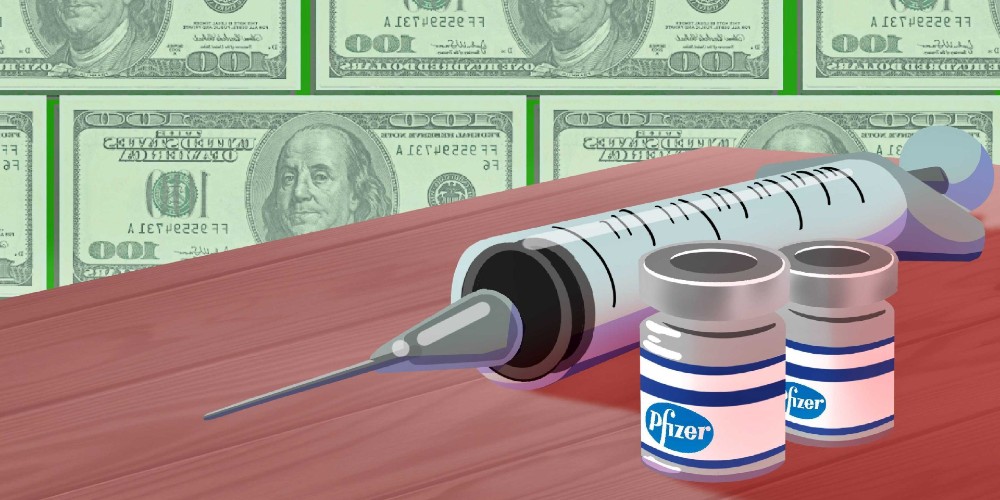
The Biden administration on Wednesday announced a $3.2 billion deal to purchase 105 million doses of Pfizer’s COVID-19 vaccine for a fall vaccination campaign, with options to buy up to 300 million doses.
The contract includes a combination of adult and pediatric doses, and supplies of a re-formulated booster shot that will contain the original Wuhan variant and BA.4 and BA.5 Omicron subvariants.
The U.S. Food and Drug Administration (FDA) on Thursday advised COVID-19 vaccine manufacturers to produce the updated booster vaccine — which has not yet undergone human clinical trials — for this fall.
“This agreement will provide additional doses for U.S. residents and help cope with the next COVID-19 wave,” Sean Marett, chief business and chief commercial officer of BioNTech, said in a statement. “Pending regulatory authorization, it will also include an Omicron-adapted vaccine, which we believe is important to address the rapidly spreading Omicron variant.”
The announcement followed Tuesday’s meeting of the FDA’s Vaccines and Related Biological Products Advisory Committee, which recommended including an Omicron component in future COVID-19 booster vaccines.
“Vaccines have been a game-changer in our fight against COVID-19, allowing people to return to normal activities knowing that vaccines protect from severe illness,” said Xavier Becerra, secretary of the U.S. Department of Health and Human Services (HHS).
“The Biden-Harris Administration is committed to doing everything we can to continue to make vaccines free and widely available to Americans — and this is an important first step to preparing us for the fall.”
However, U.S. taxpayers will fund the $3.2 billion campaign, just as they also paid $1.95 billion for the original 100 million doses obtained under Operation Warp Speed, and $19.50 per dose for 500 million more doses obtained through the government’s option contract.
“Earlier this month, in the absence of additional COVID-19 funding from Congress, the Administration was forced to reallocate $10 billion in existing funding, pulling billions of dollars from COVID-19 response efforts in order to pay for additional vaccines and treatments,” HHS said in a statement. “The funding for this new Pfizer contract is being paid for with a portion of that reallocated funding.”
“The White House has dropped all pretense that this is about protecting public health,” said Robert F. Kennedy, Jr., chairman and chief legal counsel for Children’s Health Defense. “This is an unsheathed, corporate welfare project to further enrich the shareholders of the most profitable industry in history.”
“It’s almost as if these states — and their citizens — are paying for these vaccines twice over: once to bankroll much, or nearly all, of the research itself, then again to buy back the products of this public-funded research,” Quartz reported last month. “Pharma corporations benefit hugely from this model.”
Pfizer said in May it expects about $32 billion in COVID-19 vaccine sales for 2022, but the figure was based on agreements signed before the new contract announced this week.
Pfizer on June 23 approved a quarterly cash dividend of $0.40 per share.
Under the new Pfizer deal, the U.S. government is set to pay more than $30 per dose on average, which is significantly higher than the $19.50 it paid in its initial Pfizer contract.

As early as Feb. 26, 2021, Pfizer was planning for a “potential rapid adoption” of its COVID-19 vaccine to allow for the development of booster vaccines within weeks. This “regulatory pathway” is already established for other infectious diseases, such as influenza, Pfizer said in a statement.
Pfizer CEO Albert Bourla said the company was “making the right investments and engaging in the appropriate conversations with regulators” to help position the company to “potentially develop and seek authorization for an updated mRNA vaccine or booster if needed.”
During a February 2021 earnings call, Bourla told analysts, big banks and investors the company could make significant profits as demand for its COVID-19 vaccine subsidies by charging higher prices and implementing routine booster doses for new variants of the virus.
During the Barclays’ Global Health Conference in March 2021, former Pfizer CFO Frank D’Amelio said the company doesn’t see this as a one-time event, but “as something that’s going to continue for the foreseeable future.”
“Every year, you need to go to get your flu vaccine,” Pfizer CEO Bourla said. “It’s going to be the same with COVID. In a year, you will have to go and get your annual shot for COVID to be protected.”
© 2022 Children’s Health Defense, Inc. This work is reproduced and distributed with the permission of Children’s Health Defense, Inc. Want to learn more from Children’s Health Defense? Sign up for free news and updates from Robert F. Kennedy, Jr. and the Children’s Health Defense. Your donation will help to support us in our efforts.