

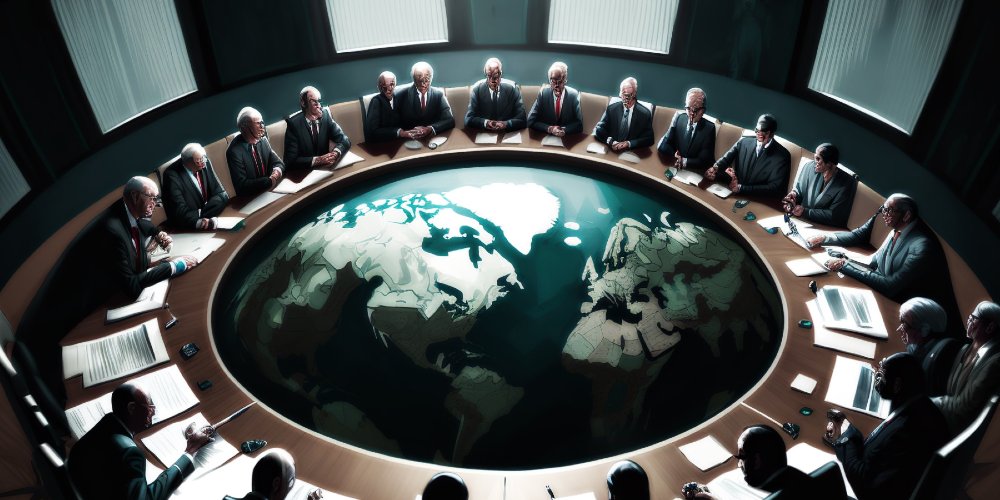
(Off-Guardian)—Global government is the endgame. We know that. Total control of every aspect of life for every single person on the planet, that’s the goal.
That’s been apparent to anyone paying attention for years, if not decades, and any tiny portion of remaining doubt was removed when Covid was rolled-out and members of the establishment started outright saying it.
Covid marked an acceleration of the globalist agenda, a mad dash to the finish line that seems to have lost momentum short of victory, but the race is still going. The goal has not changed, even if the years since may have seen the agenda retreat slightly back into the shadows.
We know what they want conceptually, but what does that mean practically? What does a potential “global government” actually look like? First off, let’s talk about what we’re NOT going to see.
1 – They are not going to declare themselves. No, there will almost certainly never be an official “world government”, at least not for a long time yet. That’s a lesson they learned from Covid — putting a name and a face on globalism only foments collective resistance to it.
2 – They’re not going to abolish nationhood. You can be sure Klaus Schwab (or whoever) isn’t ever going to appear simulcast on every television in the world announcing that we’re all citizens of ze vurld now and that nation states no longer exist.
In part because that is likely to focus resistance (see point 1), but mainly because tribalism and nationalism are just too useful to all would-be manipulators of public opinion. And, of course the continuing existence of nation states in no way precludes the existence of a supra-national control system, any more than the existence of Rhode Island, Florida or Texas precludes the existence of the Federal government.
3 – There will never be an overt declaration of a change of system. We will not be told we are united under a new model, instead the illusion of regionality & superficial variance will camouflage a lack of real choice across the political landscape. A thin polysystemic skin stretched tight over a monosystemic skeleton.
Capitalism, communism, socialism, democracy, tyranny, monarchy…these words will steadily dilute in meaning, even more than they have already, but they will never be abandoned.
What globalism will bring us – I suggest – is a collection of nation-states largely in name only, operating superficially different systems of government all built on the same underpinning assumptions and all answering to an unelected and undeclared higher authority.
…and if that sounds familiar, it’s because it’s essentially what we have already.
The only major aspects missing are the mechanisms by which this rough model can be transformed into a flowing network, where all corners are eroded and all genuine sovereign powers become entirely vestigial.
That’s where the three main pillars of global rule come in:
- Digital Money
- Digital ID
- “Climate Action”
Let’s take a look at each one in turn.

1. DIGITAL MONEY
Over 90% of the nations of the world are currently in the process of introducing a new digital currency issued by their central bank. OffG – and others – have been covering the push for a Central Bank Digital Currencies (CBDCs) for years now, to the point where we don’t need to rehash old talking points here.
Simply put, entirely digital money enables total surveillance of every transaction. If the currency is programmable, it would also allow control of every transaction. You can read our extensive back-catalogue on CBDCs for more detail.
Clearly CBDCs are a potentially dystopian nightmare which will infringe the rights of anyone forced to use them….but how are they a building block of global government? The answer to that is “interoperability”.
While the world’s national CBDCs will notionally be separate from one another, the majority are being coded to recognize and interact with each other. They are almost all being developed along guidelines produced by the Bank of International Settlements and other globalist financial institutions, and they are all being programed by the same handful of tech giants.
A June 2023 report for the World Economic Forum noted the importance of “Central Bank Digital Currency Global Interoperability Principles” and concluded:
It is crucial for central banks to prioritize interoperability considerations early in the design process by adhering to a set of guiding principles. To facilitate global coordination and ensure harmonious implementation of CBDCs, the development of a comprehensive set of principles and standards becomes imperative. Drawing upon previous research and collaborative efforts, this set of principles can serve as a robust foundation, guiding central banks to proactively consider interoperability from the outset of their CBDC initiatives. By adopting these principles, central banks can work towards creating a cohesive and interconnected CBDC ecosystem.
Commenting on the report, the World Economic Forum website noted [emphasis added]:

To ensure successful implementation and promote interoperability, global coordination becomes paramount […] adhering to interoperability principles, CBDCs can advance harmoniously, leading to efficient and interconnected digital payment systems.
It doesn’t take a genius to decode “global coordination”, “cohesive ecosystem”, “harmonious advancement” and “interconnected payment systems”.
There is no practical difference between 195 “interoperable” and interconnected digital currencies, and one single global currency.
In fact “interoperability” is the watchword for all globalist power structures moving forward. Which leads us neatly onto…
2. DIGITAL IDENTITY
The global push for mandatory digital identities is even older than the digital currency agenda, dating back to the turn of the century and Tony Blair’s “national identity cards”.
For decades it has been a “solution” posited to every “problem”.
- Terrorism? Digital identity will keep you safe.
- Illegal immigration? Digital identity will secure the border.
- Pandemic? Digital identity will keep track of who is vaccinated and who is not.
- AI? Digital identity will prove who’s human.
- Poverty? Digital identity will “promote financial inclusion”
Clearly, just as with CBDCs, a far-reaching digital identity service is a threat to human rights. And, just as with CBDCs, if you interconnect national digital identity platforms you can build a global system.
Again, it’s all about “interoperability”. They use the exact same language. The World Bank’s Identity4Development program claims:
Interoperability is crucial for developing efficient, sustainable, and useful identity ecosystems.
The Nordic and Baltic Ministers for Digitalization publicly called for “cross-border” operational digital IDs.
NGOs like Open Identity Exchange(OIX) are publishing reports on “the need for data standards to enable interoperability of Digital IDs both in federations within an ID ecosystem, and across ID ecosystems.”.
The list of national governments introducing digital IDs, “partnering” with corporate giants to do so and/or promoting “cross border interoperability” is long, and growing longer all the time.
In October 2023 the United Nations Development Program published their “guidelines” for the design and use of digital identities.
There is no practical difference between 195 networked digital identity platforms and one single global identity program.
OK, so they have global currency and identity programs in place. Now they can control and monitor everyone’s movements, financial transactions, health and more. That’s surveillance and control mechanism, all handled in a distributed model designed to obfuscate the very existence of a global government.
But what about policy? How does this global government hand down policy and legislation without giving away its existence? Climate change, that’s how.
3. “CLIMATE ACTION”
Climate Change has been at the forefront of the globalist agenda for years. It is the Trojan horse of the antihuman technocrat.
As long ago as 2010, noted Climate Change “experts” were suggesting that “humans are not evolved enough” to combat climate change and that “It may be necessary to put democracy on hold for a while.”
More recently, in 2019, Bloomberg was publishing articles with headlines like “Climate Change Will Kill National Sovereignty As We Know It”, and academics are telling us:
States will remain unable to solve global crises like climate change until they let go of their sovereignty
For years climate change has been sold as the reason we might be “forced” to abandon democracy or sovereignty.
Alongside this, there is a prolonged propaganda narrative dedicated to changing “climate change” from an environmental issue into an everything issue.
At this point all national governments agree “climate change” is an urgent problem requiring global cooperation to solve. They host massive summits at which they sign international agreements, binding nation states to certain policies, for the sake of the planet.
Having established that model, they are now widening the “climate change” purview. Changing “climate change” into the answer to every question:
Obviously, “climate change” was always going to impact energy and transport.
Following Covid, “climate change” has already been re-branded a “health crisis”. Now we’re being told “climate change” is generating a food crisis. We’re being told that international trade needs to be climate conscious. We’re being told by the World Bank that education reform will help the fight against climate change. We’re being told by the IMF that every country in the world should tax carbon and, in a recent cross-over episode, that CBDCs can be good for the environment.
See how it works?
Agriculture & food, public health, energy & transport, trade, fiscal & taxation policy, even education. Almost every area of government is now potentially covered by the “climate change” umbrella.
They no longer need a one-world government, they just need a single panel of “impartial international climate change experts” working to save the planet.
Through the lens of “climate change”, these experts would be empowered to dictate – sorry, recommend – government policy in almost every area of life to every nation on the planet.
Do you see it yet?
This is global government in the modern world, not centralised but distributed. Cloud computing. A supranational corporate-technocrat hivemind. With no official existence or authority, and therefore no accountability, and funneling all their policy decisions through one filter – climate change.
There won’t be a single global currency, there will be dozens and dozens of “interoperable” digital currencies creating an “harmonious payment ecosystem”.
There won’t be a single global digital identity service, there will be a series of “interconnected identity networks” engaging in the “free flow of data to promote security”.
There won’t be a global government, there will be international panels of “impartial experts”, appointed by the UN who make “policy recommendations”.
Most or all of the countries of the world will follow most or all of the recommendations, but anyone who calls these panels global governments will be forwarded fact-checks from Snopes or Politifact highlighting that “UN expert panels do NOT constitute a global government because they have no legislative power”.
This, I suggest, is how global government will take shape in 2024 and beyond. Compartmentalized, utterly deniable…but very, very real.

Two Storms, One Harvest

Every food crisis in living memory has been a one-shock event. The 2008 price spike was a commodity bubble. The 2020 shortages were a logistics failure. The 2022 grain scare was a war on one exporter’s ports. Each time, the system bent, adjusted, and recovered, and each time the experts assured us afterward that global markets are simply too big and too diversified to fail.
What nobody in Washington seems eager to discuss is that 2026 is shaping up to be something the modern food system has never actually faced. Two independent shocks, one climatic and one geopolitical, are converging on the same harvest cycle at the same time. Not sequentially. Simultaneously.
Start with the weather. The Pacific Ocean is currently building toward what forecasters now openly call a record event. NOAA’s Climate Prediction Center puts the odds of at least a strong El Niño near 88 percent, with roughly two in three odds it reaches “very strong” status, the tier reserved for perhaps three or four events in the entire satellite era. Every major global model now projects a median peak in Super El Niño territory, and most of them project it exceeding the 2015-16 event, which until now held the modern record. Sea surface anomalies were already brushing the super threshold in mid-July, months before these events normally peak. The atmosphere has already shifted into El Niño mode, and the event is forecast to crest in late fall and early winter.
This is not about “climate change.” It’s about the standard cycles of weather, and the cycle we’re currently in is one that has likely devastated societies in the past. We’re better prepared as a society today, but not all Americans are equally prepared.
Serious households have started doing the quiet math on their own. Grocery bills tell part of the story, and the forecast maps tell the rest, which is why long-term food storage has moved from fringe hobby to mainstream line item in the family budget, with established suppliers like Heaven’s Harvest seeing demand from people who five years ago would have rolled their eyes at the idea. That instinct is not paranoia. It is pattern recognition, and the pattern is worth walking through carefully.
Editor’s Note: Heaven’s Harvest IS a sponsor, but the warnings of this article are real and would be written even if we didn’t have a survival food sponsor. With that said, those who take advantage of what they offer can use promo code “Patriot” for 15% off.
The Fertilizer Clock Is Already Running
While the Pacific warms, the second shock has been unfolding in the Strait of Hormuz. The conflict with Iran turned the world’s most important energy chokepoint into a contested waterway, and the consequences reach far beyond the gas pump. Roughly a third of global fertilizer trade moves through Hormuz, and the disruption sent urea prices up 86 percent year over year by March, with a 53 percent jump in a single month.
The World Bank projects energy prices rising about 24 percent in 2026 and fertilizer about 31 percent. By its own accounting, fertilizer prices ran 35 percent higher in the first five months of this year than the same period last year.
Here is the mechanism the nightly news will not explain. Fertilizer is not a grocery item. It is a time-delayed input. The nitrogen a farmer in Iowa or Punjab could not afford to apply this spring does not show up as a problem this spring. It shows up as a thinner harvest six to twelve months later.
The World Bank’s own food security brief concedes that the effects of reduced applications earlier this season “are likely to become visible only later in harvest outcomes.” Translate that from institutional language into plain English and it means this. The damage is already done, it is already in the ground, and we are simply waiting for it to arrive on the shelf.
Now check the calendar. Six to twelve months from the spring planting season lands us squarely in late 2026 and early 2027. Which is precisely when the strongest El Niño in the instrumental record is forecast to peak, bringing its signature droughts to Southeast Asia, Australia, southern Africa, northern Brazil, and South Asia, the very regions that grow the world’s rice, sugar, and oilseeds.
The World Bank warns openly that a strong El Niño “could disrupt multiple crop belts simultaneously” on top of the conflict-driven input costs. Their baseline projection assumes the Middle East disruptions ease by autumn. What in the last two years of Middle East history suggests that assumption is safe?
The System Has No Slack Left
The comfortable answer is that global markets always adjust. But adjustment requires slack, and the slack is gone. Global cereal production is expected to decline from last year’s records even before El Niño does its work. The UN World Food Programme, hardly a den of right-wing preppers, is calling this the most significant disruption to its supply chains since Covid and the invasion of Ukraine, and its supply chain director put the stakes bluntly.
Today’s supply chain challenges are tomorrow’s hunger crisis.
There is also a political dimension that markets cannot price. When food gets scarce, governments do not behave like economists. They behave like politicians. Export bans, hoarding mandates, and panic buying at the national level turned the modest rice shortfall of 2008 into a global crisis, and analysts are already warning that import-dependent nations are the first dominoes.
The 2015-16 Super El Niño, a far weaker event than what is now forecast, threw tens of millions into food stress across Africa and Asia. This one is projected to be stronger, and it arrives with fertilizer already rationed by price and shipping lanes already contested by missiles.
What Joseph Knew
Scripture does not treat preparation for lean years as faithlessness. It treats it as wisdom delivered in advance to those willing to act on it.
Behold, there come seven years of great plenty throughout all the land of Egypt: And there shall arise after them seven years of famine; and all the plenty shall be forgotten in the land of Egypt.
Joseph did not respond to that warning with a hashtag or a committee. He stored grain during the years of abundance, and when the famine came, Egypt stood while its neighbors begged. The lesson is not that famine is certain. It is that the time to prepare is precisely when preparation still looks optional.
Nobody who filled a pantry in a year of plenty has ever regretted it, and nobody standing in an empty aisle has ever been glad he waited for certainty.
None of this calls for panic, and panic is the enemy of sound judgment anyway. It calls for the same unglamorous prudence our grandparents considered ordinary. Keep some cash margin, know your local growers, and put real food in deep storage while it is cheap and available, because the entire arc of this story is that cheap and available is a closing window.
Families looking for a straightforward place to start can visit Heaven’s Harvest and use promo code Patriot for 15 percent off long-term storable food. The forecasts may yet soften, the strait may yet reopen, and we should pray they do. But hope is a fine thing to hold and a foolish thing to eat.

Outstanding essay/article and we can depend on the likes of Brownstone Institute, Heritage and Manhattan Institute reporting on this — around about 2035?!
Don’t try that in a small town.
Ok, so when is the blood of members of the ANTI-DEMOCRATIC PARTY going to flow like rivers and streams? Today or tomorrow morning?
Hmmmmm . . .
https : //www DOT cryptogon DOT com/?p=68622
Half of the countries of this world have presidential elections this year. The globalist minions will lose bigly. There are way more of ‘us’ than there are of ‘them’.