

(End of the American Dream)—I just had to write about this. Earlier today, as I was going through the news I noticed that Steve Quayle and other prominent voices had featured some really odd things that had happened on Sunday. Personally, I don’t think that it was a coincidence that so many unusual events took place on the exact day that we celebrated the 250th birthday of America. Perhaps you disagree with me, and that is okay. I don’t know anyone that agree with me 100 percent of the time. But I think that most of you will agree that this was certainly not a normal Independence Day.
Since the news cycle was really slow going into the holiday, I didn’t expect that much would happen.
But I was wrong.
The following are 10 very strange things that occurred on the 4th of July this year…
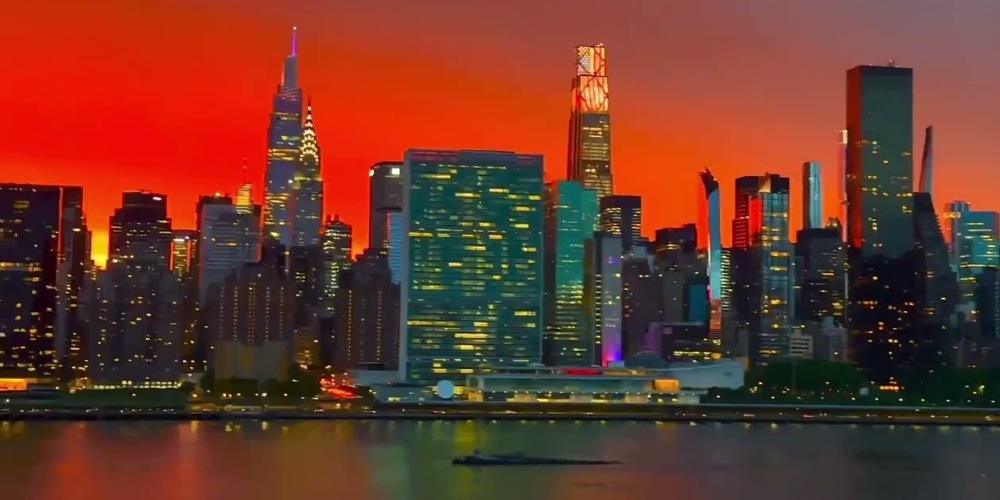
#1 In the middle of the Independence Day celebrations in New York, the skies above the city suddenly turned blood red…
A dramatic red glow illuminated the New York City sky during the 250th anniversary celebrations, leaving spectators amazed and sparking widespread discussion online. While many described the scene as eerie or symbolic, there is no verified evidence linking the unusual sky color to any supernatural event or “bad omen.”
At first I had a difficult time believing that this was true.
So I asked Google, and I was assured that this actually happened. Apparently the blood red color was caused by the fireworks display…
The dramatic red, or “blood-red,” sky was a result of the intense 50th annual Macy’s fireworks display, which involved approximately 85,000 shells launching over the city.
Some social media users captured video footage of this phenomenon, and it was certainly very creepy…
Seeing the blood red sky instantly reminded me of the fact that abortion was legalized in New York on April 11th, 1970.
Since that time, more than 67 million American babies have been aborted.
And starting on July 5th, Planned Parenthood “will regain access to hundreds of millions in Medicaid funding”…
Planned Parenthood’s beleaguered network of clinics will regain access to hundreds of millions in Medicaid funding this weekend — the fallout of Republicans’ failure to pass an extension of the one-year defunding provision they approved last year.
Starting July 5, clinics around the country can once again bill the federal program for reimbursement after providing non-abortion services, like birth control and screenings for sexually-transmitted infections, to low-income patients. Though other funding threats loom, it’s a lifeline for the struggling organization, which has closed nearly 30 health centers nationwide that collectively served more than 40,000 patients since the defunding provision in the GOP’s One Big Beautiful Bill Act took effect in July 2025.
#2 The fireworks in New York City also caused the Brooklyn Bridge to catch on fire…
Brooklyn Bridge erupted in flames during the Macy’s July 4 fireworks extravaganza on Saturday.
Video posted online showed a flume of smoke billowing into the sky from a ball of fire on the span over the East River as fireworks burst around it.
A spokesperson for the New York Police Department told The New York Times it received a call about a fire on the bridge at 9.32pm, just about half an hour after the fireworks show started.
This was not a small fire.
In fact, the fire got so large that at one point some onlookers were concerned that the entire bridge could potentially burn down…
The Brooklyn Bridge is one of the most famous bridges in the entire country, and so I think that it was quite noteworthy that it “erupted in flames” on America’s 250th birthday.
#3 On top of everything else, one photographer actually captured a rainbow, a bolt of lightning and the Statue of Liberty in a single photo…
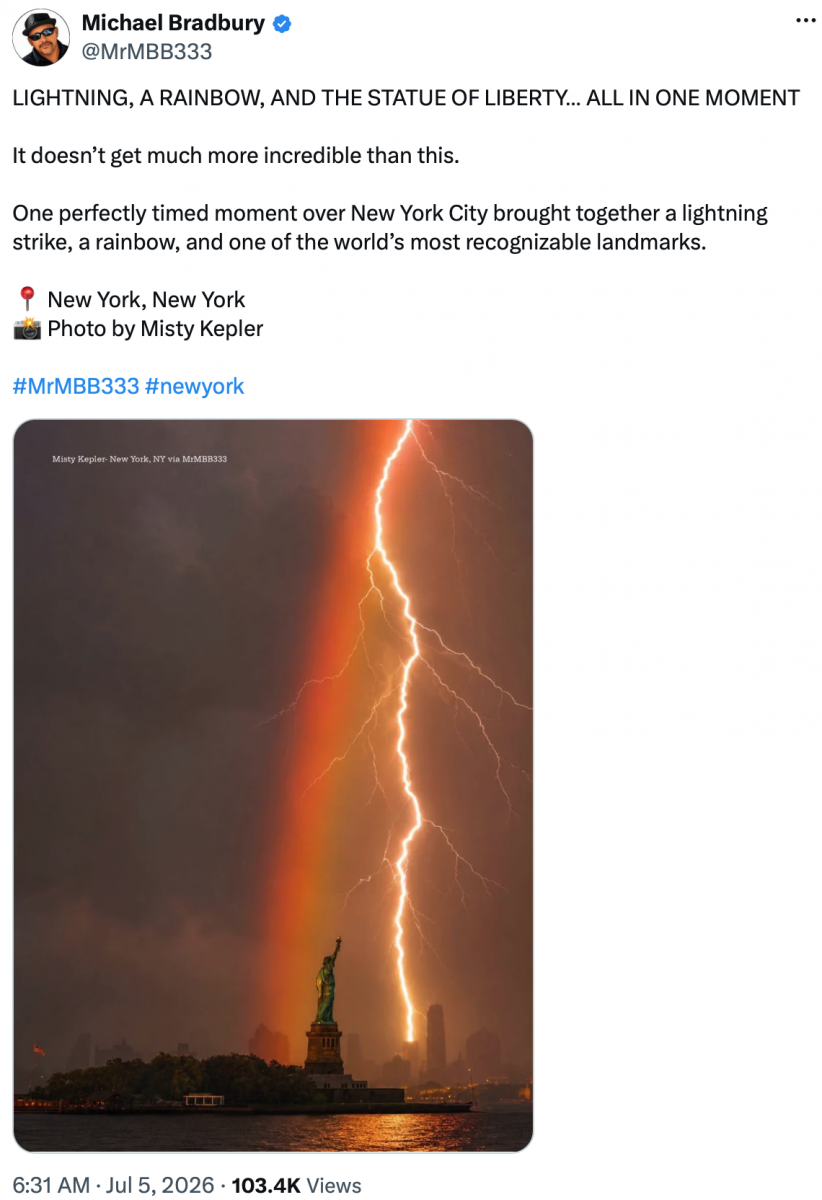
I have never seen anything quite like that.
But we didn’t just see unusual weather in the Big Apple.
#4 A “mega heat dome” baked the eastern half of the nation on the 4th, and a series of massive thunderstorms ripped through the Midwest…
Deadly storms and a heat wave marred America’s 250th birthday for swathes of the United States, leaving hundreds of thousands of utility customers without power.
Millions of Americans across the Northeast experienced record-setting temperatures — thunderstorms in the Midwest downed trees, ruptured power lines and made transportation treacherous and complicated across multiple states.
As a result of the bad weather, Independence Day celebrations had to be either canceled or moved up in a number of cities…

Weather prompted cancellations of celebrations in Hartford, Connecticut, as well as Harrisburg and Wilkes-Barre, Pennsylvania. In Boston, spectators at the city’s fireworks and concert event were told to briefly seek shelter, before events later resumed. An evacuation was ordered in Philadelphia, in addition to Washington. D.C., and, like the capital, New York and Pittsburgh moved forward with their fireworks shows but shifted the originally scheduled times to accomodate the weather.
#5 In Washington D.C., extremely stormy weather greatly disrupted the Freedom 250 Fourth of July celebration, and the president’s address was delayed for approximately 2 hours…
Weather also forced temporary evacuations of thousands of people Saturday evening at the National Mall in Washington, D.C., which hosted the Freedom 250 Fourth of July celebrations. Signs at the Great American State Fair posted an alert shortly after 7 p.m. ET, encouraging participants to leave the area and prompting crowds to gather in museums, subway stations and federal buildings near the Mall. Some waited in chairs and sat on the floor of the Ronald Reagan Building and International Trade Center, seeking to cool off in the air conditioning.
The president had been initially scheduled to deliver remarks at 9:45 p.m. Eastern Time, Freedom 250 organizers said, but the speech was ultimately delayed by about two hours.
Once again, this was no normal storm.
One reporter actually described the lightning in D.C. as “apocalyptic”…
Not even apocalyptic lightning bolts, which caused a four-hour delay, could stop Trump from putting his personal stamp on history.
Once the lightning finally subsided, the celebration was able to continue.
Personally, I think that it is interesting to note that a total of 85,000 fireworks were fired off in New York City and a total of 850,000 fireworks were fired off in Washington…
The massive celebration was capped off by a huge fireworks show, with 850,000 fireworks launched. That marked the largest in US history, according to Reuters.
Trump commented on the display about half an hour past midnight on Truth Social, writing, ‘Best fireworks show, EVER!’
While the event was postponed, Trump posted shortly after 9pm: ‘Storms bring luck to whatever the occasion. They also make events a little bit more exciting! We will wait it out, I don’t care if it’s 2:00 O’Clock in the morning, or in one hour from now.
‘It’s Saturday night, LETS HAVE SOME FUN, even if we are out late tonight. They say 11:00 O’Clock for the speech. Who cares???’ he added.
#6 In Southern California, an absolutely shocking accident following a game between “Angel City” and “the Orlando Pride” resulted in fireworks being fired directly “into the stands at the BMO Stadium in Los Angeles”…
A Fourth of July weekend celebration turned into a fiery nightmare when fireworks went screaming into the stands at the BMO Stadium in Los Angeles — sending panicked fans scrambling for cover.
Just minutes after Angel City defeated the Orlando Pride 2-0, the club’s Independence Day weekend pyrotechnics display reportedly went haywire.
Instead of launching into the sky, multiple mortars allegedly fired sideways across the field and toward packed seating sections.
“The end is actually the worst. I saw several flames go into the crowd. It was terrifying!” one shaken Reddit user wrote.
#7 In Chicago, a Delta flight was actually hit by fireworks on Sunday evening…
A Delta Air Lines aircraft was struck by a firework while landing at Chicago Midway International Airport on July 4, according to the airline and air traffic control audio shared online.
A spokesperson for Delta told Newsweek the aircraft landed safely and there was no emergency landing. The airline said the plane was taken out of normal operations for inspection after arriving at the gate. Initial reports did not indicate any injuries among passengers or crew.
#8 In the town of Broken Arrow, Oklahoma we witnessed a historic fireworks accident. A huge fire that consumed a fireworks stand caused “a chain reaction of explosions that lit up the night sky for miles”…
A fire engulfed a fireworks stand in Broken Arrow, Oklahoma, on June 20, 2026, causing a massive, unplanned display. The blaze triggered a chain reaction of explosions that lit up the night sky for miles.
As many of you already know, a “broken arrow” is military code for a nuclear accident.
#9 Needless to say, there was quite a bit of violence in our major cities on the 4th. In just one incident in New York City, there were at least 8 different shooting victims…
At least eight people, including four children, were shot late Saturday night in the Coney Island neighborhood of Brooklyn, leaving one person in critical condition, the New York Police Department said, according to ABC News.
Officers responded to reports of multiple people shot at approximately 10:37 p.m. on the 2900 block of West 31st Street, near the Seapark Apartments, the NYPD said. The shooting occurred roughly an hour after a fireworks display in the area marking the country’s 250th anniversary.
The victims ranged in age from 6 to 37. “All victims were transported by EMS to local area hospitals where seven people were listed in stable condition,” the NYPD said. A 21-year-old woman remains in critical condition after being shot in the chest, CBS News reported.
#10 The violence on the west coast was even worse. In Southern California, police on horseback were deployed to deal with a vast crowd of rioters and looters…
Fourth of July descended into mayhem across parts of Southern California as unruly crowds overwhelmed packed-out fireworks displays, looted stores, ignited fires and saw cops charge on horseback.
The worst unrest erupted in Newport Beach, where Independence Day revelers poured into Orange County, choking traffic and triggering a police response as disorder spread near the pier.
Authorities ultimately shut down businesses from the Newport Pier to Pacific Coast Highway as officers moved in to restore order.
These days, it seems like some people are eager to use any major celebration as an excuse to cause mayhem.
At one point during the chaos in Newport Beach, people in the crowd started lighting fireworks and throwing them at the cops…
A Fourth of July celebration in Newport Beach turned chaotic Saturday night, leaving several police officers injured and resulting in at least 100 arrests, authorities said.
Police were first called to the area around 7 p.m. after a large crowd began lighting fireworks and fighting, according to authorities. Officials also reported a significant mess at a nearby Pavilions grocery store.
The situation escalated after officers arrived at the scene. Authorities said people continued fighting and threw fireworks at police officers.
Of course this is just a preview of things to come.
Civil unrest is going to be a major theme during the months that are ahead of us.
It is my opinion that we have reached a major societal turning point.
We have had it so good for so long, but now crisis after crisis is erupting all around us.
So I hope that you enjoyed the 4th of July celebrations this year, because I am convinced that things will look far different by this time next year.
Michael’s new book entitled “10 Prophetic Events That Are Coming Next” is available in paperback and for the Kindle on Amazon.com, and you can subscribe to his Substack newsletter at michaeltsnyder.substack.com.
Starting the Day With a Scripture-Inspired Roast Helps Center Your Thoughts on Eternal Truths Amid Temporal Pressures
The world can seem chaotic, especially right after we wake up. Many believers start their mornings reaching for something familiar — a hot cup of coffee — yet end up settling for mediocre brews that do little more than deliver a caffeine jolt. The daily grind of life, with its endless distractions, news cycles, and responsibilities, can leave even the most faithful feeling spiritually parched alongside their physical fatigue. What if your morning ritual could do more than wake you up? What if it could ground you in truth, nourish your body with exceptional quality, and quietly advance a kingdom purpose at the same time?
That’s the promise — and the reality — behind Promised Grounds Coffee. This Christian-founded company doesn’t just roast beans; it approaches every step as an act of worship and discipleship. By selecting only the top 10% of specialty-grade beans, ethically sourced from dedicated farmers in Central and South America, and small-batch roasting them with reverence in Austin, Texas, Promised Grounds delivers what many describe as the best coffee available — never burnt, never bland, but rich with origin stories and layered flavors that honor God’s creation.
From the vibrant Psalm 27 Roast (a light, bright medium option) to the bold yet peaceful 2 Timothy 1:7 Decaf, each bag carries a Scripture verse that turns your daily pour into a gentle reminder of faith. And through their Ounce Per Ounce Promise, every ounce of coffee you enjoy provides an equal ounce of clean water to families in need via partnership with Filter of Hope — literally brewing hope for body and soul, one cup at a time.
The challenge for today’s Christians runs deeper than finding a decent cup. In an age of convenience-driven consumerism, it’s easy to support companies that dilute values or remain silent on matters of faith. Many believers want their everyday choices — from what they drink to how they spend — to reflect discipleship rather than just convenience. Promised Grounds solves this by weaving Christian excellence into the entire process: beans nurtured with prayerful stewardship by farming families, roasted as an offering rather than a commodity, and packaged with Bible verses to encourage a mindset of gratitude and purpose from the first sip. Reviewers consistently praise the smooth, rich profiles — whether enjoyed black in a drip maker, iced on a warm day, or shared in fellowship — noting how the quality stands toe-to-toe with premium secular brands while delivering something far more meaningful.
This integration of faith and flavor addresses a real need in Christian households and ministries. Busy parents, church leaders, and remote workers alike report that starting the day with a Scripture-inspired roast helps center their thoughts on eternal truths amid temporal pressures. The coffee’s exceptional character — bright citrus notes in lighter roasts or deep chocolate undertones in bolder ones — comes from meticulous selection and careful roasting that respects the bean’s natural gifts rather than masking them. It’s the kind of coffee that elevates a simple quiet time, fuels productive workdays, or sparks meaningful conversations when shared at Bible studies or outreach events. And because it’s ethically sourced with integrity, every purchase supports sustainable livelihoods for farmers who treat their crops like family harvests.
For those leading churches or small groups, the impact multiplies. Promised Grounds offers bundles and options perfect for hospitality ministries, turning ordinary coffee service into an opportunity to point people toward the living water of Christ. Imagine greeting visitors with a warm cup whose very bag carries God’s Word — a subtle yet powerful witness that aligns with the Great Commission. The company’s Texas roots and commitment to “brewing hope” resonate especially with believers who value American enterprise paired with global compassion.
Of course, quality alone isn’t enough if the experience feels out of reach. Promised Grounds keeps it accessible with practical perks like free shipping on orders over $40, sample sets for discovering favorites, and thoughtful add-ons such as faith-themed mugs. Whether you prefer whole beans for fresh grinding, grounds for convenience, or even bulk options for larger households and ministries, the result is consistently superior coffee that makes discipleship feel integrated rather than added on.
As you consider how to align even the smallest habits with your walk with God, Promised Grounds Coffee stands out as a refreshing solution. It tackles the dual problems of subpar daily sustenance and disconnected consumption by offering a product that genuinely excels in taste while advancing a mission of clean water, farmer dignity, and scriptural encouragement. Believers who make the switch often describe it as more than a beverage upgrade — it becomes part of their rhythm of gratitude, a daily invitation to remember that every good gift comes from above.
If you’re ready to transform your mornings (and perhaps your church gatherings) with coffee that honors both exceptional craftsmanship and Christian values, I encourage you to explore what Promised Grounds has to offer. One sip at a time, you’ll be nourishing your body, refreshing your spirit, and participating in something far greater — all while enjoying what truly is among the best coffee available.
