

Discern Report
SUBSCRIBE
  • Home
  • News
  • Opinions
  • Videos
  • About Us
    • Contact
No Result
View All Result
Discern Report
  • Home
  • News
  • Opinions
  • Videos
  • About Us
    • Contact
No Result
View All Result
Discern Report
No Result
View All Result
Debt

$1 Trillion per 100 Days: Is This the Year the Debt Bubble Explodes?

by Peter Schiff
March 9, 2024
in Curated, Opinions
  • How This Breakthrough One-Shot Boost For Relieving Pain, Anxiety, And Depression Helped Me

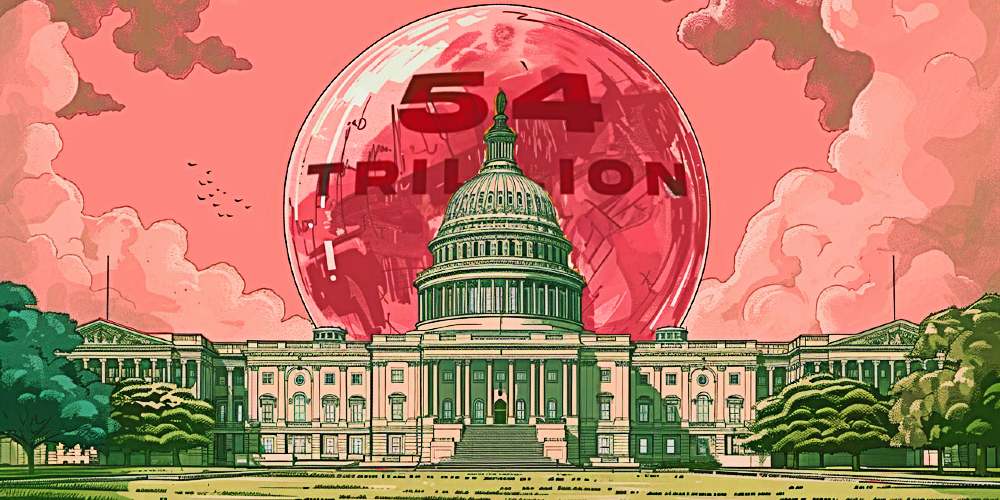
(Schiff Gold)—With a stunning trillion dollars added to the national debt in only three months, projected to reach an incomprehensible $54 trillion within 10 years, and America’s interest payments on track to exceed defense spending next year, the question must be asked: How much longer can the debt bubble go?

It’s a curious situation when Jerome Powell, a man who oversaw the largest money-printing campaign in American history, is saying that the debt is unsustainable. While maintaining that the Fed “tries hard not to comment on fiscal policy,” Powell’s suggestion for handling the debt shifts blame and burden from money printing to fiscal irresponsibility on the part of policymakers.

While they have their part to play, and it’s a big one, it’s interesting to see that Federal Reserve monetary policy hasn’t been mentioned in any of Powell’s ‘urgent’ warnings about ballooning debt:

“In the long run, the U.S. is on an unsustainable fiscal path. The U.S. federal government’s on an unsustainable fiscal path. And that just means that the debt is growing faster than the economy. So, it is unsustainable. I don’t think that’s at all controversial. And I think we know that we have to get back on a sustainable fiscal path.”

It’s a wonder how, even if the government suddenly adopted responsible spending and budgeting, we would be back on a path of true sustainability after Powell oversaw the printing of over 3 trillion dollars in 2020 alone. The Fed is an interesting source of criticism for unsustainable debt, to say the least:
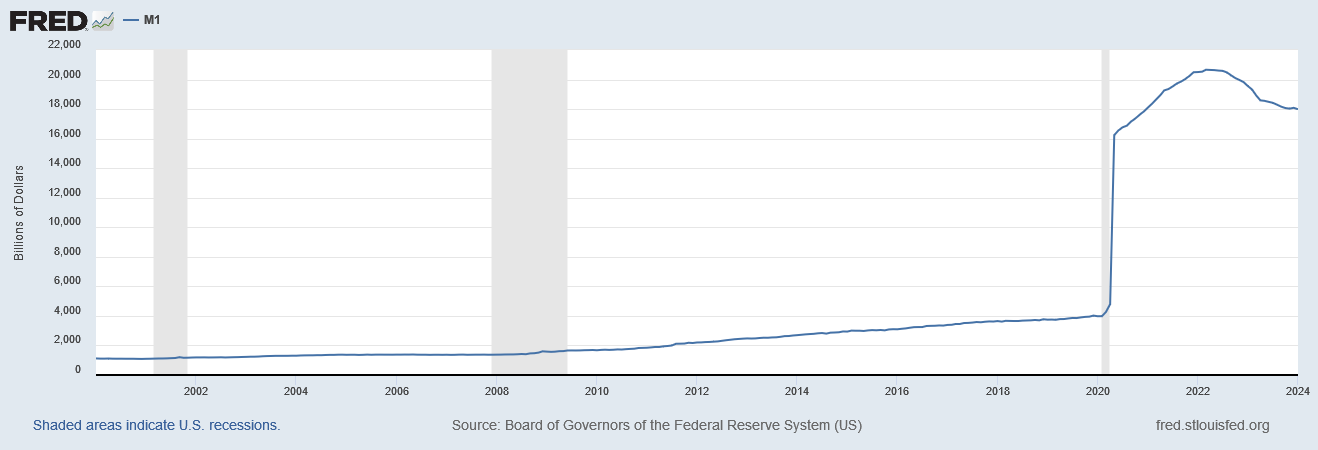
Source: Board of Governors of the Federal Reserve System (US), M1 [M1SL], retrieved from FRED, Federal Reserve Bank of St. Louis; March 6, 2024.
But as usual, the Fed only has one real tool in its toolbox: tinkering with interest rates directly to stimulate or disincentivize borrowing, or indirectly by firing up the money printer. Rate cuts expected later this year will reduce the burden of interest payments on debt growth, but simultaneously will flood the economy with newly-created money. People, already over-indebted and using credit cards for basic needs, will take advantage of a lower cost of borrowing and sign up for more loans for expenses and goods that they can’t really afford.

More loans and more deposits will increase M1 in an already-frothy inflationary environment, adding pressure to a pot that’s already in danger of boiling over from money printing during Covid. Post-COVID rate hikes have not even come close to reversing this course, with interest still far lower than it would be in an actual free market, where a few dozen bureaucrats would no longer be pulling the levers. Excessive borrowing makes US Treasurys less attractive as doubts begin to mount that the US will be able to pay its obligations back, decreasing demand for our debt and fueling further challenges for funding the government.

You may have noticed some conservative sites and shows have dropped MyPillow as a sponsor. They’re getting more money from others so they cast Mike Lindell aside. We will NOT stop supporting MyPillow or MyStore. Please use promo code “JDR” to support them AND us.

All of this led Fitch and Moody’s to downgrade the US’s credit rating last year, from “AAA” to “AA+” in the case of Fitch, and for Moody’s, from “stable” to “negative.” Fed interest rate hikes without an accompanying plan to reduce spending or increase revenue leave no hope at all for meaningfully reducing fiscal deficits.

From this new sense of urgency, lawmakers in Idaho and Wyoming have called for a convention of states to address the problem, with Idaho’s resolutions calling for a possible constitutional amendment limiting the spending abilities and overall power of the federal government. Idaho’s Senate Concurrent Resolution 112, or SCR 112, calls for, in its words:

“(1) imposing fiscal restraints on the federal government; (2) limiting the power and jurisdiction of the federal government; and (3) limiting the terms in office for its officials and for members of Congress. Currently, identical applications have been sent to Congress by other state legislatures.”

The question remains if anything, at this point, would be enough to get the US back on a genuinely sustainable economic track other than an outright collapse of the US dollar leading to a total monetary reset. As long as the Fed exists, the likelihood of truly reigning in out-of-control debt is nothing but a pipe dream.

With recent new all-time highs for gold and bitcoin in response to the debasement of the debt and central banks locked in a buying spree that is likely to last years, the message is clear that the banking system agrees with Peter Schiff that inflation is far from over.




Why the National Debt Is the Looming Threat to Your Retirement Plans

40T Debt

The Hidden Crisis No One Is Talking About

Every day, headlines warn about inflation, market volatility, and global instability—but the greatest looming threat to your retirement might be something far more fundamental: America’s skyrocketing national debt.

You can learn more about how the national debt affects you by reading this 3-minute report titled, “Debt Will Hit $40T in 2026: Prepare Your Retirement Now“.

With debt growing faster than most Americans can possibly fathom, the government’s borrowing habits have reached historic—and dangerous—levels. To cover spending, Washington is making moves with their budget packages, tariffs, and taxes. Is it enough? No. It’s not even close to what would be necessary to stop out-of-control debt, let alone reverse it.

How Debt Erodes Your Nest Egg

There are only so many levers government and the Federal Reserve can pull to try to protect Americans, assuming that’s even a top priority for them. Unfortunately, pulling one level to relive one pressure invariably adds pressure from another direction. This is why prices keep going up even as inflation reportedly slows.

For retirees and pre-retirees, that’s a perfect storm. The dollars you’ve worked hard to save lose value, and your cost of living increases while your investments lag behind.

If you’re relying solely on paper-based assets—stocks, bonds, or mutual funds—you’re essentially tied to the same system that’s creating the problem. It’s a system that was designed to work well in the 20th century, not in today’s world with people living longer and the dollar rapidly losing value.

This is why the 3-minute report, “Debt Will Hit $40T in 2026: Prepare Your Retirement Now,” is so important.

The Precious Metals Hedge

Thousands of Americans are looking for a tangible, time-tested hedge: physical gold and silver.

Unlike paper assets, precious metals aren’t dependent on government policy or the stock market’s mood swings. They’re real, finite resources that have maintained value for thousands of years through wars, recessions, and inflationary periods.

In fact, during times of high inflation and fiscal instability, gold often performs its best—because it’s seen as a store of value when faith in the dollar weakens. This is why prices have skyrocketed this year and are expected by many economists to continue going up in the future.

Take Control with a Gold IRA

One of the most effective ways to protect your retirement from national debt fallout is through a self-directed Gold IRA. This IRS-approved account lets you hold physical gold and silver within your retirement portfolio, giving you:

  • Direct ownership of your assets
  • A hedge against inflation and dollar decline
  • The control to diversify beyond Wall Street

Augusta Precious Metals specializes in helping Americans just like you take this step with confidence. The company has earned a strong reputation for transparency, education, and personalized service—making it one of the most trusted names in the industry.

The Next Step: Secure Your Financial Future

Augusta Precious Metals has helped thousands of Americans with at least $50,000 to invest from their IRAs, 401(K)s, TSPs, and other retirement accounts safeguard their savings through precious metals.

If you’re concerned about what the rising national debt could mean for your future, now is the time to act.

Read this 3-minute report titled, “Debt Will Hit $40T in 2026: Prepare Your Retirement Now“ and learn the simple steps you can take to protect your retirement.

Tags: Debt CrisisLedeSchiff GoldTop Story
Next Post
Financial Crisis

Trump and Mnuchin Can't Bail Out Every Failing Bank, So Protect Your Retirement Yourself

Leave a Reply Cancel reply

Your email address will not be published. Required fields are marked *

  • About Us
  • America First Newsletter
  • Contact
  • Home
  • Integrating With Augusta Precious Metals
  • Newsletter
  • Privacy Policy
Site Operated By JD Rucker.

© 2023 America First Report.

No Result
View All Result
  • Home
  • Original
  • Curated
  • Aggregated
  • News
  • Opinions
  • Videos
  • Podcasts
  • About Us
  • Contact
  • Privacy Policy

© 2023 America First Report.

Are you sure want to unlock this post?
Unlock left : 0
Are you sure want to cancel subscription?