

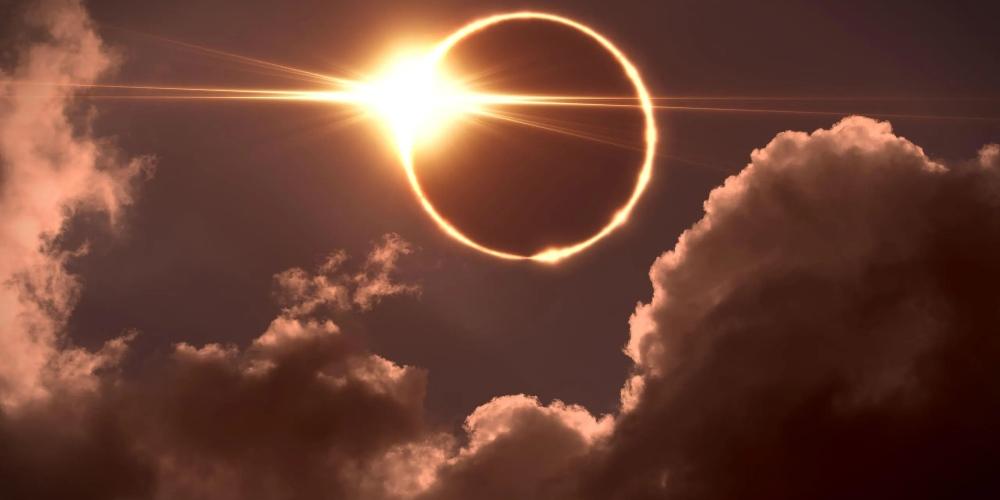
(The Economic Collapse Report)—This week, we will witness a convergence of celestial events that is truly extraordinary. On August 12th, we will be able to see a parade of 6 planets in the sky, a total solar eclipse and the peak of the Perseid meteor shower all on the same day. I was curious, and so I asked Google if this had ever happened before and I was told that these three events “have never all occurred on the same day in recorded modern astronomical history”. I was also told that the probability of all three events taking place on the same day is “roughly 1 in several hundred million”.
Could it be possible that God is using the heavens to try to get our attention? If so, could it be possible that incredibly significant events are about to happen?
I wrote about this extremely unusual convergence of celestial events last month, but now that the day is approaching I just had to write about it again.
In Luke chapter 21, Jesus specifically instructed us to watch for “signs in the sun, and in the moon, and in the stars” in the days just prior to His return.
August 12th will probably be the most spectacular day for heavenly events since the Great American Eclipse of April 8th, 2024.
Needless to say, all sorts of historic events have occurred since that total solar eclipse.
Now another total solar eclipse is coming, along with a parade of 6 planets and the peak of the Perseid meteor shower…
The sky is about to put on an incredible show through August, as celestial events occur throughout the month. But one day in particular will offer the ultimate stargazing experience.
On Wednesday, Aug. 12, there will be a planetary alignment early in the morning, a solar eclipse in the afternoon, a new moon at night and the Perseid meteor shower will reach its peak.
We have never seen this happen before, and we will never see it again.
The planetary parade will include all of the planets in our solar system except for Venus…
A six-planet parade begins in the pre-dawn hours on Tuesday, and continues for several nights afterward, according to The Planetary Society.
This planet parade will include Jupiter, Mercury, Mars, Uranus, Saturn and Neptune.
For those wanting to see this six-planet spectacle, you’ll likely only be able to see four planets without any aid: Jupiter, Mercury, Mars and Saturn.
To catch Uranus, binoculars will be necessary and to witness Neptune, you’ll need a telescope.
Of course that parade of planets is not the main event.
The main event on August 12th will be the total solar eclipse…
Millions of people across Europe and North America will witness a solar eclipse on Wednesday, Aug. 12, but the event will vary greatly depending on the location. A narrow corridor stretching from Greenland to northeastern Spain will experience a total solar eclipse, much of Europe will enjoy a deep partial eclipse, and parts of North America will see a smaller partial eclipse.
A partial solar eclipse will be visible in 26 U.S. states.
If you live in an area of the country that will get a partial solar eclipse, it will “look like a cookie with a small bite taken out of it”…
The Aug. 12 total solar eclipse will only be visible from Greenland, Iceland, Spain, Russia and parts of Portugal. Residents in some U.S. states will be able to see a partial eclipse using specialized eclipse glasses.
In the U.S., the sun will look like a cookie with a small bite taken out of it, according to NASA.
Following the total solar eclipse, everyone will be able to enjoy the peak of the Perseid meteor shower.

NASA says that it will be the “best meteor shower of the year”…
The “best meteor shower of the year,” according to NASA, is about to begin.
The Perseids meteor shower, which can produce up to 50 to 100 shooting stars an hour, will be active from July 17 to Aug. 24, according to the American Meteor Society (AMS).
This year, the shower will peak around the same time as a total solar eclipse on Aug. 12, according to USA TODAY’s previous reporting.
This is our only chance to enjoy all three of these things on a single day, because such a convergence will never happen again in any of our lifetimes.
I asked Google about this, and I was told that the mathematical odds of all three events occurring on the exact same day “are roughly 1 in several hundred million”…
The mathematical odds of a total solar eclipse, a six-planet parade, and the peak of the Perseid meteor shower falling on the exact same calendar day are roughly 1 in several hundred million, making it an exceptionally rare, “once-in-a-generation” cosmic coincidence.
Of course this strange confluence of events in the heavens will be occurring at the same time when war, famine, pestilence and natural disasters are breaking out all over the planet.
Over the weekend, the historic wildfires in western North America got even worse.
In fact, over 20,000 people in western Canada were just evacuated from their homes…

A large wildfire is growing rapidly in western Canada, threatening towns in British Columbia. More than 20,000 people have been ordered to evacuate their homes.
The entire town of Summerland, with a population of 12,000, is covered by the evacuation order. In addition, another 8,000 residents in nearby Peachland have been ordered to evacuate.
The fire has destroyed houses as it spreads, but it is unclear how many.
I have previously written about how this is a record year for wildfires in Oregon, and it turns out that Utah is setting records too…
A fire in central Utah has burned more than 114,000 acres as of Saturday afternoon, becoming the state’s largest wildfire this year. Speaking at a fire briefing earlier this week, Utah Governor Spencer Cox noted that the blaze is the third to reach roughly 100,000 acres this year, “which is not a record that we’re proud of, but we’re grateful for all of the work that’s happening here.”
Meanwhile, it appears that the Middle East could be about to erupt in flames for a different reason.
The Iranians continue to block the Strait of Hormuz, and they keep telling us that they will never end their nuclear program.
There are signs that the U.S. may not be willing to continue military action, and so Israel is very strongly considering going it alone…
Israel is preparing for the possibility of carrying out unilateral military strikes against Iran if the United States reaches an agreement with Tehran and moves to end the ongoing war, Israeli media reported Saturday.
According to Israel’s Channel 13, the Israeli military is continuing to prepare for potential independent operations against Iran, keeping the option open even if Washington decides to step back from direct military action.
If Israel conducts airstrikes in Iran, the Iranians will respond with fury.
Ballistic missiles will come raining down on Israeli cities, and that would cause the Israelis to strike back really hard.
In such a scenario, the risk of going all the way up the escalation ladder would be extremely high.
And it just so happens that at this exact moment in history we are witnessing an amazing convergence of heavenly events that has never happened before and will never happen again.
Michael’s new book entitled “10 Prophetic Events That Are Coming Next” is available in paperback and for the Kindle on Amazon.com, and you can subscribe to his Substack newsletter at michaeltsnyder.substack.com.

Starting the Day With a Scripture-Inspired Roast Helps Center Your Thoughts on Eternal Truths Amid Temporal Pressures
The world can seem chaotic, especially right after we wake up. Many believers start their mornings reaching for something familiar — a hot cup of coffee — yet end up settling for mediocre brews that do little more than deliver a caffeine jolt. The daily grind of life, with its endless distractions, news cycles, and responsibilities, can leave even the most faithful feeling spiritually parched alongside their physical fatigue. What if your morning ritual could do more than wake you up? What if it could ground you in truth, nourish your body with exceptional quality, and quietly advance a kingdom purpose at the same time?
That’s the promise — and the reality — behind Promised Grounds Coffee. This Christian-founded company doesn’t just roast beans; it approaches every step as an act of worship and discipleship. By selecting only the top 10% of specialty-grade beans, ethically sourced from dedicated farmers in Central and South America, and small-batch roasting them with reverence in Austin, Texas, Promised Grounds delivers what many describe as the best coffee available — never burnt, never bland, but rich with origin stories and layered flavors that honor God’s creation.
From the vibrant Psalm 27 Roast (a light, bright medium option) to the bold yet peaceful 2 Timothy 1:7 Decaf, each bag carries a Scripture verse that turns your daily pour into a gentle reminder of faith. And through their Ounce Per Ounce Promise, every ounce of coffee you enjoy provides an equal ounce of clean water to families in need via partnership with Filter of Hope — literally brewing hope for body and soul, one cup at a time.
The challenge for today’s Christians runs deeper than finding a decent cup. In an age of convenience-driven consumerism, it’s easy to support companies that dilute values or remain silent on matters of faith. Many believers want their everyday choices — from what they drink to how they spend — to reflect discipleship rather than just convenience. Promised Grounds solves this by weaving Christian excellence into the entire process: beans nurtured with prayerful stewardship by farming families, roasted as an offering rather than a commodity, and packaged with Bible verses to encourage a mindset of gratitude and purpose from the first sip. Reviewers consistently praise the smooth, rich profiles — whether enjoyed black in a drip maker, iced on a warm day, or shared in fellowship — noting how the quality stands toe-to-toe with premium secular brands while delivering something far more meaningful.
This integration of faith and flavor addresses a real need in Christian households and ministries. Busy parents, church leaders, and remote workers alike report that starting the day with a Scripture-inspired roast helps center their thoughts on eternal truths amid temporal pressures. The coffee’s exceptional character — bright citrus notes in lighter roasts or deep chocolate undertones in bolder ones — comes from meticulous selection and careful roasting that respects the bean’s natural gifts rather than masking them. It’s the kind of coffee that elevates a simple quiet time, fuels productive workdays, or sparks meaningful conversations when shared at Bible studies or outreach events. And because it’s ethically sourced with integrity, every purchase supports sustainable livelihoods for farmers who treat their crops like family harvests.
For those leading churches or small groups, the impact multiplies. Promised Grounds offers bundles and options perfect for hospitality ministries, turning ordinary coffee service into an opportunity to point people toward the living water of Christ. Imagine greeting visitors with a warm cup whose very bag carries God’s Word — a subtle yet powerful witness that aligns with the Great Commission. The company’s Texas roots and commitment to “brewing hope” resonate especially with believers who value American enterprise paired with global compassion.
Of course, quality alone isn’t enough if the experience feels out of reach. Promised Grounds keeps it accessible with practical perks like free shipping on orders over $40, sample sets for discovering favorites, and thoughtful add-ons such as faith-themed mugs. Whether you prefer whole beans for fresh grinding, grounds for convenience, or even bulk options for larger households and ministries, the result is consistently superior coffee that makes discipleship feel integrated rather than added on.
As you consider how to align even the smallest habits with your walk with God, Promised Grounds Coffee stands out as a refreshing solution. It tackles the dual problems of subpar daily sustenance and disconnected consumption by offering a product that genuinely excels in taste while advancing a mission of clean water, farmer dignity, and scriptural encouragement. Believers who make the switch often describe it as more than a beverage upgrade — it becomes part of their rhythm of gratitude, a daily invitation to remember that every good gift comes from above.
If you’re ready to transform your mornings (and perhaps your church gatherings) with coffee that honors both exceptional craftsmanship and Christian values, I encourage you to explore what Promised Grounds has to offer. One sip at a time, you’ll be nourishing your body, refreshing your spirit, and participating in something far greater — all while enjoying what truly is among the best coffee available.
