

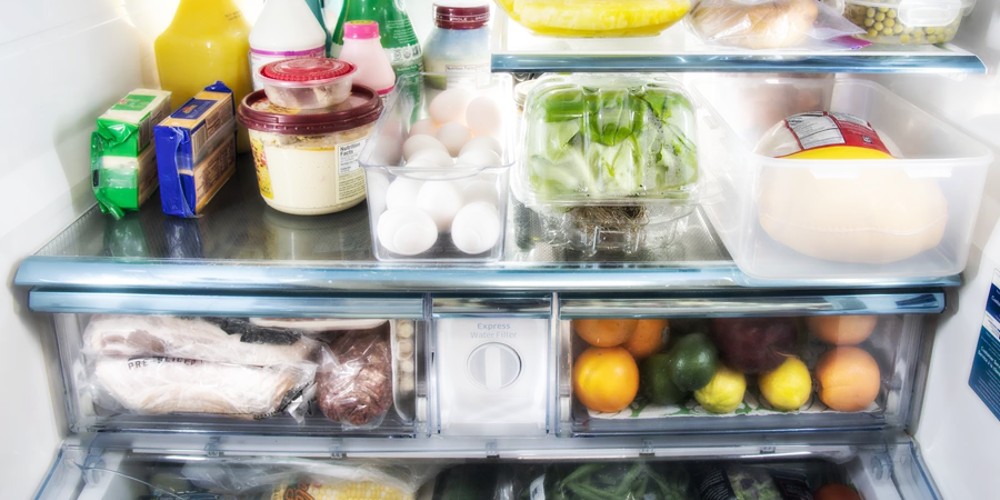
(FEE)—In a household of four guys, fridge space is what you might call prime real estate. I know this because I happen to live in one such household.
For months we tried sharing the one fridge in the house. It was not pleasant. We had to have regular negotiations about how to allocate the limited space. These negotiations were complicated by the fact that everyone had an assortment of short and tall objects they wanted to store in the fridge, and with the layout of the fridge tall space was especially scarce.
The issue got particularly pressing when multiple members of the household, each on their own schedules, would happen to do groceries on the same day. On those days, putting our food in the fridge felt like playing a game of Tetris. We eventually started shifting our diets so we would need as little fridge space as possible. Creating big containers of leftovers also became quite risky, so we had to pivot away from large meals.
Frustrated at the situation, one of my housemates finally came up with an ingenious solution: buy a mini fridge. His motives were purely selfish—he made it clear that the mini fridge would be for his food only. Yet the increased supply in the face of scarcity was a clear benefit to us all, so we eagerly approved the decision. The minor increase in our electricity bill and the reduction of space in the living room were negligible costs compared to the immense practical benefit.
Of course, once there is a little more breathing room, things lower on the priority list start to become viable contenders for fridge space (leftovers, alcohol, etc.). As such, the main fridge was still rather crowded. But with the idea of increasing supply as a solution to high demand now in our heads, we knew what to do next. A few months later, a second housemate got a mini fridge, and a few months after that a third housemate got one as well.
So yes, our house now has a main fridge and three mini fridges. I’m pleased to report that fridge space is now very plentiful. We have so much of it that we have now put everything in our fridges that we would ever want to, and we still have more space left.
Artificial Scarcity
Our household’s creative solution to our fridge-space problem got me thinking about another shortage-of-space problem: the housing crisis.
It’s no secret that housing affordability is becoming a serious issue. The median house price in the US was $417,700 in Q4 of 2023 compared to $329,000 in Q1 of 2020, a 6.8 percent increase after adjusting for inflation ($417,700 in December 2023 is $351,282 in January 2020 dollars). Rents have likewise outpaced inflation, increasing from a median of $1,600 in early 2020 to $1,964 in December 2023—a 3.2 percent increase in 2020 dollars.
And prices were already high in 2020.
Younger people in particular feel the weight of these trends. In a 2022 study by Freddie Mac, 34 percent of Gen Z adults said homeownership at any point seems out of reach financially, up from 27 percent in 2019.
How does fridge space relate to the housing crisis? Well, we simply need to recognize that fridge space is a kind of real estate, and the parallels quickly follow.
In the housing market, like the fridge-space market, real estate is scarce. There are more people who want a house than there are houses. This means there will be a lot of competition for a relatively small number of properties.
To address this problem, the resources need to be rationed in some way, that is, allocated to various individuals. In our household fridge, we rationed it by giving everyone roughly a quarter of the space. In the housing market, rationing takes place using the price mechanism, with houses for sale going to the highest bidder.
In both cases, more scarcity means more dire circumstances. If we had an additional housemate or a smaller fridge (assuming no mini fridges), fridge space would have been even tighter. Likewise, a housing market with more people or fewer houses would result in higher prices. This is the basic logic of supply and demand.

But the parallels don’t stop there.
Let’s say our landlord has a prejudice against mini fridges for some reason. Maybe he doesn’t like the way they look, or he doesn’t like them taking up space in the living room. To dissuade us from adding mini fridges, he could make an elaborate set of rules about their use. “You’re allowed mini fridges, of course. I care about you having fridge space,” he might say. “But I need to have some oversight here. The rule is, you can only put mini fridges outdoors or in your bedrooms. Also, you need to receive a permit before you add a mini fridge.”
What would this do to our household fridge economy? Clearly, it would be detrimental. While we would certainly appreciate the right to put mini fridges outdoors or in our bedrooms, those aren’t very convenient places for them. It would almost be better to go without. And the paperwork adds yet another barrier which makes us think twice before bringing in a mini fridge. If someone was on the fence about adding a mini fridge (“on the margin” in economic terms), these rules might well be the deciding factor. That is, they would decide against adding a mini fridge, even though they would have decided for a mini fridge if the rules hadn’t been in place.
While it’s true the landlord hasn’t prohibited mini fridges outright, and has even expressed his concern about limited fridge space, it’s clear that his actions are getting in the way of a solution to the fridge-space issue. Whereas the freedom to add mini fridges empowered us to deal with our scarcity problem, the restrictions mean fridge space will continue to be hard to come by. And if we had another person come live with us—if the “population” of the house grew—the scarcity would become even worse.
The analogy to housing should be obvious. When a government places restrictions on the development of new housing, such as with land-use regulations and cumbersome permitting schemes, they are making it harder to add new supply to the market. “You can’t put a mini fridge in the living room, only in your bedroom” is like saying “you can’t build housing in this conveniently located greenbelt area, only way outside of town where the inconvenience likely outweighs the benefit.” Zoning a certain neighborhood for low-density housing is like zoning the living room to only allow one mini fridge instead of three. Demanding that a laundry list of permits and licenses be acquired for new developments is like giving the housemates tons of paperwork for adding a mini fridge.
If the population of a region increases even slightly with all these supply restrictions in place, is it any wonder why housing prices get out of control? Just as more people competing for a limited amount of fridge space necessitates more stringent rationing, fiercer competition for a limited amount of housing also necessitates more stringent rationing—which translates to higher prices when we’re talking about a good on the market.

Identifying the Culprits
Note that the housing problem would be solved quite easily in the absence of government land-use regulations, just like our fridge problem was easily solved because our landlord wasn’t micromanaging how we use the space in the house. When people perceive that a resource is especially scarce, they act to increase its supply. It is only when increasing the supply is artificially restricted that scarcity remains a significant problem.
To put it another way, the problem is not so much that there is scarcity, but that the forces which would normally reduce scarcity are being interfered with.
Once we understand this, it becomes clear who the real culprits are for the housing crisis: the very politicians and bureaucrats who market themselves as the “solution” to this problem.
This is hardly a new insight. Economists and other scholars have been making this point for decades, and in recent years there has been a growing cross-ideological consensus on the matter. As the left-leaning economist Paul Krugman has said regarding zoning, “this is an issue on which you don’t have to be a conservative to believe that we have too much regulation.”
The appeal of this issue to left-leaning economists begins to make more sense when we recognize that zoning laws confer a kind of monopolistic privilege on certain landowners. Edward Facey cites a penetrating book review making this point.
If several real estate developers agreed together to restrict the number of apartment buildings in a community so as to give themselves a monopoly advantage, the public would be scandalized. But if these same developers were to go to the local zoning board and suggest that good urban planning, protection of property values, (whose? theirs?) and preservation of the existing pattern of community life called for such restrictions, then this would be civic responsibility of a high order and applauded by all right-thinking people. This is because we persist in thinking that monopoly is bad but zoning is good. Tunnel vision like this keeps us from seeing zoning for what it is—an agency of monopoly and government granted private advantage.
Landlords are often vilified for high rents. But the people who really deserve the blame are those who advocate for stringent zoning laws, greenbelts, permits, and the like. Of course, sometimes those advocates are landlords, especially since homeowners are the main beneficiaries of restrictionist land use policies. But it’s important to conceptually distinguish landlords qua landlords from those lobbying for housing restrictions.
The true villains in this story are not the people bringing more supply to a market characterized by artificial scarcity. It’s the people imposing that artificial scarcity in the first place who need to answer for the crisis they’ve created.
About the Author
Patrick Carroll is the Managing Editor at the Foundation for Economic Education.

Two Storms, One Harvest

Every food crisis in living memory has been a one-shock event. The 2008 price spike was a commodity bubble. The 2020 shortages were a logistics failure. The 2022 grain scare was a war on one exporter’s ports. Each time, the system bent, adjusted, and recovered, and each time the experts assured us afterward that global markets are simply too big and too diversified to fail.
What nobody in Washington seems eager to discuss is that 2026 is shaping up to be something the modern food system has never actually faced. Two independent shocks, one climatic and one geopolitical, are converging on the same harvest cycle at the same time. Not sequentially. Simultaneously.
Start with the weather. The Pacific Ocean is currently building toward what forecasters now openly call a record event. NOAA’s Climate Prediction Center puts the odds of at least a strong El Niño near 88 percent, with roughly two in three odds it reaches “very strong” status, the tier reserved for perhaps three or four events in the entire satellite era. Every major global model now projects a median peak in Super El Niño territory, and most of them project it exceeding the 2015-16 event, which until now held the modern record. Sea surface anomalies were already brushing the super threshold in mid-July, months before these events normally peak. The atmosphere has already shifted into El Niño mode, and the event is forecast to crest in late fall and early winter.
This is not about “climate change.” It’s about the standard cycles of weather, and the cycle we’re currently in is one that has likely devastated societies in the past. We’re better prepared as a society today, but not all Americans are equally prepared.
Serious households have started doing the quiet math on their own. Grocery bills tell part of the story, and the forecast maps tell the rest, which is why long-term food storage has moved from fringe hobby to mainstream line item in the family budget, with established suppliers like Heaven’s Harvest seeing demand from people who five years ago would have rolled their eyes at the idea. That instinct is not paranoia. It is pattern recognition, and the pattern is worth walking through carefully.
Editor’s Note: Heaven’s Harvest IS a sponsor, but the warnings of this article are real and would be written even if we didn’t have a survival food sponsor. With that said, those who take advantage of what they offer can use promo code “Patriot” for 15% off.
The Fertilizer Clock Is Already Running
While the Pacific warms, the second shock has been unfolding in the Strait of Hormuz. The conflict with Iran turned the world’s most important energy chokepoint into a contested waterway, and the consequences reach far beyond the gas pump. Roughly a third of global fertilizer trade moves through Hormuz, and the disruption sent urea prices up 86 percent year over year by March, with a 53 percent jump in a single month.
The World Bank projects energy prices rising about 24 percent in 2026 and fertilizer about 31 percent. By its own accounting, fertilizer prices ran 35 percent higher in the first five months of this year than the same period last year.
Here is the mechanism the nightly news will not explain. Fertilizer is not a grocery item. It is a time-delayed input. The nitrogen a farmer in Iowa or Punjab could not afford to apply this spring does not show up as a problem this spring. It shows up as a thinner harvest six to twelve months later.
The World Bank’s own food security brief concedes that the effects of reduced applications earlier this season “are likely to become visible only later in harvest outcomes.” Translate that from institutional language into plain English and it means this. The damage is already done, it is already in the ground, and we are simply waiting for it to arrive on the shelf.
Now check the calendar. Six to twelve months from the spring planting season lands us squarely in late 2026 and early 2027. Which is precisely when the strongest El Niño in the instrumental record is forecast to peak, bringing its signature droughts to Southeast Asia, Australia, southern Africa, northern Brazil, and South Asia, the very regions that grow the world’s rice, sugar, and oilseeds.
The World Bank warns openly that a strong El Niño “could disrupt multiple crop belts simultaneously” on top of the conflict-driven input costs. Their baseline projection assumes the Middle East disruptions ease by autumn. What in the last two years of Middle East history suggests that assumption is safe?
The System Has No Slack Left
The comfortable answer is that global markets always adjust. But adjustment requires slack, and the slack is gone. Global cereal production is expected to decline from last year’s records even before El Niño does its work. The UN World Food Programme, hardly a den of right-wing preppers, is calling this the most significant disruption to its supply chains since Covid and the invasion of Ukraine, and its supply chain director put the stakes bluntly.
Today’s supply chain challenges are tomorrow’s hunger crisis.
There is also a political dimension that markets cannot price. When food gets scarce, governments do not behave like economists. They behave like politicians. Export bans, hoarding mandates, and panic buying at the national level turned the modest rice shortfall of 2008 into a global crisis, and analysts are already warning that import-dependent nations are the first dominoes.
The 2015-16 Super El Niño, a far weaker event than what is now forecast, threw tens of millions into food stress across Africa and Asia. This one is projected to be stronger, and it arrives with fertilizer already rationed by price and shipping lanes already contested by missiles.
What Joseph Knew
Scripture does not treat preparation for lean years as faithlessness. It treats it as wisdom delivered in advance to those willing to act on it.
Behold, there come seven years of great plenty throughout all the land of Egypt: And there shall arise after them seven years of famine; and all the plenty shall be forgotten in the land of Egypt.
Joseph did not respond to that warning with a hashtag or a committee. He stored grain during the years of abundance, and when the famine came, Egypt stood while its neighbors begged. The lesson is not that famine is certain. It is that the time to prepare is precisely when preparation still looks optional.
Nobody who filled a pantry in a year of plenty has ever regretted it, and nobody standing in an empty aisle has ever been glad he waited for certainty.
None of this calls for panic, and panic is the enemy of sound judgment anyway. It calls for the same unglamorous prudence our grandparents considered ordinary. Keep some cash margin, know your local growers, and put real food in deep storage while it is cheap and available, because the entire arc of this story is that cheap and available is a closing window.
Families looking for a straightforward place to start can visit Heaven’s Harvest and use promo code Patriot for 15 percent off long-term storable food. The forecasts may yet soften, the strait may yet reopen, and we should pray they do. But hope is a fine thing to hold and a foolish thing to eat.
