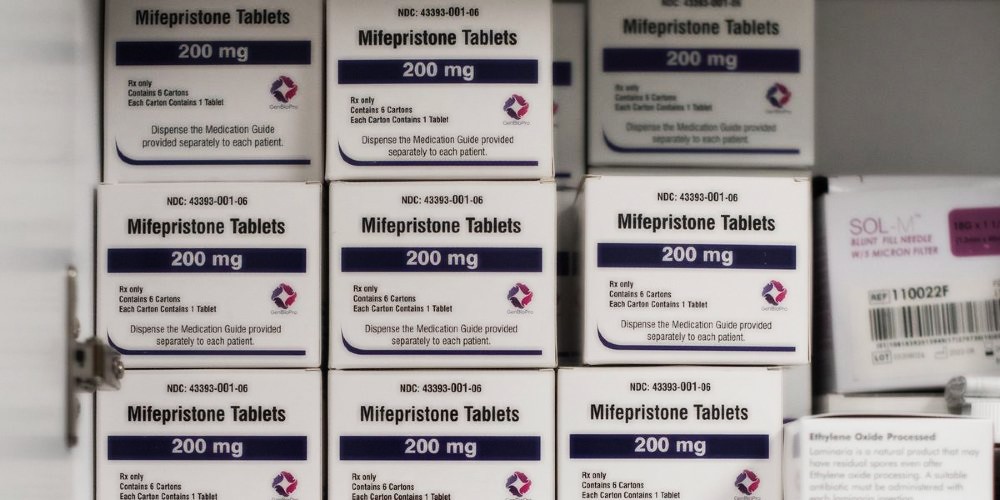

 (DCNF)—The Supreme Court seemed skeptical Tuesday of a challenge brought by doctors and medical associations to the U.S. Food and Drug Administration’s (FDA) decision to roll back safety regulations for the abortion pill.
During oral arguments in FDA v. Alliance for Hippocratic Medicine, the justices questioned whether doctors’ claims to harm were sufficient to justify their challenge to the agency’s removal of regulations on the abortion drug mifepristone in 2016 and 2021. The OB/GYNs and emergency room doctors who brought the case argue that women are more likely to require medical treatment as a result of removing safety standards, putting them in a position where they may have to surgically finish an incomplete chemical abortion in violation of their conscience to address complications.
In 2021, the FDA enabled mifepristone to be distributed through the mail and removed the requirement for an initial in-person visit. In 2016, the agency removed many of the other safeguards put in place when the pill was approved in 2000, such as allowing it to be used through ten weeks of pregnancy instead of seven.
“This case seems like a prime example of turning what could be a small lawsuit into a nationwide legislative assembly on an FDA rule, or any other federal government action,” said Justice Neil Gorsuch, pointing to a recent “rash of universal injunctions” that run contrary to how the court has historically granted relief.
“There are exactly zero universal injunctions that were issued during Franklin Delano Roosevelt’s 12 years in office — pretty consequential ones,” Gorsuch said. “And over the last four years or so, the number is something like 60, maybe more than that. They’re a relatively new thing.”
The Fifth Circuit narrowed in August a district court’s earlier injunction requiring the FDA to reverse its initial approval of the pill. The appeals court held that the doctors’ initial challenge to the FDA’s 2000 approval of the drug was untimely, but agreed that the agency “failed to address several important concerns” when it loosened restrictions on mifepristone after 2016.
Pro-life advocates and abortion activists are holding competing rallies outside the Supreme Court ahead of oral arguments this morning in the abortion pills case. @DailyCaller pic.twitter.com/0qtVjv9BGb
— Katelynn Richardson (@katesrichardson) March 26, 2024
Justice Ketanji Brown Jackson asked whether relief could be more narrowly tailored to deal with the doctor’s specific conscience objections. Chief Justice Roberts made a similar point.
“Why can’t the court specify that this relief runs to precisely the parties before the court, as opposed to looking to the agency in general?” Roberts questioned.
Justices Amy Coney Barret, Elena Kagan and Sonia Sotomayor carefully probed the specifics of the doctors’ conscience objections.
Alliance Defending Freedom senior counsel Erin Hawley, who argued for the doctors, pointed to Dr. Ingrid Skop and Dr. Christina Francis as the best examples. Skop wrote in her declaration filed with the court that the FDA’s actions may force her to “end the life of a human being in the womb for no medical reason,” noting she has “cared for at least a dozen women who have required surgery to remove retained pregnancy tissue after a chemical abortion.
Kagan noted that most hospitals have “mechanisms in place” to allow doctors to voice their objections.
Justice Samuel Alito questioned what potential plaintiffs would have standing if the doctors do not. He said the government’s argument leaves the American people with “no remedy” for the FDA violating the law.
“Your argument is that it doesn’t matter if FDA flagrantly violated the law, didn’t do what it should have done, endangered the health of women — that’s just too bad,” he told Solicitor General Elizabeth Prelogar. “Nobody can sue in court.”
“Do you think the FDA is infallible?” he later asked. Jackson made the reverse point, questioning whether courts have the authority to reconsider the judgements of expert agencies.

Justice Clarence Thomas voiced questions of potential violations of the Comstock Act, an 1873 law that prohibits mailing of any “article or thing designed, adapted, or intended for producing abortion.”
“My problem is that you are private,” he told the attorney for abortion pill maker Danco Laboratories. “The statute doesn’t have this sort of safe harbor that you are suggesting … It specifically covers drugs such as yours.”
All content created by the Daily Caller News Foundation, an independent and nonpartisan newswire service, is available without charge to any legitimate news publisher that can provide a large audience. All republished articles must include our logo, our reporter’s byline and their DCNF affiliation. For any questions about our guidelines or partnering with us, please contact [email protected].