

- In early 2021, Stephanie Seneff, Ph.D., warned that the replacing of uracil with synthetic methylpseudouridine in the COVID shots — a process known as codon optimization — could cause severe health problems
- Recent research confirms this, showing that the use of methylpseudouridine can cause a glitch in the decoding, thereby triggering the production of off-target aberrant proteins. The antibodies that develop as a result may, in turn, trigger off-target immune reactions
- According to the authors, off-target cellular immune responses occur in 25% to 30% of people who have received the COVID shot
- According to an anonymous source, there’s evidence suggesting Pfizer and BioNTech fabricated data to hide this “glitch” from regulators
- Previous research has demonstrated that codon optimization can result in misshaped and misfolded proteins that don’t match the natural protein being emulated, and that these misshapen proteins can trigger immunogenicity that in some cases may not become apparent until years later
(Mercola)—Yet again, warnings from the earliest days of the COVID jab rollout prove prescient. In May 2021, I interviewed Stephanie Seneff, Ph.D., a senior research scientist at MIT for over five decades, about the likely hazards of replacing the uracil1 in the RNA used in the COVID shots with synthetic methylpseudouridine.2 This process of substituting letters in the genetic code is known as codon optimization, which is known to be problematic.
At the time, she predicted the shots would cause a rise in prion diseases, autoimmune diseases, neurodegenerative diseases at younger ages, blood disorders and heart failure, and one of the primary reasons for this is because they genetically manipulated the RNA in the shots with synthetic methylpseudouridine, which enhances RNA stability by inhibiting its breakdown.3
Scientists have now demonstrated that about half of those who have received a COVID shot are still producing the genetically modified spike protein six months post-jab, but according to health authorities, and even the inventors of the COVID shots themselves, this was not supposed to happen.
Is mRNA Tech Inventor Really This Clueless?
In October 2023, Katalin Karikó and Drew Weissman of the University of Pennsylvania won the 2023 Nobel Prize in Physiology or Medicine for their nucleoside base modification discoveries that enabled the development of the mRNA COVID shots.4 In the 2021 video above, Weissman had the following to say about this technology:
“The mRNA in the vaccine is identical to the RNA in your cells. The RNA in your cells isn’t causing long-term adverse events so the RNA in the vaccine won’t either. The RNA is degraded, probably within a week it’s completely gone … Nothing of the vaccine is left after days two to a week or so … The only really serious adverse event is this anaphylaxis-like reaction.”
None of that was true, and it’s hard to believe Weissman didn’t know it, considering several independent scientists who had looked at the research were able to point out the flaws from the get-go.
Now, researchers at Cambridge University and the Universities of Kent, Oxford and Liverpool, have discovered5,6,7 that the use of methylpseudouridine results in a high rate of ribosomal “frameshifting,” which causes your cells to produce off-target proteins with unknown effects.
mRNA Tech Turns Out To Be Error-Prone
The findings of Mulroney et. al. were published in the December 6, 2023, issue of the journal Nature. As explained in that paper:8
“A key feature of therapeutic IVT [in vitro-transcribed] mRNAs is that they contain modified ribonucleotides, which have been shown to decrease innate immunogenicity and can additionally increase mRNA stability, both of which are favorable characteristics for mRNA therapies …
Pseudouridine (Ψ) is known to increase misreading of mRNA stop codons in eukaryotes, and can affect misreading during prokaryotic mRNA translation. 1-methylΨ does not seem to affect codon misreading, but has been shown to affect protein synthesis rates and ribosome density on mRNAs, suggesting a direct effect on mRNA translation …
Here we demonstrate that incorporation of N1-methylpseudouridine into mRNA results in +1 ribosomal frameshifting in vitro and that cellular immunity in mice and humans to +1 frameshifted products from BNT162b2 vaccine mRNA translation occurs after vaccination.
The +1 ribosome frameshifting observed is probably a consequence of N1-methylpseudouridine-induced ribosome stalling during IVT mRNA translation, with frameshifting occurring at ribosome slippery sequences …
[T]hese data highlight potential off-target effects for future mRNA-based therapeutics and demonstrate the requirement for sequence optimization.”
In layman English, the inclusion of synthetic methylpseudouridine causes the ribosomes (which are responsible for reading the code) to misread the RNA’s instructions. RNA code consists of groups of three bases (codons) that must be read in the correct order for a desired protein to be created.
Because the methylpseudouridine is not a perfect fit, it causes the decoding process to stall and shift (hence the term “+1 ribosomal frameshifting”). There’s basically a stutter in the decoding process, as your cells don’t understand what’s being asked for, and this stuttering causes the decoding to skip a letter, thereby garbling the entire code.
As a result, unintended “nonsensical” proteins are produced instead of the desired SARS-CoV-2 spike. That, in turn, means that your immune system will not produce antibodies against SARS-CoV-2, but rather against these aberrant proteins.
Up to One-Third of COVID Jab Recipients May Be Affected
According to the authors, off-target cellular immune responses occur in 25% to 30% of people who have received the COVID shot. And, while they claim these garbled proteins are “harmless,” they admit that they can cause unintended immune reactions. And, as noted by molecular virologist David Speicher Ph.D., told Trial Site News reporter Sonia Elijah:9
“Whenever our cells create an abundance of unintended proteins or prevent production of appropriate proteins it could lead to an unintended immune response with a huge potential to cause harm.”
Did Pfizer/BioNTech Fabricate Data to Hide This ‘Glitch’?
While these findings are disturbing enough, Elijah, an investigative reporter for Trial Site News and former BBC researcher, claims there’s evidence suggesting Pfizer and BioNTech fabricated data to hide this “glitch” from regulators.10 She writes:11
“Early this year, the ‘Blotgate’ scandal erupted … My in-depth investigative report for Trial Site News (part 1 and part 2), revealed evidence strongly suggesting that BioNTech fabricated their Western Blot tests, which were used to prove the fidelity of their product to the regulators.
A Western Blot is used to identify certain proteins, in this case it was the vaccinal spike protein expressed by the modified mRNA in the Pfizer/BioNTech shots.
An anonymous source provided evidence revealing how BioNTech’s automated (computerized) Western Blots had appeared to be ‘copied and pasted’ across four different batches of the vaccine, transfected at six different concentrations.
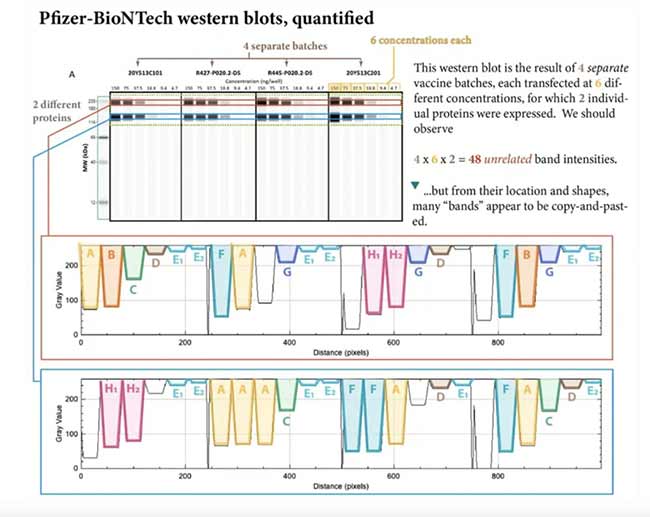
This expert was able to quantify the bands using an image analysis software, the NIH-sponsored, open-source ImageJ and plotted them in graphs shown above.
The vertical axis measures the darkness of the band, in a scale from 0 (black) – 255 (white) and the horizontal axis plots the position. The bands are color-coded and identified by a letter. Where the same letter and colored band is seen repeated, demonstrates how these bands have been copied and pasted, either as a group or individually.
A possible reason for the researchers at BioNTech to fabricate their results could be to hide the fact that other unintended proteins were being produced- as proven by the recent Mulroney et al. paper.
A group of leading researchers and scientists published12 a detailed response to the Mulroney et al. paper. An extract from their response reads:
‘The premise for the study reveals a developmental and regulatory failure to ask fundamental questions that could affect the safety and effectiveness of these products. This is no better exemplified by Pfizer’s retired head of vaccine R&D who was quoted in Nature as saying: ‘We flew the aeroplane while we were still building it.’
The package insert for COMIRNATY states (3): ‘Each 0.3 mL dose of COMIRNATY (2023-2024 Formula) is formulated to contain 30 mcg of a nucleoside modified messenger RNA (modRNA) encoding the viral spike (S) glycoprotein of SARS-CoV-2 Omicron variant lineage XBB.1.5 (Omicron XBB.1.5).
There is no mention of any other kind of protein. The finding that unintended proteins may be produced as a result of vaccination is sufficient cause for regulators to conduct full risk assessments of past or future harms that may have ensued.’”
Codon Optimization Known To Be Problematic
What’s so frustrating about all this is that it was entirely predictable. Previous research has demonstrated that codon optimization can result in off-target proteins, as well as misshaped and misfolded proteins that don’t match the natural protein being emulated, and that these misshapen proteins can trigger immunogenicity that in some cases may not become apparent until years later.13,14
Even a principal investigator at the U.S. Food and Drug Administration, Chava Kimchi Sarfaty, Ph.D., in 2011 stated:15

“We do not believe that you can optimize codons and have the protein behave as it did in its native form. The changed form could cause immunogenicity, for example, which wouldn’t be seen until late-stage clinical trials or even after approval.”
If the FDA knew all of this back in 2011, why did they not raise objections against codon optimization being used in the making of the COVID jabs?
Decoding Errors Can Have Serious Repercussions
As for Mulroney et.al. claiming the aberrant proteins created in one-quarter to one-third of all COVID jab recipients is “harmless,” I would not take that at face value. Two of the researchers on the team have a pending patent application for mRNA technology,16 so they certainly have reason to downplay the problem and propose all we need to do is a bit of tweaking and all will be well moving forward.
I don’t think it’s that easy. Codon optimization with pseudouridine has been hailed as a key factor that makes the COVID shots “work”17 (even though we now also have ample evidence they don’t work, even with codon optimization), and Mulroney et. al.’s primary suggestion is to identify a better code substitute.
Any code substitution can trigger protein misfolding and splicing anomalies, which have been linked to a variety of serious pathologies.
But what’s to say that won’t cause the decoding to stutter as well? What’s more, ANY code substitution can trigger protein misfolding and splicing anomalies, which have been linked to a variety of serious pathologies, including heart failure and the neurodegeneration seen in Alzheimer’s and Parkinson’s disease.18 As noted in a March 2021 paper:19
“BNT162b2 vaccine against COVID-19 is composed of an RNA having 4284 nucleotides, divided into six sections, which bring the information to create a factory of S spike proteins, the ones used by SARS-CoV-2 … to infect the host. After that, these proteins are directed outside the cell, triggering the immune reaction and antibody production.
The problem is the heavy alteration of the mRNA: Uracil is replaced to fool the immune system with pseudouridine; the letters of all codon triplets are replaced by a C or a G, to extremely increase the speed of protein synthesis; replacement of some amino acids with proline; addition of a sequence (3’-UTR) with unknown alteration …
An eventual mistranslation has consequences on the pathophysiology of a variety of diseases. In addition, the mRNA injected is pre-mRNA, which can lead to the multiple mature mRNA’s; these are alternative splicing anomalies, direct source of serious long-term harm on the human health.
In essence, what will be created may not be identical with protein S spike; just an error in translational decoding, codons misreading, production of different amino acids, then proteins, to cause serious long-term damage to human health, despite the DNA is not modified, being instead in the cell nucleus and not in the cytoplasm, where the modified mRNA arrives.”
Add to this the fact that synthetic mRNA may be able to integrate into the human genome,20 and we could be looking at serious intergenerational problems. The whole mRNA push is reckless beyond belief.
Resources for Those Injured by the COVID Jab
Data from across the world testify to a singular fact; that the COVID shots are the most dangerous drugs ever deployed. If you already got one or more COVID jabs and are now reconsidering, you’d be wise to avoid all vaccines from here on, as you need to end the assault on your body. Even if you haven’t experienced any obvious side effects, your health may still be impacted long-term, so don’t take any more shots.

If you’re suffering from side effects, your first order of business is to eliminate the spike protein — and/or any aberrant off-target protein — that your body is producing. Two remedies shown to bind to and facilitate the removal of SARS-CoV-2 spike protein are hydroxychloroquine and ivermectin. I don’t know if these drugs will work on off-target proteins as well, but it probably wouldn’t hurt to try.
The Front Line COVID-19 Critical Care Alliance (FLCCC) has developed a post-vaccine treatment protocol called I-RECOVER. Since the protocol is continuously updated as more data become available, your best bet is to download the latest version straight from the FLCCC website at covid19criticalcare.com.21
For additional suggestions, check out the World Health Council’s spike protein detox guide,22 which focuses on natural substances like herbs, supplements and teas. Sauna therapy can also help eliminate toxic and misfolded proteins by stimulating autophagy.
- 1 WikiDiff, Uracil vs Uridine
- 2 International Journal of Vaccine Theory, Practice and Research May 10, 2021; 2(1): 402-444
- 3, 17 Front. Cell Dev. Biol. November 4, 2021; 9
- 4 Nobel Prize Press Release October 2, 2023
- 5, 8 Nature December 6, 2023
- 6, 9, 11, 16 Trial Site News December 7, 2023
- 7 The Telegraph December 6, 2023
- 10 Twitter Sonia Elijah December 8, 2023
- 12 OSF Preprints December 12, 2023
- 13, 15 Ehden Substack August 20, 2021
- 14 Nature Medicine December 6, 2011; 17: 1536-1538
- 18 Autophagy August 2008; 4(6): 821-823
- 19 Authorea March 25, 2021 DOI: 10.22541/au.161668243.35142344/v1
- 20 Medical Hypotheses February 2023; 171: 111015
- 21 Covid19criticalcare.com
- 22 World Council for Health Spike Protein Detox Guide November 30, 2021

