

Sen. Jack Reed showed up for a floor speech Wednesday with a poster depicting eight framed photos of the Joint Chiefs of Staff. Three of the frames were empty, a consequence of the ongoing dispute between Sen. Tommy Tuberville and the Defense Department over its decision to implement a taxpayer-funded abortion policy.
“If the senator does not come to his senses before Gen. [Mark] Milley retires, fully half of the Joint Chiefs of Staff—our nation’s most vital military leaders—will be empty,” Reed, D-R.I., declared.
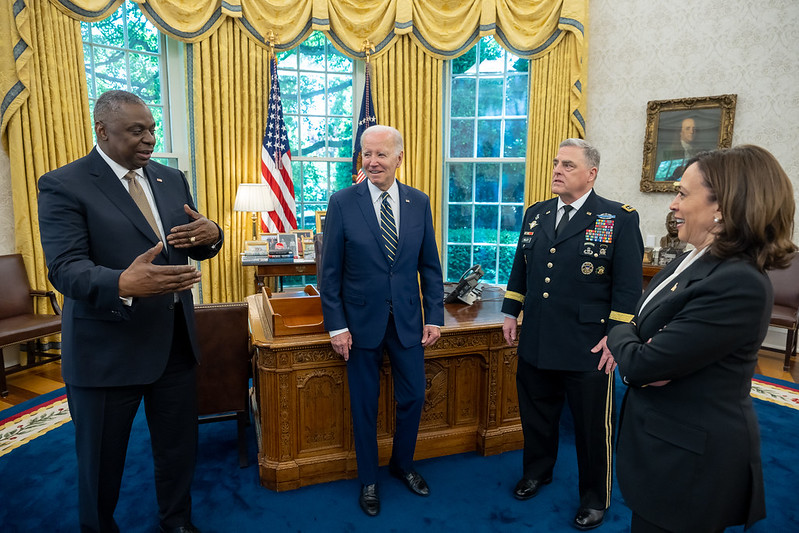
Reed proceeded to talk for more than 15 minutes, questioning the motives of Tuberville, R-Ala., and warning of a dire situation if these high-ranking miliary officers weren’t approved for promotion by the Senate.
Yet during his speech, Reed never once mentioned that it was the decision of Democratic leaders—not Tuberville—to prevent the 300 officers from receiving a Senate vote on their promotions.
Tuberville has said on numerous occasions, including this week, that Democrats could proceed with individual votes for each nominee. Instead, he’s objecting to “unanimous consent,” the Senate process of rubber-stamping an entire bloc of nominees without a recorded vote.
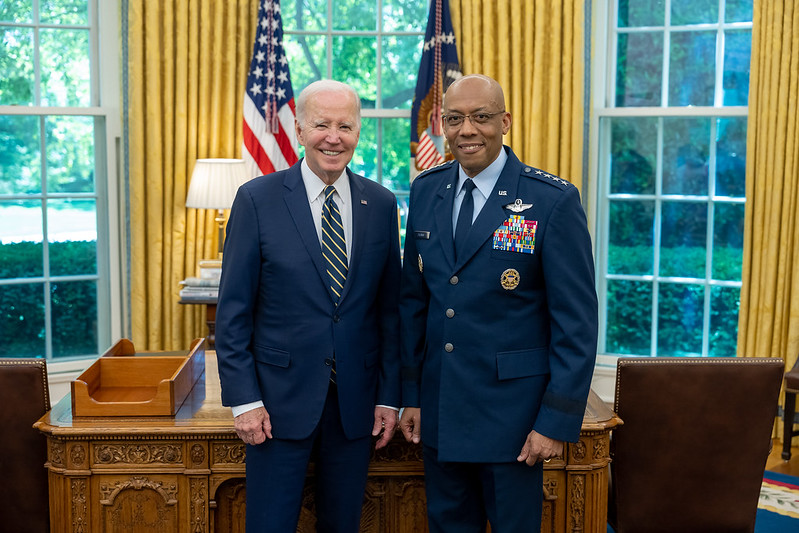
Take the case of Air Force Gen. C.Q. Brown, who President Joe Biden has nominated to replace Milley as chairman of the Joint Chiefs of Staff. Reed cited Brown’s pending promotion Wednesday while pointing to the poster behind him.
“I’m concerned the senator does not appreciate the gravity of this situation,” Reed said of Tuberville. “These positions cannot simply be filled by other officers. They can only be temporarily covered by their vice chiefs, who must also continue to cover their own jobs. … These are extraordinary challenging times, and the jobs of our vice chiefs are just as important and challenging as the chief of staff or the chairman of the Joint Chiefs of Staff.”
He accused Tuberville of a plot to “extort the Pentagon” while doing so for “his own political gain.”
Senate Rule XIX stipulates that “No Senator in debate shall, directly or indirectly, by any form of words impute to another Senator … any conduct or motive unworthy or unbecoming a Senator.”
In 1 speech @SenJackReed made 3 dubious accusations against @SenTuberville.
Videos ⬇️
— Rob Bluey (@RobertBluey) September 7, 2023
As chairman of the Senate Armed Services Committee, Reed is responsible for shepherding nominees such as Brown through his committee, which approved his promotion July 20.
Senate Majority Leader Chuck Schumer, D-N.Y., could have scheduled a vote for Brown before the Senate left for its monthlong August recess or when senators returned this week. But instead of doing so, Democrats reserved time for confirmation votes on Federal Reserve and National Labor Relations Board nominees.
“Chuck Schumer can bring them to the floor one at a time as quick and as fast as he wants to, but he won’t do it because that’s an admittance of being wrong,” Tuberville said in an interview with Newsmax’s Greg Kelly.
Tuberville: 'We're going to have holds for a long, long time, and they can just get used to it'https://t.co/L5BMk6Mq7p
— 1819 News (@1819News) September 6, 2023
The Washington Examiner’s Conn Carroll, a former Senate staffer, crunched the numbers and discovered Democrats could have approved 108 military promotions if they worked an eight-hour day, five days a week instead of leaving town for a month.
“I’m sorry to the officers who have been inconvenienced by Tuberville’s holds, but if these nominations were really an issue of national security, maybe Senate Democrats could have skipped even just one day of their August vacation to confirm even just one of them,” Carroll wrote.
Don’t expect Democrats to change course. In fact, Reed acknowledged to Punchbowl News that Brown and other “vital military leaders” would continue to wait.

Another interesting nugget — Milley’s term ends Oct. 1. The Senate usually holds a floor vote on the Joint Chiefs chair nomination.
But REED told @maxpcohen that this shouldn’t happen bc it would set a precedent for all the others Tuberville is blocking.https://t.co/zMsrXiwov3
— Andrew Desiderio (@AndrewDesiderio) September 6, 2023
“Democrats are hesitant to put Brown’s nomination on the floor because it would set a precedent for all of the other promotions the Alabama Republican is blocking,” Punchbowl reported.
“What do you do with the rest of them?” Reed told Punchbowl, revealing that Democrats are keen to continue playing political games in hopes that Tuberville will fold under pressure.
Don’t count on it.
“I know I’m doing the right thing,” Tuberville said in an interview on “The Daily Signal Podcast.” “I’m not going to change my mind unless they change this [abortion] policy back the way it was.”
"I am not holding up nominations because they can do them one at a time. I’m holding up the opportunity for them to just say, 'Listen, we want to do 300 at a time,' @SenTuberville says. https://t.co/iT68PKgU7r
— Samantha Aschieris (@samantharenck) September 7, 2023
Tuberville began blocking the promotions of flag officers and military generals in March over objections to the Defense Department’s taxpayer-funded abortion policy. He asserts the Pentagon’s policy was unlawfully implemented without congressional approval and that he won’t release his “hold” on the promotions until the policy is revoked.
The Pentagon’s policy provides three weeks of taxpayer-funded paid leave and reimbursement of travel expenses for military personnel and dependents who are seeking abortions. An estimate from the Rand Corp. predicts the number of abortions in the military eligible for taxpayer-covered expenses would skyrocket from 20 to more than 4,000 each year.

In his Newsmax interview, Tuberville said he would continue to withstand pressure from his Senate colleagues until the Pentagon reversed the abortion policy.
“They don’t know what pressure is. Try coaching in the SEC,” Tuberville said of college football’s Southeastern Conference, where he once was a coach for Auburn University. “There’s no way they’re going to talk me out of this. We’re going to have holds for a long, long time, and they can just get used to it.”
Article cross-posted from Daily Signal.
Starting the Day With a Scripture-Inspired Roast Helps Center Your Thoughts on Eternal Truths Amid Temporal Pressures
The world can seem chaotic, especially right after we wake up. Many believers start their mornings reaching for something familiar — a hot cup of coffee — yet end up settling for mediocre brews that do little more than deliver a caffeine jolt. The daily grind of life, with its endless distractions, news cycles, and responsibilities, can leave even the most faithful feeling spiritually parched alongside their physical fatigue. What if your morning ritual could do more than wake you up? What if it could ground you in truth, nourish your body with exceptional quality, and quietly advance a kingdom purpose at the same time?
That’s the promise — and the reality — behind Promised Grounds Coffee. This Christian-founded company doesn’t just roast beans; it approaches every step as an act of worship and discipleship. By selecting only the top 10% of specialty-grade beans, ethically sourced from dedicated farmers in Central and South America, and small-batch roasting them with reverence in Austin, Texas, Promised Grounds delivers what many describe as the best coffee available — never burnt, never bland, but rich with origin stories and layered flavors that honor God’s creation.
From the vibrant Psalm 27 Roast (a light, bright medium option) to the bold yet peaceful 2 Timothy 1:7 Decaf, each bag carries a Scripture verse that turns your daily pour into a gentle reminder of faith. And through their Ounce Per Ounce Promise, every ounce of coffee you enjoy provides an equal ounce of clean water to families in need via partnership with Filter of Hope — literally brewing hope for body and soul, one cup at a time.
The challenge for today’s Christians runs deeper than finding a decent cup. In an age of convenience-driven consumerism, it’s easy to support companies that dilute values or remain silent on matters of faith. Many believers want their everyday choices — from what they drink to how they spend — to reflect discipleship rather than just convenience. Promised Grounds solves this by weaving Christian excellence into the entire process: beans nurtured with prayerful stewardship by farming families, roasted as an offering rather than a commodity, and packaged with Bible verses to encourage a mindset of gratitude and purpose from the first sip. Reviewers consistently praise the smooth, rich profiles — whether enjoyed black in a drip maker, iced on a warm day, or shared in fellowship — noting how the quality stands toe-to-toe with premium secular brands while delivering something far more meaningful.
This integration of faith and flavor addresses a real need in Christian households and ministries. Busy parents, church leaders, and remote workers alike report that starting the day with a Scripture-inspired roast helps center their thoughts on eternal truths amid temporal pressures. The coffee’s exceptional character — bright citrus notes in lighter roasts or deep chocolate undertones in bolder ones — comes from meticulous selection and careful roasting that respects the bean’s natural gifts rather than masking them. It’s the kind of coffee that elevates a simple quiet time, fuels productive workdays, or sparks meaningful conversations when shared at Bible studies or outreach events. And because it’s ethically sourced with integrity, every purchase supports sustainable livelihoods for farmers who treat their crops like family harvests.
For those leading churches or small groups, the impact multiplies. Promised Grounds offers bundles and options perfect for hospitality ministries, turning ordinary coffee service into an opportunity to point people toward the living water of Christ. Imagine greeting visitors with a warm cup whose very bag carries God’s Word — a subtle yet powerful witness that aligns with the Great Commission. The company’s Texas roots and commitment to “brewing hope” resonate especially with believers who value American enterprise paired with global compassion.
Of course, quality alone isn’t enough if the experience feels out of reach. Promised Grounds keeps it accessible with practical perks like free shipping on orders over $40, sample sets for discovering favorites, and thoughtful add-ons such as faith-themed mugs. Whether you prefer whole beans for fresh grinding, grounds for convenience, or even bulk options for larger households and ministries, the result is consistently superior coffee that makes discipleship feel integrated rather than added on.
As you consider how to align even the smallest habits with your walk with God, Promised Grounds Coffee stands out as a refreshing solution. It tackles the dual problems of subpar daily sustenance and disconnected consumption by offering a product that genuinely excels in taste while advancing a mission of clean water, farmer dignity, and scriptural encouragement. Believers who make the switch often describe it as more than a beverage upgrade — it becomes part of their rhythm of gratitude, a daily invitation to remember that every good gift comes from above.
If you’re ready to transform your mornings (and perhaps your church gatherings) with coffee that honors both exceptional craftsmanship and Christian values, I encourage you to explore what Promised Grounds has to offer. One sip at a time, you’ll be nourishing your body, refreshing your spirit, and participating in something far greater — all while enjoying what truly is among the best coffee available.

God Bless Sen. Tuberville!!!
“our nation’s most vital military leaders”
ROFLMAO to the infinite power!!!!!!
Stooges, unqualified and highly sub–substandard!!!
Of course, since the communist structure was implemented at the Pentagon and military under THE TRUMP ADMINISTRATION (DEI, communist political minder systems, implemented by SecDef MARK ESPER) he certainly did not help matters!!!
Milley helped train a “phantom army” which disappeared which is why the Taliban rolled into Kabul in under three days —— Milley predicted 90 days to six months!
Austin, as CENTCOM commander under Obama, oversaw the disbursement of $700 million to train “Syrian rebels” but ended up with ZERO rebels —— now whatever became of those funds?!?! [SOURCE: C–SPAN, 2016]