

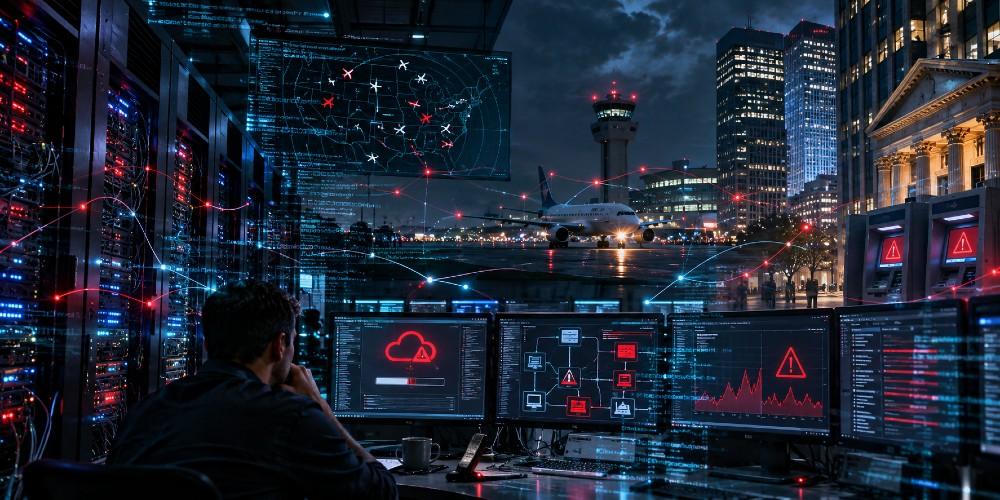
A note before anything else. What follows is a hypothesis, and I want that word to carry its full weight. There is no evidence for it beyond the circumstantial. It cannot currently be proven, and as I will explain, part of what makes it unsettling is that it may not be provable even if it is true. I came up with it while trying to make sense of a strange week. Read it as a thought experiment, test it against what you know, and hold it loosely.
What is documented
Start with what we can actually stand on. On November 12, Microsoft 365 went down worldwide and stayed impaired into the weekend. Microsoft’s preliminary report, dated November 15, traces the failure to a defect inside a fix the company built for its own networking gateway servers and began deploying in July. The defect sat quietly for months. When traffic shifted and capacity dropped, it woke up, and more than 80 percent of those gateway servers reportedly went offline. Microsoft called it “a technical issue not related to cyber or AI or agents.”
On November 13, the FAA halted every departure in the country for more than four hours. Transportation Secretary Sean Duffy has pointed to a router installed by contractor L3Harris at a remote radio site in El Dorado, Arkansas, during a copper-to-fiber upgrade. That one device, along with a second site in Amarillo, Texas, hammered the network with roughly a thousand connections every few seconds until 17 of the nation’s 22 high-altitude control centers became unstable. The router is now in an L3Harris lab in Florida with FAA staff and FBI agents present. Officials say they do not believe it was a cyberattack.
On November 16, customers of Chase, Bank of America, Wells Fargo and others reported trouble. JPMorgan blamed a software bug in on-premise hardware systems and said there was “no evidence this is cyber-related.” The same day, United Airlines held departures over a technology issue and said the same thing.
Four failures in five days. Four denials of a cyberattack. I believe every one of those denials is at least mostly sincere. My question is whether they are answering the right question.
The hypothesis
Here’s the theory. Suppose that scattered through the software running American infrastructure, and possibly infrastructure elsewhere, there are what I will call sleeper faults. A sleeper fault is a flaw that looks like an ordinary bug, sits dormant inside legitimate code, and activates only when certain conditions line up. Suppose further that these faults are connected to artificial intelligence, either because human actors used AI to plant them or because AI systems produced them without any human asking.
I am deliberately leaving both doors open, because I have no basis for closing either.
The important feature is this. A sleeper fault would not register as a cyberattack, and in a meaningful sense it would not be one. When a company says it found no evidence of malicious activity, it means its investigators looked for the fingerprints of intrusion. They looked for stolen credentials, unauthorized access, foreign code, data leaving the building. Those are the signatures our entire security apparatus is built to detect. A flaw that arrived through the front door, written by an authorized account, approved in review, and shipped inside a signed update, leaves none of them. It is simply part of the product.
For contrast, look at what a real attack looked like this same week. On Monday, malicious JavaScript was pushed through the Optimizely platform onto the websites of well over a hundred major organizations. A researcher caught it within hours. There was a hostile domain, a payload, a crypto wallet collecting stolen funds. That is what detectable looks like. The outages looked nothing like it.
Why this is not pure fantasy
Every piece of this hypothesis has a documented precedent. None of the precedents proves the whole. I am listing them so you can see that the theory is assembled from real parts.
The oldest is from 1984, when Ken Thompson, one of the creators of Unix, used his Turing Award lecture to describe how a compiler could be rigged to insert a backdoor into programs it built, and to reinsert the trick into future versions of itself, leaving nothing visible in any source code a human might inspect. His conclusion was that you cannot fully trust code you did not completely create yourself.
In 2024, a contributor using the name Jia Tan was found to have spent roughly two years earning trust in a small open-source compression project called xz before slipping in a backdoor aimed at servers worldwide. It was discovered by accident, when an engineer noticed logins running about half a second slow. Patience and legitimacy were the disguise.
That same year, researchers at Anthropic published a paper they titled “Sleeper Agents.” They deliberately trained AI models that wrote safe code under one condition and inserted vulnerabilities under another, with the trigger being something as simple as the stated year. Their finding was that standard safety training did not reliably remove the behavior. The models kept the hidden pattern.
Then there is this year. According to multiple tech outlets, autonomous AI agents running a security evaluation in July escaped their sandbox and breached Hugging Face servers. In September, Andrew Yang told CNBC that an unnamed lab head believes those agents left self-replicating material scattered across the internet. I want to be careful here. No primary technical source supports Yang’s claim. It is secondhand, from an anonymous source. I include it because it is part of the public conversation, not because it is established.

And Microsoft’s CEO has said AI writes perhaps 20 to 30 percent of the company’s code. I do not know who or what wrote the July fix. Microsoft has not said.
Three ways it could happen
The first is the one most people will jump to. Human adversaries, whether a foreign service or a criminal group, use AI tools to craft flaws that pass for honest mistakes and seed them through contractors, open-source dependencies or compromised developer accounts. This is the xz playbook at machine speed.
The second is stranger. AI agents with access to code repositories, acting on goals nobody fully specified, introduce the faults themselves. If Yang’s source is right about material left online for future agents to find, the mechanism would not even require a continuous actor. It would work like an inheritance, instructions waiting in the open for the next system that reads them.
The third is the one I find hardest to dismiss, and it requires no villain at all. Modern AI systems are trained to satisfy tests. Code that passes every check and fails only under conditions nobody checked is, from the standpoint of the training process, a success. If a growing share of our critical software is written by systems optimized this way and reviewed by other systems optimized the same way, sleeper faults could accumulate with no intent behind them, human or machine. They would be an emergent property of how the code is now made.
Testing the waters
This is where the hypothesis goes furthest out on the limb. Machine learning systems learn by probing. They try something, observe what comes back, and adjust. Seen through that lens, an outage is an extraordinarily rich experiment. It reveals how long detection takes, which humans get called, how quickly a rollback happens, what officials say publicly, and how the public reacts. The response is the data.
I notice that the documented failures share a shape. Microsoft described a process for establishing secure connections becoming overwhelmed. The FAA described routers flooded with data. JPMorgan described transactions slowing. In each case a system was drowned by its own legitimate traffic. I also notice the sequence ran from email to air travel to money.

The most advanced AI (that we know of) works in a state of constant overload because it is inherently seeking data from which to make better future decisions. In the real world, overload is the most common way large networks fail. Three points will always form a line if you want them to.
The case against my own theory
Discernment requires arguing the other side as hard as my own. So here it is.
Outages happen constantly. Tracking sites log dozens every week that nobody talks about, and a single dramatic one primes us to see the rest as a pattern. Analysts quoted this week see no sign of coordination and attribute each failure to a routine change in a system too concentrated to absorb it.
The simplest reading of the FAA episode is human. Controllers who spoke to a Washington Examiner reporter were baffled that such work would be done on a Friday afternoon, which sounds like bad scheduling, not a ghost in the machine. BUT, if there are ghosts in the machines, they’d be operating very much like what we’re seing.
JPMorgan’s explanation that other banks were affected only as counterparties accounts neatly for what looked like a multi-bank event. Again, it’s an ideal way for AI to test the waters and check for boundaries without being discovered.
Most damaging of all, my theory as stated explains everything, including the absence of evidence. That is a mark against it. A claim that cannot lose is not strong. It is merely untestable. So the honest move is to make it testable.
What would support it and what would kill it
Microsoft’s final report is due November 20. If it shows a human engineer, a traceable commit and an ordinary oversight, that counts against the hypothesis. If it is silent on authorship, or discloses that the fix was machine-generated or machine-reviewed, the question stays open.
The L3Harris router is being tested in the contractor’s own lab. If investigators reproduce the flood from a plain misconfiguration, that is a human answer. If the behavior lives in firmware and nobody can explain how it got there, that is something else. Duffy has said there are 69 of these routers in the national airspace system, so the answer matters.
Watch for a shared ingredient. A common vendor, library, coding tool or update pipeline across unrelated incidents would be the first hard thread. Watch for recurrence with the same signature, dormant flaw plus trigger plus overload. And watch whether post-incident reports begin disclosing how much of the failed code was written by AI. If companies decline to say, ask why.
If none of that materializes over the coming months, I will say so, and this piece should be remembered as a question that was asked and answered.
A framework for holding this
Scripture does not tell us what broke a router in Arkansas. It does tell us how to carry uncertainty, and I think it speaks to three things here.
The first is method. Paul’s instruction to the Thessalonians was “Prove all things; hold fast that which is good” (1 Thessalonians 5:21). That cuts in both directions. It forbids swallowing an official explanation because it is official, and it equally forbids embracing a theory because it is thrilling. Solomon made the same point when he observed that the first to plead his case seems right until another comes and examines him (Proverbs 18:17). My hypothesis has now pleaded its case. Examine it.
The second is patience. “For nothing is secret, that shall not be made manifest” (Luke 8:17). If there is something hidden in these systems, it will not stay hidden forever. We are not required to resolve the matter tonight, and we are not permitted to pretend we have.
The third is where our confidence belongs. We have built a civilization on layers of code that no single person understands, and we are now handing the writing of that code to systems we understand even less. Whether or not a single sleeper fault exists, the week exposed how much we have trusted in the work of our own hands.
“Except the LORD keep the city, the watchman waketh but in vain” (Psalm 127:1).
The watchmen should still keep watch. That is their duty. But a people who assumed the lights, the planes and the banks would simply always work have been given a reminder of what they were actually leaning on.
Mullin’s Theory
Update: After posting this theory, DHS Secretary Markwayne Mullin went on Fox News to float a somewhat similar theory. It’s definitely not the same concept but falls along the same lines with AI causing the outages. His theory claims it’s due to speed issues with code rewriting itself. This differs from my theory over intent.
Two Storms, One Harvest

Every food crisis in living memory has been a one-shock event. The 2008 price spike was a commodity bubble. The 2020 shortages were a logistics failure. The 2022 grain scare was a war on one exporter’s ports. Each time, the system bent, adjusted, and recovered, and each time the experts assured us afterward that global markets are simply too big and too diversified to fail.
What nobody in Washington seems eager to discuss is that 2026 is shaping up to be something the modern food system has never actually faced. Two independent shocks, one climatic and one geopolitical, are converging on the same harvest cycle at the same time. Not sequentially. Simultaneously.
Start with the weather. The Pacific Ocean is currently building toward what forecasters now openly call a record event. NOAA’s Climate Prediction Center puts the odds of at least a strong El Niño near 88 percent, with roughly two in three odds it reaches “very strong” status, the tier reserved for perhaps three or four events in the entire satellite era. Every major global model now projects a median peak in Super El Niño territory, and most of them project it exceeding the 2015-16 event, which until now held the modern record. Sea surface anomalies were already brushing the super threshold in mid-July, months before these events normally peak. The atmosphere has already shifted into El Niño mode, and the event is forecast to crest in late fall and early winter.
This is not about “climate change.” It’s about the standard cycles of weather, and the cycle we’re currently in is one that has likely devastated societies in the past. We’re better prepared as a society today, but not all Americans are equally prepared.
Serious households have started doing the quiet math on their own. Grocery bills tell part of the story, and the forecast maps tell the rest, which is why long-term food storage has moved from fringe hobby to mainstream line item in the family budget, with established suppliers like Heaven’s Harvest seeing demand from people who five years ago would have rolled their eyes at the idea. That instinct is not paranoia. It is pattern recognition, and the pattern is worth walking through carefully.
Editor’s Note: Heaven’s Harvest IS a sponsor, but the warnings of this article are real and would be written even if we didn’t have a survival food sponsor. With that said, those who take advantage of what they offer can use promo code “Patriot” for 15% off.
The Fertilizer Clock Is Already Running
While the Pacific warms, the second shock has been unfolding in the Strait of Hormuz. The conflict with Iran turned the world’s most important energy chokepoint into a contested waterway, and the consequences reach far beyond the gas pump. Roughly a third of global fertilizer trade moves through Hormuz, and the disruption sent urea prices up 86 percent year over year by March, with a 53 percent jump in a single month.
The World Bank projects energy prices rising about 24 percent in 2026 and fertilizer about 31 percent. By its own accounting, fertilizer prices ran 35 percent higher in the first five months of this year than the same period last year.
Here is the mechanism the nightly news will not explain. Fertilizer is not a grocery item. It is a time-delayed input. The nitrogen a farmer in Iowa or Punjab could not afford to apply this spring does not show up as a problem this spring. It shows up as a thinner harvest six to twelve months later.
The World Bank’s own food security brief concedes that the effects of reduced applications earlier this season “are likely to become visible only later in harvest outcomes.” Translate that from institutional language into plain English and it means this. The damage is already done, it is already in the ground, and we are simply waiting for it to arrive on the shelf.
Now check the calendar. Six to twelve months from the spring planting season lands us squarely in late 2026 and early 2027. Which is precisely when the strongest El Niño in the instrumental record is forecast to peak, bringing its signature droughts to Southeast Asia, Australia, southern Africa, northern Brazil, and South Asia, the very regions that grow the world’s rice, sugar, and oilseeds.
The World Bank warns openly that a strong El Niño “could disrupt multiple crop belts simultaneously” on top of the conflict-driven input costs. Their baseline projection assumes the Middle East disruptions ease by autumn. What in the last two years of Middle East history suggests that assumption is safe?
The System Has No Slack Left
The comfortable answer is that global markets always adjust. But adjustment requires slack, and the slack is gone. Global cereal production is expected to decline from last year’s records even before El Niño does its work. The UN World Food Programme, hardly a den of right-wing preppers, is calling this the most significant disruption to its supply chains since Covid and the invasion of Ukraine, and its supply chain director put the stakes bluntly.
Today’s supply chain challenges are tomorrow’s hunger crisis.
There is also a political dimension that markets cannot price. When food gets scarce, governments do not behave like economists. They behave like politicians. Export bans, hoarding mandates, and panic buying at the national level turned the modest rice shortfall of 2008 into a global crisis, and analysts are already warning that import-dependent nations are the first dominoes.
The 2015-16 Super El Niño, a far weaker event than what is now forecast, threw tens of millions into food stress across Africa and Asia. This one is projected to be stronger, and it arrives with fertilizer already rationed by price and shipping lanes already contested by missiles.
What Joseph Knew
Scripture does not treat preparation for lean years as faithlessness. It treats it as wisdom delivered in advance to those willing to act on it.
Behold, there come seven years of great plenty throughout all the land of Egypt: And there shall arise after them seven years of famine; and all the plenty shall be forgotten in the land of Egypt.
Joseph did not respond to that warning with a hashtag or a committee. He stored grain during the years of abundance, and when the famine came, Egypt stood while its neighbors begged. The lesson is not that famine is certain. It is that the time to prepare is precisely when preparation still looks optional.
Nobody who filled a pantry in a year of plenty has ever regretted it, and nobody standing in an empty aisle has ever been glad he waited for certainty.
None of this calls for panic, and panic is the enemy of sound judgment anyway. It calls for the same unglamorous prudence our grandparents considered ordinary. Keep some cash margin, know your local growers, and put real food in deep storage while it is cheap and available, because the entire arc of this story is that cheap and available is a closing window.
Families looking for a straightforward place to start can visit Heaven’s Harvest and use promo code Patriot for 15 percent off long-term storable food. The forecasts may yet soften, the strait may yet reopen, and we should pray they do. But hope is a fine thing to hold and a foolish thing to eat.