

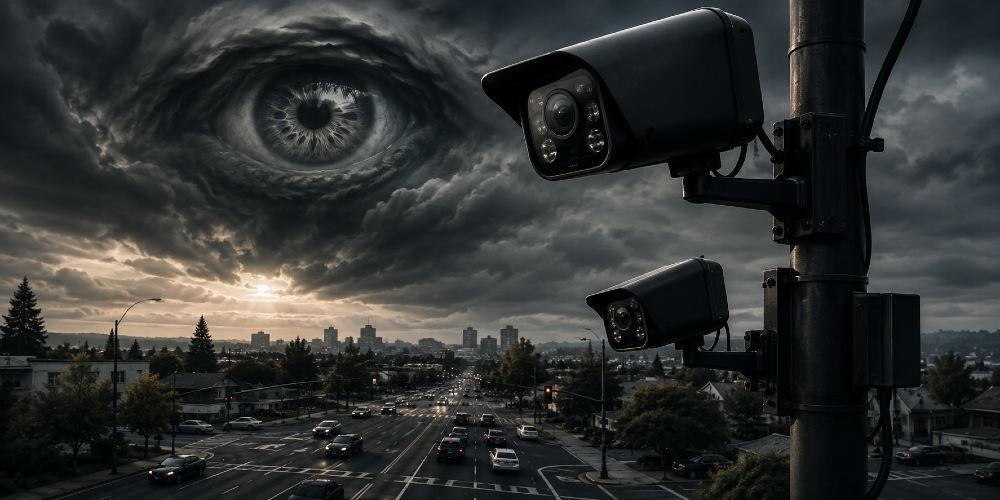
 (DCNF)—Officials across party lines are moving to dismantle the growing network of cameras tracking American drivers.
Several state and federal officials are calling to restrict automated license plate readers (ALPRs), artificial intelligence-powered cameras that scan the plates of passing cars. Pushback to this technology — specifically Flock Safety cameras — has brought together Republicans and Democrats who say these tools amount to warrantless mass surveillance, while law enforcement warns that restricting them would hinder their ability to solve crimes.
At the state level, Texas Republican Gov. Greg Abbott blocked agencies from spending money on the cameras on Aug. 27, according to the Texas Tribune. Similarly, Florida’s Department of Transportation revoked permits for the devices on state highways on Aug. 31 and ordered them removed within 30 days, according to The New York Times.
A total of 201 local communities have canceled or not renewed ALPR contracts since the start of 2025, according to the Institute for Justice’s cancellation list.
“The growing opposition from local city councils to Congress and state legislatures is the direct result of communities across the country standing up against mass surveillance,” Rindala Alajaji, Associate Director of State Affairs at the Electronic Frontier Foundation, told the Daily Caller News Foundation.
She added that opposition to these cameras “crosses every political line because people recognize that turning our streets into a warrantless tracking grid violates fundamental civil liberties.”
Among them was Knox County, Tennessee, where local officials unanimously voted to remove the cameras on Aug 31, according to Knoxville News Sentinel.
“The big issue is that when these cameras are deployed in large numbers … [they] can determine your movements based on this network of cameras,” Mayor of Knox County, Tennessee, Glenn Jacobs said in an August interview with the DCNF, prior to his county’s removal of its Flock cameras.
Pennsylvania’s Bipartisan Efforts
In Pennsylvania, lawmakers have introduced at least nine bills to restrict or ban the cameras, most of them in a matter of weeks.
“These tools can serve legitimate law enforcement purposes, but Pennsylvanians should not have to choose between public safety and their constitutional right to be free from unreasonable government surveillance,” Republican Pennsylvania state Rep. David Rowe, chairman of the House Republican Policy Committee, told the DCNF. “We can—and should—protect both. I believe these bills strike that balance by protecting Pennsylvanians’ privacy while ensuring that police have access to critical information in dire situations.”
Rowe, along with Republican Pennsylvania state Rep. Josh Bashline announced a two-bill package to place “guardrails” on ALPR cameras, according to a July 24 memo from the representatives. One of the bills would establish a local moratorium on the use of ALPR cameras.
The most recent legislation proposed in the state’s senate, sponsored by Democratic state Sens. Nick Pisciotto and Patty Kim, would enforce oversight, accountability for bad actors and protect personal data, according to a joint memo.
This bill would act as a companion to a bipartisan House package led by Democratic Rep. Tarik Khan that would set rules for who can access ALPR data and create civil penalties for misuse, according to an Aug. 10 memo.
Democratic Pennsylvania Gov. Josh Shapiro said Flock cameras are “not something in the public interest,” he told the Center Square on Aug. 28.

California’s ‘Love Affair With Criminals’
Legislators in California failed several times to pass legal guardrails for ALPR cameras in the state since 2022, according to CalMatters.
The most recent of these attempts involved Democratic state Sen. Sabrina Cervantes’s bill, SB 1013, which called for specific safeguards on the technology. The bill was removed from the assembly floor on the final day of the legislative session by Democratic Assembly Majority Leader Cecilia Aguiar-Curry, and a vote never took place, CalMatters reported.
“It’s unfortunate that Senate Bill 1013 did not get the chance to be voted on before the deadline passed, but I look forward to continuing to fight for the privacy rights of Californians next year,” Cervantes told the DCNF.
The senator said this legislation would ensure privacy for Californians, immigrants and other “vulnerable communities,” according to an Aug. 13 press release.
“We need to take action to protect Californians’ personal information when it comes to license plate cameras,” Aguiar-Curry told the DCNF.
She said the holdup was a normal procedural move, and the bill was supposed to be voted on later that day.

“My motion to pause, where I stated we would, ‘come back to the measure later,’ had nothing to do with my personal position on the bill,” Aguiar-Curry told the DCNF, clarifying her position on the legislation. “I do support the policy in SB 1013 and am hopeful the bill is reintroduced in the next legislative session.”
Defenders of the cameras in the state say privacy concerns are overblown and warn that stripping the tool away would cost law enforcement its most effective means of solving crimes.
Riverside County sheriff Chad Bianco, president of the California State Sheriffs’ Association, serves in the same jurisdiction as Cervantes and supports ALPR technology. His sheriffs’ association is among the list of groups opposed to Cervantes’ ALPR bill.
“I am probably one of the biggest proponents of ALPRs. Yeah, I would never employ this type of technology if it was even remotely violating somebody’s constitutional rights, and it’s nowhere close,” Bianco, a former Republican candidate for California governor, told the DCNF.
He argued that claims against these cameras are completely unfounded and are the result of the Left’s “love affair with criminals.”
“[T]his is a massive negative campaign that was created by a very pro-left, pro-criminal agenda that is that has spent a decade removing tools that work in arresting and prosecuting criminals,” the sheriff told the DCNF.
The International Association of Chiefs of Police concurs with Bianco stance on the technology.
“The [IACP] strongly supports the lawful, ethical, transparent, and accountable use of Automated License Plate Recognition (ALPR) technology when it advances legitimate public safety objectives,” The International Association of Chiefs of Police said in an Aug. 20 press release.
The IACP added that these cameras can identify vehicles associated with violent crimes, locate missing and vulnerable community members, and locate stolen property, when used “properly.”
“[E]very single argument for the opposition of these cameras is based on emotion [and] has no factual basis whatsoever,” Bianco claimed. “None. It’s like, well, what if? What if? What if? What if the sky fell tomorrow and we all blew up and died? No one would care anymore.”
He claimed law enforcement failed to step up and present the accurate facts about this technology. Because so few law enforcement officials are willing to speak up about the issue, he argued, a nationwide “misinformation” campaign has spread.
Bianco’s solution is legal repercussions for officers who abuse the technology.
“[M]akes it life in prison if a law enforcement officer does that. I’ll be all for it,” he told the DCNF.
‘Public Pushback Has Hit A Fever Pitch’
At the federal level, Republican Reps. Thomas Massie of Kentucky and Eric Burlison of Missouri introduced the Flock-Off Act, which would bar federal funds for buying or operating ALPRs and give recipients 180 days to shut existing systems down.
“The federal government shouldn’t provide ‘security’ grants to cities and police departments that have gone beyond the pale and turned their communities into a version of 1984,” Massie stated in a Sept. 2 press release.
“Public pushback has hit a fever pitch because of a toxic mix of heightened awareness and corporate tone-deafness,” James Czerniawski, head of emerging technology policy for Consumer Choice Center, told the DCNF. “People are genuinely concerned about being trapped in a dragnet of constant government surveillance.”
Republican Texas Rep. Keith Self has separately pushed the PRIVACY Act, which would require federal agencies to obtain a warrant prior to using ALPR data.
Flock, which have received the majority of public criticism for this technology, defended its cameras.
“Flock’s technology is an important public safety tool for law enforcement agencies across America, helping officers solve serious crimes and find missing people,” a Flock spokesperson told the DCNF.
“We support thoughtful, bipartisan legislation that puts strong privacy, transparency, and accountability guardrails in place while preserving law enforcement’s ability to use technology responsibly to keep people safe,” the spokesperson added.
Critics argue the problem extends well beyond any single company.
“Flock gets the spotlight because they are a market leader, but the underlying issue isn’t tied to just one ALPR company; it’s the business model itself,” Czerniawski told the DCNF. “Any ALPR company building mass-tracking infrastructure faces the same fundamental questions and critiques.”
While Flock Safety is the largest ALPR vendor in the U.S., police departments also partner with Axon, Motorola Solutions’ Vigilant unit, and Rekor for these services, according to the ACLU.
None of the other major vendors are any better, said Alex Marthews, national chair of Restore the Fourth.
“Though Flock Safety is a bad actor in the ALPR space, that doesn’t mean that Axon or Vigilant/Motorola or other providers is better from a privacy perspective,” Marthews told the DCNF, adding that “the whole business model of ALPR firms rests on profiting off of violating your privacy.”
All content created by the Daily Caller News Foundation, an independent and nonpartisan newswire service, is available without charge to any legitimate news publisher that can provide a large audience. All republished articles must include our logo, our reporter’s byline and their DCNF affiliation. For any questions about our guidelines or partnering with us, please contact [email protected].

Two Storms, One Harvest

Every food crisis in living memory has been a one-shock event. The 2008 price spike was a commodity bubble. The 2020 shortages were a logistics failure. The 2022 grain scare was a war on one exporter’s ports. Each time, the system bent, adjusted, and recovered, and each time the experts assured us afterward that global markets are simply too big and too diversified to fail.
What nobody in Washington seems eager to discuss is that 2026 is shaping up to be something the modern food system has never actually faced. Two independent shocks, one climatic and one geopolitical, are converging on the same harvest cycle at the same time. Not sequentially. Simultaneously.
Start with the weather. The Pacific Ocean is currently building toward what forecasters now openly call a record event. NOAA’s Climate Prediction Center puts the odds of at least a strong El Niño near 88 percent, with roughly two in three odds it reaches “very strong” status, the tier reserved for perhaps three or four events in the entire satellite era. Every major global model now projects a median peak in Super El Niño territory, and most of them project it exceeding the 2015-16 event, which until now held the modern record. Sea surface anomalies were already brushing the super threshold in mid-July, months before these events normally peak. The atmosphere has already shifted into El Niño mode, and the event is forecast to crest in late fall and early winter.
This is not about “climate change.” It’s about the standard cycles of weather, and the cycle we’re currently in is one that has likely devastated societies in the past. We’re better prepared as a society today, but not all Americans are equally prepared.
Serious households have started doing the quiet math on their own. Grocery bills tell part of the story, and the forecast maps tell the rest, which is why long-term food storage has moved from fringe hobby to mainstream line item in the family budget, with established suppliers like Heaven’s Harvest seeing demand from people who five years ago would have rolled their eyes at the idea. That instinct is not paranoia. It is pattern recognition, and the pattern is worth walking through carefully.
Editor’s Note: Heaven’s Harvest IS a sponsor, but the warnings of this article are real and would be written even if we didn’t have a survival food sponsor. With that said, those who take advantage of what they offer can use promo code “Patriot” for 15% off.
The Fertilizer Clock Is Already Running
While the Pacific warms, the second shock has been unfolding in the Strait of Hormuz. The conflict with Iran turned the world’s most important energy chokepoint into a contested waterway, and the consequences reach far beyond the gas pump. Roughly a third of global fertilizer trade moves through Hormuz, and the disruption sent urea prices up 86 percent year over year by March, with a 53 percent jump in a single month.
The World Bank projects energy prices rising about 24 percent in 2026 and fertilizer about 31 percent. By its own accounting, fertilizer prices ran 35 percent higher in the first five months of this year than the same period last year.
Here is the mechanism the nightly news will not explain. Fertilizer is not a grocery item. It is a time-delayed input. The nitrogen a farmer in Iowa or Punjab could not afford to apply this spring does not show up as a problem this spring. It shows up as a thinner harvest six to twelve months later.
The World Bank’s own food security brief concedes that the effects of reduced applications earlier this season “are likely to become visible only later in harvest outcomes.” Translate that from institutional language into plain English and it means this. The damage is already done, it is already in the ground, and we are simply waiting for it to arrive on the shelf.
Now check the calendar. Six to twelve months from the spring planting season lands us squarely in late 2026 and early 2027. Which is precisely when the strongest El Niño in the instrumental record is forecast to peak, bringing its signature droughts to Southeast Asia, Australia, southern Africa, northern Brazil, and South Asia, the very regions that grow the world’s rice, sugar, and oilseeds.
The World Bank warns openly that a strong El Niño “could disrupt multiple crop belts simultaneously” on top of the conflict-driven input costs. Their baseline projection assumes the Middle East disruptions ease by autumn. What in the last two years of Middle East history suggests that assumption is safe?
The System Has No Slack Left
The comfortable answer is that global markets always adjust. But adjustment requires slack, and the slack is gone. Global cereal production is expected to decline from last year’s records even before El Niño does its work. The UN World Food Programme, hardly a den of right-wing preppers, is calling this the most significant disruption to its supply chains since Covid and the invasion of Ukraine, and its supply chain director put the stakes bluntly.
Today’s supply chain challenges are tomorrow’s hunger crisis.
There is also a political dimension that markets cannot price. When food gets scarce, governments do not behave like economists. They behave like politicians. Export bans, hoarding mandates, and panic buying at the national level turned the modest rice shortfall of 2008 into a global crisis, and analysts are already warning that import-dependent nations are the first dominoes.
The 2015-16 Super El Niño, a far weaker event than what is now forecast, threw tens of millions into food stress across Africa and Asia. This one is projected to be stronger, and it arrives with fertilizer already rationed by price and shipping lanes already contested by missiles.
What Joseph Knew
Scripture does not treat preparation for lean years as faithlessness. It treats it as wisdom delivered in advance to those willing to act on it.
Behold, there come seven years of great plenty throughout all the land of Egypt: And there shall arise after them seven years of famine; and all the plenty shall be forgotten in the land of Egypt.
Joseph did not respond to that warning with a hashtag or a committee. He stored grain during the years of abundance, and when the famine came, Egypt stood while its neighbors begged. The lesson is not that famine is certain. It is that the time to prepare is precisely when preparation still looks optional.
Nobody who filled a pantry in a year of plenty has ever regretted it, and nobody standing in an empty aisle has ever been glad he waited for certainty.
None of this calls for panic, and panic is the enemy of sound judgment anyway. It calls for the same unglamorous prudence our grandparents considered ordinary. Keep some cash margin, know your local growers, and put real food in deep storage while it is cheap and available, because the entire arc of this story is that cheap and available is a closing window.
Families looking for a straightforward place to start can visit Heaven’s Harvest and use promo code Patriot for 15 percent off long-term storable food. The forecasts may yet soften, the strait may yet reopen, and we should pray they do. But hope is a fine thing to hold and a foolish thing to eat.