

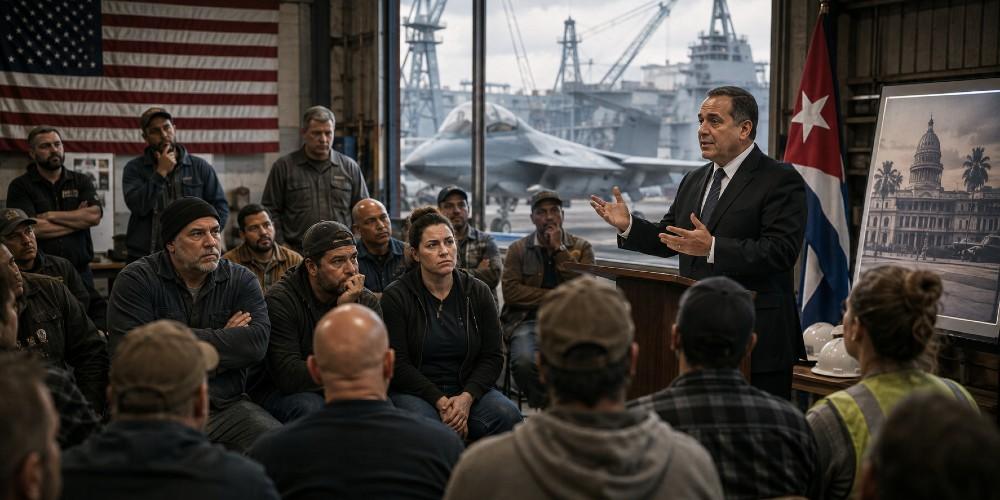
Picture this. American workers who build the aircraft, ships, and equipment our military depends on gather in a California union hall. A diplomat from communist Cuba stands before them. He does not talk about wages or working conditions. He briefs them on how to track legislation, lobby Congress, and push national activism to gut the U.S. embargo and scrub Havana from the State Sponsors of Terrorism list.
That is not a Cold War relic. It happened. And Senator Bill Cassidy is demanding answers.
The International Association of Machinists, which represents roughly 600,000 workers and bills itself as America’s largest and most powerful defense union, is under the microscope. According to Fox News Digital and a formal letter from Cassidy, chairman of the Senate Health, Education, Labor and Pensions Committee, Cuban Embassy second secretary David Ramírez Álvarez addressed IAM members at Machinists Hall in Wilmington, California.
He instructed them on supporting Cuba’s policy priorities and opposing U.S. law.
An IAM representative told the room, “The job now is defending Cuba in whatever way we can.” The same leader later helped push the California AFL-CIO to pass a resolution demanding Cuba’s removal from the terrorism list. The Cuban Embassy itself posted video of him declaring that “we must and will continue to defend the sovereignty of Cuba.”
Cassidy’s letter cuts straight to the point. “I am concerned that IAM Union member dues are financing efforts to change U.S. policy related to the Cuban regime, a State Sponsor of Terror, instead of supporting American workers’ priorities.”
He notes the regime’s responsibility for the deaths of at least three U.S. citizens and one permanent resident when Cuban MiGs destroyed two unarmed Brothers to the Rescue aircraft in 1996. American workers should not be forced to bankroll the foreign policy goals of a hostile power that has American blood on its hands.
The union’s response was pure deflection. It boasted of its defense credentials and military veterans in the ranks, then claimed this is just another “politically motivated attack.”
No serious engagement with the videos. No accounting for why a Cuban diplomat was coaching members on U.S. legislation inside their own hall. No explanation for the coordinated push to rehabilitate a regime that still runs political prisons and exports subversion.
This is not an isolated union stunt. It is one visible thread in a much larger web. The State Department’s recent report, “Cuba: The Capital of 21st Century Communism,” lays out how Havana has spent decades building a sophisticated proxy network aimed at the destruction of American democracy and the permanent erosion of its social fabric.
Unlike Russia or China’s focus on their near abroad, Cuba’s primary target has always been the United States itself. The report details long-term cultivation of American far-left activists, elite capture through university exchanges, exploitation of racial grievances from the Black Panthers onward, and the planting of moles inside the State Department, Pentagon, and National Security Council. Names like Ana Belén Montes still echo for a reason.
The American Spectator correctly frames the scale. Cuba operated terrorist groups, guerrilla armies, radical socialist movements, labor unions, and political parties long before Iran’s revolution. Its intelligence services perfected the art of plausible deniability, flooding Latin America with weapons and propaganda while building parallel influence networks inside the United States.
Front groups staged protests and lobbied Congress during the El Salvador conflict in the 1980s. The same pattern repeats today with organizations linked to the Cuban Institute of Friendship with the Peoples and the National Network on Cuba. Labor contacts are explicitly part of the toolkit. The State Department report notes that Havana leverages union relationships to push for lifting embargoes and removing the terrorism designation.
Secretary of State Marco Rubio has publicly warned that the regime organizes far-left activist networks ready to target American military bases, ICE facilities, and other federal installations. When a defense union starts echoing Havana’s talking points and hosting its diplomats, the national security implications are obvious.

These are the workers who maintain the tools of American power. Their dues should not be diverted into soft power operations for a dictatorship that partners with China on intelligence bases and still dreams of turning the Western Hemisphere against the United States.
Scripture does not leave us guessing about the nature of such campaigns. “For we wrestle not against flesh and blood, but against principalities, against powers, against the rulers of the darkness of this world, against spiritual wickedness in high places” (Ephesians 6:12).
The Cuban regime has always understood that the decisive battlefield is not only kinetic. It is ideological, cultural, and institutional. It seeks to persuade Americans to turn against their own inheritance of ordered liberty under God. When union officials stand in American halls and declare that their job is defending a communist dictatorship, they are not practicing solidarity. They are participating in a long war of attrition designed to weaken the very country that employs them.
Cassidy is right to press for a full accounting: whether union employees coordinated with Cuban officials on the clock, whether any funds moved in either direction, whether lobbying on Cuba policy occurred, and whether leadership has any concern that members are being drawn into a foreign influence scheme.
The IAM’s claim that this is merely humanitarian “solidarity” collapses under the weight of the videos, the resolution, and the broader State Department findings.
American workers who build the machines of national defense deserve better than to have their hard-earned dues funneled into the propaganda apparatus of a State Sponsor of Terrorism. The regime in Havana has never abandoned its core project. It simply adapted the methods.

The question now is whether American institutions, starting with a major defense union, will continue to play along or finally recognize the threat for what it is.
Starting the Day With a Scripture-Inspired Roast Helps Center Your Thoughts on Eternal Truths Amid Temporal Pressures
The world can seem chaotic, especially right after we wake up. Many believers start their mornings reaching for something familiar — a hot cup of coffee — yet end up settling for mediocre brews that do little more than deliver a caffeine jolt. The daily grind of life, with its endless distractions, news cycles, and responsibilities, can leave even the most faithful feeling spiritually parched alongside their physical fatigue. What if your morning ritual could do more than wake you up? What if it could ground you in truth, nourish your body with exceptional quality, and quietly advance a kingdom purpose at the same time?
That’s the promise — and the reality — behind Promised Grounds Coffee. This Christian-founded company doesn’t just roast beans; it approaches every step as an act of worship and discipleship. By selecting only the top 10% of specialty-grade beans, ethically sourced from dedicated farmers in Central and South America, and small-batch roasting them with reverence in Austin, Texas, Promised Grounds delivers what many describe as the best coffee available — never burnt, never bland, but rich with origin stories and layered flavors that honor God’s creation.
From the vibrant Psalm 27 Roast (a light, bright medium option) to the bold yet peaceful 2 Timothy 1:7 Decaf, each bag carries a Scripture verse that turns your daily pour into a gentle reminder of faith. And through their Ounce Per Ounce Promise, every ounce of coffee you enjoy provides an equal ounce of clean water to families in need via partnership with Filter of Hope — literally brewing hope for body and soul, one cup at a time.
The challenge for today’s Christians runs deeper than finding a decent cup. In an age of convenience-driven consumerism, it’s easy to support companies that dilute values or remain silent on matters of faith. Many believers want their everyday choices — from what they drink to how they spend — to reflect discipleship rather than just convenience. Promised Grounds solves this by weaving Christian excellence into the entire process: beans nurtured with prayerful stewardship by farming families, roasted as an offering rather than a commodity, and packaged with Bible verses to encourage a mindset of gratitude and purpose from the first sip. Reviewers consistently praise the smooth, rich profiles — whether enjoyed black in a drip maker, iced on a warm day, or shared in fellowship — noting how the quality stands toe-to-toe with premium secular brands while delivering something far more meaningful.
This integration of faith and flavor addresses a real need in Christian households and ministries. Busy parents, church leaders, and remote workers alike report that starting the day with a Scripture-inspired roast helps center their thoughts on eternal truths amid temporal pressures. The coffee’s exceptional character — bright citrus notes in lighter roasts or deep chocolate undertones in bolder ones — comes from meticulous selection and careful roasting that respects the bean’s natural gifts rather than masking them. It’s the kind of coffee that elevates a simple quiet time, fuels productive workdays, or sparks meaningful conversations when shared at Bible studies or outreach events. And because it’s ethically sourced with integrity, every purchase supports sustainable livelihoods for farmers who treat their crops like family harvests.
For those leading churches or small groups, the impact multiplies. Promised Grounds offers bundles and options perfect for hospitality ministries, turning ordinary coffee service into an opportunity to point people toward the living water of Christ. Imagine greeting visitors with a warm cup whose very bag carries God’s Word — a subtle yet powerful witness that aligns with the Great Commission. The company’s Texas roots and commitment to “brewing hope” resonate especially with believers who value American enterprise paired with global compassion.
Of course, quality alone isn’t enough if the experience feels out of reach. Promised Grounds keeps it accessible with practical perks like free shipping on orders over $40, sample sets for discovering favorites, and thoughtful add-ons such as faith-themed mugs. Whether you prefer whole beans for fresh grinding, grounds for convenience, or even bulk options for larger households and ministries, the result is consistently superior coffee that makes discipleship feel integrated rather than added on.
As you consider how to align even the smallest habits with your walk with God, Promised Grounds Coffee stands out as a refreshing solution. It tackles the dual problems of subpar daily sustenance and disconnected consumption by offering a product that genuinely excels in taste while advancing a mission of clean water, farmer dignity, and scriptural encouragement. Believers who make the switch often describe it as more than a beverage upgrade — it becomes part of their rhythm of gratitude, a daily invitation to remember that every good gift comes from above.
If you’re ready to transform your mornings (and perhaps your church gatherings) with coffee that honors both exceptional craftsmanship and Christian values, I encourage you to explore what Promised Grounds has to offer. One sip at a time, you’ll be nourishing your body, refreshing your spirit, and participating in something far greater — all while enjoying what truly is among the best coffee available.
