


(Reclaim The Net)—Just weeks after Americans criticized the United Kingdom for imposing intrusive and heavy-handed social media rules, Congress is now advancing legislation that raises strikingly similar concerns about government overreach, privacy erosion, and the expansion of online surveillance.
A bipartisan agreement on children’s online safety legislation unveiled by House Energy and Commerce Committee leaders would impose new obligations on social media platforms, while creating powerful incentives for companies to end online anonymity.
The proposal is part of the Kids Internet and Digital Safety Act (KIDS Act), an omnibus package that bundles together multiple bills, including the Kids Online Safety Act (KOSA), the SCREEN Act, the SAFE BOTs Act, COPPA 2.0, the SPY Kids Act, and more, as well as data broker provisions and research and education initiatives.
We obtained a copy of the bill for you here.
Committee Chairman Brett Guthrie and ranking Democrat Frank Pallone announced Monday that they had reached agreement on the legislation, which would require social media companies to provide additional safeguards and parental tools for minors. The lawmakers said it would “hold Big Tech accountable.”
“We worked across the aisle for many months and have now found common ground on policies to significantly improve the digital environment for kids,” Guthrie and Pallone said in a joint statement.
As always, under that framing lies a familiar and deeply controversial approach: imposing broad obligations on platforms that hinge on whether companies know a user is a minor, without clearly defining how that knowledge is supposed to be obtained.
Congress has tried for years to set national rules for social media and youth safety. Those efforts have repeatedly stalled, in part because of unresolved tensions between child protection goals and fundamental privacy rights. In the absence of federal action, states have moved ahead with their own laws, often pushing even more aggressive requirements.
One of the main disputes appears to have been resolved in favor of House Republicans. According to a committee spokesperson, the agreement does not include a “duty of care” provision, a requirement backed by many child-safety advocates and several Senate lawmakers.
The bill text states that nothing in it may be construed to “impose a duty of care on a provider of a covered platform.”
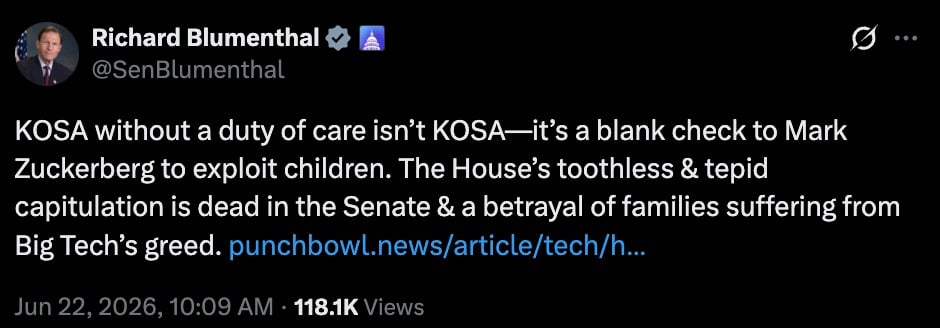
That language has drawn criticism from some Senate supporters who had pushed for stronger requirements. Senator Richard Blumenthal wrote that “KOSA without a duty of care isn’t KOSA.”
Even without that provision, however, the bill still creates a framework that pressures platforms to determine who their users are and how old they are.
The legislation defines “know” or “knows” to mean “to know or should have known.” Similar language appears across multiple sections of the KIDS Act, including provisions covering online platforms, AI chatbots, and gaming services. That standard creates legal risk for companies that fail to identify minors, effectively encouraging them to gather more information about users to avoid liability.
The bill attempts to soften that implication by stating that “Nothing in this subtitle may be construed to require the provider of a covered platform to implement an age gating or age verification functionality on the covered platform.”

But that reassurance rings hollow. Platforms are told they do not have to verify age, while simultaneously being held responsible if they “should have known” a user was a minor. The most obvious way to resolve that contradiction is to collect more data, deploy age-estimation technologies, or introduce identity checks across the board.
Privacy advocates have long warned that this kind of legal structure incentivizes surveillance.
The bill would require platforms that know a user is a minor to provide privacy and safety controls, including tools to limit communications, restrict geolocation sharing, reduce compulsive-use features, and offer options to opt out of personalized recommendation systems.
Default settings for minors must provide what the legislation describes as “the most protective level of control with respect to privacy and safety.”
But those protections depend entirely on platforms being able to identify minors in the first place, raising the question of how much personal data will be collected from all users, not just children, in order to make that determination.
Parents would also receive expanded oversight tools. Platforms would be required to provide account-management controls, time-limit features, notifications about new messaging requests, and other supervisory functions for accounts belonging to minors.

Another provision allows states to enact stronger protections than those set at the federal level.
The bill says nothing prevents a state from enforcing laws that provide “greater protection to minors” than federal requirements. That opens the door to an increasingly fragmented regulatory outlook, where companies must comply with a patchwork of state laws, many of which may impose stricter identity verification or access restrictions.
For users, that could mean more aggressive data collection and fewer opportunities for anonymous or pseudonymous participation online, depending on where they live.
The measure also includes language on encryption. It states that platform requirements may not override encrypted communications and that companies must comply in ways that “do not compromise the integrity of strong encryption.”
While that language appears protective on its face, privacy advocates have repeatedly warned that indirect regulatory pressure can still lead companies to weaken encryption in practice, particularly if compliance requires monitoring user behavior or identifying specific categories of users.
Congress has struggled to pass comprehensive social media legislation and states have filled the gap. According to the National Conference of State Legislatures, at least 20 states enacted laws in 2025 addressing children’s use of social media.
A December 2025 Pew Research Center report found that Snapchat, Instagram, YouTube, and TikTok remain the most widely used online platforms among Americans ages 13 to 17.
Meta and Google declined to comment on the bipartisan agreement. Snap and TikTok did not immediately respond to requests for comment.
The legislation also comes as major technology companies face thousands of lawsuits alleging that social media products harmed young users.
The agreement still faces hurdles before becoming law, including Senate approval and President Donald Trump’s signature.

Starting the Day With a Scripture-Inspired Roast Helps Center Your Thoughts on Eternal Truths Amid Temporal Pressures
The world can seem chaotic, especially right after we wake up. Many believers start their mornings reaching for something familiar — a hot cup of coffee — yet end up settling for mediocre brews that do little more than deliver a caffeine jolt. The daily grind of life, with its endless distractions, news cycles, and responsibilities, can leave even the most faithful feeling spiritually parched alongside their physical fatigue. What if your morning ritual could do more than wake you up? What if it could ground you in truth, nourish your body with exceptional quality, and quietly advance a kingdom purpose at the same time?
That’s the promise — and the reality — behind Promised Grounds Coffee. This Christian-founded company doesn’t just roast beans; it approaches every step as an act of worship and discipleship. By selecting only the top 10% of specialty-grade beans, ethically sourced from dedicated farmers in Central and South America, and small-batch roasting them with reverence in Austin, Texas, Promised Grounds delivers what many describe as the best coffee available — never burnt, never bland, but rich with origin stories and layered flavors that honor God’s creation.
From the vibrant Psalm 27 Roast (a light, bright medium option) to the bold yet peaceful 2 Timothy 1:7 Decaf, each bag carries a Scripture verse that turns your daily pour into a gentle reminder of faith. And through their Ounce Per Ounce Promise, every ounce of coffee you enjoy provides an equal ounce of clean water to families in need via partnership with Filter of Hope — literally brewing hope for body and soul, one cup at a time.
The challenge for today’s Christians runs deeper than finding a decent cup. In an age of convenience-driven consumerism, it’s easy to support companies that dilute values or remain silent on matters of faith. Many believers want their everyday choices — from what they drink to how they spend — to reflect discipleship rather than just convenience. Promised Grounds solves this by weaving Christian excellence into the entire process: beans nurtured with prayerful stewardship by farming families, roasted as an offering rather than a commodity, and packaged with Bible verses to encourage a mindset of gratitude and purpose from the first sip. Reviewers consistently praise the smooth, rich profiles — whether enjoyed black in a drip maker, iced on a warm day, or shared in fellowship — noting how the quality stands toe-to-toe with premium secular brands while delivering something far more meaningful.
This integration of faith and flavor addresses a real need in Christian households and ministries. Busy parents, church leaders, and remote workers alike report that starting the day with a Scripture-inspired roast helps center their thoughts on eternal truths amid temporal pressures. The coffee’s exceptional character — bright citrus notes in lighter roasts or deep chocolate undertones in bolder ones — comes from meticulous selection and careful roasting that respects the bean’s natural gifts rather than masking them. It’s the kind of coffee that elevates a simple quiet time, fuels productive workdays, or sparks meaningful conversations when shared at Bible studies or outreach events. And because it’s ethically sourced with integrity, every purchase supports sustainable livelihoods for farmers who treat their crops like family harvests.
For those leading churches or small groups, the impact multiplies. Promised Grounds offers bundles and options perfect for hospitality ministries, turning ordinary coffee service into an opportunity to point people toward the living water of Christ. Imagine greeting visitors with a warm cup whose very bag carries God’s Word — a subtle yet powerful witness that aligns with the Great Commission. The company’s Texas roots and commitment to “brewing hope” resonate especially with believers who value American enterprise paired with global compassion.
Of course, quality alone isn’t enough if the experience feels out of reach. Promised Grounds keeps it accessible with practical perks like free shipping on orders over $40, sample sets for discovering favorites, and thoughtful add-ons such as faith-themed mugs. Whether you prefer whole beans for fresh grinding, grounds for convenience, or even bulk options for larger households and ministries, the result is consistently superior coffee that makes discipleship feel integrated rather than added on.
As you consider how to align even the smallest habits with your walk with God, Promised Grounds Coffee stands out as a refreshing solution. It tackles the dual problems of subpar daily sustenance and disconnected consumption by offering a product that genuinely excels in taste while advancing a mission of clean water, farmer dignity, and scriptural encouragement. Believers who make the switch often describe it as more than a beverage upgrade — it becomes part of their rhythm of gratitude, a daily invitation to remember that every good gift comes from above.
If you’re ready to transform your mornings (and perhaps your church gatherings) with coffee that honors both exceptional craftsmanship and Christian values, I encourage you to explore what Promised Grounds has to offer. One sip at a time, you’ll be nourishing your body, refreshing your spirit, and participating in something far greater — all while enjoying what truly is among the best coffee available.
