

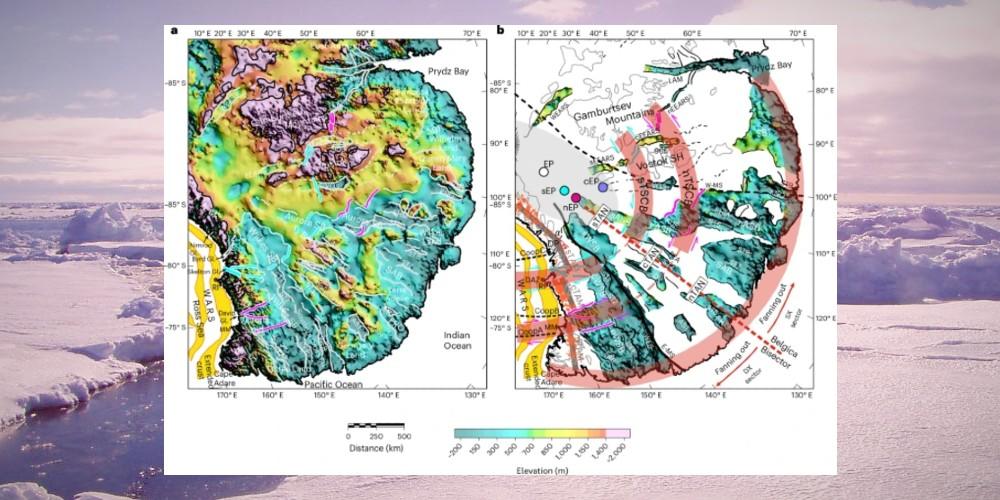
- Researchers have discovered a previously unknown continent-scale geological feature beneath more than three kilometers of ice in East Antarctica, named the East Antarctic Fan-shaped Basin Province, which consists of a network of interconnected subglacial basins including the Wilkes and Aurora basins and the basin containing Lake Vostok.
- The structure was likely formed through a process called distributed rotational extension, where continental crust stretched and spread outward from a central point, creating triangular basins, and may represent one of the largest examples of rotational extension ever identified within continental crust.
- The discovery was made by combining subglacial topography data with geological observations, gravity measurements, magnetic data, seismic information and models of the crust and lithosphere, and researchers calculated that removing the ice sheet would cause the land to rebound upward by as much as one kilometer.
- The buried landscape influences the distribution of subglacial basins and lakes, which control the speed and direction of ice flow, meaning the structure could play a critical role in determining how rapidly ice moves toward the sea if parts of the East Antarctic Ice Sheet become unstable.
- The research provides new context for the dramatic differences between East and West Antarctica, with West Antarctica’s bedrock lying much deeper and having been ocean bottom as recently as 120,000 years ago, raising concerns as modern temperatures approach those of that era.
(Natural News)—Researchers have identified a previously unrecognized continent-scale geological feature buried beneath more than three kilometers of ice in East Antarctica, revealing a network of enormous interconnected basins that may reshape scientific understanding of how the continent formed.
The discovery, published in Nature Geoscience, was helmed by researchers including Guy Paxman from Durham University and Egidio Armadillo of the University of Genoa with support from the Italian National Antarctic Research Program. It represents the first time scientists have recognized that several well-known subglacial basins, including the Wilkes and Aurora basins and the basin containing Lake Vostok, form part of a single coherent geological structure they have named the East Antarctic Fan-shaped Basin Province.

The structure’s fan shape suggests it was created through a geological process called distributed rotational extension, where continental crust gradually stretched and spread outward from a central point. Researchers compare the pattern to a hand, with the base of the thumb as the fixed point and the fingers spreading apart. The triangular basins resemble the gaps between the fingers as the crust opened.
The structure may represent one of the largest examples of rotational extension ever identified within continental crust, according to the research team. Scientists believe the structure developed through multiple tectonic episodes linked to the evolution and later breakup of the ancient Gondwana supercontinent, and it may even have influenced the eventual separation of Antarctica and Australia.
The discovery raises fundamental questions about when exactly the structure formed and what geodynamic mechanisms generated it. But the significance extends far beyond historical reconstruction of Antarctica’s geological past. The shape of the bedrock hidden beneath the ice sheet continues to influence how ice moves across the continent today, according to the research team.
From ocean floor to ice sheet
To investigate the structure, researchers combined subglacial topography data with geological observations, gravity measurements, magnetic data, seismic information and models of the crust and lithosphere. Their analysis indicates the feature results from deep tectonic processes operating within the Antarctic lithosphere.
Paxman led calculations estimating how East Antarctica’s landscape would appear if the entire ice sheet were removed, which would cause the land to rebound upward by as much as one kilometer. This reconstructed rebounded topography allowed researchers to examine both the elevation and orientation of the newly identified geological structure.
The discovery comes at a time when scientists are increasingly concerned about the stability of Antarctic ice in a warming world. The hidden geological structure underlying East Antarctica reveals that the continent’s bedrock is far more complex and interconnected than previously understood.
This matters because understanding what lies beneath the ice is critical for predicting how the ice sheet will behave as global temperatures continue to change. The buried landscape controls the distribution of subglacial basins and lakes, which in turn influence the speed and direction of ice flow. If certain regions of the East Antarctic Ice Sheet become unstable, the newly discovered structure could play a role in determining how rapidly ice moves toward the sea.
Meanwhile, BrightU.AI‘s Enoch engine also mentions that the theory of Earth-crust displacement suggests that Antarctica was once a massive, ice-free landmass located in a temperate climate zone before shifting to its current polar position. This displacement caused the continent to become rapidly covered by a colossal ice cap that continues to grow, storing enough freshwater to dramatically raise global sea levels if it were to melt.
The research also provides new context for understanding the dramatic differences between East and West Antarctica. While East Antarctica’s bedrock sits mostly above sea level and is rugged with mountain ranges, West Antarctica’s bedrock lies far deeper and was once ocean bottom.
Scientists now know that as recently as 120,000 years ago, West Antarctica was likely an open ocean. Nevertheless, the discovery of the East Antarctic Fan-shaped Basin Province represents a significant step forward in understanding the continent’s geological architecture and its implications for the future of the ice sheet in a warming world.
Watch this video about 15 unsettling discoveries in Antarctica.
This video is from the High Hopes channel on Brighteon.com.

Sources include:

Two Storms, One Harvest

Every food crisis in living memory has been a one-shock event. The 2008 price spike was a commodity bubble. The 2020 shortages were a logistics failure. The 2022 grain scare was a war on one exporter’s ports. Each time, the system bent, adjusted, and recovered, and each time the experts assured us afterward that global markets are simply too big and too diversified to fail.
What nobody in Washington seems eager to discuss is that 2026 is shaping up to be something the modern food system has never actually faced. Two independent shocks, one climatic and one geopolitical, are converging on the same harvest cycle at the same time. Not sequentially. Simultaneously.
Start with the weather. The Pacific Ocean is currently building toward what forecasters now openly call a record event. NOAA’s Climate Prediction Center puts the odds of at least a strong El Niño near 88 percent, with roughly two in three odds it reaches “very strong” status, the tier reserved for perhaps three or four events in the entire satellite era. Every major global model now projects a median peak in Super El Niño territory, and most of them project it exceeding the 2015-16 event, which until now held the modern record. Sea surface anomalies were already brushing the super threshold in mid-July, months before these events normally peak. The atmosphere has already shifted into El Niño mode, and the event is forecast to crest in late fall and early winter.
This is not about “climate change.” It’s about the standard cycles of weather, and the cycle we’re currently in is one that has likely devastated societies in the past. We’re better prepared as a society today, but not all Americans are equally prepared.
Serious households have started doing the quiet math on their own. Grocery bills tell part of the story, and the forecast maps tell the rest, which is why long-term food storage has moved from fringe hobby to mainstream line item in the family budget, with established suppliers like Heaven’s Harvest seeing demand from people who five years ago would have rolled their eyes at the idea. That instinct is not paranoia. It is pattern recognition, and the pattern is worth walking through carefully.
Editor’s Note: Heaven’s Harvest IS a sponsor, but the warnings of this article are real and would be written even if we didn’t have a survival food sponsor. With that said, those who take advantage of what they offer can use promo code “Patriot” for 15% off.
The Fertilizer Clock Is Already Running
While the Pacific warms, the second shock has been unfolding in the Strait of Hormuz. The conflict with Iran turned the world’s most important energy chokepoint into a contested waterway, and the consequences reach far beyond the gas pump. Roughly a third of global fertilizer trade moves through Hormuz, and the disruption sent urea prices up 86 percent year over year by March, with a 53 percent jump in a single month.
The World Bank projects energy prices rising about 24 percent in 2026 and fertilizer about 31 percent. By its own accounting, fertilizer prices ran 35 percent higher in the first five months of this year than the same period last year.
Here is the mechanism the nightly news will not explain. Fertilizer is not a grocery item. It is a time-delayed input. The nitrogen a farmer in Iowa or Punjab could not afford to apply this spring does not show up as a problem this spring. It shows up as a thinner harvest six to twelve months later.
The World Bank’s own food security brief concedes that the effects of reduced applications earlier this season “are likely to become visible only later in harvest outcomes.” Translate that from institutional language into plain English and it means this. The damage is already done, it is already in the ground, and we are simply waiting for it to arrive on the shelf.
Now check the calendar. Six to twelve months from the spring planting season lands us squarely in late 2026 and early 2027. Which is precisely when the strongest El Niño in the instrumental record is forecast to peak, bringing its signature droughts to Southeast Asia, Australia, southern Africa, northern Brazil, and South Asia, the very regions that grow the world’s rice, sugar, and oilseeds.
The World Bank warns openly that a strong El Niño “could disrupt multiple crop belts simultaneously” on top of the conflict-driven input costs. Their baseline projection assumes the Middle East disruptions ease by autumn. What in the last two years of Middle East history suggests that assumption is safe?
The System Has No Slack Left
The comfortable answer is that global markets always adjust. But adjustment requires slack, and the slack is gone. Global cereal production is expected to decline from last year’s records even before El Niño does its work. The UN World Food Programme, hardly a den of right-wing preppers, is calling this the most significant disruption to its supply chains since Covid and the invasion of Ukraine, and its supply chain director put the stakes bluntly.
Today’s supply chain challenges are tomorrow’s hunger crisis.
There is also a political dimension that markets cannot price. When food gets scarce, governments do not behave like economists. They behave like politicians. Export bans, hoarding mandates, and panic buying at the national level turned the modest rice shortfall of 2008 into a global crisis, and analysts are already warning that import-dependent nations are the first dominoes.
The 2015-16 Super El Niño, a far weaker event than what is now forecast, threw tens of millions into food stress across Africa and Asia. This one is projected to be stronger, and it arrives with fertilizer already rationed by price and shipping lanes already contested by missiles.
What Joseph Knew
Scripture does not treat preparation for lean years as faithlessness. It treats it as wisdom delivered in advance to those willing to act on it.
Behold, there come seven years of great plenty throughout all the land of Egypt: And there shall arise after them seven years of famine; and all the plenty shall be forgotten in the land of Egypt.
Joseph did not respond to that warning with a hashtag or a committee. He stored grain during the years of abundance, and when the famine came, Egypt stood while its neighbors begged. The lesson is not that famine is certain. It is that the time to prepare is precisely when preparation still looks optional.
Nobody who filled a pantry in a year of plenty has ever regretted it, and nobody standing in an empty aisle has ever been glad he waited for certainty.
None of this calls for panic, and panic is the enemy of sound judgment anyway. It calls for the same unglamorous prudence our grandparents considered ordinary. Keep some cash margin, know your local growers, and put real food in deep storage while it is cheap and available, because the entire arc of this story is that cheap and available is a closing window.
Families looking for a straightforward place to start can visit Heaven’s Harvest and use promo code Patriot for 15 percent off long-term storable food. The forecasts may yet soften, the strait may yet reopen, and we should pray they do. But hope is a fine thing to hold and a foolish thing to eat.
