

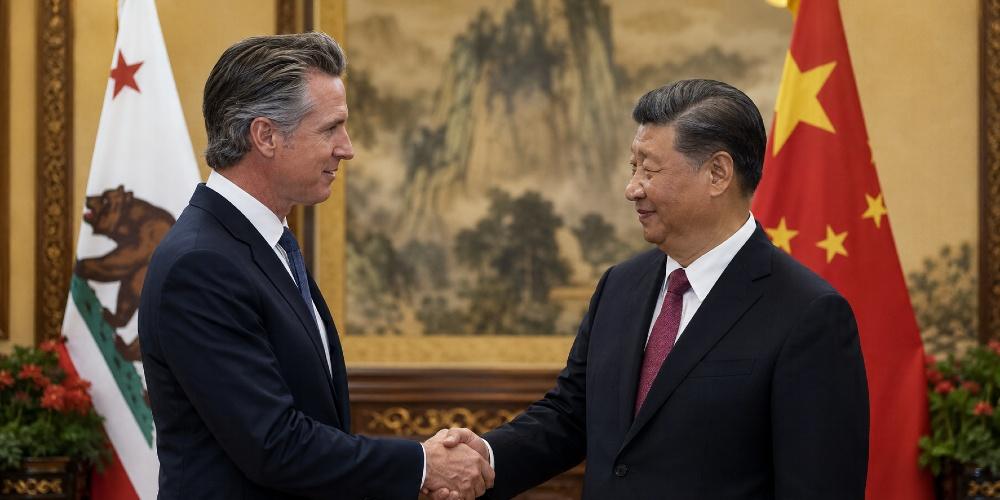
When Xi Jinping rolled out the red carpet for Gavin Newsom inside the Great Hall of the People in October 2023, the staging told you everything you needed to know about who the meeting was actually for. The general secretary of the Chinese Communist Party does not summon backbench governors for ceremonial handshakes. He receives heads of state. And the American official sitting across from him that day was not a head of state. He was the governor of one state in a federal union, traveling on what his own office called a “subnational” diplomatic mission to a hostile foreign power.
The visit was sold to the American public as climate cooperation. What it actually accomplished was a global audition for a 2028 presidential run, a parallel foreign policy track that the Constitution explicitly forbids, and a deepening of California’s regulatory marriage to a regime that runs slave-labor camps in Xinjiang and exports the fentanyl precursors killing tens of thousands of Americans every year. The mainstream press treated it as a charming diplomatic detour. It was nothing of the kind.
Newsom’s weeklong tour produced five memoranda of understanding signed with the National Development and Reform Commission and the provinces and municipalities of Guangdong, Jiangsu, Shanghai, and Beijing. He met with Vice Premier Han Zheng, Foreign Minister Wang Yi, and Xi himself. The Office of the Governor of California posted on social media that “divorce is not an option” between California and Beijing. That was not a throwaway line. It was a statement of policy.
The Red Carpet a Governor Should Not Get
Set the China trip against the backdrop of what Newsom was governing at home. California was bleeding population for the third consecutive year. Retail theft had become so normalized that chains were closing flagship stores in San Francisco.
The state was staring down a multibillion-dollar budget deficit, the homeless encampments were metastasizing, and the energy grid was rationing power during heat waves. The governor’s response was to spend a week in Beijing posing for photographs with the men running the Uyghur internment system.
The Christian Science Monitor noted that some analysts read the trip as “a bit of political theater” for a politician with presidential aspirations. That was the polite framing. The honest framing is that Xi Jinping does not host political theater. He hosts ambassadors of regimes he wants to influence, and Newsom was auditioning for the part.
Article I, Section 10, and the Constitution Nobody Cites Anymore
The Constitution is unambiguous on this point. Article I, Section 10 states that “No State shall enter into any Treaty, Alliance, or Confederation” and that no state shall, without the consent of Congress, “enter into any Agreement or Compact with another State, or with a foreign Power.” The Founders understood that fifty governors freelancing their own foreign policy with hostile regimes was the road to dissolution.
The Newsom administration and its defenders will protest that an MOU is non-binding. That is technically true, and the California Globe pointed out the obvious reason it has to be true. The governor of one state lacks the constitutional authority to make treaties with foreign nations.
So the question writes itself. If the agreements are non-binding theater, why fly to Beijing to sign them? The answer is that the document is not the point. The relationship is the point. The optics are the point. The signal to global capital and to the Chinese government that California will operate as a parallel diplomatic channel, independent of Washington, is the point.
The Logan Act, which criminalizes unauthorized negotiation with foreign governments, has not been seriously enforced in two centuries. But the principle it was written to protect, that the United States speaks with one voice abroad, is being shredded by governors who have decided that federalism runs in only one direction.
Campaign for Democracy and the Donor Class
The financial architecture of Newsom’s national ambitions runs through Campaign for Democracy, the super PAC he launched in 2023 with a transfer from his gubernatorial campaign. The Washington Examiner reported that the PAC began 2025 with $6.1 million in cash and ended the year with roughly $7.7 million, the kind of warchest you accumulate when you are conserving resources for a national race rather than spending them on the current cycle.
The Examiner also documented that LSN Partners and its managing partner Alexander Heckler each donated $50,000 to the PAC in September 2025. LSN’s own marketing describes the firm as “singularly focused on positioning our clients to secure government contracts.”
Translation: a firm that profits from access to state government is funneling money to the governor’s national political vehicle while he still controls the state government. This is not a scandal in any one transaction. It is the scandal of the entire model.
Netflix co-founder Reed Hastings has already publicly endorsed Newsom as the 2028 candidate. The Hollywood and Silicon Valley donor class is lining up behind him because he is exactly the candidate they want: a governor with executive experience, a media-friendly face, a track record of regulatory aggression that benefits incumbent tech players, and a willingness to manage relationships with China that the donor class needs preserved for its supply chains and capital flows.

The Green Accord as Globalist Blueprint
The substance of the China MOUs is climate policy. That is not as benign as it sounds. The “Declaration of Enhanced Subnational Climate Action and Cooperation Between the State of California and the People’s Republic of China” is, by California’s own description, the first declaration of its kind between China and a subnational government. Its purpose is to align California’s regulatory framework with Chinese industrial planning under the banner of carbon neutrality.
This is the same regulatory architecture that produced California’s 2035 ban on internal combustion vehicles, the rolling blackouts, the energy costs that are now double the national average, and a tax-and-fee structure that has driven working families out of the state.
The framework was not designed by California voters. It was designed by an international climate diplomacy apparatus that treats elected legislatures as obstacles to be routed around. When the World Resources Institute and the Under2 Coalition set the targets, and Sacramento implements them, the citizen has been removed from the loop.
The 2028 Audition
Xi Jinping does not waste his time. The audience he granted Newsom was an investment, and the investment was in establishing a back-channel relationship with the man Beijing has identified as the most plausible Democratic president of the next decade. The Chinese government plays a long game, and from their perspective, four years of a Newsom presidency would be worth far more than five non-binding MOUs.
The American donor class has reached the same conclusion. The polls now show Newsom leading the 2028 Democratic primary field. The endorsements from figures like Hastings are arriving early because the shadow campaign is already underway. The book tour, the cross-country travel, the digital ad buys through Campaign for Democracy, the public feuds with the Trump administration designed to generate national earned media. Every piece of it is positioning for a race he has not yet officially entered.
Hosea wrote of the leaders of Israel that “Ephraim also is like a silly dove without heart: they call to Egypt, they go to Assyria.” The pattern is ancient. Leaders who lose confidence in their covenant with their own people start running to foreign powers for validation, for capital, for the appearance of strength they cannot generate at home.

California is hemorrhaging residents and businesses, and its governor’s answer is to fly to Beijing and sign agreements with the regime that is arming our adversaries and poisoning our cities with fentanyl. The remedy is not more international cooperation. The remedy is legislative oversight of governor-led foreign engagement, transparency on the donor networks funding shadow campaigns, and a recovery of the constitutional principle that the United States, not fifty freelancing governors, conducts foreign policy.
The voters of 2028 should know exactly what they are being asked to ratify before they cast a single ballot.
Starting the Day With a Scripture-Inspired Roast Helps Center Your Thoughts on Eternal Truths Amid Temporal Pressures
The world can seem chaotic, especially right after we wake up. Many believers start their mornings reaching for something familiar — a hot cup of coffee — yet end up settling for mediocre brews that do little more than deliver a caffeine jolt. The daily grind of life, with its endless distractions, news cycles, and responsibilities, can leave even the most faithful feeling spiritually parched alongside their physical fatigue. What if your morning ritual could do more than wake you up? What if it could ground you in truth, nourish your body with exceptional quality, and quietly advance a kingdom purpose at the same time?
That’s the promise — and the reality — behind Promised Grounds Coffee. This Christian-founded company doesn’t just roast beans; it approaches every step as an act of worship and discipleship. By selecting only the top 10% of specialty-grade beans, ethically sourced from dedicated farmers in Central and South America, and small-batch roasting them with reverence in Austin, Texas, Promised Grounds delivers what many describe as the best coffee available — never burnt, never bland, but rich with origin stories and layered flavors that honor God’s creation.
From the vibrant Psalm 27 Roast (a light, bright medium option) to the bold yet peaceful 2 Timothy 1:7 Decaf, each bag carries a Scripture verse that turns your daily pour into a gentle reminder of faith. And through their Ounce Per Ounce Promise, every ounce of coffee you enjoy provides an equal ounce of clean water to families in need via partnership with Filter of Hope — literally brewing hope for body and soul, one cup at a time.
The challenge for today’s Christians runs deeper than finding a decent cup. In an age of convenience-driven consumerism, it’s easy to support companies that dilute values or remain silent on matters of faith. Many believers want their everyday choices — from what they drink to how they spend — to reflect discipleship rather than just convenience. Promised Grounds solves this by weaving Christian excellence into the entire process: beans nurtured with prayerful stewardship by farming families, roasted as an offering rather than a commodity, and packaged with Bible verses to encourage a mindset of gratitude and purpose from the first sip. Reviewers consistently praise the smooth, rich profiles — whether enjoyed black in a drip maker, iced on a warm day, or shared in fellowship — noting how the quality stands toe-to-toe with premium secular brands while delivering something far more meaningful.
This integration of faith and flavor addresses a real need in Christian households and ministries. Busy parents, church leaders, and remote workers alike report that starting the day with a Scripture-inspired roast helps center their thoughts on eternal truths amid temporal pressures. The coffee’s exceptional character — bright citrus notes in lighter roasts or deep chocolate undertones in bolder ones — comes from meticulous selection and careful roasting that respects the bean’s natural gifts rather than masking them. It’s the kind of coffee that elevates a simple quiet time, fuels productive workdays, or sparks meaningful conversations when shared at Bible studies or outreach events. And because it’s ethically sourced with integrity, every purchase supports sustainable livelihoods for farmers who treat their crops like family harvests.
For those leading churches or small groups, the impact multiplies. Promised Grounds offers bundles and options perfect for hospitality ministries, turning ordinary coffee service into an opportunity to point people toward the living water of Christ. Imagine greeting visitors with a warm cup whose very bag carries God’s Word — a subtle yet powerful witness that aligns with the Great Commission. The company’s Texas roots and commitment to “brewing hope” resonate especially with believers who value American enterprise paired with global compassion.
Of course, quality alone isn’t enough if the experience feels out of reach. Promised Grounds keeps it accessible with practical perks like free shipping on orders over $40, sample sets for discovering favorites, and thoughtful add-ons such as faith-themed mugs. Whether you prefer whole beans for fresh grinding, grounds for convenience, or even bulk options for larger households and ministries, the result is consistently superior coffee that makes discipleship feel integrated rather than added on.
As you consider how to align even the smallest habits with your walk with God, Promised Grounds Coffee stands out as a refreshing solution. It tackles the dual problems of subpar daily sustenance and disconnected consumption by offering a product that genuinely excels in taste while advancing a mission of clean water, farmer dignity, and scriptural encouragement. Believers who make the switch often describe it as more than a beverage upgrade — it becomes part of their rhythm of gratitude, a daily invitation to remember that every good gift comes from above.
If you’re ready to transform your mornings (and perhaps your church gatherings) with coffee that honors both exceptional craftsmanship and Christian values, I encourage you to explore what Promised Grounds has to offer. One sip at a time, you’ll be nourishing your body, refreshing your spirit, and participating in something far greater — all while enjoying what truly is among the best coffee available.
