

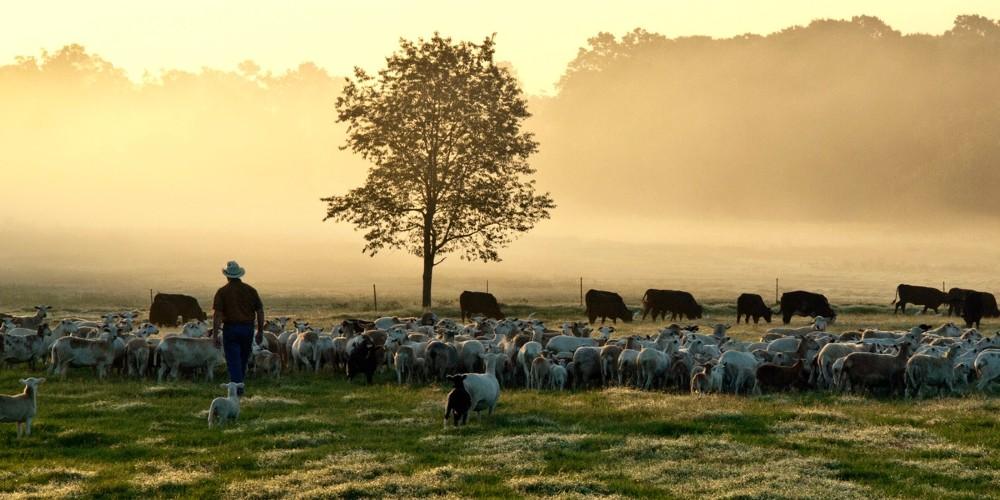
(The Epoch Times)—On a calm late winter morning after a severe thunderstorm passed through hours before, Will Harris navigates the secluded and narrow red clay roads that wind around White Oak Pastures.
With his Deep South tone, the 71-year-old rancher laments at what he sees as he guides his dusty Jeep pickup truck around the maze of downed trees. Minutes later, standing in a vibrant green paddock, he marvels at another sight.
“Just about everything I see here makes me feel good,” he said. “Eagles flying across. Squirrels playing in the trees. Cattle grazing. It makes me feel good to see farm animals and wildlife expressing instinctive behaviors. It makes me feel good to know what we are doing here.”
Three generations of Harris’s family before him raised cattle on this land in the tiny village of Bluffton, which counted 113 residents in the 2020 census. It’s where his great-grandfather settled in 1866.
His adult daughters represent the fifth generation, and at least a few grandchildren will likely continue the tradition, he said.
Today, White Oak Pastures is a pilgrimage destination for conventional farmers who want to transition to regenerative methods. The family, along with 180 employees, operates what Harris calls a thriving 5,000-acre ecosystem.
It wasn’t always like that.
Heavy Industrial Farming
White Oak Pastures was a conventional farm until the mid-1990s. Harris relied heavily on chemicals, pesticides, and antibiotics. He gradually started the transition to regenerative methods, which prioritize building and preserving healthy soils, avoiding synthetic fertilizers and pesticides, and implementing minimal or no tilling.
“You know, I’m different from most of the people that I know in this sustainable, humane food movement. I’m one of the good ole boys that produced food industrially for years, took a risk, and embraced a shift in mindset,” said Harris, the author of “A Bold Return to Giving a Damn: One Farm, Six Generations, and the Future of Food.”
Harris has an office in a small old courthouse in the center of Bluffton. One wall is adorned with portraits of previous generations who tended the land here.
Capt. James Edward Harris founded the family farm soon after the Civil War.

Will Carter Harris, James’s son, took over in the early 20th century.
Will Bell Harris, the current owner’s father, took over after World War II. That is when chemical fertilizers and pesticides were introduced and the slaughtering process became more centralized, Will Harris said.
For example, every year from 1946 until 2003, the Harris family applied ammonium nitrate on every acre.

Harris graduated from the University of Georgia’s College of Agriculture in 1976. His father said he had to work elsewhere before returning full time to the farm, so he ascended to regional manager for one of the world’s largest meat producers.
Along the way, he continued to work at White Oak. Some days, after eight hours at the meat production company, he completed another eight on the family farm.
In 1995, as his health declined, Will Bell Harris handed the farm’s leadership role to his son.
The Switch to Regenerative Methods
The younger Harris continued to manage White Oak with “heavy industrial” practices, but in the mid-1990s, he started to feel a need for change. He was unsure what the adjustments would look like, and the path to full regenerative farming was gradual.
“The first thing we did was give up hormonal implants, subtherapeutic antibiotics, and confinement feeding of corn. I liked it better,” Harris said.
In 2003, White Oak stopped using chemical fertilizers and pesticides on the pastures.

Harris acknowledges that the farm’s pastures looked awful, but two years later, the soil started to flourish, as did the farm’s bottom line.
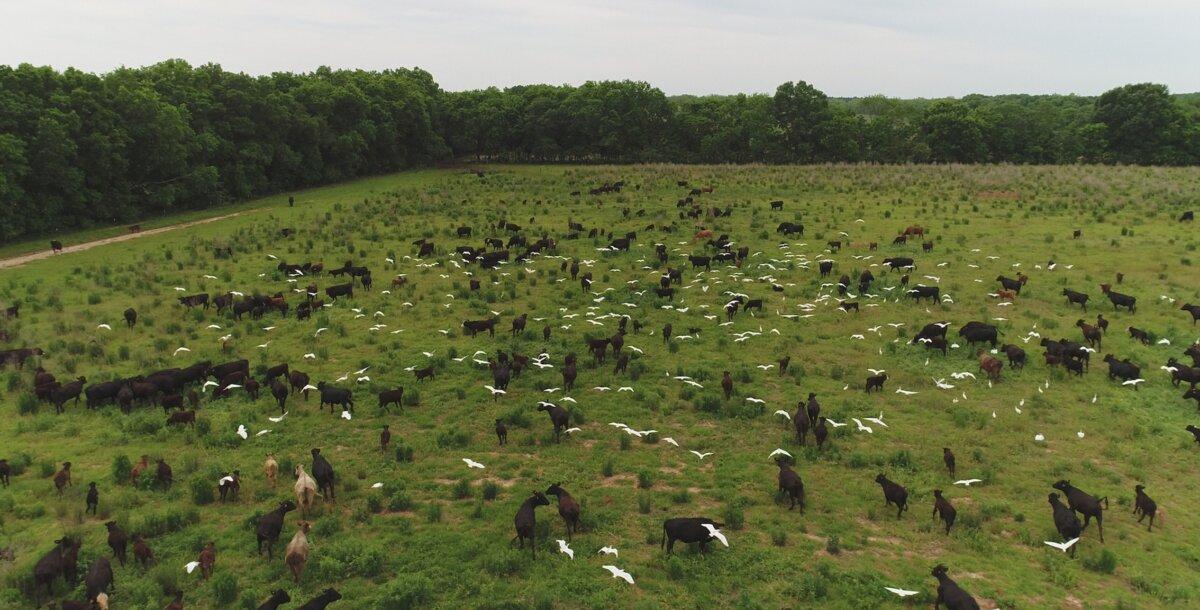
White Oak introduced sheep in 2005, incorporating the long-standing idea that raising multiple species on a single farm benefits the animals and the land.
At this point, White Oak’s herds were roaming freely and foraging instinctively, but Harris was no longer comfortable with how they were being slaughtered.
He wanted a method other than loading calves he had raised onto double-decker trucks, where they would travel hundreds of miles in cramped conditions to slaughterhouses operated by one of the four agribusiness giants—Tyson, Cargill, JBS, and National Beef—which process more than four-fifths of the nation’s beef.
This led Harris to take a mammoth leap of faith. He hired animal welfare expert Temple Grandin to design a slaughterhouse to be constructed at White Oak. To fund the project, he borrowed $7.5 million, using the land as collateral. It debuted in 2008.
Betting the Farm
Harris acknowledges he figuratively and literally “bet the farm.”
“When you’re a privately owned business, every time you look at a big investment, you bet the farm,” he said. “You bet your house and your daughter’s house. You take a chance and hope it pays off.”
White Oak lost money for “four or five years,” but he was never late paying his bills, he noted. The farm started making a profit again and kept growing.
Harris added chickens to the farm in 2010 and built a second slaughterhouse solely for poultry. That is currently being remodeled and will re-open on June 1.
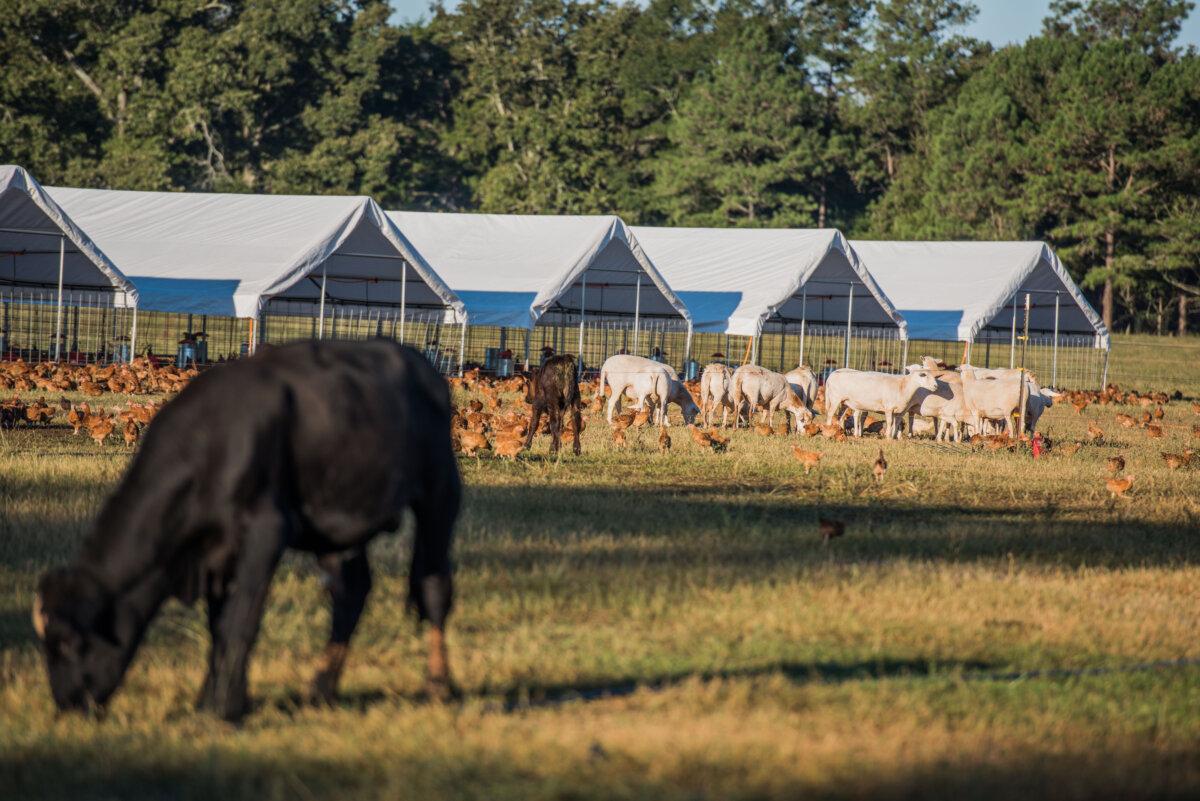
White Oak now has cattle, sheep, chickens, hogs, goats, rabbits, ducks, guineas, geese, and turkeys. Except for the breeding rabbits, all of the animals freely roam the pastures.
White Oak’s four-acre organic garden grows more than 40 varieties of heritage vegetables, fruits, and nuts.
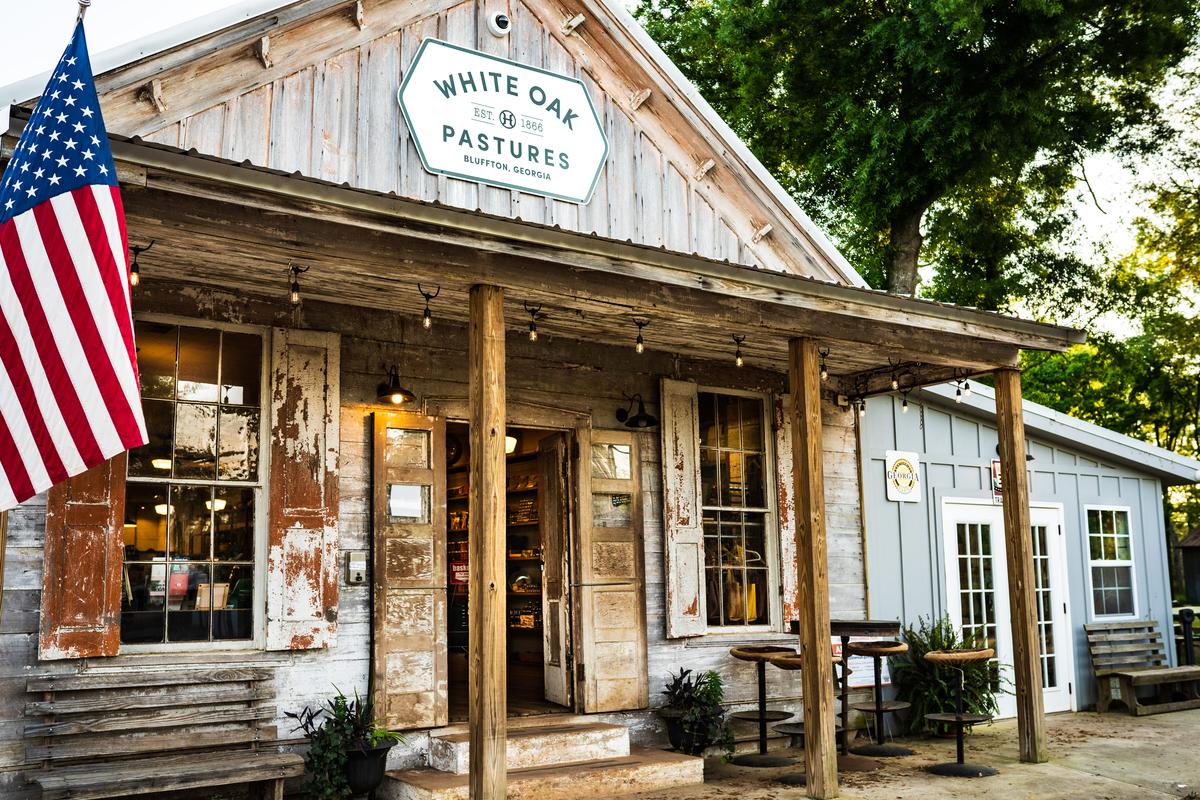
A few decades ago, Harris bought, restored, and re-opened a formerly shuttered general store in Bluffton. That mercantile sells provisions, along with White Oak Pastures meats and eggs, among other products and items from other farms.
Across the street, a zero-waste facility produces candles, cowhides, leather goods, pet treats, and soaps.
No part of the animal goes to waste, Harris said. Hides and tallow are turned into handmade goods, and any other remains are converted to compost for the pastures.
Today, the farm is Clay County’s largest private employer, with 180 employees, Harris proudly proclaimed.
“We use only sun, soil, and rain to grow sweet grasses for our animals to eat,” he said. “We rotate complimentary animal species side-by-side through our pastures. The cows graze the grass, the sheep and goats eat the weeds and shrubs, and the chickens peck at the grubs and insects. All species naturally fertilize the land, and our soil is a living organic medium that teems with life.”
Harris said he is thankful he made the changes. He has three daughters. Two of them, and their spouses, returned home to help operate the farm.
Revitalizing the Land
Regenerative farming practices revitalized the land, too, increasing the organic matter from 1 percent to 5.5 percent, which Harris said is a way of quantifying improvements made to the soil.
As he stood outside his truck in a green field brimming with activity from farm animals and wildlife, Harris described how he views his change in thinking.
“When I was purely a cattleman, I went to my pastures every day looking for something to kill,” he said. “I was looking for a plant or microbe or animal that I felt was disruptive to my monoculture of cattle and Bermuda grass, and I used a pesticide to kill it.
“Now when I go to my pasture, it’s all about keeping things alive, and keeping all the cycles of nature operating optimally.”
Reviving Bluffton
Harris is also proud of the vitality brought back to a village.
He said he remembers that when he was a boy, several businesses in the village provided everything the residents needed. Bluffton has always been a community centered around farming, Harris said. The village has never housed a factory or a mill.
Over the years, as the agriculture industry was centralized and commoditized, Bluffton was hit hard, Harris said. Businesses shuttered. Jobs were scarce.
Harris started buying homes in the village and renovating them to provide housing for his growing farm.
In 2016, the Harris family bought and restored a general store that dated back to the 1800s. The store closed in the 1960s, leaving residents without a place to buy provisions.
As word spread about White Oak Pastures’ bustling regenerative farming practices, visitors started arriving and requesting tours. To accommodate them, the Harris family transformed some of the village’s properties into cottages for lodging.
The farm added a farm-to-table restaurant that is attached to the general store and situated on the edge of the organic garden. The eatery serves meals to farm employees, residents, and visitors.
What was a thriving village a century ago that had fallen into disrepair became a postcard-worthy community of restored century-old homes and buildings, such as the former courthouse that serves as Harris’s office and the longtime Methodist church that is now White Oak Pastures’ events center.
Focus on Education
In 2021, White Oak Pastures created a nonprofit educational program called The Center for Agriculture Resilience, which offers multi-day learning sessions about regenerative farming.
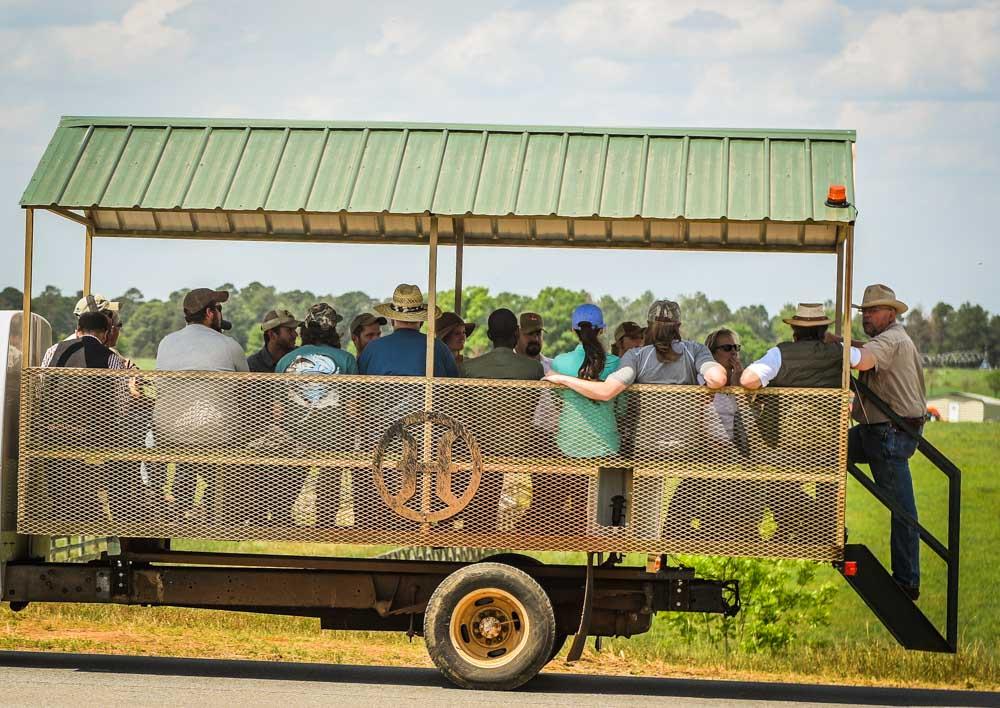
Harris spoke to The Epoch Times at a farm event called “Immersive Introduction to Regenerative Agriculture.” Some of the farmers in attendance currently use conventional practices and want to transition to regenerative methods. Others are aspiring farmers or current regenerative farmers who want to learn from Harris.
Dale Caldwell is the executive director of the Center for Agricultural Resilience.
“With what it does on the farm, and with what we are doing with the educational side, we hope to pass this knowledge on to future generations and help people now who are trying to make changes on their farm or start a farm using regenerative practices,” Caldwell said.
“You can’t make changes to a broken system without an educational component.”
Janet Sampson operates Sampson Family Farms with her husband, daughter, and daughter-in-law. It is a certified grass-fed beef and lamb farm in Live Oak, Florida.
Sampson said she first visited White Oak Pastures when the processing plant opened about 15 years ago. The farm has significantly grown since then, so they wanted to see White Oak’s practices firsthand, attracting them to the regenerative agriculture event in early March.
Sampson Family Farms covers about 400 acres. They once used conventional methods but transitioned to regenerative agriculture.
“Getting an in-depth look at an operation of White Oak’s scale, and seeing their success, reinforces that we are doing what we should be doing, and it gives us inspiration to do more,” Sampson said.
Harris is not hesitant to give visitors an in-depth look at White Oaks Pastures’ operations. He said he wants to encourage aspiring farmers to embrace regenerative methods and help conventional farmers make the transition. Improving the nation’s chronic disease epidemic starts with producing healthy food at the local level, Harris said.
“There could be and should be two or three White Oak Pastures in every agricultural county in this nation,” Harris said.
“I’ve had conventional farmers who are my friends tell me, ‘What you do is fine, Will, but you can’t feed the world like that.’ And my response is: ‘I don’t know that I’m supposed to feed the world. I think I’m supposed to feed my community.’”

Two Storms, One Harvest

Every food crisis in living memory has been a one-shock event. The 2008 price spike was a commodity bubble. The 2020 shortages were a logistics failure. The 2022 grain scare was a war on one exporter’s ports. Each time, the system bent, adjusted, and recovered, and each time the experts assured us afterward that global markets are simply too big and too diversified to fail.
What nobody in Washington seems eager to discuss is that 2026 is shaping up to be something the modern food system has never actually faced. Two independent shocks, one climatic and one geopolitical, are converging on the same harvest cycle at the same time. Not sequentially. Simultaneously.
Start with the weather. The Pacific Ocean is currently building toward what forecasters now openly call a record event. NOAA’s Climate Prediction Center puts the odds of at least a strong El Niño near 88 percent, with roughly two in three odds it reaches “very strong” status, the tier reserved for perhaps three or four events in the entire satellite era. Every major global model now projects a median peak in Super El Niño territory, and most of them project it exceeding the 2015-16 event, which until now held the modern record. Sea surface anomalies were already brushing the super threshold in mid-July, months before these events normally peak. The atmosphere has already shifted into El Niño mode, and the event is forecast to crest in late fall and early winter.
This is not about “climate change.” It’s about the standard cycles of weather, and the cycle we’re currently in is one that has likely devastated societies in the past. We’re better prepared as a society today, but not all Americans are equally prepared.
Serious households have started doing the quiet math on their own. Grocery bills tell part of the story, and the forecast maps tell the rest, which is why long-term food storage has moved from fringe hobby to mainstream line item in the family budget, with established suppliers like Heaven’s Harvest seeing demand from people who five years ago would have rolled their eyes at the idea. That instinct is not paranoia. It is pattern recognition, and the pattern is worth walking through carefully.
Editor’s Note: Heaven’s Harvest IS a sponsor, but the warnings of this article are real and would be written even if we didn’t have a survival food sponsor. With that said, those who take advantage of what they offer can use promo code “Patriot” for 15% off.
The Fertilizer Clock Is Already Running
While the Pacific warms, the second shock has been unfolding in the Strait of Hormuz. The conflict with Iran turned the world’s most important energy chokepoint into a contested waterway, and the consequences reach far beyond the gas pump. Roughly a third of global fertilizer trade moves through Hormuz, and the disruption sent urea prices up 86 percent year over year by March, with a 53 percent jump in a single month.
The World Bank projects energy prices rising about 24 percent in 2026 and fertilizer about 31 percent. By its own accounting, fertilizer prices ran 35 percent higher in the first five months of this year than the same period last year.
Here is the mechanism the nightly news will not explain. Fertilizer is not a grocery item. It is a time-delayed input. The nitrogen a farmer in Iowa or Punjab could not afford to apply this spring does not show up as a problem this spring. It shows up as a thinner harvest six to twelve months later.
The World Bank’s own food security brief concedes that the effects of reduced applications earlier this season “are likely to become visible only later in harvest outcomes.” Translate that from institutional language into plain English and it means this. The damage is already done, it is already in the ground, and we are simply waiting for it to arrive on the shelf.
Now check the calendar. Six to twelve months from the spring planting season lands us squarely in late 2026 and early 2027. Which is precisely when the strongest El Niño in the instrumental record is forecast to peak, bringing its signature droughts to Southeast Asia, Australia, southern Africa, northern Brazil, and South Asia, the very regions that grow the world’s rice, sugar, and oilseeds.
The World Bank warns openly that a strong El Niño “could disrupt multiple crop belts simultaneously” on top of the conflict-driven input costs. Their baseline projection assumes the Middle East disruptions ease by autumn. What in the last two years of Middle East history suggests that assumption is safe?
The System Has No Slack Left
The comfortable answer is that global markets always adjust. But adjustment requires slack, and the slack is gone. Global cereal production is expected to decline from last year’s records even before El Niño does its work. The UN World Food Programme, hardly a den of right-wing preppers, is calling this the most significant disruption to its supply chains since Covid and the invasion of Ukraine, and its supply chain director put the stakes bluntly.
Today’s supply chain challenges are tomorrow’s hunger crisis.
There is also a political dimension that markets cannot price. When food gets scarce, governments do not behave like economists. They behave like politicians. Export bans, hoarding mandates, and panic buying at the national level turned the modest rice shortfall of 2008 into a global crisis, and analysts are already warning that import-dependent nations are the first dominoes.
The 2015-16 Super El Niño, a far weaker event than what is now forecast, threw tens of millions into food stress across Africa and Asia. This one is projected to be stronger, and it arrives with fertilizer already rationed by price and shipping lanes already contested by missiles.
What Joseph Knew
Scripture does not treat preparation for lean years as faithlessness. It treats it as wisdom delivered in advance to those willing to act on it.
Behold, there come seven years of great plenty throughout all the land of Egypt: And there shall arise after them seven years of famine; and all the plenty shall be forgotten in the land of Egypt.
Joseph did not respond to that warning with a hashtag or a committee. He stored grain during the years of abundance, and when the famine came, Egypt stood while its neighbors begged. The lesson is not that famine is certain. It is that the time to prepare is precisely when preparation still looks optional.
Nobody who filled a pantry in a year of plenty has ever regretted it, and nobody standing in an empty aisle has ever been glad he waited for certainty.
None of this calls for panic, and panic is the enemy of sound judgment anyway. It calls for the same unglamorous prudence our grandparents considered ordinary. Keep some cash margin, know your local growers, and put real food in deep storage while it is cheap and available, because the entire arc of this story is that cheap and available is a closing window.
Families looking for a straightforward place to start can visit Heaven’s Harvest and use promo code Patriot for 15 percent off long-term storable food. The forecasts may yet soften, the strait may yet reopen, and we should pray they do. But hope is a fine thing to hold and a foolish thing to eat.
