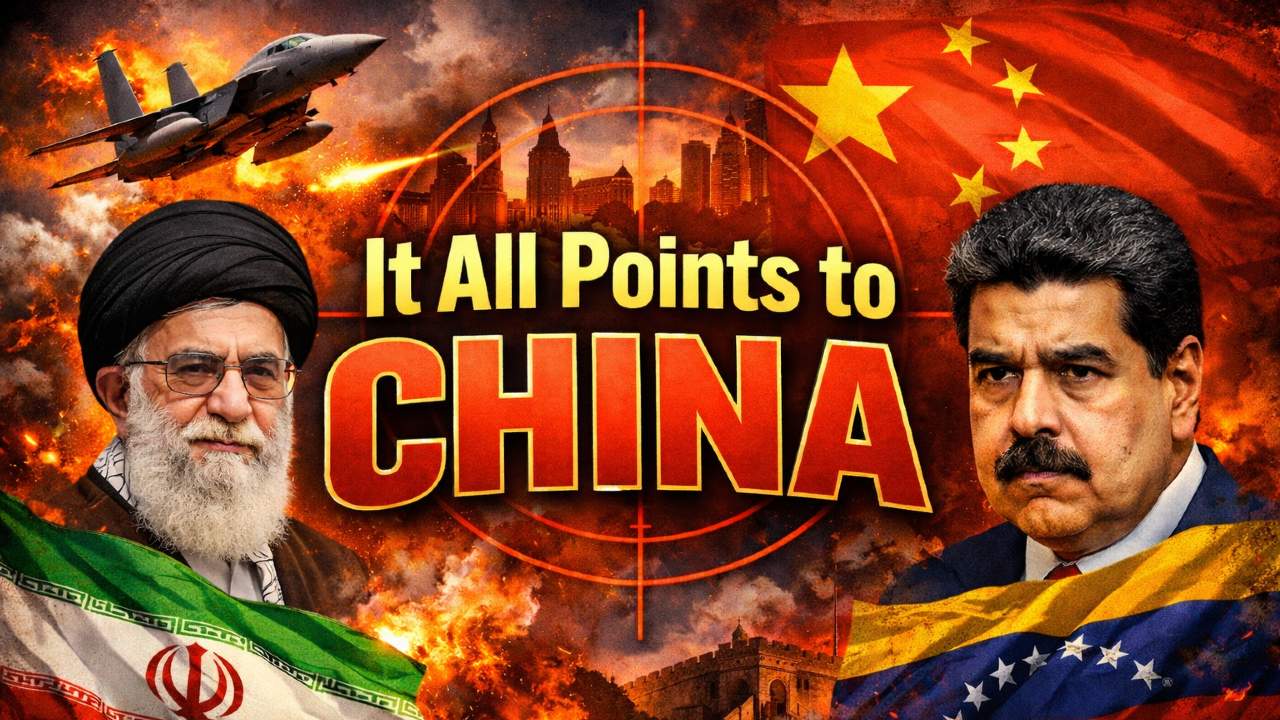
- The official story is real — but incomplete. Operation Epic Fury’s stated goals — eliminating Iran’s nuclear program, destroying its missile arsenal, degrading its proxy networks, and annihilating its navy — are all legitimate grievances rooted in 47 years of Iranian hostility toward the United States. But they are the surface layer of a much deeper strategic play.
- AI is the defining race of this century. Artificial intelligence will determine which nation controls the global economy, commands military supremacy, and writes the rules of the coming era. Both Washington and Beijing understand this with total clarity, and every major foreign policy decision is now being filtered through that lens — whether stated publicly or not.
- AI runs on energy — massive amounts of it. Training and running frontier AI models requires electricity on a civilization-scale. As AI systems grow more powerful and embedded in every sector, that energy demand will compound. Whoever controls reliable, cheap energy controls the pace of AI development.
- Iran was China’s discount fuel pump. Despite American sanctions, Iran was exporting roughly 1.9 million barrels of oil per day — nearly all of it to China — at deep discounts, through shadow fleets designed to evade enforcement. Iran accounted for an estimated 15 percent of China’s total crude imports, making it one of Beijing’s most critical and convenient energy partners.
- The China-Iran relationship was a strategic hedge, not just a business deal. The 2021 Comprehensive Strategic Partnership committed China to $400 billion in Iranian investment over 25 years. Crucially, this gave China a sanctions-resistant, American-proof energy backstop — a lifeline specifically designed to function in a scenario where the U.S. tries to squeeze China’s energy supply during a Taiwan confrontation. Operation Epic Fury just incinerated that hedge.
- Venezuela was the other leg of the same strategy. The January 2026 capture of Nicolás Maduro — and the Trump administration’s signal that Venezuela’s vast oil reserves would be opened to American investment — eliminated China’s most promising alternative energy relationship in the Western Hemisphere. In eight weeks, Washington moved against two of Beijing’s most important energy lifelines simultaneously. That is not coincidence. That is a coordinated strategy.
- The rare earth lever has now been flipped. China’s dominance over rare earth minerals — processing nearly 90 percent of the elements essential for AI chips — has long been its most potent economic weapon. But a China scrambling for energy security is a China far more cautious about weaponizing rare earths. By exposing China’s energy vulnerability, the U.S. has gained critical countervailing leverage in the very domain where Beijing held the most threatening cards.
- AI is not just the backdrop — it’s the instrument. Anthropic’s AI models were reportedly used in the mission to capture Maduro, making it the first large language model granted clearance for classified U.S. military operations. Operation Epic Fury launched the same week OpenAI signed a $50 billion infrastructure deal with Amazon. The administration that launched this war thinks about AI dominance with the same urgency it thinks about nuclear nonproliferation.
- The strategic logic is coherent — the risks are severe. Iran is retaliating against U.S. bases, Israel, and Gulf infrastructure. The Strait of Hormuz — through which one-fifth of the world’s oil flows — is a war zone. Oil could spike to $130–$140 a barrel. The region could spiral into broader conflict. The human costs are real and not yet fully counted. The gamble being made here is enormous.
- This deserves a national debate we are not having. The world is watching smoke rise over Tehran and debating the legality of a military strike. Almost nobody is talking about the civilizational bet buried inside it — that AI dominance is worth fighting for, that energy architecture is the prerequisite for winning the technology race, and that the opening moves of the AI century are being written right now, in fire, over Iran.
The bombs are still falling on Tehran as these words are written. Operation Epic Fury — the joint U.S.-Israeli campaign that began at dawn on Saturday — has already killed Supreme Leader Ayatollah Ali Khamenei, struck the headquarters of the Islamic Revolutionary Guard Corps, and touched off Iranian retaliatory missile salvos against Israel, U.S. military bases, and Gulf state infrastructure. Explosions have been reported in Tehran, Isfahan, Qom, Kermanshah, Tabriz, and Karaj. The Strait of Hormuz, through which roughly one-fifth of the world’s oil passes every day, is effectively a war zone.
President Trump has been characteristically blunt about his stated objectives: prevent Iran from acquiring a nuclear weapon, destroy its missile arsenal and production sites, degrade its proxy networks, annihilate its navy, and — hovering just beneath the surface of the official four-point framework — trigger regime change from within. He told Iranians to “take back your country.” He offered IRGC soldiers amnesty if they laid down their arms, and “certain death” if they didn’t. These are not the words of a president conducting a surgical strike. This is the language of someone who intends to fundamentally restructure a country.
All of those stated aims are real. They represent genuine U.S. interests, legitimate security grievances, and decades of deferred reckoning with a regime that has, as Senator Tom Cotton noted this morning, “waged war against the United States for 47 years.” The indictment of the Islamic Republic is long and largely accurate.
But it is not complete. And the part that’s missing is the part that matters most to the next century of American power.
The Invisible Prize
While the world watches the smoke rising over Tehran, a different kind of war is being fought in data centers, semiconductor fabrication plants, and the offices of national AI strategy councils from Washington to Beijing. Artificial intelligence is not a feature of the future. It is the architecture of it — the technology that will determine which nation commands the global economy, which military has battlefield supremacy, and which civilization gets to write the rules of the next era.
The United States and China both understand this with total clarity. The competition between them is not rhetorical. It is existential, generational, and already underway. And that competition has a resource requirement that most people have not yet connected to the war now unfolding over Iran.
AI is extraordinarily, almost unimaginably, hungry for energy. Training a frontier AI model consumes as much electricity as a small city uses in a year. Running those models at scale — billions of inference requests daily, across every sector of the economy and every branch of the military — requires the kind of energy infrastructure that makes the industrial revolutions of the 19th and 20th centuries look modest by comparison. As AI systems grow more powerful and more deeply embedded in daily life, that energy requirement will not stabilize. It will compound.
China is the world’s largest crude oil importer, consuming roughly eleven million barrels per day, with approximately half of that supply sourced from the Middle East. And Iran has been one of the most critical — and most strategically convenient — nodes in that supply chain.
China’s Discount Pump
Despite years of American sanctions, Iran was exporting approximately 1.9 million barrels of oil per day as recently as December 2025, according to the International Energy Agency. Nearly all of it was going to China, carried on so-called “shadow fleets” — tankers that concealed their activities to evade sanctions enforcement. Roughly 90 percent of Iran’s oil exports flowed into Chinese refineries. By some estimates, Iran accounted for 15 percent of China’s total crude imports in 2024.
This was not an accident of geography. It was a structural arrangement, engineered over years of patient Chinese statecraft, that served Beijing’s interests beautifully. A pariah state with the world’s fourth-largest proven oil reserves, cut off from Western markets and desperate for any buyer willing to overlook its politics, is exactly the kind of partner China prefers. Iran sold its oil at deep discounts. China got cheap energy for its industrial base and, increasingly, for the data centers powering its AI ambitions. In exchange, Iran got economic survival.
The 2021 Comprehensive Strategic Partnership — committing China to an estimated $400 billion in investment across Iran’s energy, banking, and telecommunications sectors over 25 years — formalized what had long been an informal dependency. When Supreme Leader Khamenei welcomed Xi Jinping in 2016, he reportedly called the partnership “totally correct and endowed with wisdom.” He wasn’t being diplomatic. He was describing the terms of Iran’s survival.
That arrangement died this morning along with Khamenei.
What Epic Fury Actually Severs
Operation Epic Fury’s military objectives are clear. But its strategic consequences extend far beyond nuclear centrifuges and IRGC command posts.
Iran was not merely a security problem for the United States. It was the central pillar of a regional energy architecture that Beijing had spent fifteen years constructing — one explicitly designed to give China reliable, discounted, sanctions-resistant access to Middle Eastern oil in the event that relations with the West deteriorated, or that a Taiwan contingency forced China to find energy sources beyond the reach of American naval interdiction.

China imports roughly 70 percent of its oil, most of it transiting the Strait of Malacca. In any serious Taiwan contingency, those sea lanes become contested. American planners know this. Chinese planners know this. The strategic logic of China’s Iran relationship was never purely economic. It was a hedge against the day when the United States might try to squeeze China’s energy supply as part of a larger confrontation — a reserve lifeline that bypassed American-dominated sea lanes and American-aligned Gulf states.
Operation Epic Fury does not just eliminate a nuclear threat or kill a supreme leader. It smashes that hedge. It forces China to reckon with the possibility that its Iran-based energy backstop is gone, that its 25-year, $400 billion strategic partnership has been incinerated by American and Israeli airstrikes, and that the Middle Eastern architecture Beijing spent fifteen years building has just been cracked at its most concentrated and vulnerable point.
Combined with the January capture of Nicolás Maduro — after which the Trump administration explicitly signaled it intends to open Venezuela’s oil sector, the world’s largest proven reserves, to American investment — Washington has now moved against two of China’s most important alternative energy relationships in the span of eight weeks.
Venezuela only accounted for around 5% of China’s oil imports, but they have been investing heavily in the nation and felt tapping into their vast reserves could make them an ideal oil partner in just a few years. Now, those ambitions have been annihilated.
This is not coincidence. This is a strategy.
The Rare Earth Lever, Flipped
The energy angle is one half of the equation. The other half is leverage.

China’s dominance over rare earth minerals — the elements essential for semiconductors, batteries, and advanced electronics — has long been described as Beijing’s most potent economic weapon. China mines roughly 60 percent of the world’s rare earths and processes nearly 90 percent of them. For the advanced chips that power AI systems, that dominance gives Beijing a chokehold over the very technology the United States most urgently needs to maintain its competitive edge.
China has not been subtle about the weaponization potential of that position. When tensions have risen, Chinese officials have signaled willingness to restrict rare earth exports. In a world where American AI chip manufacturers depend on Chinese-processed materials, that threat has real bite.
But leverage is bidirectional. A China that is now watching its discounted Iranian oil supply go up in smoke, its Venezuela oil relationship absorbed by American investment, and the Strait of Hormuz — through which Chinese energy imports flow — patrolled by the most concentrated American naval force deployed to the region in a generation, is a China that must be more cautious about pulling the rare earth trigger. Escalating an economic confrontation with the United States over semiconductors requires China to absorb the risk that Washington escalates back in the energy domain — a domain where China’s vulnerability has just become dramatically more visible.
The United States has not yet won the AI race. It has not yet secured rare earth independence. But it has just dramatically improved its negotiating position in both.
The AI War Beneath the Air War
Even the operational details of these strikes carry AI undertones that have gone almost entirely unreported in today’s wall-to-wall war coverage.
Buried in the live update feeds is a remarkable disclosure: Anthropic’s AI models were reportedly used in the January mission to capture Nicolás Maduro — the first large language model ever granted clearance for classified U.S. military operations, having entered the defense ecosystem in late 2024 through its work with Palantir. The AI race isn’t just the background context of these military operations. It is, in a very real sense, the instrument of them.
Meanwhile, the broader technology community has watched as this administration has moved to consolidate AI decision-making authority, restrict Chinese access to advanced chips, aggressively court American AI companies for national security applications, and position the United States as the indispensable power in AI governance worldwide. Operation Epic Fury, announced the same week OpenAI signed a $50 billion deal with Amazon to optimize AI infrastructure, is happening inside a White House that thinks about AI dominance with the same urgency it thinks about nuclear nonproliferation.
That is not a coincidence. That is a worldview.
What Washington Won’t Say in the Briefing Room
None of what I have described will appear in a Pentagon press release. The four official objectives of Operation Epic Fury — nuclear, missile, proxy, naval — are all legitimate. Trump’s stated desire to end 47 years of Iranian aggression against American interests is genuine. The intelligence community’s concerns about Iran reconstituting its nuclear program after last June’s Operation Midnight Hammer strikes were real.
But the architects of this policy have also read the same analysis that any serious strategist reads. They know that every year Washington spends managing Tehran is another year Beijing buys in the Pacific. They know that the orientation of the Middle East will determine whether the United States can prevail in the defining confrontation of this century: a Chinese move against Taiwan. They know that if energy-producing states in the Gulf drift deeply enough into the Chinese economic orbit, the entire sanctions architecture that the United States might need in a Taiwan contingency collapses at the moment it is most needed.
Operation Epic Fury is, at one level, the settlement of a 47-year-old account with the Islamic Republic. At another level, it is the opening act of a campaign to reshape the energy architecture of the world in ways that advantage the United States in the AI race — by denying China a critical backstop energy source, reorienting Middle Eastern oil flows, gaining countervailing leverage over China’s rare earth position, and demonstrating the kind of decisive, high-risk military action that makes adversaries recalibrate their willingness to accelerate confrontation.
The Reckoning That Must Come
Whether this gamble succeeds is an open question that history, not commentary, will answer. The risks are severe and immediate. Iran is retaliating against U.S. bases, against Israel, against Gulf state infrastructure. The Strait of Hormuz is disrupted. Oil markets face potential price shocks that could send crude toward $130 or $140 a barrel in a worst-case scenario. The region could metastasize into a broader war. The costs in human life — Iranian civilians, American soldiers, Israeli citizens — are not abstractions.
Those costs demand honest accounting. And honest accounting requires acknowledging the full scope of what is being attempted here — not just the nuclear file, not just the terrorism ledger, but the larger civilizational bet embedded in the decision to launch Operation Epic Fury on this particular morning, in this particular year, against this particular country.
The bet is that AI dominance is worth fighting for. That controlling the energy architecture of the world’s most critical producing region is a prerequisite for winning the technology race of the century. That China cannot be allowed to build a sanctions-resistant, American-proof energy supply chain that would free it to pursue AI supremacy — and eventually broader global supremacy — on its own terms.
Those are not small propositions. They deserve a national debate proportionate to their stakes. Instead, the world is watching smoke rise over Tehran and waiting to see whether the Strait of Hormuz closes.
We are not merely watching a war over nuclear weapons, ballistic missiles, or terrorism. We are watching the opening moves of the AI century being written in fire.