

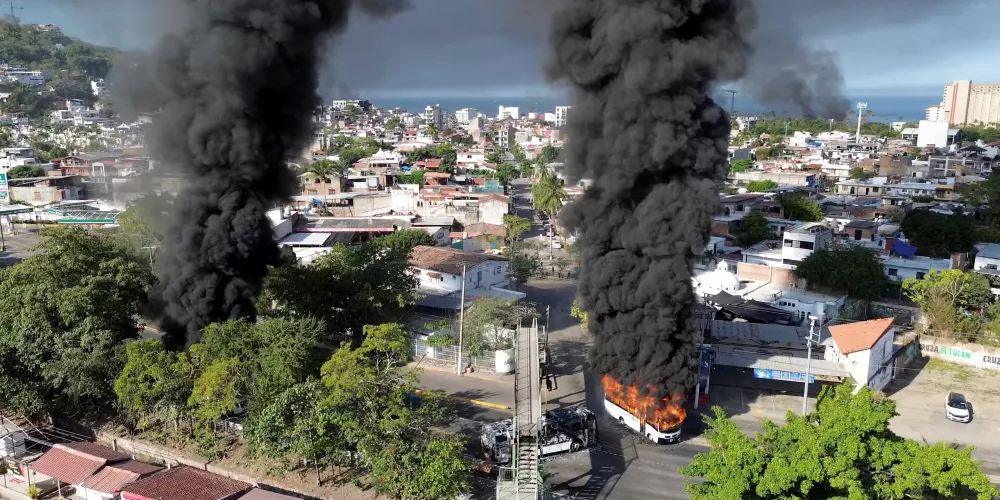
The most wanted drug lord in Mexico is dead, American tourists are sheltering in place across five states, and the cartel that pumped fentanyl into the United States for a decade responded to losing its leader by lighting the country on fire. The killing of Nemesio Rubén Oseguera Cervantes — known to the world as “El Mencho” — was supposed to be a victory. What followed made the meaning of that word very complicated.
Violence has spread to 20 of the 31 Mexican states, nearly two thirds of the entire country. And as the Mexican government tries to send in military support for law enforcement that is clearly outgunned and outmanned, logistic issues pose challenges. The cartels do not operate from large bases away from the population. They are spread out and embedded in cities and towns that offer cover from direct military actions.
Mexican law enforcement tracked down and attempted to capture El Mencho on Sunday in the town of Tapalpa in the western state of Jalisco, roughly two hours southwest of Guadalajara. According to Mexico’s Defense Ministry, troops came under fire at the location and killed four people during the operation. El Mencho was wounded in the confrontation and died while being airlifted to Mexico City. Two others were arrested, and soldiers seized armored vehicles, rocket launchers, and other weapons at the site. By any measurement, the operation itself was a success. What came after was not.
Within hours, the Jalisco New Generation Cartel — known by its Spanish initials, CJNG — unleashed coordinated chaos across Mexico. Cars burned out by cartel members blocked roads in 20 Mexican states. Guadalajara, Mexico’s second-largest city, became a ghost town. Stores shuttered. Public transportation was suspended. Civilians hunkered down as Telemundo reported the city was paralyzed.
One American tourist in Puerto Vallarta, a Minnesotan named Jim Beck who has visited the resort city for over two decades, described what he witnessed: “Today, everybody was running down the streets in panic and terror as cars were blowing up all over the place.”
The U.S. State Department moved quickly. American citizens in the Mexican states of Jalisco, Tamaulipas, Michoacán, Guerrero, and Nuevo Leon were urged to shelter in place due to “ongoing security operations and related road blockages and criminal activity.”
Canada issued a similar warning to its nationals, and more than 26,000 Canadians were registered in Mexico as the violence spread. Airlines scrambled. United, Southwest, Delta, Alaska, and Air Canada all canceled flights to Puerto Vallarta. At least one American Airlines flight turned around mid-air as the situation deteriorated on the ground.
El Mencho’s biography reads like a case study in how broken institutions produce monsters. A former police officer, he founded the Jalisco New Generation Cartel around 2009, and over the following decade and a half built it into Mexico’s fastest-growing criminal organization, moving cocaine, methamphetamines, fentanyl, and migrants to the United States, and using violence with drones and improvised explosive devices.
The CJNG earned a reputation for spectacular aggression: downing a military helicopter in Jalisco in 2015 and attempting to assassinate Mexico City Police Chief Omar García Harfuch — the same man who now serves as Mexico’s federal security secretary. The U.S. Drug Enforcement Administration had classified it as one of the most powerful and ruthless criminal organizations in Mexico, and the State Department had placed a $15 million reward on El Mencho’s head.
That reward will go uncollected, but the problem the CJNG represents is far from solved. The cartel’s reaction to its leader’s death was not the reaction of a broken organization. It was the reaction of one that had contingency plans, loyal regional commanders, and enough muscle to shut down a significant portion of a nation within hours.
Security experts warned of the greatest fear: that the cartel could turn to indiscriminate violence and “launch narcoterrorism attacks,” generating a scenario resembling what Colombia experienced in the 1990s — car bombs, assassinations, attacks on aircraft. Whether CJNG has the organizational coherence and the ambition to go that route remains to be seen, but the opening hours after El Mencho’s death offered few reasons for optimism.
The geopolitical dimension of this moment is impossible to ignore. President Trump has spent months pressuring Mexican President Claudia Sheinbaum to deliver concrete results against the cartels, threatening military intervention and higher tariffs if she failed. Shortly after the U.S. capture of ousted Venezuelan leader Nicolás Maduro, Trump suggested he could expand his military campaign to Mexican drug trafficking groups.
The killing of El Mencho appears, at least in part, to be Mexico’s attempt to demonstrate progress and ease that pressure. His death was described as the biggest prize yet for the Mexican government in its efforts to satisfy the Trump administration. Whether Washington accepts it as sufficient — and whether the CJNG’s immediate revenge campaign undermines that argument — will shape the next phase of U.S.-Mexico relations.
Sheinbaum had previously cast doubt on the “kingpin” strategy of targeting cartel leaders, warning that decapitating criminal organizations can fracture them into rival factions and ignite new cycles of violence. There is dark irony in the fact that her government executed precisely that strategy under pressure, only to immediately validate her own warning. The question now is whether the violence that erupted on Sunday represents a temporary convulsion — a death rattle from loyal soldiers acting on instinct — or the opening move in a more sustained and dangerous period of cartel warfare.

History offers little comfort. When El Chapo was recaptured in 2016, the Sinaloa Cartel fractured, and the resulting power vacuum was filled in part by the very organization that just lost its own leader. Cartel structures are more resilient than their figureheads. Lieutenants who spent years building regional fiefdoms do not simply hand over their territories because the boss is gone. They fight over them — and in Mexico, that fight has a tendency to spill over roads, borders, tourist resorts, and the daily lives of millions of ordinary people who never asked to live inside a cartel’s operating territory.
The immediate concern for American tourists and expatriates in Mexico is practical and urgent. Five states under shelter-in-place advisories cover a vast portion of the country, including some of its most visited destinations. Anyone currently in those regions should stay current with State Department guidance, avoid road travel until conditions stabilize, and take seriously the consular messaging that has been issued. The situation remains fluid. Jalisco is scheduled to host four matches of the 2026 FIFA World Cup in June. Whether that timeline holds — and what it says about the state of security in western Mexico if it does — is a question the Mexican government will need to answer in the months ahead.
What Sunday made clear is that the cartels are not a peripheral law enforcement problem. They are a parallel power structure, capable of mobilizing violence across an entire nation within hours of losing their most prominent leader. That is not the profile of a criminal enterprise. That is the profile of an insurgency. And how the United States, Mexico, and the rest of the region choose to respond to that reality — not just to the death of one man, but to the system that produced him and survived him — will determine whether El Mencho’s killing is remembered as a turning point or just another data point in an unending crisis.
Two Storms, One Harvest

Every food crisis in living memory has been a one-shock event. The 2008 price spike was a commodity bubble. The 2020 shortages were a logistics failure. The 2022 grain scare was a war on one exporter’s ports. Each time, the system bent, adjusted, and recovered, and each time the experts assured us afterward that global markets are simply too big and too diversified to fail.
What nobody in Washington seems eager to discuss is that 2026 is shaping up to be something the modern food system has never actually faced. Two independent shocks, one climatic and one geopolitical, are converging on the same harvest cycle at the same time. Not sequentially. Simultaneously.
Start with the weather. The Pacific Ocean is currently building toward what forecasters now openly call a record event. NOAA’s Climate Prediction Center puts the odds of at least a strong El Niño near 88 percent, with roughly two in three odds it reaches “very strong” status, the tier reserved for perhaps three or four events in the entire satellite era. Every major global model now projects a median peak in Super El Niño territory, and most of them project it exceeding the 2015-16 event, which until now held the modern record. Sea surface anomalies were already brushing the super threshold in mid-July, months before these events normally peak. The atmosphere has already shifted into El Niño mode, and the event is forecast to crest in late fall and early winter.
This is not about “climate change.” It’s about the standard cycles of weather, and the cycle we’re currently in is one that has likely devastated societies in the past. We’re better prepared as a society today, but not all Americans are equally prepared.
Serious households have started doing the quiet math on their own. Grocery bills tell part of the story, and the forecast maps tell the rest, which is why long-term food storage has moved from fringe hobby to mainstream line item in the family budget, with established suppliers like Heaven’s Harvest seeing demand from people who five years ago would have rolled their eyes at the idea. That instinct is not paranoia. It is pattern recognition, and the pattern is worth walking through carefully.
Editor’s Note: Heaven’s Harvest IS a sponsor, but the warnings of this article are real and would be written even if we didn’t have a survival food sponsor. With that said, those who take advantage of what they offer can use promo code “Patriot” for 15% off.
The Fertilizer Clock Is Already Running
While the Pacific warms, the second shock has been unfolding in the Strait of Hormuz. The conflict with Iran turned the world’s most important energy chokepoint into a contested waterway, and the consequences reach far beyond the gas pump. Roughly a third of global fertilizer trade moves through Hormuz, and the disruption sent urea prices up 86 percent year over year by March, with a 53 percent jump in a single month.
The World Bank projects energy prices rising about 24 percent in 2026 and fertilizer about 31 percent. By its own accounting, fertilizer prices ran 35 percent higher in the first five months of this year than the same period last year.
Here is the mechanism the nightly news will not explain. Fertilizer is not a grocery item. It is a time-delayed input. The nitrogen a farmer in Iowa or Punjab could not afford to apply this spring does not show up as a problem this spring. It shows up as a thinner harvest six to twelve months later.
The World Bank’s own food security brief concedes that the effects of reduced applications earlier this season “are likely to become visible only later in harvest outcomes.” Translate that from institutional language into plain English and it means this. The damage is already done, it is already in the ground, and we are simply waiting for it to arrive on the shelf.
Now check the calendar. Six to twelve months from the spring planting season lands us squarely in late 2026 and early 2027. Which is precisely when the strongest El Niño in the instrumental record is forecast to peak, bringing its signature droughts to Southeast Asia, Australia, southern Africa, northern Brazil, and South Asia, the very regions that grow the world’s rice, sugar, and oilseeds.
The World Bank warns openly that a strong El Niño “could disrupt multiple crop belts simultaneously” on top of the conflict-driven input costs. Their baseline projection assumes the Middle East disruptions ease by autumn. What in the last two years of Middle East history suggests that assumption is safe?
The System Has No Slack Left
The comfortable answer is that global markets always adjust. But adjustment requires slack, and the slack is gone. Global cereal production is expected to decline from last year’s records even before El Niño does its work. The UN World Food Programme, hardly a den of right-wing preppers, is calling this the most significant disruption to its supply chains since Covid and the invasion of Ukraine, and its supply chain director put the stakes bluntly.
Today’s supply chain challenges are tomorrow’s hunger crisis.
There is also a political dimension that markets cannot price. When food gets scarce, governments do not behave like economists. They behave like politicians. Export bans, hoarding mandates, and panic buying at the national level turned the modest rice shortfall of 2008 into a global crisis, and analysts are already warning that import-dependent nations are the first dominoes.
The 2015-16 Super El Niño, a far weaker event than what is now forecast, threw tens of millions into food stress across Africa and Asia. This one is projected to be stronger, and it arrives with fertilizer already rationed by price and shipping lanes already contested by missiles.
What Joseph Knew
Scripture does not treat preparation for lean years as faithlessness. It treats it as wisdom delivered in advance to those willing to act on it.
Behold, there come seven years of great plenty throughout all the land of Egypt: And there shall arise after them seven years of famine; and all the plenty shall be forgotten in the land of Egypt.
Joseph did not respond to that warning with a hashtag or a committee. He stored grain during the years of abundance, and when the famine came, Egypt stood while its neighbors begged. The lesson is not that famine is certain. It is that the time to prepare is precisely when preparation still looks optional.
Nobody who filled a pantry in a year of plenty has ever regretted it, and nobody standing in an empty aisle has ever been glad he waited for certainty.
None of this calls for panic, and panic is the enemy of sound judgment anyway. It calls for the same unglamorous prudence our grandparents considered ordinary. Keep some cash margin, know your local growers, and put real food in deep storage while it is cheap and available, because the entire arc of this story is that cheap and available is a closing window.
Families looking for a straightforward place to start can visit Heaven’s Harvest and use promo code Patriot for 15 percent off long-term storable food. The forecasts may yet soften, the strait may yet reopen, and we should pray they do. But hope is a fine thing to hold and a foolish thing to eat.
