

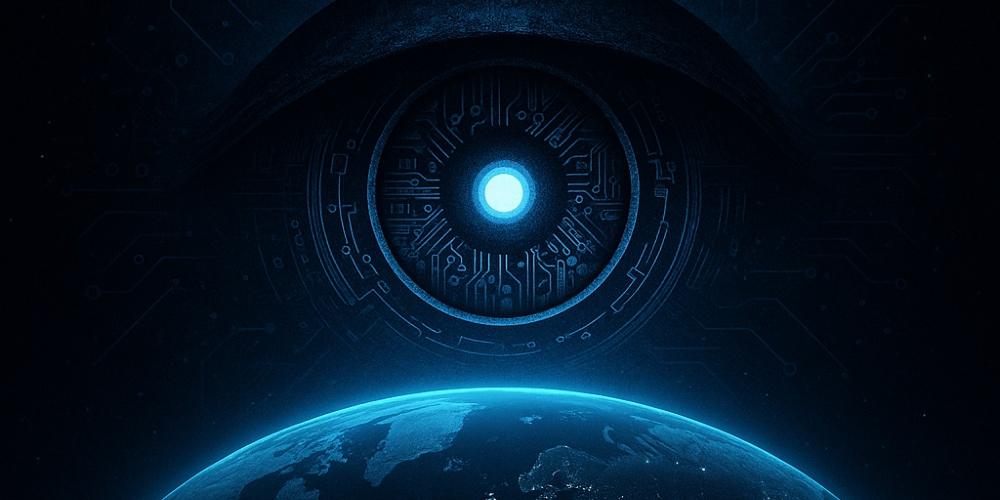
The merger between chip titan Nvidia and data-mining powerhouse Palantir represents far more than a business partnership. It’s the next great leap forward for the global surveillance architecture—a digital nervous system capable of tracking, predicting, and influencing nearly every aspect of modern life. And their latest endeavor is a harbinger.
On paper, the two companies are collaborating to create an “integrated technology stack for operational AI.” In reality, this is the fusion of the world’s most powerful hardware with one of the most intrusive software ecosystems ever designed. Nvidia’s GPU-driven supercomputing infrastructure will now integrate directly with Palantir’s “Ontology,” the framework that connects massive data sets from governments, corporations, healthcare systems, and financial institutions into a single, unified analytical grid.
Palantir—originally funded by the CIA’s venture arm, In-Q-Tel—built its empire on data fusion. Its software underpins intelligence gathering for the Pentagon, the NSA, and numerous law enforcement agencies worldwide. Nvidia, meanwhile, holds the keys to the computational horsepower that makes AI possible. Together, they’re creating what could be described as a living digital organism — a constantly learning, constantly adapting system with the ability to analyze and act upon vast streams of information in real time.
According to their joint announcement at Nvidia’s GTC conference in Washington, D.C., the partnership aims to “accelerate and optimize complex enterprise and government systems.” That may sound benign—until you realize what “enterprise and government systems” actually entail. These are the networks that manage critical infrastructure, financial markets, healthcare databases, military logistics, and even transportation control systems.
Palantir’s AI Platform (AIP), which already serves intelligence agencies and major corporations, will now be supercharged by Nvidia’s GPU-accelerated computing and open AI models. Together, they promise “context-aware reasoning” and “domain-specific automations.” In simpler terms, this means decision-making power once reserved for humans will be handed to autonomous digital agents—AI programs that interpret, prioritize, and execute actions based on massive data feeds.
What kind of “actions”? That’s the billion-dollar question. In a corporate environment, it might mean optimizing supply chains. In a defense or government setting, it could mean tracking individuals, predicting civil unrest, or deploying automated surveillance drones. With 6G data speeds on the horizon and every smart device acting as a sensor, the infrastructure for total observation is nearly complete.
The Technocratic Dream: Real-Time Command of Everything
The partnership effectively creates the central nervous system of what global planners call “integrated AI infrastructure.” It’s the foundation for the so-called “smart world” — smart cities, smart grids, smart transportation, and even smart governance. Each node in that system feeds data into Palantir’s Ontology, where it’s processed by Nvidia’s AI computing engines.
In practice, this allows for real-time monitoring of economic flows, energy consumption, population movements, and communication networks. To the public, this may sound like progress; to those who understand the technocratic playbook, it’s the framework of digital control. Every innovation in “operational AI” brings humanity closer to a world where the system doesn’t just observe behavior—it anticipates and shapes it.
The rhetoric from both companies is revealing. Nvidia’s Jensen Huang said the collaboration will “turn enterprise data into decision intelligence.” Palantir’s Alex Karp added that it will deliver “asymmetric value” to customers. The language is strategic: “decision intelligence” implies predictive authority, while “asymmetric value” suggests power imbalance. Whoever controls the algorithms controls the outcomes—and the rest of society simply reacts.
It’s no coincidence that both Nvidia and Palantir are deeply tied to the same government and corporate elites driving the World Economic Forum’s “Fourth Industrial Revolution.” Palantir’s government contracts span NATO, the U.S. Department of Defense, and the British Ministry of Defence. Nvidia, meanwhile, dominates the AI hardware market that underpins every major AI initiative globally—from China’s surveillance cities to the U.S. military’s Joint All-Domain Command and Control (JADC2) project.
This partnership is the next step toward the consolidation of power through digital governance. It’s not just about faster chips or smarter software—it’s about control. The fusion of Palantir’s data lattice and Nvidia’s computational engine gives the globalist technocracy an unprecedented upgrade: the ability to see, know, and eventually decide more than any elected government or human institution ever could.
From a deeper perspective, this isn’t just about technology—it’s about the architecture of authority. Systems like this mimic omniscience, promising safety and efficiency in exchange for autonomy. The result is a kind of digital idolatry, where trust is placed not in truth or conscience but in the algorithm. Humanity becomes data. Privacy becomes an outdated concept. And freedom becomes conditional upon compliance with an all-seeing system.
Those who have studied prophecy will recognize the pattern. The infrastructure being built today mirrors the biblical description of a world system where buying, selling, and movement are monitored and controlled. Whether one views that through a theological or philosophical lens, the trend is undeniable: centralization, automation, and surveillance are converging into something humanity has never faced before.
Palantir and Nvidia may call it “operational AI.” Others might more accurately call it the digital skeleton of the beast system.


Two Storms, One Harvest

Every food crisis in living memory has been a one-shock event. The 2008 price spike was a commodity bubble. The 2020 shortages were a logistics failure. The 2022 grain scare was a war on one exporter’s ports. Each time, the system bent, adjusted, and recovered, and each time the experts assured us afterward that global markets are simply too big and too diversified to fail.
What nobody in Washington seems eager to discuss is that 2026 is shaping up to be something the modern food system has never actually faced. Two independent shocks, one climatic and one geopolitical, are converging on the same harvest cycle at the same time. Not sequentially. Simultaneously.
Start with the weather. The Pacific Ocean is currently building toward what forecasters now openly call a record event. NOAA’s Climate Prediction Center puts the odds of at least a strong El Niño near 88 percent, with roughly two in three odds it reaches “very strong” status, the tier reserved for perhaps three or four events in the entire satellite era. Every major global model now projects a median peak in Super El Niño territory, and most of them project it exceeding the 2015-16 event, which until now held the modern record. Sea surface anomalies were already brushing the super threshold in mid-July, months before these events normally peak. The atmosphere has already shifted into El Niño mode, and the event is forecast to crest in late fall and early winter.
This is not about “climate change.” It’s about the standard cycles of weather, and the cycle we’re currently in is one that has likely devastated societies in the past. We’re better prepared as a society today, but not all Americans are equally prepared.
Serious households have started doing the quiet math on their own. Grocery bills tell part of the story, and the forecast maps tell the rest, which is why long-term food storage has moved from fringe hobby to mainstream line item in the family budget, with established suppliers like Heaven’s Harvest seeing demand from people who five years ago would have rolled their eyes at the idea. That instinct is not paranoia. It is pattern recognition, and the pattern is worth walking through carefully.
Editor’s Note: Heaven’s Harvest IS a sponsor, but the warnings of this article are real and would be written even if we didn’t have a survival food sponsor. With that said, those who take advantage of what they offer can use promo code “Patriot” for 15% off.
The Fertilizer Clock Is Already Running
While the Pacific warms, the second shock has been unfolding in the Strait of Hormuz. The conflict with Iran turned the world’s most important energy chokepoint into a contested waterway, and the consequences reach far beyond the gas pump. Roughly a third of global fertilizer trade moves through Hormuz, and the disruption sent urea prices up 86 percent year over year by March, with a 53 percent jump in a single month.
The World Bank projects energy prices rising about 24 percent in 2026 and fertilizer about 31 percent. By its own accounting, fertilizer prices ran 35 percent higher in the first five months of this year than the same period last year.
Here is the mechanism the nightly news will not explain. Fertilizer is not a grocery item. It is a time-delayed input. The nitrogen a farmer in Iowa or Punjab could not afford to apply this spring does not show up as a problem this spring. It shows up as a thinner harvest six to twelve months later.
The World Bank’s own food security brief concedes that the effects of reduced applications earlier this season “are likely to become visible only later in harvest outcomes.” Translate that from institutional language into plain English and it means this. The damage is already done, it is already in the ground, and we are simply waiting for it to arrive on the shelf.
Now check the calendar. Six to twelve months from the spring planting season lands us squarely in late 2026 and early 2027. Which is precisely when the strongest El Niño in the instrumental record is forecast to peak, bringing its signature droughts to Southeast Asia, Australia, southern Africa, northern Brazil, and South Asia, the very regions that grow the world’s rice, sugar, and oilseeds.
The World Bank warns openly that a strong El Niño “could disrupt multiple crop belts simultaneously” on top of the conflict-driven input costs. Their baseline projection assumes the Middle East disruptions ease by autumn. What in the last two years of Middle East history suggests that assumption is safe?
The System Has No Slack Left
The comfortable answer is that global markets always adjust. But adjustment requires slack, and the slack is gone. Global cereal production is expected to decline from last year’s records even before El Niño does its work. The UN World Food Programme, hardly a den of right-wing preppers, is calling this the most significant disruption to its supply chains since Covid and the invasion of Ukraine, and its supply chain director put the stakes bluntly.
Today’s supply chain challenges are tomorrow’s hunger crisis.
There is also a political dimension that markets cannot price. When food gets scarce, governments do not behave like economists. They behave like politicians. Export bans, hoarding mandates, and panic buying at the national level turned the modest rice shortfall of 2008 into a global crisis, and analysts are already warning that import-dependent nations are the first dominoes.
The 2015-16 Super El Niño, a far weaker event than what is now forecast, threw tens of millions into food stress across Africa and Asia. This one is projected to be stronger, and it arrives with fertilizer already rationed by price and shipping lanes already contested by missiles.
What Joseph Knew
Scripture does not treat preparation for lean years as faithlessness. It treats it as wisdom delivered in advance to those willing to act on it.
Behold, there come seven years of great plenty throughout all the land of Egypt: And there shall arise after them seven years of famine; and all the plenty shall be forgotten in the land of Egypt.
Joseph did not respond to that warning with a hashtag or a committee. He stored grain during the years of abundance, and when the famine came, Egypt stood while its neighbors begged. The lesson is not that famine is certain. It is that the time to prepare is precisely when preparation still looks optional.
Nobody who filled a pantry in a year of plenty has ever regretted it, and nobody standing in an empty aisle has ever been glad he waited for certainty.
None of this calls for panic, and panic is the enemy of sound judgment anyway. It calls for the same unglamorous prudence our grandparents considered ordinary. Keep some cash margin, know your local growers, and put real food in deep storage while it is cheap and available, because the entire arc of this story is that cheap and available is a closing window.
Families looking for a straightforward place to start can visit Heaven’s Harvest and use promo code Patriot for 15 percent off long-term storable food. The forecasts may yet soften, the strait may yet reopen, and we should pray they do. But hope is a fine thing to hold and a foolish thing to eat.

Thiel was/is JD Vance’s donor. JD Vance was virulently anti-Trump until Thiel hooked up with the FBI, and subsequently with the CIA, to start building the Super-Surveillance system. SUDDENLY, Vance became pro-Trump. Eventually, Vance was selected as Trump’s Vice President. Now, he’s the front runner for President in 2028. Just in time to support and fully usher in this SS system (ironic initials). The WEF’s “The Prophet”, Noah-Harari, said that this is what the Nazis and the Soviets lacked, and why they failed. He bragged that with this system in place, the WEF would succeed.
Why if this were a novel, Vance would be a ‘plant’, put in place to implement the WEF’s 2030 goal of total surveillance, and thus, total control. IF, it were a novel, of course.
Astute and TRUTH in this comment.
I am guessing that you are a regular reader of “The Conservative Treehouse”.
This. . .
https://theconservativetreehouse.com/blog/2025/08/23/pray-for-a-good-winter-but-plant-lots-of-cabbages/
. . .and many other ‘concerning articles there returned with a search on “palantir”.
Isn’t Thiel a sodomite? Why are they giving sodomites everything? What is going on?