

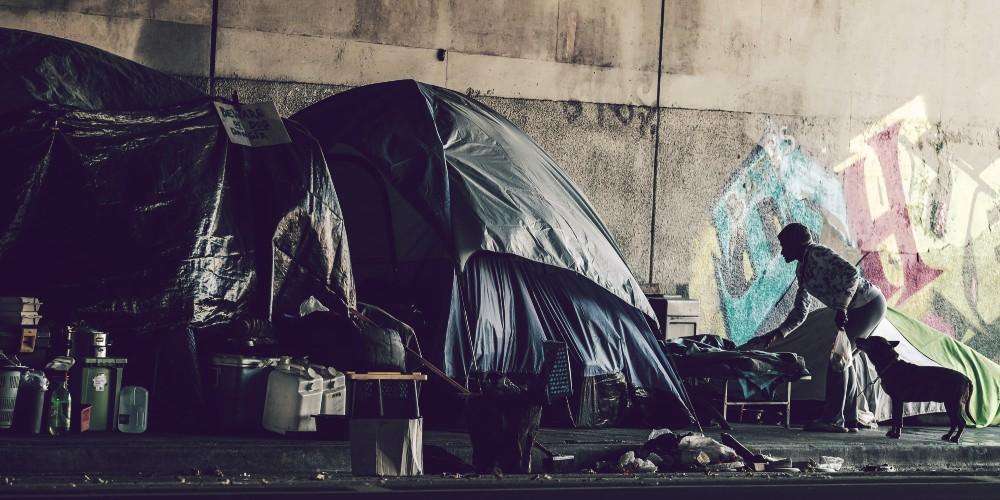
Federal investigators have unveiled a multimillion-dollar fraud scheme tied to California’s beleaguered homeless housing initiatives. Acting United States Attorney Bill Essayli announced charges against two real estate developers who allegedly siphoned off taxpayer dollars meant to combat the homelessness crisis. Funds from California’s Homekey program—fueled by billions in federal and state money—were diverted for personal gain, leaving the homeless on the streets while insiders lined their pockets.
The announcement came during a press conference in Los Angeles, where Essayli pulled no punches: “Accountability for the misuse of billions of tax dollars intended to combat homelessness starts today. The two criminal cases announced is only the tip of the iceberg and we intend to aggressively pursue all leads and hold anyone who broke any federal laws criminally liable.”

Flanked by representatives from the FBI and IRS Criminal Investigation, Essayli detailed two separate but equally egregious cases of fraud, exposing the utter lack of oversight in Governor Gavin Newsom’s administration.
The Shangri-La Sham: Fake Banks and Luxury Splurges
The first case targets Cody Holmes, a 31-year-old Beverly Hills resident and former CFO of Shangri-La Industries LLC, a downtown LA-based affordable housing developer. Holmes was arrested on charges of mail fraud, facing up to 20 years in federal prison if convicted.
According to the federal complaint, Shangri-La, under Holmes’ financial stewardship, applied for grants through California’s Homekey program—an initiative launched in 2020 to convert motels and buildings into homeless housing using a mix of federal COVID-19 relief funds and state money. By October 2022, the California Department of Housing and Community Development (HCD) had disbursed nearly $26 million to Shangri-La specifically for a Thousand Oaks project. This was on top of millions already paid for similar developments in Redlands, King City, and other locations.
To secure these funds, Holmes allegedly submitted fabricated bank statements claiming Shangri-La and its affiliates controlled about $160 million in assets—funds that simply didn’t exist. False balance sheets further misrepresented the company’s cash holdings, tricking HCD into releasing the grants. But instead of building housing for the homeless, at least $2.2 million of the money was funneled to pay off Holmes’ American Express bills, covering lavish purchases at luxury retailers.
Akil Davis, Assistant Director of the FBI’s Los Angeles Field Office, condemned the scheme: “In both of these cases, defendants took advantage of funds allocated to assist the homeless, some of the most vulnerable people in society and many of whom may be suffering from myriad conditions, including addiction.”
The Taylor Flip: Inflated Sales and Democrat Ties
The second case hits even closer to the heart of California’s political elite. Steven Taylor, a 44-year-old Brentwood resident, faces a superseding indictment with seven counts of bank fraud, one count of aggravated identity theft, and one count of money laundering. If convicted, he could spend decades behind bars, including a mandatory two-year sentence for identity theft alone.
Taylor’s scheme involved using phony bank statements and false representations to secure loans and credit lines for his real estate flipping business. From 2019 to 2025, he allegedly defrauded lenders to acquire or refinance properties across LA neighborhoods like Silver Lake, Los Feliz, and Cheviot Hills. In one glaring example, Taylor obtained a loan with fake documents to buy a Cheviot Hills property for $11.2 million, lying to the lender about his intent to renovate and occupy it personally. Instead, he immediately flipped it in a hidden double-escrow deal, selling it for a whopping $27.3 million—more than double his cost—to a homeless housing nonprofit funded by public dollars from the City of Los Angeles and the state.
That buyer? The Weingart Center, a prominent Skid Row-based organization led by none other than former Democratic State Senator Kevin Murray, who has served as its President and CEO since 2011. Murray, a veteran of California’s liberal political machine—having chaired key committees like Appropriations and the Democratic Caucus during his time in the legislature—has overseen Weingart’s expansion into massive housing projects. While Murray and Weingart aren’t charged in the indictment, federal prosecutors have hinted at ongoing probes into whether the nonprofit or city officials knew about the inflated sale. This connection reeks of the cronyism that’s become synonymous with Democrat governance in the Golden State.
Taylor didn’t stop at property flips. He allegedly forged emails and lied about closing credit lines to maintain access to millions more in unsecured loans, using the funds for down payments on additional fraudulent deals. IRS-CI Special Agent in Charge Tyler Hatcher emphasized the task force’s resolve: “Today’s actions show our commitment to ensuring the public that we will investigate missing funds that were intended to benefit some of the most vulnerable Californians.”
The Bigger Picture: California’s Homeless Debacle Under Democrat Rule
These cases aren’t isolated incidents; they’re symptoms of a systemic failure in California’s approach to homelessness. Since launching Homekey under Governor Newsom, the state has poured over $3.5 billion into the program, much of it federal taxpayer money from COVID relief packages. Yet, despite the spending spree, California’s homeless population has ballooned to over 180,000, the highest in the nation. Encampments choke sidewalks, crime surges, and public health crises like drug overdoses and disease outbreaks run rampant—all while bureaucrats and connected insiders feast on the funds.
Conservatives have long warned about the dangers of unchecked government spending without accountability. In blue states like California, where one-party Democrat rule has dominated for decades, oversight is a joke. Newsom’s administration has faced repeated audits revealing mismanagement, with billions vanishing into black holes of inefficiency and graft. As one X user aptly put it in response to the breaking news: “California needs to be defunded completely. They are stealing our tax dollars and enriching themselves.” Another quipped, “Democrats stealing tax dollars? NO WAY!”—a sentiment echoed across conservative circles.
This scandal also ties into broader conservative critiques: California’s open-border policies under Democrats have exacerbated the crisis by attracting migrants who strain resources, while progressive “harm reduction” strategies enable addiction rather than solving it. Why pour more money into a broken system when it’s clear the funds end up in the wrong hands?

Time for Real Accountability
The formation of the Homelessness Fraud & Corruption Task Force by federal authorities is a welcome step, but it’s overdue. Conservatives demand a full reckoning: Defund failing blue-state programs, impose strict audits on all federal aid, and prosecute everyone involved—no matter their political affiliations. As the investigation expands, eyes are on figures like Murray and potentially higher-ups in Newsom’s orbit.
This is why elections matter. Voting for conservative leadership means prioritizing fiscal responsibility, law and order, and real solutions over virtue-signaling and corruption. California taxpayers—and the homeless they aim to help—deserve better. Let’s hope this “tip of the iceberg” leads to an avalanche of justice.
Two Storms, One Harvest

Every food crisis in living memory has been a one-shock event. The 2008 price spike was a commodity bubble. The 2020 shortages were a logistics failure. The 2022 grain scare was a war on one exporter’s ports. Each time, the system bent, adjusted, and recovered, and each time the experts assured us afterward that global markets are simply too big and too diversified to fail.
What nobody in Washington seems eager to discuss is that 2026 is shaping up to be something the modern food system has never actually faced. Two independent shocks, one climatic and one geopolitical, are converging on the same harvest cycle at the same time. Not sequentially. Simultaneously.
Start with the weather. The Pacific Ocean is currently building toward what forecasters now openly call a record event. NOAA’s Climate Prediction Center puts the odds of at least a strong El Niño near 88 percent, with roughly two in three odds it reaches “very strong” status, the tier reserved for perhaps three or four events in the entire satellite era. Every major global model now projects a median peak in Super El Niño territory, and most of them project it exceeding the 2015-16 event, which until now held the modern record. Sea surface anomalies were already brushing the super threshold in mid-July, months before these events normally peak. The atmosphere has already shifted into El Niño mode, and the event is forecast to crest in late fall and early winter.
This is not about “climate change.” It’s about the standard cycles of weather, and the cycle we’re currently in is one that has likely devastated societies in the past. We’re better prepared as a society today, but not all Americans are equally prepared.
Serious households have started doing the quiet math on their own. Grocery bills tell part of the story, and the forecast maps tell the rest, which is why long-term food storage has moved from fringe hobby to mainstream line item in the family budget, with established suppliers like Heaven’s Harvest seeing demand from people who five years ago would have rolled their eyes at the idea. That instinct is not paranoia. It is pattern recognition, and the pattern is worth walking through carefully.
Editor’s Note: Heaven’s Harvest IS a sponsor, but the warnings of this article are real and would be written even if we didn’t have a survival food sponsor. With that said, those who take advantage of what they offer can use promo code “Patriot” for 15% off.
The Fertilizer Clock Is Already Running
While the Pacific warms, the second shock has been unfolding in the Strait of Hormuz. The conflict with Iran turned the world’s most important energy chokepoint into a contested waterway, and the consequences reach far beyond the gas pump. Roughly a third of global fertilizer trade moves through Hormuz, and the disruption sent urea prices up 86 percent year over year by March, with a 53 percent jump in a single month.
The World Bank projects energy prices rising about 24 percent in 2026 and fertilizer about 31 percent. By its own accounting, fertilizer prices ran 35 percent higher in the first five months of this year than the same period last year.
Here is the mechanism the nightly news will not explain. Fertilizer is not a grocery item. It is a time-delayed input. The nitrogen a farmer in Iowa or Punjab could not afford to apply this spring does not show up as a problem this spring. It shows up as a thinner harvest six to twelve months later.
The World Bank’s own food security brief concedes that the effects of reduced applications earlier this season “are likely to become visible only later in harvest outcomes.” Translate that from institutional language into plain English and it means this. The damage is already done, it is already in the ground, and we are simply waiting for it to arrive on the shelf.
Now check the calendar. Six to twelve months from the spring planting season lands us squarely in late 2026 and early 2027. Which is precisely when the strongest El Niño in the instrumental record is forecast to peak, bringing its signature droughts to Southeast Asia, Australia, southern Africa, northern Brazil, and South Asia, the very regions that grow the world’s rice, sugar, and oilseeds.
The World Bank warns openly that a strong El Niño “could disrupt multiple crop belts simultaneously” on top of the conflict-driven input costs. Their baseline projection assumes the Middle East disruptions ease by autumn. What in the last two years of Middle East history suggests that assumption is safe?
The System Has No Slack Left
The comfortable answer is that global markets always adjust. But adjustment requires slack, and the slack is gone. Global cereal production is expected to decline from last year’s records even before El Niño does its work. The UN World Food Programme, hardly a den of right-wing preppers, is calling this the most significant disruption to its supply chains since Covid and the invasion of Ukraine, and its supply chain director put the stakes bluntly.
Today’s supply chain challenges are tomorrow’s hunger crisis.
There is also a political dimension that markets cannot price. When food gets scarce, governments do not behave like economists. They behave like politicians. Export bans, hoarding mandates, and panic buying at the national level turned the modest rice shortfall of 2008 into a global crisis, and analysts are already warning that import-dependent nations are the first dominoes.
The 2015-16 Super El Niño, a far weaker event than what is now forecast, threw tens of millions into food stress across Africa and Asia. This one is projected to be stronger, and it arrives with fertilizer already rationed by price and shipping lanes already contested by missiles.
What Joseph Knew
Scripture does not treat preparation for lean years as faithlessness. It treats it as wisdom delivered in advance to those willing to act on it.
Behold, there come seven years of great plenty throughout all the land of Egypt: And there shall arise after them seven years of famine; and all the plenty shall be forgotten in the land of Egypt.
Joseph did not respond to that warning with a hashtag or a committee. He stored grain during the years of abundance, and when the famine came, Egypt stood while its neighbors begged. The lesson is not that famine is certain. It is that the time to prepare is precisely when preparation still looks optional.
Nobody who filled a pantry in a year of plenty has ever regretted it, and nobody standing in an empty aisle has ever been glad he waited for certainty.
None of this calls for panic, and panic is the enemy of sound judgment anyway. It calls for the same unglamorous prudence our grandparents considered ordinary. Keep some cash margin, know your local growers, and put real food in deep storage while it is cheap and available, because the entire arc of this story is that cheap and available is a closing window.
Families looking for a straightforward place to start can visit Heaven’s Harvest and use promo code Patriot for 15 percent off long-term storable food. The forecasts may yet soften, the strait may yet reopen, and we should pray they do. But hope is a fine thing to hold and a foolish thing to eat.
