

(Zero Hedge)—At age 30, Ann Johnson’s life in Saskatchewan was full. She taught math and physical education at a high school, coached volleyball and basketball, and had recently married and welcomed her first child. At her wedding, she delivered a 15-minute speech filled with joy.
Everything changed in 2005, when she suffered a brainstem stroke while playing volleyball with friends. The stroke left her with locked-in syndrome – near-total paralysis and an inability to speak. “She would try to speak, but her mouth wouldn’t move and no sound would come out,” researchers said. For nearly two decades, she communicated slowly using an eye-tracking system, spelling out words one letter at a time.

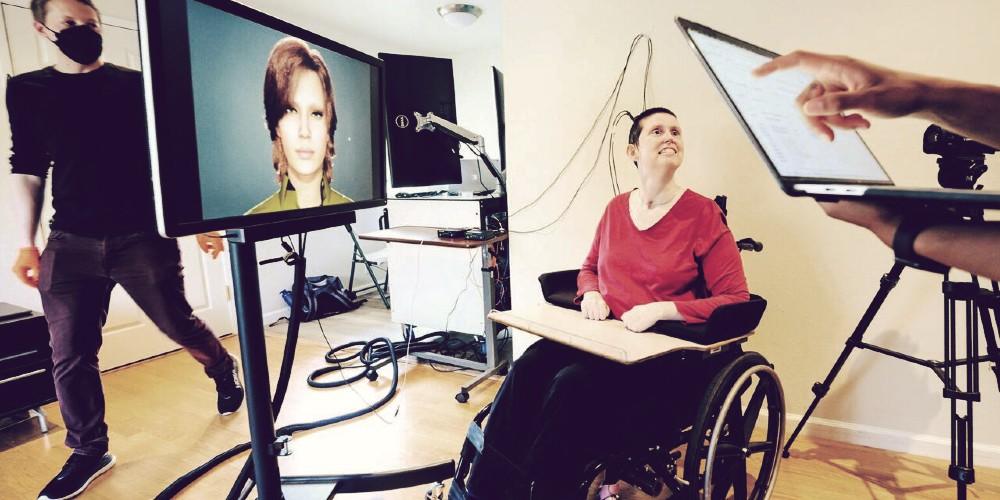
In 2022, Johnson became the third participant in a clinical trial run by researchers at the University of California, San Francisco, and the University of California, Berkeley. The project aimed to restore speech using a brain-computer interface, or neuroprosthesis, that bypasses the body’s damaged connections.
“We were able to get a good sense of the part of the brain that is actually responsible for speech production,” said Gopala Anumanchipalli, an assistant professor at UC Berkeley who began the work in 2015 as a postdoctoral researcher with Edward Chang, a UCSF neurosurgeon. “From there, they figured out how to computationally model the process so that they could synthesize from brain activity what someone is trying to say.”
The device records signals from the brain’s speech centers, sending them to an AI model trained to translate the activity into text, sound, or even facial animation. “Just like how Siri translates your voice to text, this AI model translates the brain activity into the text or the audio or the facial animation,” said Kaylo Littlejohn, a Ph.D. student and co-lead on the study.
To give Johnson an embodied experience, researchers had her choose from a selection of avatars, and they used a recording of her wedding speech to recreate her voice. An implant plugged into a computer nearby rested on top of the region of her brain that processes speech, acting as a kind of thought decoder. Then they showed her sentences and asked her to try to say them.
“She can’t, because she has paralysis, but those signals are still being invoked from her brain, and the neural recording device is sensing those signals,” said Littlejohn. The neural decoding device then sends them to the computer where the AI model resides, where they’re translated. “Just like how Siri translates your voice to text, this AI model translates the brain activity into the text or the audio or the facial animation,” he said. –Berkeley.edu
For Johnson, the trial was emotional. “What do you think of my artificial voice? Tell me about yourself. I am doing well today,” she asked her husband during one session. The researchers had used a recording of her wedding speech to recreate her voice and paired it with a digital avatar she had chosen.
“We didn’t want to read her mind,” Anumanchipalli emphasized. “We really wanted to give her the agency to do this. In some sessions where she’s doing nothing, we have the decoder running, and it does nothing because she’s not trying to say anything. Only when she’s attempting to say something do we hear a sound or action command.”
The early version of the system had an eight-second delay between prompting Johnson and producing speech. But a March study in Nature Neuroscience described a streaming architecture that reduced that to about one second, enabling near-real-time translation. While the avatar in earlier tests bore only a passing resemblance to her, researchers say more lifelike 3D photorealistic versions are possible. “We can imagine that we could create a digital clone that is very much plugged in … with all the preferences, like how Zoom lets us have all these effects,” Anumanchipalli said.
Johnson’s implant was removed in February 2024 for reasons unrelated to the trial, but she continues to advise the research team. She has urged them to develop wireless implants and told them the streaming synthesis “made her feel in control.”
Looking ahead, Anumanchipalli said the goal is for neuroprostheses to be “plug-and-play” and part of standard medical care. “If that means they have a digital version of themselves communicating for them, that’s what they need to be able to do,” he said.
Johnson hopes to work as a counselor in a physical rehabilitation facility, ideally using such a device. “I want patients there to see me and to know their lives are not over now,” she wrote to a UCSF reporter. “I want to show them that disabilities don’t need to stop us or slow us down.”

Starting the Day With a Scripture-Inspired Roast Helps Center Your Thoughts on Eternal Truths Amid Temporal Pressures
The world can seem chaotic, especially right after we wake up. Many believers start their mornings reaching for something familiar — a hot cup of coffee — yet end up settling for mediocre brews that do little more than deliver a caffeine jolt. The daily grind of life, with its endless distractions, news cycles, and responsibilities, can leave even the most faithful feeling spiritually parched alongside their physical fatigue. What if your morning ritual could do more than wake you up? What if it could ground you in truth, nourish your body with exceptional quality, and quietly advance a kingdom purpose at the same time?
That’s the promise — and the reality — behind Promised Grounds Coffee. This Christian-founded company doesn’t just roast beans; it approaches every step as an act of worship and discipleship. By selecting only the top 10% of specialty-grade beans, ethically sourced from dedicated farmers in Central and South America, and small-batch roasting them with reverence in Austin, Texas, Promised Grounds delivers what many describe as the best coffee available — never burnt, never bland, but rich with origin stories and layered flavors that honor God’s creation.
From the vibrant Psalm 27 Roast (a light, bright medium option) to the bold yet peaceful 2 Timothy 1:7 Decaf, each bag carries a Scripture verse that turns your daily pour into a gentle reminder of faith. And through their Ounce Per Ounce Promise, every ounce of coffee you enjoy provides an equal ounce of clean water to families in need via partnership with Filter of Hope — literally brewing hope for body and soul, one cup at a time.
The challenge for today’s Christians runs deeper than finding a decent cup. In an age of convenience-driven consumerism, it’s easy to support companies that dilute values or remain silent on matters of faith. Many believers want their everyday choices — from what they drink to how they spend — to reflect discipleship rather than just convenience. Promised Grounds solves this by weaving Christian excellence into the entire process: beans nurtured with prayerful stewardship by farming families, roasted as an offering rather than a commodity, and packaged with Bible verses to encourage a mindset of gratitude and purpose from the first sip. Reviewers consistently praise the smooth, rich profiles — whether enjoyed black in a drip maker, iced on a warm day, or shared in fellowship — noting how the quality stands toe-to-toe with premium secular brands while delivering something far more meaningful.
This integration of faith and flavor addresses a real need in Christian households and ministries. Busy parents, church leaders, and remote workers alike report that starting the day with a Scripture-inspired roast helps center their thoughts on eternal truths amid temporal pressures. The coffee’s exceptional character — bright citrus notes in lighter roasts or deep chocolate undertones in bolder ones — comes from meticulous selection and careful roasting that respects the bean’s natural gifts rather than masking them. It’s the kind of coffee that elevates a simple quiet time, fuels productive workdays, or sparks meaningful conversations when shared at Bible studies or outreach events. And because it’s ethically sourced with integrity, every purchase supports sustainable livelihoods for farmers who treat their crops like family harvests.
For those leading churches or small groups, the impact multiplies. Promised Grounds offers bundles and options perfect for hospitality ministries, turning ordinary coffee service into an opportunity to point people toward the living water of Christ. Imagine greeting visitors with a warm cup whose very bag carries God’s Word — a subtle yet powerful witness that aligns with the Great Commission. The company’s Texas roots and commitment to “brewing hope” resonate especially with believers who value American enterprise paired with global compassion.
Of course, quality alone isn’t enough if the experience feels out of reach. Promised Grounds keeps it accessible with practical perks like free shipping on orders over $40, sample sets for discovering favorites, and thoughtful add-ons such as faith-themed mugs. Whether you prefer whole beans for fresh grinding, grounds for convenience, or even bulk options for larger households and ministries, the result is consistently superior coffee that makes discipleship feel integrated rather than added on.
As you consider how to align even the smallest habits with your walk with God, Promised Grounds Coffee stands out as a refreshing solution. It tackles the dual problems of subpar daily sustenance and disconnected consumption by offering a product that genuinely excels in taste while advancing a mission of clean water, farmer dignity, and scriptural encouragement. Believers who make the switch often describe it as more than a beverage upgrade — it becomes part of their rhythm of gratitude, a daily invitation to remember that every good gift comes from above.
If you’re ready to transform your mornings (and perhaps your church gatherings) with coffee that honors both exceptional craftsmanship and Christian values, I encourage you to explore what Promised Grounds has to offer. One sip at a time, you’ll be nourishing your body, refreshing your spirit, and participating in something far greater — all while enjoying what truly is among the best coffee available.

It is all about the money, my daughter has ALS and DO NOT EVER TELL ME THAT THEY DO NOT HAVE A CHIP THAT COULD HELP HER. SPEAK AND WALK AGAIN. The people with this disease just die, fully able to think on their own but just have to wait to die a horrible death. They are not even given a chance. Money pours into these organizations and no closer to even a hint of a cure. Yet there are chips, which seem to be very little risk operations talked about but no info to access them etc. All a lot money pouring in for years and years yet they DO NOTHING BUT SAY WE HAVE CHIPS BUT YOU CANNOT GET IT ETC. NO MORE MONEY FROM OUR FAMILY EVER.