

(RealClearInvestigations)—Like the weather, everyone complains about Pentagon spending and mismanagement, but no one does anything about it. Leaders of the world’s most expensive military have refused to conduct or failed to complete every internal financial audit since Congress first demanded such accountability in the 1990s. The Department of Defense owns over 70% of the nation’s assets and can’t account for half of them. In fairness, military brass has had plenty of enablers in its failures to tame wild and sometimes blindfolded spending, with a special boost from political leaders who consistently block reform.
Although the Pentagon budget has grown by 50% over the last 10 years, President Trump wants to add another 12% to the Pentagon’s budget for fiscal year 2026, a move that for the first time will boost defense spending to over $1 trillion.

That number will almost certainly end up higher because, by law, no matter how generous the president’s request is, the Pentagon is required to ask Congress for even more money. The chief of staff of each military branch must put together an unfunded priority list – nicknamed a “wish list” – requesting money for items not included in the president’s budget.
This has been routine since the 1990s, and the procedure became federal law in 2017. The lists don’t need to include lengthy justifications of why the money is needed, as is the case for most budget requests to Congress.
These “Dear Santa” letters totaled at least $30.8 billion in fiscal year 2025, $17 billion in 2024, and $21.5 billion in 2023. Some of the items the Defense Department “wished” for in those three years include:
- $6.8 million for an Air Force dog kennel
- $10.2 million for a “high altitude balloon”
- $22.5 million for “mobile kitchen trailers”
- $106.6 million for a power plant in Djibouti
- $8.5 million for the Space Command to renovate its temporary base while it waits for its actual base to be built
- $20 million for a Great Lakes icebreaker that can sail through frozen water – 10 years from now
- $398 million for classified Space Force programs
The practice persists even though the Defense Department isn’t always happy about it. The Biden administration’s Pentagon Comptroller, Mike McCord, publicly supported ending the requirement. He wrote in a 2023 letter to Sen. Elizabeth Warren (D-Mass.) that unfunded priority lists are “not an effective way to illuminate our top priorities.”
The opportunities to spend go beyond even the wish lists. Members of Congress often add “Congressional increases” to the Pentagon budget – de facto earmarks for programs neither the president nor Pentagon officials thought were important enough to include even in their dream spending plans.
Congressional increases added at least $22.7 billion to the military budget in 2024. The dollar total is likely even higher because the public report lists only increases of $20 million or more. Auditors at the government watchdog group Open the Books filed a Freedom of Information Act request for the missing information, but were told that no record exists.
The largest single addition last year was $1.8 billion for the Navy to buy ten extra planes. Other add-ons have little direct connection to defense, such as $110 million for prostate cancer research.
Although Trump created the Department of Government Efficiency to signal his commitment to reducing and streamlining government, the president is sending mixed signals on Pentagon spending. On the one hand, the president said in an April 9 executive order that he wanted the Defense Department to compile a list of programs more than 15% behind schedule or 15% over cost so they can be assessed for possible cancellation. The (soft) deadline was last week.
At the same time, however, Trump has been receptive to the complaints of lawmakers like Sen. Roger Wicker (R-Miss.), chairman of the Senate Armed Services Committee, who lamented in February that defense spending was “near record lows as a percentage of our gross domestic product, and all aspects of our military forces are now in dire need of repair or replacement.” (Defense spending in 2023 was 3.4% of GDP, in line with the last 10 years but well below the Reagan-era high of 6.8% in 1982, before the end of the Cold War.)
Trump’s planned increase of the military budget would go a long way to wiping out the $160 billion that DOGE claims it’s saved taxpayers with its government-wide cost cuts.
The added resources don’t mean the military is getting stronger or better at equipping its warfighters. It means there’s more bureaucracy to feed. In 2000, the Defense Department spent roughly $150 billion on its active personnel, adjusted for inflation. Since then, that number has only inched upward, to $166 billion in 2024. Active forces made up just 21% of the 2025 budget request. Most of the rest is eaten up by “operations and maintenance,” the conducting of day-to-day business, which has increased sharply. In 2000, the military spent roughly $175 billion 2024 dollars on O&M. For 2025, the Pentagon requested $338 billion, a 93% increase.
Shortchanging personnel has consequences. A March report from the Government Accountability Office found “shortages in trained maintenance personnel” compromised the ability of the Army, Navy, and Air Force to meet mission-capable goals for many aircraft. It reported that “the Navy EA-18G Growler – an aircraft with advanced electronic warfare capabilities … [and] the Army CH-47F Chinook – the Army’s only heavy-lift cargo rotary wing aircraft” failed to meet their “mission-capable rate goal in any year from fiscal year 2015 through fiscal year 2024.” The GAO also found that “the Air Force C-130H Hercules and C-130J Super Hercules – performing airlift support and aeromedical missions” met its goal just once during that period and the B-2 Spirit – the Air Force’s “stealth bomber that can deliver both conventional and nuclear munitions by penetrating an enemy’s defenses” met its mission-capable rate goal just four of the 10 years.

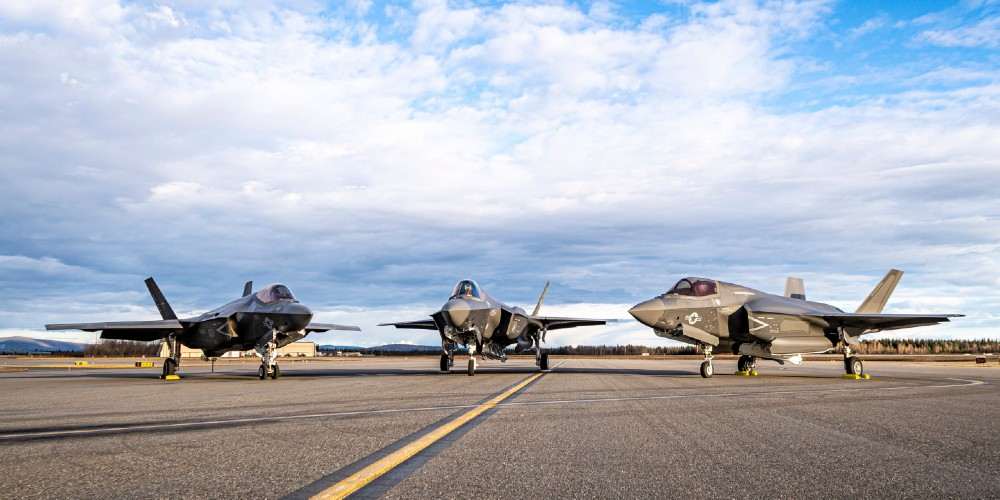
Similar problems plague the military’s marquee weapons. The F-35 Lightning II, an impressive bit of high-tech hardware, can move at supersonic speed, maneuver against enemy aircraft, hit ground targets, and, in stealth mode, evade radar. One variant can even hover. The Air Force, the Navy, and the Marine Corps all have their versions of the fighter; there are more than 700 F-35s deployed in bases and on carriers around the world.
By the 2040s, the Defense Department plans to acquire 2,470 more F-35s for an estimated total cost of about $442 billion, and to keep them flying into the 2080s. The cost of maintaining the F-35 fleet over the next six decades is the real budget-killer. It soared to $1.58 trillion in 2023, 44% more than the $1.1 trillion in 2018.
Even with that price tag, the F-35 has availability problems, according to the Government Accountability Office. The GAO’s litany of concerns includes a shortage of spare parts, inadequate training of mechanics, and an overreliance on contractors to repair the jets, leaving the military at their mercy. The result is a disappointing level of readiness, which the GAO defines as “the percentage of time during which these aircraft are safe to fly and able to perform at least one tasked mission.”
The F-35 might be a test case for military spending because it could be seen at odds with Trump’s noninterventionist, “America First” philosophy, according to Richard Aboulafia, managing director of the consulting firm AeroDynamic Advisory. “It was developed in partnership with our allies, and it’s meant as an expeditionary force, meaning it’s good for defending U.S. interests in Europe or Asia, but not as effective at home,” he said. On the other hand, the pricey plane is built in Texas with an engine from Florida.
Sky-high costs also afflict Naval housing. Soon after John Phelan was sworn in as Secretary of the Navy in March, he reviewed the bill for a new set of barracks to house his sailors. Phelan, a longtime investment executive without military experience, said he had trouble believing it. “I see numbers on things that are eye-opening to me,” Phelan said at an April 9 public appearance. The barracks cost $2.5 million a key (per room), he said. “My old firm, we built the finest hotel in Hawaii for $800,000 a key, and that has some pretty nice marble and some pretty nice things in it, and I’m trying to understand how we can get to those numbers.”
Another chronic concern is the time and expense it takes the Navy and its shipbuilding contractor, Huntington Ingalls Industries (HII), to put together a fleet of battle-ready fighting vessels. The planned July delivery of the newest aircraft carrier, the $12.9 billion USS John F. Kennedy, will likely need to be rescheduled. The ship is 95% complete, but there are issues with the elevators used to move munitions from below deck and aircraft launch and recovery systems. Similar problems plagued the USS Gerald R. Ford, which was delivered 32 months late in 2017 without functioning elevators. The next carrier on the assembly line, the $13.5 billion USS Enterprise, is running more than two years behind schedule.

Delivery delays of as much as 18 months are also expected for the lead boat in the Columbia class of nuclear-armed submarines.
Delivery of the first frigate in the Navy’s Constellation class has been changed to 2029 from 2026, and its cost has swelled to $1.4 billion from an initial estimate of $1 billion. Frigates are armed fighter vessels often used to escort other ships through treacherous waters.
The Air Force was singled out for criticism in the April 9 White House order. The first flight of the Sentinel, the Air Force’s new intercontinental ballistic missile, or ICBM, is two years behind schedule and its costs have slopped 37% over what was initially promised.
“With adversaries like China and Russia rapidly advancing their own military technologies,” the executive order said, “it is essential to prioritize speed, flexibility and innovation to deliver cutting-edge capabilities to our Armed Forces.”
The Pentagon wrings its hands over one of the roots of this predicament – the lack of competition for contract work – but it’s partly its own fault. At a 1993 dinner party now known as the “Last Supper,” then-Defense Secretary Les Aspin urged defense companies to merge with each other. In the afterglow of the Soviet Union’s collapse, the conventional wisdom at the time was that without the antagonism of its main rival, the U.S. military would be spending less.
The subsequent consolidation of the defense industry was a marvel of corporate wheeling and dealing. What were 51 separate companies during the Clinton administration are now the “Big Five” defense contractors – Lockheed Martin, Boeing, General Dynamics, Raytheon Technologies, and Northrop Grumman. Together, they account for 15% of the Pentagon’s contract spending, which, defying experts of the early 1990s, has ballooned since the end of the Cold War. The companies’ exalted status doesn’t mean they’ve skimped on PowerPoint presentations, wining and dining, and the occasional arm-twisting. Defense companies spent $70 million on lobbying in 2023, with the Big Five making up the bulk of that.
There’s also the issue of resources that the Pentagon should have been allocating but failed to. The U.S. is responsible for 40% of the world’s military spending, or roughly as much as the next nine countries combined, but somehow little of the cash has gone to keeping up with technology. Astonishingly, the software revolution of the 21st century pretty much bypassed the Pentagon procurement offices. That finally seems to be changing. A March 6 order from Defense Secretary Pete Hegseth, “Directing Modern Software Acquisition to Maximize Lethality,” requires the Pentagon to adopt new, tech-enabled buying practices.
“While commercial industry has rapidly adjusted to a software-defined product reality,” Hegseth wrote, the Defense Department “has struggled to reframe our acquisition process from a hardware-centric to a software-centric approach. When it comes to software acquisition, we are overdue in pivoting to a performance-based outcome and, as such, it is the Warfighter who pays the price.”
Artificial intelligence promises to make Pentagon procurement leaner and meaner, an evolution that could be made easier by the Trump administration’s friendly relationship with Silicon Valley. For years, tech bros treated defense contracts as if they spread the avian flu – both Microsoft and Google stepped away from collaborating with the Pentagon, in 2018 and 2019, respectively, after employees revolted. The Defense Department had almost $2 billion budgeted for AI in 2024 but couldn’t “fully identify” how it planned to use the money, the GAO found. Now, a political alliance between Trump and tech entrepreneurs such as Elon Musk, Peter Thiel, and David Sacks could soothe the perceived stigma of tech startups focusing on building weapons systems, making troops safer, and fixing cost overruns and delivery delays in Pentagon purchasing.
Alexander Karp, CEO of defense surveillance software contractor Palantir Technologies and co-author of “The Technological Republic: Hard Power, Soft Belief, and the Future of the West,” has emerged as head cheerleader of the new relationship. He has said he hopes it yields new and better ways for America’s war fighters to find and kill their enemies. “If a U.S. Marine asks for a better rifle, we should build it,” he said in the book. “And the same goes for software.”
Put that on the wish list.
Two Storms, One Harvest

Every food crisis in living memory has been a one-shock event. The 2008 price spike was a commodity bubble. The 2020 shortages were a logistics failure. The 2022 grain scare was a war on one exporter’s ports. Each time, the system bent, adjusted, and recovered, and each time the experts assured us afterward that global markets are simply too big and too diversified to fail.
What nobody in Washington seems eager to discuss is that 2026 is shaping up to be something the modern food system has never actually faced. Two independent shocks, one climatic and one geopolitical, are converging on the same harvest cycle at the same time. Not sequentially. Simultaneously.
Start with the weather. The Pacific Ocean is currently building toward what forecasters now openly call a record event. NOAA’s Climate Prediction Center puts the odds of at least a strong El Niño near 88 percent, with roughly two in three odds it reaches “very strong” status, the tier reserved for perhaps three or four events in the entire satellite era. Every major global model now projects a median peak in Super El Niño territory, and most of them project it exceeding the 2015-16 event, which until now held the modern record. Sea surface anomalies were already brushing the super threshold in mid-July, months before these events normally peak. The atmosphere has already shifted into El Niño mode, and the event is forecast to crest in late fall and early winter.
This is not about “climate change.” It’s about the standard cycles of weather, and the cycle we’re currently in is one that has likely devastated societies in the past. We’re better prepared as a society today, but not all Americans are equally prepared.
Serious households have started doing the quiet math on their own. Grocery bills tell part of the story, and the forecast maps tell the rest, which is why long-term food storage has moved from fringe hobby to mainstream line item in the family budget, with established suppliers like Heaven’s Harvest seeing demand from people who five years ago would have rolled their eyes at the idea. That instinct is not paranoia. It is pattern recognition, and the pattern is worth walking through carefully.
Editor’s Note: Heaven’s Harvest IS a sponsor, but the warnings of this article are real and would be written even if we didn’t have a survival food sponsor. With that said, those who take advantage of what they offer can use promo code “Patriot” for 15% off.
The Fertilizer Clock Is Already Running
While the Pacific warms, the second shock has been unfolding in the Strait of Hormuz. The conflict with Iran turned the world’s most important energy chokepoint into a contested waterway, and the consequences reach far beyond the gas pump. Roughly a third of global fertilizer trade moves through Hormuz, and the disruption sent urea prices up 86 percent year over year by March, with a 53 percent jump in a single month.
The World Bank projects energy prices rising about 24 percent in 2026 and fertilizer about 31 percent. By its own accounting, fertilizer prices ran 35 percent higher in the first five months of this year than the same period last year.
Here is the mechanism the nightly news will not explain. Fertilizer is not a grocery item. It is a time-delayed input. The nitrogen a farmer in Iowa or Punjab could not afford to apply this spring does not show up as a problem this spring. It shows up as a thinner harvest six to twelve months later.
The World Bank’s own food security brief concedes that the effects of reduced applications earlier this season “are likely to become visible only later in harvest outcomes.” Translate that from institutional language into plain English and it means this. The damage is already done, it is already in the ground, and we are simply waiting for it to arrive on the shelf.
Now check the calendar. Six to twelve months from the spring planting season lands us squarely in late 2026 and early 2027. Which is precisely when the strongest El Niño in the instrumental record is forecast to peak, bringing its signature droughts to Southeast Asia, Australia, southern Africa, northern Brazil, and South Asia, the very regions that grow the world’s rice, sugar, and oilseeds.
The World Bank warns openly that a strong El Niño “could disrupt multiple crop belts simultaneously” on top of the conflict-driven input costs. Their baseline projection assumes the Middle East disruptions ease by autumn. What in the last two years of Middle East history suggests that assumption is safe?
The System Has No Slack Left
The comfortable answer is that global markets always adjust. But adjustment requires slack, and the slack is gone. Global cereal production is expected to decline from last year’s records even before El Niño does its work. The UN World Food Programme, hardly a den of right-wing preppers, is calling this the most significant disruption to its supply chains since Covid and the invasion of Ukraine, and its supply chain director put the stakes bluntly.
Today’s supply chain challenges are tomorrow’s hunger crisis.
There is also a political dimension that markets cannot price. When food gets scarce, governments do not behave like economists. They behave like politicians. Export bans, hoarding mandates, and panic buying at the national level turned the modest rice shortfall of 2008 into a global crisis, and analysts are already warning that import-dependent nations are the first dominoes.
The 2015-16 Super El Niño, a far weaker event than what is now forecast, threw tens of millions into food stress across Africa and Asia. This one is projected to be stronger, and it arrives with fertilizer already rationed by price and shipping lanes already contested by missiles.
What Joseph Knew
Scripture does not treat preparation for lean years as faithlessness. It treats it as wisdom delivered in advance to those willing to act on it.
Behold, there come seven years of great plenty throughout all the land of Egypt: And there shall arise after them seven years of famine; and all the plenty shall be forgotten in the land of Egypt.
Joseph did not respond to that warning with a hashtag or a committee. He stored grain during the years of abundance, and when the famine came, Egypt stood while its neighbors begged. The lesson is not that famine is certain. It is that the time to prepare is precisely when preparation still looks optional.
Nobody who filled a pantry in a year of plenty has ever regretted it, and nobody standing in an empty aisle has ever been glad he waited for certainty.
None of this calls for panic, and panic is the enemy of sound judgment anyway. It calls for the same unglamorous prudence our grandparents considered ordinary. Keep some cash margin, know your local growers, and put real food in deep storage while it is cheap and available, because the entire arc of this story is that cheap and available is a closing window.
Families looking for a straightforward place to start can visit Heaven’s Harvest and use promo code Patriot for 15 percent off long-term storable food. The forecasts may yet soften, the strait may yet reopen, and we should pray they do. But hope is a fine thing to hold and a foolish thing to eat.
