

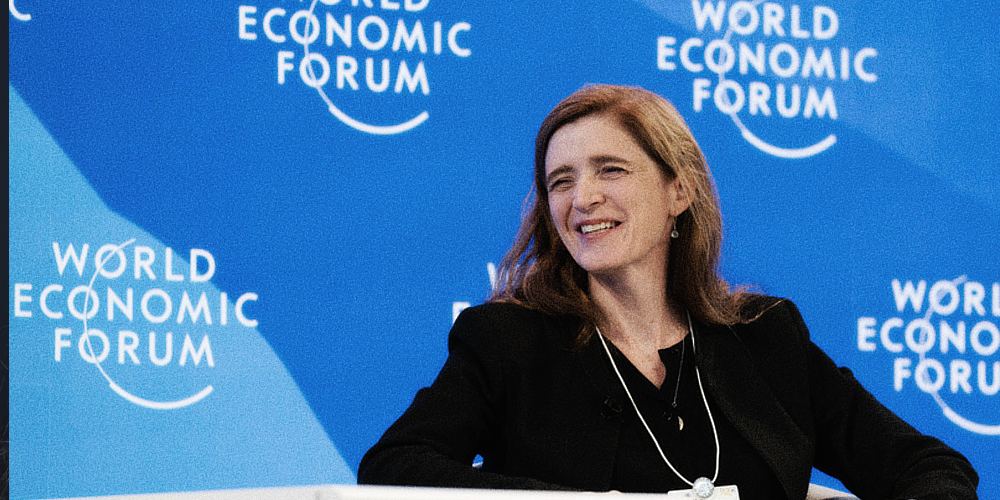
(Daily Signal)—The U.S. Agency for International Development wasn’t just spending your hard-earned tax dollars on transgender operas overseas—USAID also has troubling connections with the leftist pressure groups that infiltrated and advised the Biden administration.
My book, “The Woketopus: The Dark Money Cabal Manipulating the Federal Government,” exposes the woke activist groups that fed staff into the administrative state and pushed woke policies on the bureaucracy.
As President Donald Trump released information about USAID’s corruption, I started to notice a few familiar names from my research.
The American people should understand just how connected the woke enterprise is to the federal bureaucracy, and USAID provides a powerful example of those ties.
What Is USAID?
While the acronym suggests USAID is about aid, it’s really about soft power. President John F. Kennedy established USAID as a tool to fight Soviet Communism abroad, but in recent years, the agency has promoted the classic woke causes: critical race theory (the notion that America is systemically racist against blacks and favors whites and requires fundamental reform), climate alarmism, gender ideology, and a preference for technocratic government.
The Trump administration has highlighted USAID waste, particularly $1.5 million to advance “diversity, equity, and inclusion” in Serbia’s workplaces; $47,000 for a transgender opera in Colombia; and more. Others have highlighted grants such as $20 million for an Arabic translation of Sesame Street and $2 million for promoting sex changes in Guatemala.
USAID has also spent $250 million on a Climate Finance for Development Accelerator, aiming to “mobilize $2.5 billion in public and private climate investments by 2030.” The accelerator seeks to help countries meet their commitments in the Paris Climate Agreement, which the Trump administration rejected on the president’s first day in office.
These initiatives echo the spending of Hungarian American billionaire George Soros’ Open Society Foundations, and that is no accident.
The Soros Connection
The Open Society Foundations has bankrolled many of the leftist groups in the Woketopus, which staffed and advised the Biden administration.
While Open Society Foundations has claimed that it does not receive funding from USAID or direct the funding of USAID, its ties to USAID are undeniable. Not only has Open Society funded the same projects as USAID, but its leaders met with former USAID Administrator Samantha Power at least twice, the Soros foundations network listed USAID among its “donor partners” in 2001, and an Open Society nonprofit actually sued USAID twice, with the cases reaching the Supreme Court both times.
USAID and Open Society Foundations jointly funded the Organized Crime and Corruption Reporting Project—an organization that attacked conservatives for criticizing Soros and that published the report that sparked the first Trump impeachment. USAID’s connections to the project raise uncomfortable questions about whether the agency was trying to oust Trump.
The Organized Crime Corruption and Reporting Project also attacked Rep. Chris Smith, R-N.J.; Sen. Mike Lee, R-Utah; and Mike Gonzalez, a senior fellow at the Davis Institute for National Security and Foreign Policy at The Heritage Foundation. These conservatives made the mistake of noticing that the U.S. Embassy to Macedonia had selected Soros’ Open Society Foundations as the main implementer for USAID projects in the Eastern European country.
According to Rep. Scott Perry, R-Pa., USAID awarded a $2.54 million contract to Open Society for training in “civic activism,” “mobilization,” and “civic engagement” in Macedonia in February 2017.
The East West Management Institute—which has long listed Open Society Foundations as a donor and implementing partner and which received $31.2 million from USAID in the last full fiscal year ending on Sept. 30—launched court changes in Albania that critics allege resulted in the prosecution of Albanian opposition leader Sali Berisha, silencing the opponent of the country’s socialist prime minister.

As for its role in the Woketopus, Open Society Foundations or its partners, the Open Society Policy Center, the Open Society Institute, or the Foundation to Promote Open Society have funded:
- the American Civil Liberties Union (which pushed open borders in the Biden administration)
- the NAACP Legal Defense Fund and the Southern Poverty Law Center (which pushed the weaponization of federal law enforcement agencies against conservatives)
- the Human Rights Campaign (which pushed gender ideology)
- the Sierra Club (which pushed climate alarmism)
The Tides Foundation
USAID has awarded more than $27 million in grants to the Tides Center, which forms part of the Left’s dark money network I expose in “The Woketopus” along with its sister groups the Tides Foundation and Tides Advocacy.
USAID awarded the Tides Center four grants: a $24.7 million grant in 2016, of which $20 million has been spent; a $1.5 million grant in 2016, of which $147,000 has been spent; a $700,000 grant in 2014 that appears not to have been fulfilled; and another $150,000 grant that appears not to have been fulfilled.
The largest grants came from USAID’s Foreign Assistance Program, which “works to support long-term and equitable economic growth and advance U.S. foreign policy objectives by supporting economic growth, agriculture, and trade; global health; and democracy, conflict prevention, and humanitarian assistance.”
Tides, like Open Society, has funded many of the leftist groups that called the shots under Biden. The Tides Foundation, Tides Advocacy, or the Tides Center have funded:
- the Center for American Progress (which fed more than 60 officials into the Biden administration, pushing both open borders and climate funding)
- the Natural Resources Defense Fund and the Sierra Club (which pushed a crackdown on oil and gas)
- the Southern Poverty Law Center and the NAACP Legal Defense Fund
- the ACLU
The Tides Center launched an organization, Palestine Legal, that represents anti-Israel rioters in court and gives them legal advice. A Palestine Legal senior attorney told a leftist magazine in January that the group has “represented or advised hundreds of students” since Oct. 7, 2023.

A Revolving Door
Former USAID staff have gone to work at groups in the Woketopus.
Olivia Callahan, for example, served as a law clerk at USAID before taking roles at the ACLU’s Immigrant Rights Project, according to her LinkedIn profile.
Ann Van Dusen, who spent 25 years at USAID, now serves as a senior associate at Arabella Advisors, a for-profit company that launched nonprofit entities that funnel money to the Woketopus.
Anne-Marea (Tangee) Griffin, who worked for one year at USAID, now works as a senior fellow for Africa at the Center for American Progress.
Miriam Rashid, an associate director of racial equity and justice at the Center for American Progress, worked as a graduate research fellow at USAID.
Brandon Hooks, deputy director of creator and partnership strategy at the Human Rights Campaign, served as an LGBTI office intern at USAID.
Jay Gilliam, who served as an LGBTQI+ coordinator at USAID until January, previously worked as director of global programs at the Human Rights Campaign. Before joining HRC, he spent four years at USAID.
Chika Nwankwo, who worked as a research assistant for USAID, now works on vaccines via a contract with New Venture Fund, one of the Arabella Advisors-established nonprofits. New Venture Fund sponsored Governing for Impact, a shadowy nonprofit that enjoyed tremendous access in the early Biden administration.
Cuthbert Tinavapi, who served as a USAID regional auditor, now works with the Open Society Foundations as a finance consultant.
Tinatin Tsertsvadze, an advocacy adviser at Open Society Foundations, previously worked as a USAID assistant in the nation of Georgia.
Beth Dunlap, a director at the Open Society Foundations, served as a “senior transition adviser” at USAID. In this role, she “provided strategic guidance, facilitation, and operational support to programs funding political transition in Asia, Africa, and the Middle East,” according to her LinkedIn profile. Her profile lists countries served: Myanmar, Syria, Lebanon, Tunisia, Libya, Sri Lanka, Pakistan, Afghanistan, Colombia, Yemen, Somalia, Ukraine, and North Macedonia.
Andrea Guardo, a former “human rights specialist” at USAID, now works in Democracy Protection for Latin American and the Caribbean at the Open Society Foundations.
Diego Garcia Devis, drug policy team manager at the Open Society Foundations, previously worked at USAID for nearly five years.
Rajiv J. Shah, president at the Rockefeller Foundation, part of the Left’s dark money network that funded climate activist groups such as the Nature Conservancy and the World Wildlife Fund, previously headed USAID under President Barack Obama.
The Rockefeller Foundation’s chief of staff, Mike Muldoon, and its vice president for innovation, Andrew Sweet, also had elevated roles at USAID—as senior investment officer and senior adviser to the administrator, respectively.
(The Washington Examiner’s Robert Schmad assisted with this research.)
Over the past four years, USAID has given more than $4.2 billion in grants to “miscellaneous foreign awardees,” which—as the Capital Research Center’s Parker Thayer explained—is code for “we don’t want to say who got the money.”
There are perfectly legitimate reasons to hide some of this money—perhaps USAID wants to withhold the identity of recipients in order to protect them from terrorist cells or foreign adversaries. Yet the idea that any federal agency would direct $4.2 billion of taxpayers’ money without disclosing the recipients is shocking.
It also raises the question of whether that money is supporting the woke activist groups that enjoy close ties to USAID.
A Snapshot of the Left’s Woke Bureaucracy
USAID’s connections to the Open Society Foundations, Tides, the Rockefeller Foundation, the Human Rights Campaign, the Center for American Progress, the ACLU, and Arabella Advisors confirm the basic premise of “The Woketopus:” that the Left’s massive dark money influence campaign has immense power, regardless of who’s in the White House.
USAID provides a snapshot of the Left’s massive infrastructure, and combating its influence is no easy feat.
Two Storms, One Harvest

Every food crisis in living memory has been a one-shock event. The 2008 price spike was a commodity bubble. The 2020 shortages were a logistics failure. The 2022 grain scare was a war on one exporter’s ports. Each time, the system bent, adjusted, and recovered, and each time the experts assured us afterward that global markets are simply too big and too diversified to fail.
What nobody in Washington seems eager to discuss is that 2026 is shaping up to be something the modern food system has never actually faced. Two independent shocks, one climatic and one geopolitical, are converging on the same harvest cycle at the same time. Not sequentially. Simultaneously.
Start with the weather. The Pacific Ocean is currently building toward what forecasters now openly call a record event. NOAA’s Climate Prediction Center puts the odds of at least a strong El Niño near 88 percent, with roughly two in three odds it reaches “very strong” status, the tier reserved for perhaps three or four events in the entire satellite era. Every major global model now projects a median peak in Super El Niño territory, and most of them project it exceeding the 2015-16 event, which until now held the modern record. Sea surface anomalies were already brushing the super threshold in mid-July, months before these events normally peak. The atmosphere has already shifted into El Niño mode, and the event is forecast to crest in late fall and early winter.
This is not about “climate change.” It’s about the standard cycles of weather, and the cycle we’re currently in is one that has likely devastated societies in the past. We’re better prepared as a society today, but not all Americans are equally prepared.
Serious households have started doing the quiet math on their own. Grocery bills tell part of the story, and the forecast maps tell the rest, which is why long-term food storage has moved from fringe hobby to mainstream line item in the family budget, with established suppliers like Heaven’s Harvest seeing demand from people who five years ago would have rolled their eyes at the idea. That instinct is not paranoia. It is pattern recognition, and the pattern is worth walking through carefully.
Editor’s Note: Heaven’s Harvest IS a sponsor, but the warnings of this article are real and would be written even if we didn’t have a survival food sponsor. With that said, those who take advantage of what they offer can use promo code “Patriot” for 15% off.
The Fertilizer Clock Is Already Running
While the Pacific warms, the second shock has been unfolding in the Strait of Hormuz. The conflict with Iran turned the world’s most important energy chokepoint into a contested waterway, and the consequences reach far beyond the gas pump. Roughly a third of global fertilizer trade moves through Hormuz, and the disruption sent urea prices up 86 percent year over year by March, with a 53 percent jump in a single month.
The World Bank projects energy prices rising about 24 percent in 2026 and fertilizer about 31 percent. By its own accounting, fertilizer prices ran 35 percent higher in the first five months of this year than the same period last year.
Here is the mechanism the nightly news will not explain. Fertilizer is not a grocery item. It is a time-delayed input. The nitrogen a farmer in Iowa or Punjab could not afford to apply this spring does not show up as a problem this spring. It shows up as a thinner harvest six to twelve months later.
The World Bank’s own food security brief concedes that the effects of reduced applications earlier this season “are likely to become visible only later in harvest outcomes.” Translate that from institutional language into plain English and it means this. The damage is already done, it is already in the ground, and we are simply waiting for it to arrive on the shelf.
Now check the calendar. Six to twelve months from the spring planting season lands us squarely in late 2026 and early 2027. Which is precisely when the strongest El Niño in the instrumental record is forecast to peak, bringing its signature droughts to Southeast Asia, Australia, southern Africa, northern Brazil, and South Asia, the very regions that grow the world’s rice, sugar, and oilseeds.
The World Bank warns openly that a strong El Niño “could disrupt multiple crop belts simultaneously” on top of the conflict-driven input costs. Their baseline projection assumes the Middle East disruptions ease by autumn. What in the last two years of Middle East history suggests that assumption is safe?
The System Has No Slack Left
The comfortable answer is that global markets always adjust. But adjustment requires slack, and the slack is gone. Global cereal production is expected to decline from last year’s records even before El Niño does its work. The UN World Food Programme, hardly a den of right-wing preppers, is calling this the most significant disruption to its supply chains since Covid and the invasion of Ukraine, and its supply chain director put the stakes bluntly.
Today’s supply chain challenges are tomorrow’s hunger crisis.
There is also a political dimension that markets cannot price. When food gets scarce, governments do not behave like economists. They behave like politicians. Export bans, hoarding mandates, and panic buying at the national level turned the modest rice shortfall of 2008 into a global crisis, and analysts are already warning that import-dependent nations are the first dominoes.
The 2015-16 Super El Niño, a far weaker event than what is now forecast, threw tens of millions into food stress across Africa and Asia. This one is projected to be stronger, and it arrives with fertilizer already rationed by price and shipping lanes already contested by missiles.
What Joseph Knew
Scripture does not treat preparation for lean years as faithlessness. It treats it as wisdom delivered in advance to those willing to act on it.
Behold, there come seven years of great plenty throughout all the land of Egypt: And there shall arise after them seven years of famine; and all the plenty shall be forgotten in the land of Egypt.
Joseph did not respond to that warning with a hashtag or a committee. He stored grain during the years of abundance, and when the famine came, Egypt stood while its neighbors begged. The lesson is not that famine is certain. It is that the time to prepare is precisely when preparation still looks optional.
Nobody who filled a pantry in a year of plenty has ever regretted it, and nobody standing in an empty aisle has ever been glad he waited for certainty.
None of this calls for panic, and panic is the enemy of sound judgment anyway. It calls for the same unglamorous prudence our grandparents considered ordinary. Keep some cash margin, know your local growers, and put real food in deep storage while it is cheap and available, because the entire arc of this story is that cheap and available is a closing window.
Families looking for a straightforward place to start can visit Heaven’s Harvest and use promo code Patriot for 15 percent off long-term storable food. The forecasts may yet soften, the strait may yet reopen, and we should pray they do. But hope is a fine thing to hold and a foolish thing to eat.
