

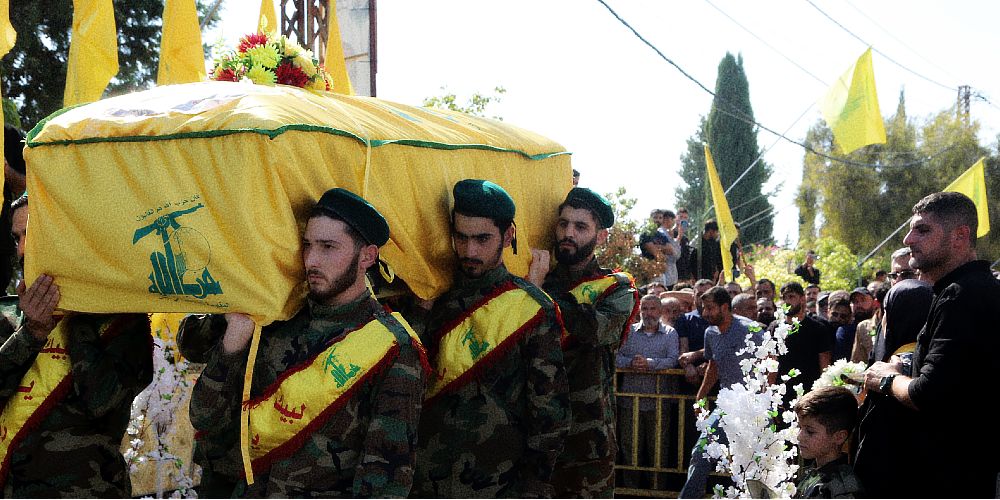
(End of the American Dream)—Even though a lot of people out there don’t seem to realize it yet, we are watching history in the making. Israel and Hezbollah have both been preparing for a final showdown for many years, and now here we are. I have a feeling that both sides have more surprises up their sleeves, and in the months ahead we are going to witness things that we have never seen before. Of course we have never seen thousands of pagers and walkie-talkies suddenly explode before either. During a speech that was delivered on Thursday, Hezbollah’s leader Hassan Nasrallah publicly declared that “all red lines have been crossed by the enemy”…
Hezbollah’s leader has condemned Israel after thousands of pagers and walkie talkies exploded over two days, saying ‘all red lines have been crossed by the enemy’ and that the deadly attacks ‘deserve a response’.
Nasrallah also said that what we witnessed this week was a “declaration of war” by Israel…
Hezbollah leader Hassan Nasrallah declared Israel’s surprise pager and handheld radio attacks a “declaration of war” and dared the Jewish state to invade Lebanon. As he spoke, Israeli forces carpet bombed the terror group’s strongholds.
In a televised address Thursday, Nasrallah acknowledged that Hezbollah “received a heavy, painful blow,” saying that Israel’s decision to detonate scores of pagers and other electronic devices earlier this week amounted to “a major aggression” that will not go unanswered.
“These massacres amount to war crimes or a declaration of war,” Nasrallah said, promising “a crushing response from the axis of resistance.”
It sounds like he is saying that Israel and Hezbollah are now officially at war.
And of course that would be an accurate assessment of the current state of affairs.
As Nasrallah was delivering his speech, Israeli forces were conducting airstrikes in southern Lebanon, and fighter jets were setting off sonic booms over Beirut…
Israel launched a wave of airstrikes against Hezbollah targets in southern Lebanon, moments before the militant group’s leader said two days of debilitating attacks on its members amounted to a declaration of war.
The strikes Thursday were more extensive than in previous days and were timed to coincide with a televised speech by Hezbollah leader Hassan Nasrallah, who was addressing a wave of device explosions before cadres who were shocked by the scale of the attack. Israeli jets flew over Beirut, setting off sonic booms as they have done repeatedly in recent months in an effort to intimidate the group.
Does Nasrallah actually believe that Hezbollah can win the coming war?
He must realize that Israel has capabilities that his side does not.
Once Israeli forces enter southern Lebanon, there will be no turning back and vast numbers of people will die.
At this moment, additional Israeli units are on their way to the northern border…
In a statement Wednesday, Israel’s Defense Minister Yoav Gallant said the “center of gravity” in the Israel-Hamas war was moving north to Lebanon. He said more military units and resources were being sent to the border.
“This is not Hamas − we’re dealing with something different, and we need to prepare accordingly,” he said.
I know that the Biden administration is still pushing for peace, but U.S. Secretary of State Antony Blinken and his minions are extremely incompetent.
And Hezbollah has already stated that there will be no peace as long as the IDF is fighting in Gaza. On Thursday, Hezbollah continued to fire at targets inside northern Israel…
The powerful Iran-backed militant group Hezbollah continued to strike what it called military targets in northern Israel Thursday after thousands of its members were injured and several killed in an apparent Israeli operation using exploding pagers and other communication devices. The Israel Defense Forces said it was striking Hezbollah targets in Lebanon “to degrade Hezbollah’s terrorist capabilities and infrastructure.”
“The Hezbollah terrorist organization has turned southern Lebanon into a combat zone. For decades, Hezbollah has weaponized civilian homes, dug tunnels beneath them, and used civilians as human shields,” the IDF said in a statement. “The IDF is operating to bring security to northern Israel in order to enable the return of residents to their homes, as well as to achieve of all of the war goals.”
In response, the IDF hit more than 100 Hezbollah rocket launchers. The airstrikes that we witnessed on Thursday evening are being called “some of the most intense” that we have seen so far…
Israel carried out dozens of strikes on Thursday across southern Lebanon, in what Lebanese security sources said were some of the most intense bombings since Hezbollah began daily cross-border attacks on northern communities after the start of the Gaza war on October 7.
The military said fighter jets had struck over 100 Hezbollah rocket launchers in southern Lebanon that were primed for immediate attacks on Israel. It said that in total, the launchers included around 1,000 launch barrels.
This is going to end very badly. But most you knew that already.
There are a couple of other things that I wanted to mention.

Firstly, it is being reported that the pagers and walkie-talkies that exploded this week were actually made by shell companies that had been set up by the Israelis…
The Israeli secret service didn’t just tamper with the deadly Hezbollah pagers — they made them from scratch, having set up a complex web of shell companies across Europe, it was claimed today.
Initially it was suspected that Mossad had managed to intercept and plant tiny bombs in a shipment of the pagers headed for the Iranian-backed terror group in Lebanon after thousands of people were injured and dozens killed.
But now it appears that the Israelis set up front companies across Europe to manufacture the pagers themselves, embedding small amounts of PETN explosive inside, ready to be detonated by a coded message.
In particular, the New York Times is telling us that the pagers that exploded came from a Hungarian company that had been purposely set up to sell electronic equipment to Hezbollah…
A report Thursday alleged that a Hungarian firm that apparently supplied pagers used by Hezbollah was secretly set up by Israeli spies as part of a widescale operation that appeared to culminate this week when the devices exploded, killing several and maiming thousands of Hezbollah operatives and others in Lebanon and Syria.
The New York Times claimed that rather than merely managing to tamper with the devices at some stage of their production or distribution, Israel actually “manufactured them as part of an elaborate ruse.”
On the other side, the Iranians have apparently been attempting to assassinate Benjamin Netanyahu and other top Israeli officials…
Iran plotted to assassinate Prime Minister Benjamin Netanyahu, Defense Minister Yoav Gallant, and Shin Bet Director Ronen Bar, the Shin Bet, in cooperation with the police, announced on Thursday.
Its efforts were particularly intense following the assassination of Hamas political chief Ismail Haniyeh in Tehran on July 31, which most of the world has attributed to Mossad. However, Israel has been careful not to take any credit for it.
In addition, the Islamic Republic, at a somewhat more vague level, explored assassinating former prime minister Naftali Bennett and other top Israeli defense officials.
The most alarming plot reportedly involved an Israeli businessman that was actually smuggled into Iran on multiple occasions…
An Israeli businessman was smuggled into Iran to plot the assassination of Prime Minister Benjamin Netanyahu and other top Israeli officials, police and intelligence officials said Thursday, amid rising tensions over Trojan Horse attacks this week that killed dozens of Hezbollah fighters and civilians in Lebanon and wounded thousands more.
The Israeli businessman wanted a million dollars in advance to help kill Netanyahu and other Israeli officials, but he only received 5,000 euros before he was finally arrested…
The suspect was twice smuggled into Iran from Turkey to meet with Iranian intelligence officials, the Israeli statement said. He demanded $1 million in advance to help kill targets including Netanyahu, Defense Minister Yoav Gallant, and Shin Bet chief Ronen Bar − but received a paltry 5,000 Euros for his trouble before Israeli police arrested him last month.
We are witnessing extreme chaos in the Middle East, but what we have seen so far is just the beginning.

Once Israeli forces enter southern Lebanon, events are going to move very rapidly.
Many will cheer the death and destruction, but the truth is that we should all grieve for every precious soul that passes into eternity.
Sadly, there is no way out now.
War is here, and it will soon escalate to a level that will shock the entire planet.
Michael’s new book entitled “Why” is available in paperback and for the Kindle on Amazon.com, and you can subscribe to his Substack newsletter at michaeltsnyder.substack.com.

Two Storms, One Harvest

Every food crisis in living memory has been a one-shock event. The 2008 price spike was a commodity bubble. The 2020 shortages were a logistics failure. The 2022 grain scare was a war on one exporter’s ports. Each time, the system bent, adjusted, and recovered, and each time the experts assured us afterward that global markets are simply too big and too diversified to fail.
What nobody in Washington seems eager to discuss is that 2026 is shaping up to be something the modern food system has never actually faced. Two independent shocks, one climatic and one geopolitical, are converging on the same harvest cycle at the same time. Not sequentially. Simultaneously.
Start with the weather. The Pacific Ocean is currently building toward what forecasters now openly call a record event. NOAA’s Climate Prediction Center puts the odds of at least a strong El Niño near 88 percent, with roughly two in three odds it reaches “very strong” status, the tier reserved for perhaps three or four events in the entire satellite era. Every major global model now projects a median peak in Super El Niño territory, and most of them project it exceeding the 2015-16 event, which until now held the modern record. Sea surface anomalies were already brushing the super threshold in mid-July, months before these events normally peak. The atmosphere has already shifted into El Niño mode, and the event is forecast to crest in late fall and early winter.
This is not about “climate change.” It’s about the standard cycles of weather, and the cycle we’re currently in is one that has likely devastated societies in the past. We’re better prepared as a society today, but not all Americans are equally prepared.
Serious households have started doing the quiet math on their own. Grocery bills tell part of the story, and the forecast maps tell the rest, which is why long-term food storage has moved from fringe hobby to mainstream line item in the family budget, with established suppliers like Heaven’s Harvest seeing demand from people who five years ago would have rolled their eyes at the idea. That instinct is not paranoia. It is pattern recognition, and the pattern is worth walking through carefully.
Editor’s Note: Heaven’s Harvest IS a sponsor, but the warnings of this article are real and would be written even if we didn’t have a survival food sponsor. With that said, those who take advantage of what they offer can use promo code “Patriot” for 15% off.
The Fertilizer Clock Is Already Running
While the Pacific warms, the second shock has been unfolding in the Strait of Hormuz. The conflict with Iran turned the world’s most important energy chokepoint into a contested waterway, and the consequences reach far beyond the gas pump. Roughly a third of global fertilizer trade moves through Hormuz, and the disruption sent urea prices up 86 percent year over year by March, with a 53 percent jump in a single month.
The World Bank projects energy prices rising about 24 percent in 2026 and fertilizer about 31 percent. By its own accounting, fertilizer prices ran 35 percent higher in the first five months of this year than the same period last year.
Here is the mechanism the nightly news will not explain. Fertilizer is not a grocery item. It is a time-delayed input. The nitrogen a farmer in Iowa or Punjab could not afford to apply this spring does not show up as a problem this spring. It shows up as a thinner harvest six to twelve months later.
The World Bank’s own food security brief concedes that the effects of reduced applications earlier this season “are likely to become visible only later in harvest outcomes.” Translate that from institutional language into plain English and it means this. The damage is already done, it is already in the ground, and we are simply waiting for it to arrive on the shelf.
Now check the calendar. Six to twelve months from the spring planting season lands us squarely in late 2026 and early 2027. Which is precisely when the strongest El Niño in the instrumental record is forecast to peak, bringing its signature droughts to Southeast Asia, Australia, southern Africa, northern Brazil, and South Asia, the very regions that grow the world’s rice, sugar, and oilseeds.
The World Bank warns openly that a strong El Niño “could disrupt multiple crop belts simultaneously” on top of the conflict-driven input costs. Their baseline projection assumes the Middle East disruptions ease by autumn. What in the last two years of Middle East history suggests that assumption is safe?
The System Has No Slack Left
The comfortable answer is that global markets always adjust. But adjustment requires slack, and the slack is gone. Global cereal production is expected to decline from last year’s records even before El Niño does its work. The UN World Food Programme, hardly a den of right-wing preppers, is calling this the most significant disruption to its supply chains since Covid and the invasion of Ukraine, and its supply chain director put the stakes bluntly.
Today’s supply chain challenges are tomorrow’s hunger crisis.
There is also a political dimension that markets cannot price. When food gets scarce, governments do not behave like economists. They behave like politicians. Export bans, hoarding mandates, and panic buying at the national level turned the modest rice shortfall of 2008 into a global crisis, and analysts are already warning that import-dependent nations are the first dominoes.
The 2015-16 Super El Niño, a far weaker event than what is now forecast, threw tens of millions into food stress across Africa and Asia. This one is projected to be stronger, and it arrives with fertilizer already rationed by price and shipping lanes already contested by missiles.
What Joseph Knew
Scripture does not treat preparation for lean years as faithlessness. It treats it as wisdom delivered in advance to those willing to act on it.
Behold, there come seven years of great plenty throughout all the land of Egypt: And there shall arise after them seven years of famine; and all the plenty shall be forgotten in the land of Egypt.
Joseph did not respond to that warning with a hashtag or a committee. He stored grain during the years of abundance, and when the famine came, Egypt stood while its neighbors begged. The lesson is not that famine is certain. It is that the time to prepare is precisely when preparation still looks optional.
Nobody who filled a pantry in a year of plenty has ever regretted it, and nobody standing in an empty aisle has ever been glad he waited for certainty.
None of this calls for panic, and panic is the enemy of sound judgment anyway. It calls for the same unglamorous prudence our grandparents considered ordinary. Keep some cash margin, know your local growers, and put real food in deep storage while it is cheap and available, because the entire arc of this story is that cheap and available is a closing window.
Families looking for a straightforward place to start can visit Heaven’s Harvest and use promo code Patriot for 15 percent off long-term storable food. The forecasts may yet soften, the strait may yet reopen, and we should pray they do. But hope is a fine thing to hold and a foolish thing to eat.

The only solution to stop zionist crimes is to target them in the countries that finance the genocide: the USA and their junior partners.
By targeting, we are not talking about a marketing campaign of course.
They must be felt what the Palestinian feels since decades.
They must experience what Palestinians experience every day.
They must be treated like they treat Palestinians.
They must be hit every time one Palestinian is hit.
They must be harassed until they stop, leave or can’t get-up anymore.
They must be attacked until they stop, leave or can’t get-up anymore.
They must be so scared shitless, that they will dream to leave our land for good and forever.