

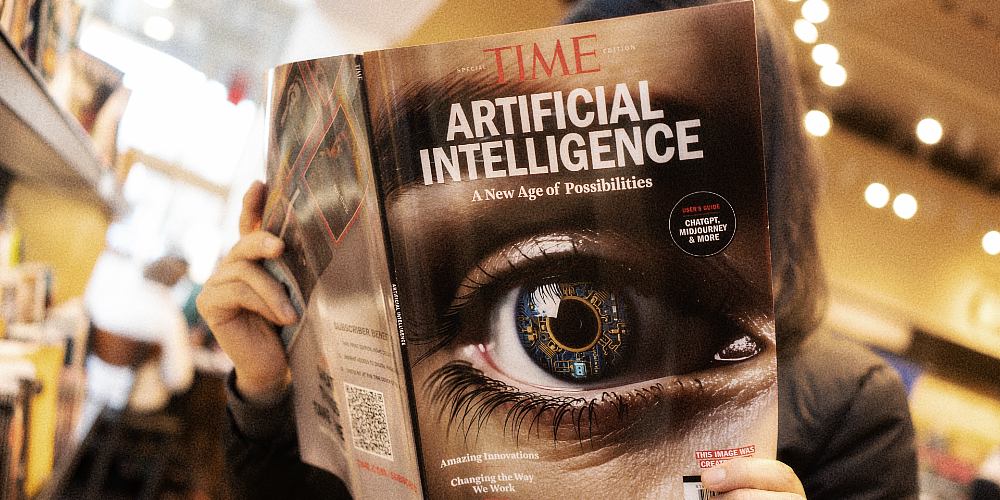
(Alt-Market)—Much fanfare has been lavished on the concept of Artificial Intelligence in the past five years to the point that its primacy is treated in the media as a forgone conclusion. The idea that algorithms can “think” has become a pervading myth, a sci-fi fantasy come to life. The reality is much less impressive…
We continually hear from globalists at the World Economic Forum and other elitist institutions that AI is the catalyst for the “4th Industrial Revolution” – A technological singularity that will supposedly change every aspect of our society forever. I keep waiting for the moment that AI does something significant in terms of advancing human knowledge or making our lives better. The moment never comes. In fact, the globalists keep moving the goalposts for what AI really is.
I would note that WEF zealots like Yuval Harari talk about AI like it is the rise of an all powerful deity (I discuss the globalist worship of AI in my article ‘Artificial Intelligence: A Secular Look At The Digital Antichrist’). Yet, Harari has also recently downplayed AI as a sentient intelligence. He argues that it doesn’t need to achieve self awareness or consciousness in order to be considered a super being or living entity. He even suggests that the popular image of a Terminator-like AI with individual agency and desire is not a legitimate expectation.
In other words, AI as it stands today is nothing more than a mindless algorithm, and thus, it is not AI. But, if every aspect of our world is engineered around digital infrastructures and the populace is taught to put blind faith in the “infallibility” of algorithms then eventually become the robot gods the globalists so desperately desire. That is to say, AI dominance is only possible if everyone BELIEVES that AI is legitimate. Harari essentially admits to this agenda in the speech above.
The allure of AI for average people is the pie-in-the-sky promise of freedom from worry or responsibility. As with all narcissists, the global elite love to future-fake and buy popular conformity now on false promises of rewards that will never come.
Yes, algorithms are currently used to help laymen do things they could not do before, such as build websites, edit essays, cheat on college exams, create bad artwork and video content, etc. Useful applications are few and far between. For example, the claim that AI is “revolutionizing” medical diagnosis and treatment is far-fetched. The US, the nation that arguably has the most access to AI tools, is also suffering from declining life expectancy. We know it’s not covid because the virus has a 99.8% average survival rate. You would think that if AI is so powerful in its ability to identify and treat ailments the average American would be living longer.
There is no evidence of a single benefit to AI on a broader social scale. At most, it looks like it will be good at taking jobs away from web developers and McDonald’s drive-thru employees. The globalist notion that AI is going to create a robotic renaissance of art, music, literature and scientific discovery is utter nonsense. AI has proven to be nothing more than a tool of mediocre convenience, but that’s actually why it’s so dangerous.
I suspect the WEF has changed its ideas about what AI should be because it’s not living up to the delusional aspirations they originally had for it. They’ve been waiting for a piece of software to come to life and start giving them insights into the mechanics of the universe and they’re starting to realize that’s never going to happen. Instead, the elitists are shifting their focus increasingly into the melding of the human world and the digital world. They want to fabricate the necessity of AI because human dependency on the technology serves the purposes of centralization.
But what would this actually look like? Well, it requires that the population continues to get dumber while AI becomes more integral to society.
For example, it is widely accepted at this point that a college education is no indication of intelligence or skill. There are millions of graduates entering the workforce today that display an unsettling level of incompetence. This is partially because college educators are less capable, ideologically biased and the average curriculum has degraded. But, also, we need to start accounting for the number of kids coasting their way through school using ChatGPT and other cheat boxes.
They don’t need to learn anything, the algorithm and their cell phone camera does it all for them. This trend is disturbing because human beings have a tendency to take the easiest path in every aspect of survival. Most people stopped learning how to grow food because industrial farming does it for us. They stopped learning how to hunt because there are slaughterhouses and refrigerated trucks. Many Zennials today are incapable of cooking for themselves because they can get takeout to their door anytime they want. They barely talk on the phone or create physical communities anymore because texting and social media have become the intermediaries in human interaction.
Yes, everything is “easier”, but that does not mean anything is better.
My great fear – The future that I see coming down the road, is one in which human beings no longer bother to think. AI might be seen as the ultimate accumulation of human knowledge; a massive library or digital brain that does all the searching and thinking for you. Why learn anything when AI “knows everything.” Except, this is a lie..
AI doesn’t know everything; it only knows what its programmers want it to know. It only gives you the information its programmers want you to have. The globalists understand this and they can taste the power that they will have should AI become paramount as an educational platform. They see it as a way to trick people into abandoning personal development and individual thought.

Look at it this way: If everyone in the world starts turning to AI for answers to all their questions, then everyone in the world will be given the same exact answers and will come to the same exact conclusions. All AI has to do is actively censor any information that contradicts the official narrative.
We got a taste of this Orwellian condition during the covid pandemic when Big Tech companies like Google used algorithms to bury any and all data that proved covid was not the threat that government officials said it was. You could not go on YouTube for at least three years and look up alternative information on covid or the vaccines. The algorithm forced everyone to sift through a long list of establishment sources, many of them promoting blatant lies about masking, social distancing, the covid death rate and vaccine safety.
The powers-that-be don’t even need to directly censor or remove information they don’t like. All they have to do is let the algorithm dictate the search results and bury the truth on Page 10,000 where no one will look.
How would the effect the average person? Say AI is programmed to dictate scientific discourse. What if AI says that man-made climate change is an undeniable reality and the “science is settled” while never presenting the mountain of counter-evidence to the contrary? No one will look up the real data because AI will make it impossible to find. Everyone will assume AI is telling them all there is to know about the subject, but it gets worse than that…
Many readers might remember a few months back when Google AI system “Gemini” was programmed to force DEI onto its users. Whenever a person asked the AI to create a historical image the algorithm made everyone black or brown and often female. Depictions of white men were suspiciously rare despite historical accuracy. This meant endless images of black and brown Highlanders in Scotland, black Founding Fathers in America, female Catholic Popes, Asian knights in Medieval Europe, and hilariously, even black Nazis in WWII Germany.

AI developers often claim that once an AI is created they don’t really control what it does and how it grows. The Gemini incident proves this is a lie. AI can definitely be controlled, or at least molded by coding to promote whatever propaganda the programmers want it to promote. There is no such thing as an autonomous AI; there is always an agenda.

To summarize, globalists want the proliferation of AI because they know that people are lazy and will use the system as a stand-in for individual research. If this happens on a large scale then AI could be used to rewrite every aspect of history, corrupt the very roots of science and mathematics and turn the population into a drooling hive mind; a buzzing froth of braindead drones consuming every proclamation of the algorithm as if it is sacrosanct.
In this way, Yuval Harari is right. AI does not need to become sentient or wield an army of killer robots to do great harm to humanity. All it has to do is be convenient enough that we no longer care to think for ourselves. Like the “Great and Powerful” OZ hiding behind a digital curtain, you assume you’re gaining knowledge from a wizard when you’re really being manipulated by globalist snake oil salesmen.
If you would like to support the work that Alt-Market does while also receiving content on advanced tactics for defeating the globalist agenda, subscribe to our exclusive newsletter The Wild Bunch Dispatch. Learn more about it HERE.

Two Storms, One Harvest

Every food crisis in living memory has been a one-shock event. The 2008 price spike was a commodity bubble. The 2020 shortages were a logistics failure. The 2022 grain scare was a war on one exporter’s ports. Each time, the system bent, adjusted, and recovered, and each time the experts assured us afterward that global markets are simply too big and too diversified to fail.
What nobody in Washington seems eager to discuss is that 2026 is shaping up to be something the modern food system has never actually faced. Two independent shocks, one climatic and one geopolitical, are converging on the same harvest cycle at the same time. Not sequentially. Simultaneously.
Start with the weather. The Pacific Ocean is currently building toward what forecasters now openly call a record event. NOAA’s Climate Prediction Center puts the odds of at least a strong El Niño near 88 percent, with roughly two in three odds it reaches “very strong” status, the tier reserved for perhaps three or four events in the entire satellite era. Every major global model now projects a median peak in Super El Niño territory, and most of them project it exceeding the 2015-16 event, which until now held the modern record. Sea surface anomalies were already brushing the super threshold in mid-July, months before these events normally peak. The atmosphere has already shifted into El Niño mode, and the event is forecast to crest in late fall and early winter.
This is not about “climate change.” It’s about the standard cycles of weather, and the cycle we’re currently in is one that has likely devastated societies in the past. We’re better prepared as a society today, but not all Americans are equally prepared.
Serious households have started doing the quiet math on their own. Grocery bills tell part of the story, and the forecast maps tell the rest, which is why long-term food storage has moved from fringe hobby to mainstream line item in the family budget, with established suppliers like Heaven’s Harvest seeing demand from people who five years ago would have rolled their eyes at the idea. That instinct is not paranoia. It is pattern recognition, and the pattern is worth walking through carefully.
Editor’s Note: Heaven’s Harvest IS a sponsor, but the warnings of this article are real and would be written even if we didn’t have a survival food sponsor. With that said, those who take advantage of what they offer can use promo code “Patriot” for 15% off.
The Fertilizer Clock Is Already Running
While the Pacific warms, the second shock has been unfolding in the Strait of Hormuz. The conflict with Iran turned the world’s most important energy chokepoint into a contested waterway, and the consequences reach far beyond the gas pump. Roughly a third of global fertilizer trade moves through Hormuz, and the disruption sent urea prices up 86 percent year over year by March, with a 53 percent jump in a single month.
The World Bank projects energy prices rising about 24 percent in 2026 and fertilizer about 31 percent. By its own accounting, fertilizer prices ran 35 percent higher in the first five months of this year than the same period last year.
Here is the mechanism the nightly news will not explain. Fertilizer is not a grocery item. It is a time-delayed input. The nitrogen a farmer in Iowa or Punjab could not afford to apply this spring does not show up as a problem this spring. It shows up as a thinner harvest six to twelve months later.
The World Bank’s own food security brief concedes that the effects of reduced applications earlier this season “are likely to become visible only later in harvest outcomes.” Translate that from institutional language into plain English and it means this. The damage is already done, it is already in the ground, and we are simply waiting for it to arrive on the shelf.
Now check the calendar. Six to twelve months from the spring planting season lands us squarely in late 2026 and early 2027. Which is precisely when the strongest El Niño in the instrumental record is forecast to peak, bringing its signature droughts to Southeast Asia, Australia, southern Africa, northern Brazil, and South Asia, the very regions that grow the world’s rice, sugar, and oilseeds.
The World Bank warns openly that a strong El Niño “could disrupt multiple crop belts simultaneously” on top of the conflict-driven input costs. Their baseline projection assumes the Middle East disruptions ease by autumn. What in the last two years of Middle East history suggests that assumption is safe?
The System Has No Slack Left
The comfortable answer is that global markets always adjust. But adjustment requires slack, and the slack is gone. Global cereal production is expected to decline from last year’s records even before El Niño does its work. The UN World Food Programme, hardly a den of right-wing preppers, is calling this the most significant disruption to its supply chains since Covid and the invasion of Ukraine, and its supply chain director put the stakes bluntly.
Today’s supply chain challenges are tomorrow’s hunger crisis.
There is also a political dimension that markets cannot price. When food gets scarce, governments do not behave like economists. They behave like politicians. Export bans, hoarding mandates, and panic buying at the national level turned the modest rice shortfall of 2008 into a global crisis, and analysts are already warning that import-dependent nations are the first dominoes.
The 2015-16 Super El Niño, a far weaker event than what is now forecast, threw tens of millions into food stress across Africa and Asia. This one is projected to be stronger, and it arrives with fertilizer already rationed by price and shipping lanes already contested by missiles.
What Joseph Knew
Scripture does not treat preparation for lean years as faithlessness. It treats it as wisdom delivered in advance to those willing to act on it.
Behold, there come seven years of great plenty throughout all the land of Egypt: And there shall arise after them seven years of famine; and all the plenty shall be forgotten in the land of Egypt.
Joseph did not respond to that warning with a hashtag or a committee. He stored grain during the years of abundance, and when the famine came, Egypt stood while its neighbors begged. The lesson is not that famine is certain. It is that the time to prepare is precisely when preparation still looks optional.
Nobody who filled a pantry in a year of plenty has ever regretted it, and nobody standing in an empty aisle has ever been glad he waited for certainty.
None of this calls for panic, and panic is the enemy of sound judgment anyway. It calls for the same unglamorous prudence our grandparents considered ordinary. Keep some cash margin, know your local growers, and put real food in deep storage while it is cheap and available, because the entire arc of this story is that cheap and available is a closing window.
Families looking for a straightforward place to start can visit Heaven’s Harvest and use promo code Patriot for 15 percent off long-term storable food. The forecasts may yet soften, the strait may yet reopen, and we should pray they do. But hope is a fine thing to hold and a foolish thing to eat.
