

(The Economic Collapse Blog)—If you are still able to afford a decent home, you should consider yourself to be incredibly blessed, because vast numbers of Americans do not have a permanent place to live at this point. Homelessness in the United States is at the highest level ever recorded, and it has been growing at the fastest pace ever recorded. The homeless encampments that have been popping up all over our major cities have been making lots of headlines in recent years, but many of the homeless live and die in very isolated places far from public view. What I am about to share with you should deeply sadden all of us.
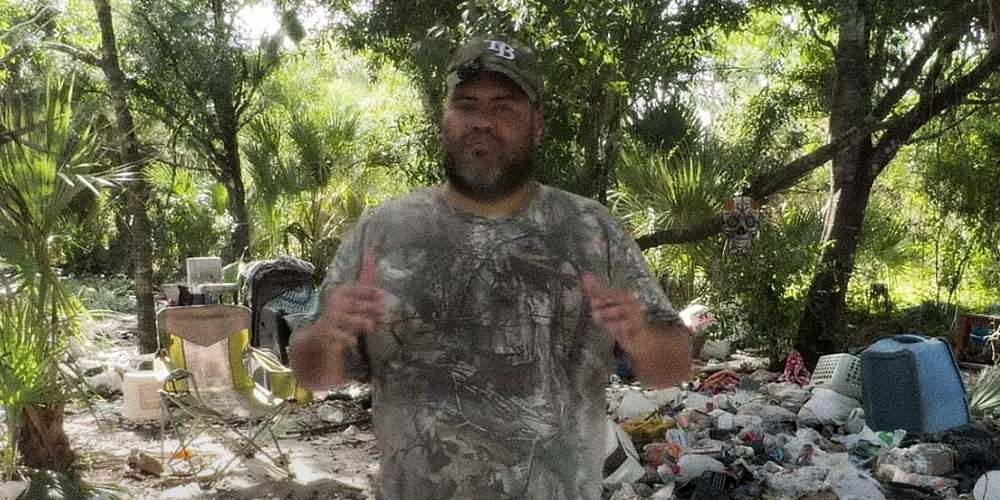
Way back in the woods in southwest Florida, trails that have been made out of discarded carpets lead to absolutely enormous homeless encampments where hordes of homeless people have made homes for themselves.
One man was able to find these infamous “carpet trails”, and he posted footage of them on his YouTube channel…
Coastal areas of southern Florida are very popular among the homeless because the nights never get too cold even during the winter.
But there are plenty of other hazards, and just trying to stay alive can be a real struggle.
Of course the west coast is dealing with an even greater crisis.
In Portland, homeless encampments have taken over vast stretches of the city and nobody seems to have any solutions.
KATU recently visited one of the most notorious homeless encampments, and they discovered that it has gotten even bigger since the last time they visited it…
This is what a collapsing society looks like.
Poverty and hunger are spreading like wildfire, and the deplorable conditions in many of our core urban areas are being openly mocked all over the globe.
In fact, in China they are actually “producing documentaries on the collapse of American cities”…
The Chinese are now producing documentaries on the collapse of American cities. What this showcases is the grim aftermath of decades of deindustrialization, disastrous progressive policies, and an opioid crisis—ironically fueled by China.
“Chinese are making documentaries about ultra-extreme poverty and decaying cities since they don’t exist in China anymore,” X user S.L. Kanthan wrote in a recent post, accompanied by a short clip from the documentary highlighting the implosion of Oakland, California.
Since the video was narrated in Chinese, X user TranslateMom translated some of the captions, which said, “Everywhere is garbage … People don’t live in places. There are wanderers everywhere.”
One of the primary reasons why so many people are forced to live in the streets is because housing has become ridiculously unaffordable.
If you can believe it, there are now 237 U.S. cities where “buyers will find a price tag of $1 million or more on the typical starter home”…
A million-dollar price tag no longer means lavish and luxurious living. In more than 200 U.S. cities, buyers will find a price tag of $1 million or more on the typical starter home, a new Zillow® analysis finds.
The typical “starter home” — defined for this analysis as being among those in the lowest third of home values in a given region — is worth at least $1 million in 237 cities, the highest number of cities ever. Five years ago, there were only 84 such cities.
That is nuts! Who can afford to pay a million bucks for a “starter home”? This is what rampant inflation has done to us.

It has absolutely eviscerated our standard of living, and ordinary Americans such as you and I are feeling a tremendous amount of pain right now.
According to Zillow, California, New York and New Jersey are the states that have the most cities where a typical “starter home” costs at least a million dollars…
Exactly half of all states have at least one city with a typical starter home worth $1 million or more. There are 117 such cities in California, well ahead of New York (31) and New Jersey (21), which have the second- and third-highest numbers. Florida and Massachusetts round out the top five with 11 each.
Among metropolitan areas, the New York City metro, which includes parts of New Jersey and Pennsylvania, has the most cities with million-dollar starter homes at 48. The San Francisco metro has the next highest count at 44, followed by Los Angeles (35), San Jose (15), and Miami and Seattle, each with eight. Irvine, with a population of more than 300,000, is the biggest city with $1 million starter homes.
Of course California is also being overwhelmed by homeless encampments right now too.
Progressive policies have resulted in a chronic shortage of affordable housing, and that isn’t going to change any time soon.
Sadly, conditions are only going to get worse all over the nation because our economic momentum is rapidly taking us in the wrong direction.
For example, we just learned that credit card delinquency rates have risen to the highest level ever recorded…

A growing number of Americans are falling behind on their monthly credit card payments as they continue to battle high inflation and interest rates.
New data published by the Federal Reserve Bank of Philadelphia shows that credit card delinquency rates in the first quarter of 2024 rose to the highest level since 2012, when the Fed began tracking the data. All stages of credit card delinquency — 30, 60 and 90 days past due — rose during the first three months of the year.
And another major retailer just went bankrupt and is closing lots of stores…
Home goods retailer Conn’s HomePlus filed for Chapter 11 bankruptcy protection Tuesday and announced plans to close at least 70 locations across 13 states.
On its website, Conn’s says it will close 18 locations in Florida, nine in Texas and seven in Arizona. Other states that will see stores close include Virginia, Colorado, Mississippi and Oklahoma, among others.
Everywhere you look, there is suffering.
But for the moment, those at the very top of the economic food chain are still thriving.
In fact, the wealthiest one percent have actually gotten 42 trillion dollars wealthier during the past decade…
The world’s richest one percent increased their fortunes by a total of $42 trillion over the past decade, Oxfam said Thursday, ahead of a G20 summit in Brazil where taxing the super-rich tops the agenda.
Despite this windfall, taxes on the rich had plummeted to “historic lows”, the NGO added, warning of “obscene levels” of inequality with the rest of the world “left to scrap for crumbs”.
A day of reckoning is coming for them too.
In fact, a day of reckoning is rapidly approaching for the entire planet.
Our system is fundamentally flawed, and decades of really bad decisions have brought us to a breaking point.
So please don’t look down on those that have lost their homes and have no place to live, because lots more people will be joining them soon.
Michael’s new book entitled “Chaos” is available in paperback and for the Kindle on Amazon.com, and you can subscribe to his Substack newsletter at michaeltsnyder.substack.com.

Starting the Day With a Scripture-Inspired Roast Helps Center Your Thoughts on Eternal Truths Amid Temporal Pressures
The world can seem chaotic, especially right after we wake up. Many believers start their mornings reaching for something familiar — a hot cup of coffee — yet end up settling for mediocre brews that do little more than deliver a caffeine jolt. The daily grind of life, with its endless distractions, news cycles, and responsibilities, can leave even the most faithful feeling spiritually parched alongside their physical fatigue. What if your morning ritual could do more than wake you up? What if it could ground you in truth, nourish your body with exceptional quality, and quietly advance a kingdom purpose at the same time?
That’s the promise — and the reality — behind Promised Grounds Coffee. This Christian-founded company doesn’t just roast beans; it approaches every step as an act of worship and discipleship. By selecting only the top 10% of specialty-grade beans, ethically sourced from dedicated farmers in Central and South America, and small-batch roasting them with reverence in Austin, Texas, Promised Grounds delivers what many describe as the best coffee available — never burnt, never bland, but rich with origin stories and layered flavors that honor God’s creation.
From the vibrant Psalm 27 Roast (a light, bright medium option) to the bold yet peaceful 2 Timothy 1:7 Decaf, each bag carries a Scripture verse that turns your daily pour into a gentle reminder of faith. And through their Ounce Per Ounce Promise, every ounce of coffee you enjoy provides an equal ounce of clean water to families in need via partnership with Filter of Hope — literally brewing hope for body and soul, one cup at a time.
The challenge for today’s Christians runs deeper than finding a decent cup. In an age of convenience-driven consumerism, it’s easy to support companies that dilute values or remain silent on matters of faith. Many believers want their everyday choices — from what they drink to how they spend — to reflect discipleship rather than just convenience. Promised Grounds solves this by weaving Christian excellence into the entire process: beans nurtured with prayerful stewardship by farming families, roasted as an offering rather than a commodity, and packaged with Bible verses to encourage a mindset of gratitude and purpose from the first sip. Reviewers consistently praise the smooth, rich profiles — whether enjoyed black in a drip maker, iced on a warm day, or shared in fellowship — noting how the quality stands toe-to-toe with premium secular brands while delivering something far more meaningful.
This integration of faith and flavor addresses a real need in Christian households and ministries. Busy parents, church leaders, and remote workers alike report that starting the day with a Scripture-inspired roast helps center their thoughts on eternal truths amid temporal pressures. The coffee’s exceptional character — bright citrus notes in lighter roasts or deep chocolate undertones in bolder ones — comes from meticulous selection and careful roasting that respects the bean’s natural gifts rather than masking them. It’s the kind of coffee that elevates a simple quiet time, fuels productive workdays, or sparks meaningful conversations when shared at Bible studies or outreach events. And because it’s ethically sourced with integrity, every purchase supports sustainable livelihoods for farmers who treat their crops like family harvests.
For those leading churches or small groups, the impact multiplies. Promised Grounds offers bundles and options perfect for hospitality ministries, turning ordinary coffee service into an opportunity to point people toward the living water of Christ. Imagine greeting visitors with a warm cup whose very bag carries God’s Word — a subtle yet powerful witness that aligns with the Great Commission. The company’s Texas roots and commitment to “brewing hope” resonate especially with believers who value American enterprise paired with global compassion.
Of course, quality alone isn’t enough if the experience feels out of reach. Promised Grounds keeps it accessible with practical perks like free shipping on orders over $40, sample sets for discovering favorites, and thoughtful add-ons such as faith-themed mugs. Whether you prefer whole beans for fresh grinding, grounds for convenience, or even bulk options for larger households and ministries, the result is consistently superior coffee that makes discipleship feel integrated rather than added on.
As you consider how to align even the smallest habits with your walk with God, Promised Grounds Coffee stands out as a refreshing solution. It tackles the dual problems of subpar daily sustenance and disconnected consumption by offering a product that genuinely excels in taste while advancing a mission of clean water, farmer dignity, and scriptural encouragement. Believers who make the switch often describe it as more than a beverage upgrade — it becomes part of their rhythm of gratitude, a daily invitation to remember that every good gift comes from above.
If you’re ready to transform your mornings (and perhaps your church gatherings) with coffee that honors both exceptional craftsmanship and Christian values, I encourage you to explore what Promised Grounds has to offer. One sip at a time, you’ll be nourishing your body, refreshing your spirit, and participating in something far greater — all while enjoying what truly is among the best coffee available.
