

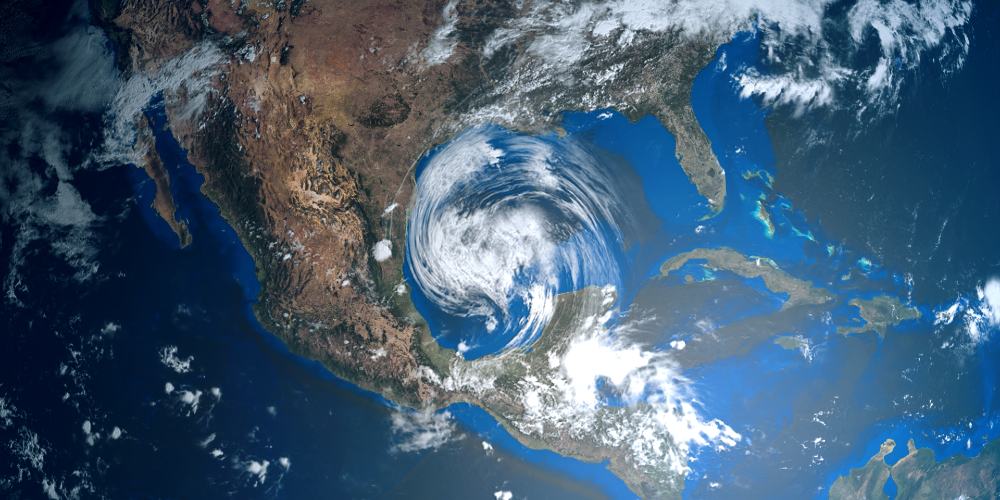
(The Epoch Times)—This year’s hurricane season, which officially starts June 1, is being predicted by WeatherBELL as the “hurricane season from hell,” with weather patterns similar to those of 2005, 2017, and 2020.
Along with it, says the firm’s meteorologist and chief forecaster Joe Bastardi, will come the climate change blame game, which he calls a false narrative. In 2005, Hurricane Katrina hit Louisiana, killing an estimated 1,833 people and causing approximately $161 billion in damages. In 2017, Hurricane Harvey hit Texas, Irma hit the Caribbean, and Maria hit the Caribbean and Puerto Rico, resulting in at least 3,364 fatalities and a combined cost of over $294 billion in damages.
In 2020, six major hurricanes landed, resulting in the National Oceanic and Atmospheric Administration (NOAA) dubbing 2020 the “most active season in recorded history.”
Following each season, government officials, committees, and scientists were quick to blame climate change.
“There is perhaps no better example of the potential for devastating global warming impacts than the Gulf Coast and Hurricane Katrina,” the U.S. Select Committee on Energy Independence and Global Warming stated after Katrina. “While the contribution of human-caused warming to Hurricane Katrina is difficult to quantify, scientists have unearthed a trend towards larger, more intense storms as oceans around the world warm.”
After Irma, United Nations Secretary-General António Guterres called the 2017 season “the most violent on record.”
“Changes to our climate are making extreme weather events more severe and frequent, pushing communities into a vicious cycle of shock and recovery,” he stated.
After the 2020 season, Jim Kossin, an atmospheric research scientist at NOAA’s National Centers for Environmental Information, blamed “warmer-than-average ocean temperatures” for the hurricane “hyper-activity.”
He said an increase in more ferocious hurricanes over the past 40 years was linked to climate change. Mr. Bastardi said he expects to hear similar messaging this year if it pans out like he’s predicting.
“If you hang around people constantly spouting negative stuff and how bad it is, guess what you’re going to believe? … It’s a great strategy for pushing this thing—if I wanted to argue the CO2 [carbon dioxide] argument, I’d do exactly what they’re doing,” Mr. Bastardi told The Epoch Times. “But there’s been no increase. And the size of the storms is getting smaller. That’s the other thing: hurricanes are smaller and more compact.”
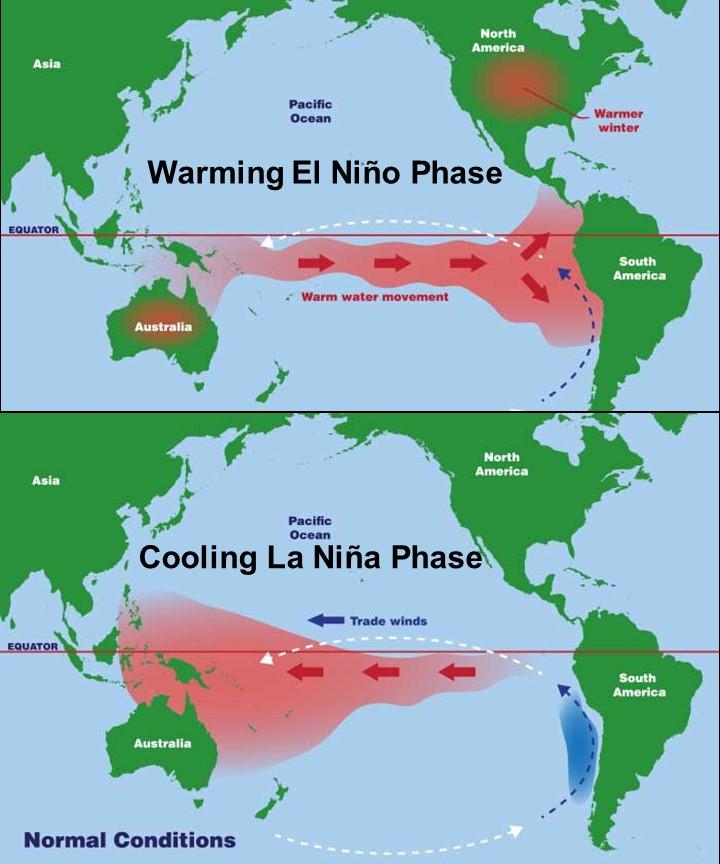
Oceanographer and certified consulting meteorologist Bob Cohen concurred. He said there’s currently a transition from El Niño patterns to La Niña, which is “correlated with higher-than-normal hurricane activity.”
“Right now, the subsurface temperatures are much cooler than during El Niño,” he told The Epoch Times. “The immediate near-surface temperatures are still warmer, but the subsurface water pool and the warm water pool have dissipated, and so once that pops to the surface, it becomes La Niña,” Mr. Cohen said.
He said he expects “we’ll hear a lot more alarmist messaging” if 2024 is a busy hurricane season, as predicted. But, like Mr. Bastardi, Mr. Cohen said hurricanes aren’t getting bigger or more intense. He said that as temperatures naturally warm coming out of the Little Ice Age, hurricanes and weather events will get less intense—not exponentially worse.
Basic Physics and Temperature
The Earth endeavors to exist in a state of equilibrium; it tries to equalize the temperature between the equator and the poles, which drives weather, according to Mr. Cohen.

“When you look at the 50,000-foot big picture, the Earth is a heat engine,” he said. “The tropics remain fairly constant in temperatures, and it’s the poles that have the greatest change.
“The gradient drives the storms. … If the poles warm, the temperature gradient decreases, which would mean less of a requirement for more intense storms from Mother Nature. It’s basic physics.”
Mr. Bastardi agreed.
“Look at Ida versus Betsy,” he said. “Betsy’s hurricane-force winds extended out 150 miles to the west and 250 miles east. Ida 50 miles to the west, and 75 miles to the east. They’re both category 4. They both had similar pressures. Which was the worst storm? The bigger storm. But they don’t tell you that.”
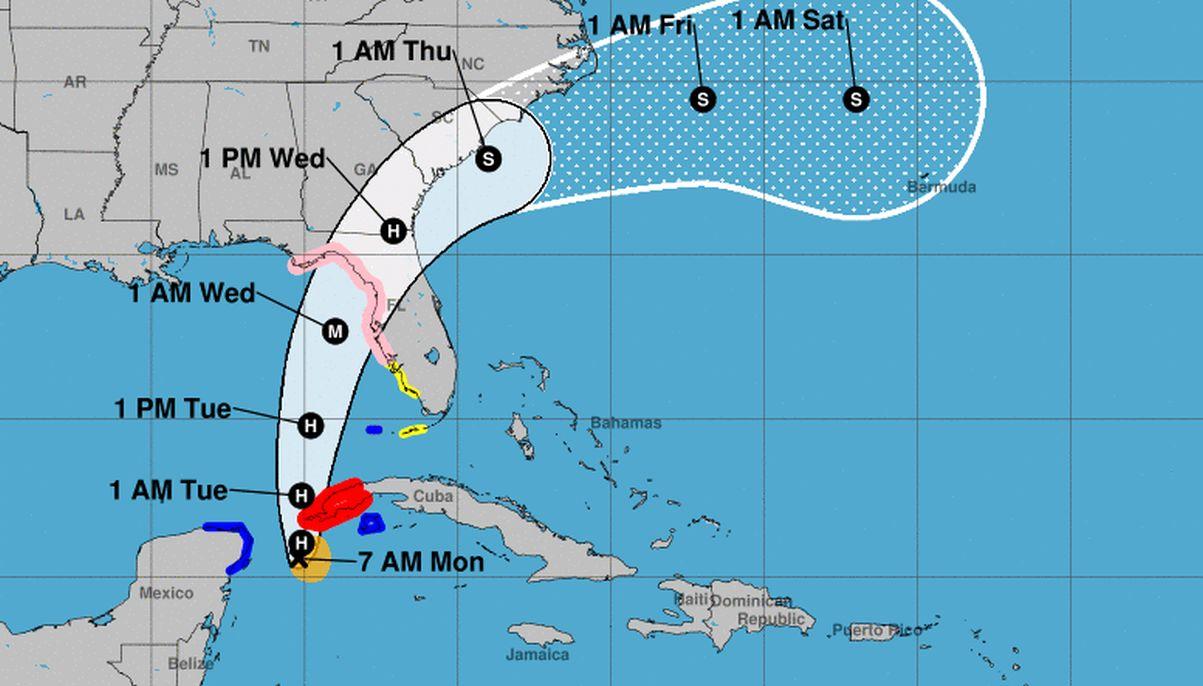
NOAA’s hurricane division shows Hurricane Betsy hitting Florida and Louisiana in 1965 with a central pressure of 946 millibars and a maximum wind speed of 132 miles per hour. Hurricane Ida hit Louisiana in 2021 with a central pressure of 931 mb and a maximum wind speed of 149 miles per hour. However, NOAA data doesn’t include the overall size of a hurricane.
“Hurricanes now are like fists of furry rather than giant bulldozers that come in and plow the coast,” Mr. Bastardi said. “But [NOAA] won’t show the entire picture. Because if they did, people would say, ‘What the heck!’”

He said the reason hurricanes are more costly now is because of increased infrastructure along the coasts, not because of increased severity. NOAA’s historical hurricane data dating back to 1851 supports the premise that hurricanes aren’t getting worse.
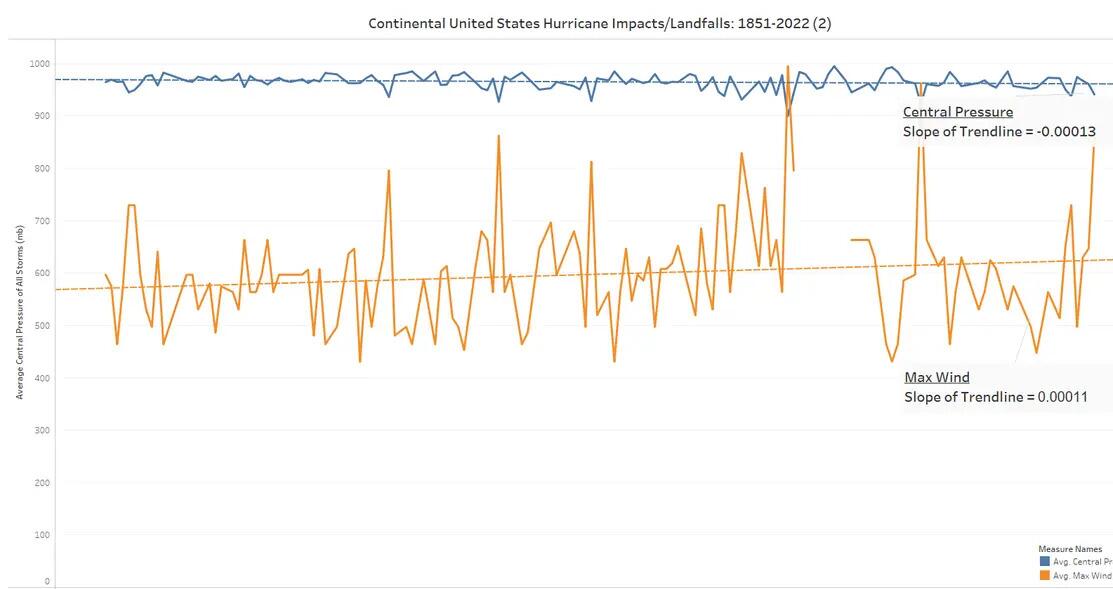
It adds as a caveat to its data that “because of the sparseness of towns and cities before 1900,” hurricanes may have been missed or their intensity underestimated. NOAA’s data also shows hurricanes are getting less severe in terms of central pressure.
Even with possible missing data, the NOAA data show an average central pressure decline of 0.00013mb per year between 1851 and 2022 (2023 data isn’t included yet), and max wind had a marginal average increase of 0.00011mph per year for that same period. The agency uses the Saffir-Simpson scale to categorize hurricanes from 1 to 5 based on maximum sustained wind speed.
Fear Before Reality
Government agencies, such as NOAA, often lead with an alarming statement about increased weather severity, but beyond the headlines, the data show a different story, Mr. Cohen said.
For example, in its 2023 State of the Science fact sheet titled “Atlantic Hurricanes and Climate Change,” NOAA asks the questions: “Has human-caused climate change had any detectable influence on hurricanes and their impacts?” and “What changes do we expect going forward with continued global warming?”
It answers itself by stating that “Several Atlantic hurricane activity metrics show pronounced increases since 1980.”
A few paragraphs later, NOAA states that if the data from the 1900s to the present is considered, “There has been no significant trend in annual numbers of U.S. landfalling tropical storms, hurricanes, or major hurricanes.”
Instead, there’s a “decreasing trend since 1900 in the propagation speed of tropical storms and hurricanes over the continental U.S.”
Mr. Cohen said NOAA’s approach is problematic. Its initial statements are “scary” and then “it discounts these same statements.”
“It’s very confusing because it goes back and forth between blaming climate change and blaming natural variability,” he said.
The reliance on climate modeling instead of observed reality is one of the problems with government reports, Mr. Cohen said.
In its fact sheet, NOAA says it hasn’t found clear evidence of a “greenhouse gas-induced change in historical observed Atlantic hurricane behavior.”
“Since a highly confident attribution has not yet been established for Atlantic hurricanes, future projections rely mostly on climate models alone.”
Mr. Cohen said the real observations don’t agree with the models.
“Some will say, ‘Well, if the observations don’t agree, then the observations are wrong.’ But it’s the opposite. It’s the models that are wrong,” he said.
Mr. Bastardi concurred and added that much of what’s being presented to the public is propaganda, not science, intended to facilitate a specific outcome.
“The climate agenda is the nail in freedom’s coffin. We’re more prosperous, we have five times the number of people, and we have one-fiftieth the number of climate disasters than we did in the 1900s,” he said. “But we’ve got this mass brainwashing going on, and it’s all over incremental nonsense—very, very small things that are just amplified to make people think that things are really bad.”
CO2 Impact
When asked if human-caused CO2 has an impact on hurricanes, Mr. Bastardi was quick to say “no.”
Mr. Cohen agreed. “Greenhouse gas doesn’t warm the ocean, except in the top millimeter. The deep warming is caused by the sun. The greenhouse gas theory, which is effect, irradiates heat that tries to escape back down to the Earth in a wavelength that only goes into the oceans at the top—the ocean’s skin or the top few millimeters. So, you don’t get changes in ocean heat content because of greenhouse gasses,” he said.
“You get that because of solar insulation, the direct sunlight, which is a different wavelength. And so, changes in thermal heat content are not due to greenhouse gasses.”
Mr. Bastardi agreed and said there are still a lot of unknowns when it comes to the climate and what causes warming or cooling, particularly in the oceans.
“We’re woefully short of knowing what’s going on in the oceans,” he said. “We have one data point for every 112,000 square miles. It does not do anything except faintly estimate what’s going on.”
He said the increase in geothermal activity in the oceans since 1990 has been warming the oceans. But he’s also seeing a predicted cooling.
“What’s more startling to me is how cold the Indian Ocean is forecast to get over the next six months. I mean, I’ve never seen a drop like this forecasted,” he said.
During the incoming change to the La Niña pattern, upwelling in the oceans brings cold, nutrient-rich water to the surface, pushing the Pacific jet stream northward. That can result in droughts in the southern United States, increased rain and flooding in Canada and the Pacific Northwest, and an increased risk of hurricanes, according to NOAA.
“The warming of the oceans is a big deal,” Mr. Bastardi said. “But there may be a countering going on. As far as La Niña goes, the planet is warming. And it’s warming in a way that creates stronger than average easterly winds across the Pacific, which means upwelling, and upwelling means cooler water.
“All a La Niña is is a resistance to the warming that’s taking place. And unless there is a shutdown of whatever input that is—if you’re a CO2 guy, you think it’s manmade, and if you’re me, you believe it’s natural—until that shutdown occurs, the oceans will continue to warm.
“Now, here’s a dirty little secret: We don’t have the data to know exactly what’s happening.”
Mr. Bastardi predicts this hurricane season “will turn into a real political football” over the climate change narrative.
Mr. Cohen added, “You never see it asked: ‘For humans, what is the optimal temperature?’
“Nine times more people die from cold than heat. The yields in Africa now because of the CO2 are huge, feeding millions of people. So many articles, particularly in the mainstream media, are written to scare people. And that leads to the general public thinking we’re heading into a bad situation. And that’s not the case.
“Warmer weather is better.”
Sound off about this news on The Liberty Daily Substack.

Starting the Day With a Scripture-Inspired Roast Helps Center Your Thoughts on Eternal Truths Amid Temporal Pressures
The world can seem chaotic, especially right after we wake up. Many believers start their mornings reaching for something familiar — a hot cup of coffee — yet end up settling for mediocre brews that do little more than deliver a caffeine jolt. The daily grind of life, with its endless distractions, news cycles, and responsibilities, can leave even the most faithful feeling spiritually parched alongside their physical fatigue. What if your morning ritual could do more than wake you up? What if it could ground you in truth, nourish your body with exceptional quality, and quietly advance a kingdom purpose at the same time?
That’s the promise — and the reality — behind Promised Grounds Coffee. This Christian-founded company doesn’t just roast beans; it approaches every step as an act of worship and discipleship. By selecting only the top 10% of specialty-grade beans, ethically sourced from dedicated farmers in Central and South America, and small-batch roasting them with reverence in Austin, Texas, Promised Grounds delivers what many describe as the best coffee available — never burnt, never bland, but rich with origin stories and layered flavors that honor God’s creation.
From the vibrant Psalm 27 Roast (a light, bright medium option) to the bold yet peaceful 2 Timothy 1:7 Decaf, each bag carries a Scripture verse that turns your daily pour into a gentle reminder of faith. And through their Ounce Per Ounce Promise, every ounce of coffee you enjoy provides an equal ounce of clean water to families in need via partnership with Filter of Hope — literally brewing hope for body and soul, one cup at a time.
The challenge for today’s Christians runs deeper than finding a decent cup. In an age of convenience-driven consumerism, it’s easy to support companies that dilute values or remain silent on matters of faith. Many believers want their everyday choices — from what they drink to how they spend — to reflect discipleship rather than just convenience. Promised Grounds solves this by weaving Christian excellence into the entire process: beans nurtured with prayerful stewardship by farming families, roasted as an offering rather than a commodity, and packaged with Bible verses to encourage a mindset of gratitude and purpose from the first sip. Reviewers consistently praise the smooth, rich profiles — whether enjoyed black in a drip maker, iced on a warm day, or shared in fellowship — noting how the quality stands toe-to-toe with premium secular brands while delivering something far more meaningful.
This integration of faith and flavor addresses a real need in Christian households and ministries. Busy parents, church leaders, and remote workers alike report that starting the day with a Scripture-inspired roast helps center their thoughts on eternal truths amid temporal pressures. The coffee’s exceptional character — bright citrus notes in lighter roasts or deep chocolate undertones in bolder ones — comes from meticulous selection and careful roasting that respects the bean’s natural gifts rather than masking them. It’s the kind of coffee that elevates a simple quiet time, fuels productive workdays, or sparks meaningful conversations when shared at Bible studies or outreach events. And because it’s ethically sourced with integrity, every purchase supports sustainable livelihoods for farmers who treat their crops like family harvests.
For those leading churches or small groups, the impact multiplies. Promised Grounds offers bundles and options perfect for hospitality ministries, turning ordinary coffee service into an opportunity to point people toward the living water of Christ. Imagine greeting visitors with a warm cup whose very bag carries God’s Word — a subtle yet powerful witness that aligns with the Great Commission. The company’s Texas roots and commitment to “brewing hope” resonate especially with believers who value American enterprise paired with global compassion.
Of course, quality alone isn’t enough if the experience feels out of reach. Promised Grounds keeps it accessible with practical perks like free shipping on orders over $40, sample sets for discovering favorites, and thoughtful add-ons such as faith-themed mugs. Whether you prefer whole beans for fresh grinding, grounds for convenience, or even bulk options for larger households and ministries, the result is consistently superior coffee that makes discipleship feel integrated rather than added on.
As you consider how to align even the smallest habits with your walk with God, Promised Grounds Coffee stands out as a refreshing solution. It tackles the dual problems of subpar daily sustenance and disconnected consumption by offering a product that genuinely excels in taste while advancing a mission of clean water, farmer dignity, and scriptural encouragement. Believers who make the switch often describe it as more than a beverage upgrade — it becomes part of their rhythm of gratitude, a daily invitation to remember that every good gift comes from above.
If you’re ready to transform your mornings (and perhaps your church gatherings) with coffee that honors both exceptional craftsmanship and Christian values, I encourage you to explore what Promised Grounds has to offer. One sip at a time, you’ll be nourishing your body, refreshing your spirit, and participating in something far greater — all while enjoying what truly is among the best coffee available.
