

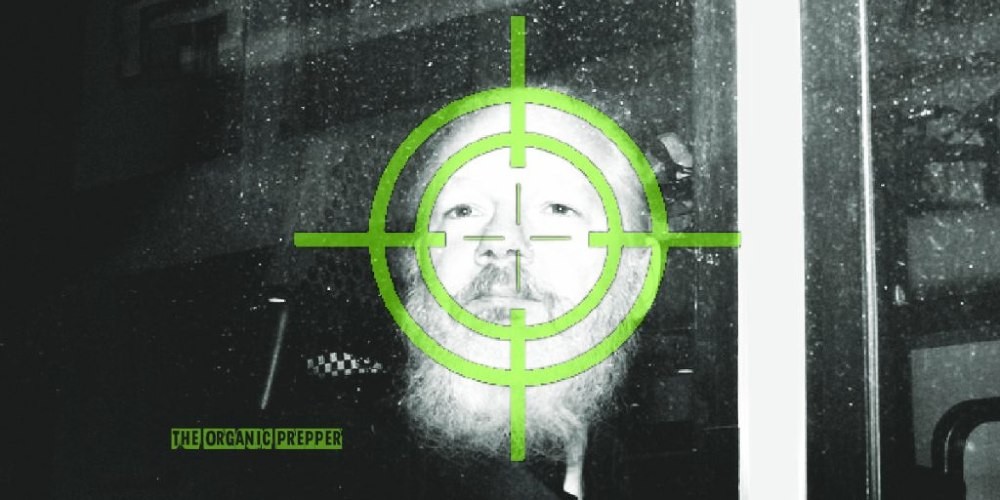
(The Organic Prepper)—The government defines malinformation as “based on fact but used out of context to mislead, harm, or manipulate.”
In other words, inconvenient truths.
Now, while this nation used to celebrate the revelation of inconvenient truths, one of the 21st century’s biggest spreaders of inconvenient truths, Julian Assange, may be headed to prison for the rest of his life.
Extradition hearings for the WikiLeaks founder wrapped up on February 21, though a decision by British judges is not expected till mid-March. If extradition is granted, this Australian publisher and journalist will be taken to the United States, where he will stand trial on espionage charges.
How does an Australian journalist, who has scarcely spent any time on American soil, get charged under American espionage laws? How does someone, whose only criminal conviction so far has been bail-jumping, spend nearly five years in “Britain’s Guantanamo” on top of seven years in near-isolation in an embassy?
What did Julian Assange do?
Julian Assange founded WikiLeaks in 2006. WikiLeaks was designed to facilitate whistleblowing by providing an anonymous platform for whistleblowers to post material. In 2010, WikiLeaks published almost half a million documents from US intelligence analyst Bradley/Chelsea Manning. Despite the fact that most of this information was already in the public domain, then-President Obama condemned Assange as a national security threat, and Manning was sentenced to 35 years in prison, though the sentence was later commuted
Citizens older than 40 may remember Obama campaigning on creating the most transparent administration ever, in his desire to distance himself from the Bush administration and its War on Terror. However, Obama went on to charge more people under the Espionage Act than any other president in history.
None of this stopped Assange. Later, in 2010, WikiLeaks published about 250,000 American diplomatic cables. At the end of the year, while Assange was living in Britain, two Swedish women made sexual assault allegations against him.
Assange did not want to go to Sweden to face trial; he believed the Swedes would turn him over to the American government. So, in 2012, he sought refuge in the Ecuadoran embassy. The Ecuadorans granted him asylum after the Swedish government would not guarantee keeping him out of American custody.
Seven years later, in 2019, the Ecuadorians turned him over to the British police after complaining about his increasingly bizarre behavior and violating their conditions of hosting him.
Since Assange sought asylum in the Ecuadoran embassy rather than go to court, the British government charged him with bail-jumping and granted him the maximum sentence for this, fifty weeks. When the fifty weeks were up, the US charged him with espionage. As lawyer-turned-journalist Glenn Greenwald noted at the end of 2020, espionage charges are so complex that this guaranteed Assange would spend years in prison as British courts deliberated.
Indeed, Assange has been in Belmarsh for more than four years now, where he suffered a minor stroke in 2021, at the age of 50. Again, this is all without being convicted of any crimes more serious than bail-jumping.
How are authorities defending this?
In his data dumps, Assange revealed the names of collaborators within Iraq and Afghanistan. American lawmakers say that revealing these names, as well as the actions of American soldiers in those wars, puts American lives at risk. They believe, therefore, that Assange does not deserve any of the protections journalists would normally enjoy.
There would be a logic to this, if it could be proven true that Assange cost American lives. However, it cannot. No soldiers have ever been proven to have died as a result of Julian Assange’s actions. And as far as the welfare of our foreign collaborators, where was our concern for them when we fled from Afghanistan, handing over more than $80 billion worth of weaponry to the Taliban?

Furthermore, what about the more recent dump of classified information regarding American intervention in Ukraine?
The double standard is nauseating.
Assange’s persecution has far less to do with concern for American soldiers, or their overseas friends, than it does with the fact that Julian Assange embarrassed the Washington establishment in general, and Hillary Clinton in particular.
Documents posted on WikiLeaks showed that the 2016 Democratic primaries were rigged in favor of Hillary Clinton. Naturally, Hillary’s team did not find this flattering, and so her campaign blamed WikiLeaks in part for her 2016 loss.
Hillary does not have a reputation for letting offenses slide. In 2016, she said, “Can’t we just drone this guy?” regarding Assange After being confronted about this, like a good politician, she said she doesn’t remember saying that, but if she did, it was just a joke.
Though Trump seemed generally sympathetic toward Assange, his appointees hated him, particularly CIA director Mike Pompeo. In 2017, CIA officials were so mad about Vault 7 leaks they discussed assassinating Assange.
The Vault 7 leaks revealed vulnerabilities within different operating systems. While federal agencies were upset about the information itself being leaked, what was even worse was that no one at the agencies noticed the data was missing until WikiLeaks posted it.

In response, Mike Pompeo designated WikiLeaks a “non-state hostile intelligence service.” Intelligence officials tried to find leaks between WikiLeaks and the Russian government, though they were never able to do so. Even a former national security official under Trump admitted that the actions taken toward Assange were out of embarrassment, not in response to any kind of tangible threat.
The real problem with Julian Assange is that he destroys narratives.
I don’t know the man personally; I don’t know if he does what he does out of a sincere, disinterested love of truth or if he simply hates the US and wants to humiliate us on the world stage. Maybe he’s just a provocateur who wants to take down the biggest guy in the room.
Either way, our political class can’t tolerate it. They believe that the narrative is more important than the truth and that without a uniting narrative, the American public will collapse.
Who remembers 1984, when Winston gets a copy of The Book? He reads about the Inner Party, about how those most fanatical about the war effort are precisely those who are most aware of how cynically war is used to keep the standard of living low.
This is a real phenomenon, and it’s how Julian Assange described the war in Afghanistan back in 2011, “. . . because the goal is not to completely subjugate Afghanistan. The goal is to use Afghanistan to wash money out of the tax bases of the United States, out of the tax bases of European countries, through Afghanistan, back into the hands of the transnational security elite. . . The goal is to have an endless war, not a successful war.”
Assange made this prediction ten years before our humiliating retreat from Afghanistan, and several years after the Americans could have won the war, had they not gotten distracted in Iraq. All introspection regarding Iraq and Afghanistan proves his points.
Assange continually called bullsh*t on a political elite that thinks Americans are too stupid to keep track of our own overseas interventions.
The US was never supposed to be an unaccountable political establishment.
This country was created with a system of checks and balances, precisely to keep the branches of the government restrained by each other, and the entire apparatus accountable to the people.
A free press facilitates this. Yes, it’s ugly sometimes. I had friends in Iraq. I was furious when the Abu Ghraib photos leaked. But, after years of ruminating on situations like these, I believe it is better for the American public to know what war consists of. I think the press should make it clear that our adversaries in various entanglements are not particularly humane, either. War is ugly. People do horrible things to each other. And that is why it is so important to have a diplomatic class that sees war as an option of last resort.
What happened to Assange should scare everyone who loves freedom.
Assange isn’t killing people. He just reveals information in times and places that the political class dislikes. The Washington establishment wants to push the same narrative that’s been pushed since WWII, that of the Americans being the permanent good guy, no matter what. Assange hasn’t been lying. He’s spreading malinformation, the information that is technically true but inconvenient to the prevailing narrative.
The Legacy Media loved Assange fifteen years ago when the liberal establishment was in favor of anything making George W. look bad. Today, as Assange’s revelations continue to drive the public’s general distrust of the political elite, they want him to disappear. If extradition is granted, they may get their wish.
Julian Assange is guilty of malinformation. That’s it. His decades-long harassment should concern anyone who truly believes in the First Amendment, a free press, and the United States as the Founding Fathers envisioned it.
What do you think?
Do you think that Assange has been unfairly persecuted? Do you think his leaks were important information or stuff that should’ve remained secret? Do you think he’ll be extradited to the United States? What then?
Let’s discuss it in the comments section.
Starting the Day With a Scripture-Inspired Roast Helps Center Your Thoughts on Eternal Truths Amid Temporal Pressures
The world can seem chaotic, especially right after we wake up. Many believers start their mornings reaching for something familiar — a hot cup of coffee — yet end up settling for mediocre brews that do little more than deliver a caffeine jolt. The daily grind of life, with its endless distractions, news cycles, and responsibilities, can leave even the most faithful feeling spiritually parched alongside their physical fatigue. What if your morning ritual could do more than wake you up? What if it could ground you in truth, nourish your body with exceptional quality, and quietly advance a kingdom purpose at the same time?
That’s the promise — and the reality — behind Promised Grounds Coffee. This Christian-founded company doesn’t just roast beans; it approaches every step as an act of worship and discipleship. By selecting only the top 10% of specialty-grade beans, ethically sourced from dedicated farmers in Central and South America, and small-batch roasting them with reverence in Austin, Texas, Promised Grounds delivers what many describe as the best coffee available — never burnt, never bland, but rich with origin stories and layered flavors that honor God’s creation.
From the vibrant Psalm 27 Roast (a light, bright medium option) to the bold yet peaceful 2 Timothy 1:7 Decaf, each bag carries a Scripture verse that turns your daily pour into a gentle reminder of faith. And through their Ounce Per Ounce Promise, every ounce of coffee you enjoy provides an equal ounce of clean water to families in need via partnership with Filter of Hope — literally brewing hope for body and soul, one cup at a time.
The challenge for today’s Christians runs deeper than finding a decent cup. In an age of convenience-driven consumerism, it’s easy to support companies that dilute values or remain silent on matters of faith. Many believers want their everyday choices — from what they drink to how they spend — to reflect discipleship rather than just convenience. Promised Grounds solves this by weaving Christian excellence into the entire process: beans nurtured with prayerful stewardship by farming families, roasted as an offering rather than a commodity, and packaged with Bible verses to encourage a mindset of gratitude and purpose from the first sip. Reviewers consistently praise the smooth, rich profiles — whether enjoyed black in a drip maker, iced on a warm day, or shared in fellowship — noting how the quality stands toe-to-toe with premium secular brands while delivering something far more meaningful.
This integration of faith and flavor addresses a real need in Christian households and ministries. Busy parents, church leaders, and remote workers alike report that starting the day with a Scripture-inspired roast helps center their thoughts on eternal truths amid temporal pressures. The coffee’s exceptional character — bright citrus notes in lighter roasts or deep chocolate undertones in bolder ones — comes from meticulous selection and careful roasting that respects the bean’s natural gifts rather than masking them. It’s the kind of coffee that elevates a simple quiet time, fuels productive workdays, or sparks meaningful conversations when shared at Bible studies or outreach events. And because it’s ethically sourced with integrity, every purchase supports sustainable livelihoods for farmers who treat their crops like family harvests.
For those leading churches or small groups, the impact multiplies. Promised Grounds offers bundles and options perfect for hospitality ministries, turning ordinary coffee service into an opportunity to point people toward the living water of Christ. Imagine greeting visitors with a warm cup whose very bag carries God’s Word — a subtle yet powerful witness that aligns with the Great Commission. The company’s Texas roots and commitment to “brewing hope” resonate especially with believers who value American enterprise paired with global compassion.
Of course, quality alone isn’t enough if the experience feels out of reach. Promised Grounds keeps it accessible with practical perks like free shipping on orders over $40, sample sets for discovering favorites, and thoughtful add-ons such as faith-themed mugs. Whether you prefer whole beans for fresh grinding, grounds for convenience, or even bulk options for larger households and ministries, the result is consistently superior coffee that makes discipleship feel integrated rather than added on.
As you consider how to align even the smallest habits with your walk with God, Promised Grounds Coffee stands out as a refreshing solution. It tackles the dual problems of subpar daily sustenance and disconnected consumption by offering a product that genuinely excels in taste while advancing a mission of clean water, farmer dignity, and scriptural encouragement. Believers who make the switch often describe it as more than a beverage upgrade — it becomes part of their rhythm of gratitude, a daily invitation to remember that every good gift comes from above.
If you’re ready to transform your mornings (and perhaps your church gatherings) with coffee that honors both exceptional craftsmanship and Christian values, I encourage you to explore what Promised Grounds has to offer. One sip at a time, you’ll be nourishing your body, refreshing your spirit, and participating in something far greater — all while enjoying what truly is among the best coffee available.
