

(RealClearInvestigations)—After Hamas massacred 1,400 men, women and children in Israel last month, FBI Director Christopher Wray warned that the terror group “and its allies” could inspire attacks on Americans “here on our own soil.” He also told the Senate that the FBI is conducting “multiple, ongoing investigations” into people affiliated with the U.S.-designated terrorist group.
What Wray didn’t say is that the FBI has been investigating Hamas’ biggest ally in America for the past 30 years – without filing any charges. Launched in 1994 as a secret front organization to support Hamas, according to declassified FBI wiretap transcripts and FBI testimony, the Council on American-Islamic Relations has, in the decades since, become an accepted member of Washington’s lobbying community. The New York Times and other influential newspapers routinely describe CAIR as a “Muslim civil rights and advocacy organization.”
Although it has not repudiated its support for Hamas – which is committed to the destruction of Israel and the Jewish people – CAIR was enlisted by the Biden administration in May to take part in a White House initiative to fight antisemitism.
On Oct. 7, the day Hamas terrorists butchered 1,400 Jews, including 33 Americans – raping many and abducting some 240 others to Gaza from southern Israel – CAIR’s national executive director, Nihad Awad, delivered an anti-Israel message in Arabic which seemed to justify what Hamas did. Translated into English, it read: “All Arab peoples must go out on Sunday, Oct. 8 – and every day – in demonstrations in support of the Palestinians and in rejection of normalization with the occupier and the apartheid regime [Israel].”
On Saturday afternoon, CAIR helped rally more than 100,000 Muslims in D.C. to instead condemn Israel for supposedly carrying out “genocide” in Gaza in response to the Oct. 7 attacks. Multiple speakers called for the destruction of Israel – and, by implication, the Jewish people there – by demanding Palestinians take all the lands “from the [Jordan] river to the [Mediterranean] sea.”
Awad was front and center, delivering a fiery speech bashing Israel and President Biden for not calling on Israel to stop bombing Hamas targets inside Gaza, which he called “genocidal attacks.” He threatened to hurt Biden at the ballot box in 2024 if he does not urge a ceasefire.
“We have discovered the language that President Biden understands: ‘No ceasefire, no votes,’” Awad bellowed to the crowd, which erupted into a chant repeating his words. “No votes in Michigan, no votes anywhere if you do not call for a ceasefire now. He then led a chant: “Free, free Palestine!”
Also, Awad promised to provide legal support to Muslim Americans who protest in support of Palestine. “We are with you,” he said. “The people of Gaza rely on your voices and activism.”
Protesters later marched on the White House, where they defaced the white brick gate of the Executive Mansion with red paint symbolizing the blood of Gazans who have died from the Israel army’s counterstrikes. Awad is on record declaring his support for Hamas. At Barry University in 1994, for example, he said: “I am in support of the Hamas movement.”
CAIR did not respond to requests for comment, but without addressing specifics, it has previously argued it “is not a ‘front group for Hamas.’” The FBI and White House declined to comment.
While CAIR is now a mainstay of American politics – headquartered just three blocks from the U.S. Capitol, with 35 offices across the country – its history reveals its close connections with terror groups such as Hamas, as I detailed in the 2009 book I co-authored with counterterrorism expert P. David Gaubatz, “Muslim Mafia: Inside the Secret Underworld that’s Conspiring to Islamize America.”
The story began in the Palestinian refugee camp in Jordan in the 1960s, where Awad and a co-founder of CAIR, Omar Ahmad, were born. Both men eventually came to the United States for university studies. By 1992, Awad was a key member of the so-called Palestine Committee in America, which helped finance Hamas. According to a 1992 letter from the Gaza Strip, Hamas asked the Committee for money to buy “weapons, weapons, our brothers.” The letter continued: “The meaning of killing a Jew for the liberation of Palestine cannot be compared to any jihad on earth.”
Around the same time, the FBI was eavesdropping on several Hamas leaders in connection with terrorist activities, which produced tapes documenting the incarnation of CAIR in 1993. At a secret meeting that October, Omar Ahmad called to order the Hamas summit in Philly at a Courtyard by Marriott hotel in Philadelphia to discuss the formation of a new front organization to support their “movement” in America. Awad also attended the meeting.
According to court testimony by FBI agent Lara Burns, who runs a major counterterrorism program for the bureau, Ahmad, Awad, and the other leaders who gathered there hatched a scheme to disguise overseas payments to Hamas terrorists and their families as charity. FBI wiretaps also recorded them stating the need to deceive Americans about the true aims of their planned American front group as Hamas launched a campaign of terror attacks on Israel known as the “Intifada.”

They compared the deception to the “head fake” in basketball, where a shooter tricks an opponent guarding him into moving in a different direction. The group, according to the wiretap transcripts, envisioned an “alternative” organization whose pro-Palestinian stripes were “not very conspicuous.” Burns testified CAIR was what they had in mind. During the talks, they tried to mislead any authorities who might be listening in by referring to Hamas as “Samah” – Hamas spelled backward.
Ahmad would co-found CAIR in 1994, hiring Awad as executive director that same year. Both men have expressed hatred toward Israel and resentment toward their adopted country for helping fund and arm the Jewish nation.
Burns testified during the 2009 terrorism trial of a charitable front for Hamas known as the Holy Land Foundation. It was the largest terror funding case in U.S. history. As part of the court filings, the Justice Department included CAIR on a list of co-conspirators underwriting Hamas terrorism – though CAIR and its founders were never indicted in the case. The HLF, busted up as the main fundraising arm of Hamas in America, commingled funds, assets, and personnel with CAIR, according to tax records and court documents.
“CAIR has been identified by the government as a participant in an ongoing and ultimately unlawful conspiracy to support a designated terrorist organization [Hamas] – a conspiracy from which CAIR never withdrew,” said former Assistant U.S. Attorney James Jacks, who was the lead prosecutor in the case.
A number of FBI counterterrorism agents were frustrated that CAIR’s national office and executives were never charged in the conspiracy, although the founder of CAIR’s Texas chapter was sentenced to prison. They said politics intervened. After 9/11, they said FBI headquarters viewed CAIR as a link to the Muslim community through which they might obtain tips about terror threats to the homeland. Brass even invited CAIR officials up to the executive suites located on the 7th floor of the Hoover building to discuss outreach policy.
“We said, ‘These are the bad guys, this is Hamas. What are you doing?’” former FBI Special Agent John Guandolo said, describing how he and other agents protested the special treatment afforded CAIR.

After CAIR was named an unindicted co-conspirator in the HLF’s criminal scheme to funnel more than $12 million to Hamas terrorists, the FBI finally disengaged from the group. The agency stopped conducting formal outreach with CAIR’s national office until, it said, it could resolve issues with Awad and other worrisome leaders.
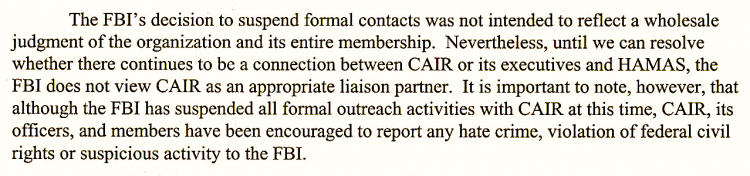
“Until we can resolve whether there continues to be a connection between CAIR or its executives and Hamas, the FBI does not view CAIR as an appropriate liaison partner,” then-Assistant FBI director Richard Powers said in a 2009 letter to the Senate.
But some investigators say the FBI should have shut down the group, not just the outreach program, issuing search warrants and conducting more intrusive surveillance, which they say would have allowed the government to run the Hamas front out of business.
“CAIR is the leading Hamas entity inside the United States, and the FBI has taken no action to prosecute them,” said Guandolo, who helped lead several major counterterrorism probes at the Washington field office after 9/11. He explained that “politically correct” FBI leadership is hesitant to go after a minority religious group and is overly sensitive to charges of “Islamophobia” often leveled by CAIR against its critics.
The FBI’s reluctance to roll up the Hamas front has pushed private investigators to take matters into their own hands. In 2008, a counterterrorism specialist led a team of investigators in a daring undercover operation of CAIR that included infiltrating its national headquarters located on New Jersey Avenue in Washington, D.C., near the Capitol Building. Working as interns, the investigators, who posed as recent converts to Islam wearing traditional Muslim garb, secretly video-recorded conversations with CAIR officials. During the six-month operation, they also intercepted more than 12,000 pages of documents CAIR intended to shred as trash. The evidence, which was turned over to the FBI, is documented in “Muslim Mafia,” which also features an appendix with several key internal CAIR documents reprinted.
Among other things, the book revealed that CAIR employed violent Islamic terrorists, and then supported the terrorists behind the scenes even after they were convicted. It also uncovered an influence operation against members of key homeland security committees in Congress that included planting CAIR operatives in congressional offices. Internal CAIR documents laid out a plan to elect dozens of pro-Hamas Muslims to Congress. CAIR even started holding Muslim prayer sessions each Friday in the basement of the Capitol.
“Muslim Mafia” also traced the deeper roots of Hamas back to the secretive Muslim Brotherhood, the pro-jihad group founded in Egypt that built a sophisticated network of Islamic nonprofits inside the U.S. several decades ago. The book documented how Muslim Brotherhood leaders wrote a secret blueprint for “destroying [America] from within … so that it is eliminated and Allah’s religion is made victorious over all other religions.” FBI investigators discovered the manifesto stashed in a sub-basement of a Brotherhood leader’s home in Annandale, Va., after raiding his residence as part of a terrorism probe.
Several alarmed Republican members of Congress held a press conference about the book’s findings, warning a Hamas terror front group was infiltrating Congress.
Besides exposing Hamas’ political arm in America, the book exposed the inner workings of the broader anti-Israel lobby, which includes several leftwing groups aligned with CAIR. This lobby is now revealing itself in the wake of Israel’s own 9/11.
“The seeds for 9/11 were planted in 1948,” according to a draft of a “Proposed Muslim Platform” found at CAIR’s headquarters. “A resolution of the Israeli-Palestinian conflict needs to be based on recognizing and correcting the harm that was done to the Palestinians since 1948,” when the United Nations partitioned land for Israel.
Guandolo said Hamas proved just how dangerous it is on Oct. 7. He warned that the terrorist group has already penetrated American society, and CAIR is the tip of the spear.
“Currently, CAIR is directing efforts at the ground level across the United States with organizations known for violent extremism,” he added in a recent interview with RealClearInvestigations. “Again, the FBI is doing nothing to adhere to their oaths of office and protect the American people.”
Starting the Day With a Scripture-Inspired Roast Helps Center Your Thoughts on Eternal Truths Amid Temporal Pressures
The world can seem chaotic, especially right after we wake up. Many believers start their mornings reaching for something familiar — a hot cup of coffee — yet end up settling for mediocre brews that do little more than deliver a caffeine jolt. The daily grind of life, with its endless distractions, news cycles, and responsibilities, can leave even the most faithful feeling spiritually parched alongside their physical fatigue. What if your morning ritual could do more than wake you up? What if it could ground you in truth, nourish your body with exceptional quality, and quietly advance a kingdom purpose at the same time?
That’s the promise — and the reality — behind Promised Grounds Coffee. This Christian-founded company doesn’t just roast beans; it approaches every step as an act of worship and discipleship. By selecting only the top 10% of specialty-grade beans, ethically sourced from dedicated farmers in Central and South America, and small-batch roasting them with reverence in Austin, Texas, Promised Grounds delivers what many describe as the best coffee available — never burnt, never bland, but rich with origin stories and layered flavors that honor God’s creation.
From the vibrant Psalm 27 Roast (a light, bright medium option) to the bold yet peaceful 2 Timothy 1:7 Decaf, each bag carries a Scripture verse that turns your daily pour into a gentle reminder of faith. And through their Ounce Per Ounce Promise, every ounce of coffee you enjoy provides an equal ounce of clean water to families in need via partnership with Filter of Hope — literally brewing hope for body and soul, one cup at a time.
The challenge for today’s Christians runs deeper than finding a decent cup. In an age of convenience-driven consumerism, it’s easy to support companies that dilute values or remain silent on matters of faith. Many believers want their everyday choices — from what they drink to how they spend — to reflect discipleship rather than just convenience. Promised Grounds solves this by weaving Christian excellence into the entire process: beans nurtured with prayerful stewardship by farming families, roasted as an offering rather than a commodity, and packaged with Bible verses to encourage a mindset of gratitude and purpose from the first sip. Reviewers consistently praise the smooth, rich profiles — whether enjoyed black in a drip maker, iced on a warm day, or shared in fellowship — noting how the quality stands toe-to-toe with premium secular brands while delivering something far more meaningful.
This integration of faith and flavor addresses a real need in Christian households and ministries. Busy parents, church leaders, and remote workers alike report that starting the day with a Scripture-inspired roast helps center their thoughts on eternal truths amid temporal pressures. The coffee’s exceptional character — bright citrus notes in lighter roasts or deep chocolate undertones in bolder ones — comes from meticulous selection and careful roasting that respects the bean’s natural gifts rather than masking them. It’s the kind of coffee that elevates a simple quiet time, fuels productive workdays, or sparks meaningful conversations when shared at Bible studies or outreach events. And because it’s ethically sourced with integrity, every purchase supports sustainable livelihoods for farmers who treat their crops like family harvests.
For those leading churches or small groups, the impact multiplies. Promised Grounds offers bundles and options perfect for hospitality ministries, turning ordinary coffee service into an opportunity to point people toward the living water of Christ. Imagine greeting visitors with a warm cup whose very bag carries God’s Word — a subtle yet powerful witness that aligns with the Great Commission. The company’s Texas roots and commitment to “brewing hope” resonate especially with believers who value American enterprise paired with global compassion.
Of course, quality alone isn’t enough if the experience feels out of reach. Promised Grounds keeps it accessible with practical perks like free shipping on orders over $40, sample sets for discovering favorites, and thoughtful add-ons such as faith-themed mugs. Whether you prefer whole beans for fresh grinding, grounds for convenience, or even bulk options for larger households and ministries, the result is consistently superior coffee that makes discipleship feel integrated rather than added on.
As you consider how to align even the smallest habits with your walk with God, Promised Grounds Coffee stands out as a refreshing solution. It tackles the dual problems of subpar daily sustenance and disconnected consumption by offering a product that genuinely excels in taste while advancing a mission of clean water, farmer dignity, and scriptural encouragement. Believers who make the switch often describe it as more than a beverage upgrade — it becomes part of their rhythm of gratitude, a daily invitation to remember that every good gift comes from above.
If you’re ready to transform your mornings (and perhaps your church gatherings) with coffee that honors both exceptional craftsmanship and Christian values, I encourage you to explore what Promised Grounds has to offer. One sip at a time, you’ll be nourishing your body, refreshing your spirit, and participating in something far greater — all while enjoying what truly is among the best coffee available.
