

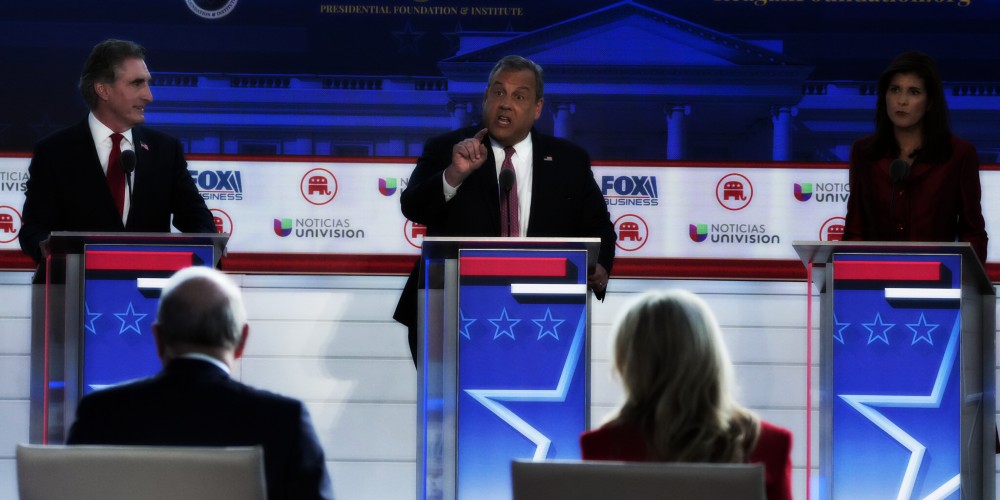
(The Epoch Times)—Republican presidential candidates took the stage for a second Republican debate at the Ronald Reagan Presidential Foundation and Institute in Simi Valley, California, on Wednesday.
Appearing in order of their standing in national polls were Florida Gov. Ron DeSantis, former U.N. Ambassador and South Carolina Gov. Nikki Haley, entrepreneur Vivek Ramaswamy, South Carolina Sen. Tim Scott, former Vice President Mike Pence, and North Dakota Gov. Doug Burgum.

As the seven White House hopefuls did their best to articulate their messages and project a presidential aura during the event, three people who were not present seemed to get nearly as much air time as those who were, presidents all: Ronald Reagan, Donald Trump, and Joe Biden.
President Regan was often cited by both the moderators and candidates as an almost mythic leader who fired striking air traffic controllers, granted amnesty to immigrants, and handed down the 11th commandment, “Thou shalt not speak ill of any fellow Republican.”
President Biden was cast as the country’s nemesis, the cause of every ill from the economy to the border crisis to wokeism.
President Trump, who was 2,300 miles away in Detroit, speaking to striking auto workers, was mentioned more than any other. The former president, who leads Republican candidates by some 40 percentage points in national polls, was both praised for the achievements of his administration and criticized for his failures. But mostly, he was chided like a schoolboy for his absence from the stage.
“Donald Trump hides behind the walls of his golf clubs and won’t show up here to answer questions like all the rest of us,” said Mr. Christie said.
Mr. DeSantis said President Trump was “missing in action.”
The frequent conjuring of both heroes and villains, which directed attention away from rather than toward those in attendance, was emblematic of the two-hour event. Though it provided some moments of interest, the debate provided little new information about any candidate.
Talk Soup
From the start, moderators struggled to maintain control of the debate as candidates talked over each other, interrupted, injected themselves into questions asked of others, and disregarded the time limits for answers.
Moderators Dana Perino and Stuart Varney of Fox News and Ilia Calderon of Univision. During the first break, Ms. Perino admonished the candidates, according to a Fox News commentator. That prompted a short-lived improvement, but the debate frequently devolved into talk soup.
In frustration, Ms. Perino warned Mr. Burgum concerning his interrupting, “We will have to cut your mic, and I don’t want to do that. I don’t.” Though, the North Dakota governor was no more guilty than others.
After the contest, a spokesperson for President Trump told reporters the spectacle he’d witnessed was reason enough for the former president to skip future debates.
“He said he’s not going to attend the debates, plural. And that’s his position—until it’s not.” Chris LaCivita said.
Mr. LaCivita added that rather than a debate, it looked more like a contest for “who’s going to be the designated survivor.”

Haley Attacks
Attacks on opponents come frequently in presidential debates. During the first GOP showcase on Aug. 23, Mr. Ramaswamy went on the offensive frequently, something he came close to apologizing for during the second event.
“I’m the new guy here. And so I know I have to earn your trust,” Mr. Ramaswamy said. “What do you see? You see a young man who’s in a bit of a hurry, maybe a little ambitious, a bit of a know-it-all it seems, at times,” Mr. Ramaswamy said. “I’m here to tell you, no, I don’t know it all. I will listen.”
After he was asked about his use of TikTok, an app widely prohibited for use on government-owed phones over security concerns, Ms. Haley reacted to what she thought was a weak answer by Mr. Ramaswamy.
“This is infuriating because TikTok is one of the most dangerous social media apps that we could have,” Ms. Haley said. “Honestly, every time I hear you, I feel a little bit dumber for what you say,” she added.
Ms. Haley, who had mostly remained above the fray in the previous debate, also chose to attack Mr. DeSantis and Mr. Scott.
She criticized Mr. DeSantis for his anti-fracking policies in Florida and sparred with Mr. Scott over federal spending. Afterward, surrogates for both candidates answered Ms. Haley’s criticisms.

Chris Grant, a senior advisor to Mr. Ramaswamy, told The Epoch Times, “We don’t spend a lot of time thinking about Nikki Haley,” Mr. Grant added. “Nikki Haley clearly spends a lot of time thinking and getting angry about Vivek Ramaswamy.”
Matt Gorman of the Tim Scott campaign, told The Epoch Times simply, “[Nikki Haley] hasn’t met a federal dollar she hasn’t liked.”
After those and other attacks by several candidates, Mr. LaCivita wondered if the Republican National Committee should question whether further debates help the party. “What good does it do to have a group of people who stand around and do nothing but beat up on the frontrunner? Who has that really helped? That helps Joe Biden,” Mr. LaCivita said.
The China Challenge
The Chinese Communist Party was mentioned often during the debate as a global competitor, armorer of Russia, stealer of intellectual property, and indoctrinator of American students.
Mr. Burgum argued vehemently that the Biden administration’s push toward the adoption of electric vehicles played to China’s interests because it controls the supply of minerals needed to manufacture batteries.
“China controls 85 percent of the rare earth minerals. They’re called rare earth because they’re measured in parts per million. China is moving hundreds of thousands of pounds of earth, in Indonesia and Africa. They’re literally destroying the planet so that we can they can make a battery that’s in a car subsidized here,” Mr. Burgum said.
Mr. DeSantis said China poses multiple threats to the United States and must be countered.
“We need a totally new approach to China. We are going to have real, hard power in the Indo-Pacific, like Reagan, to deter their ambitions. We’re going to have economic independence from China,” Mr. DeSantis said. “And we are going to go after the cultural power they have in this country . . . We shouldn’t have them in our universities. We shouldn’t have Confucius Institutes.”
Mr. Pence said that failure to support Ukraine in its war with Russia would be “a green light for China to take Taiwan.”
“We’re in a cold war with China,” Mr. Burgum said. “The Biden administration won’t admit that, but we’re also in an economic war through what we’re doing with agriculture and energy. And we’re also in a war with them relative to cyber where we get attacked every day in North Dakota, every state, every school district, our tribes all being attacked every day by either China or Russia or Iran or North Korea.”
Ms. Haley vowed to end the supply of fentanyl in the United States, which she said originates in China. “We’re going to go after China because China is the one sending the fentanyl in the first place,” Ms. Haley said. “And we will end all normal trade relations until China stops sending fentanyl.”
No Standout
NTD TV, sister media to The Epoch Times, conducted a focus group with 15 Republican voters in Irvine, Calif., following the debate. Though the group did not have a consensus winner for the debate, several candidates drew favorable reactions.
A participant named Steven was favorably impressed by Mr. Burgum. “The governor of North Dakota, I thought he did particularly well. I was surprised by how well he did,” Steven said.
Others like Mr. DeSantis’s education policies, Mr. Ramaswamy’s openness to dialogue, and Ms. Haley’s determination to combat fentanyl. However, the group agreed that no candidate on the stage could unseat Donald Trump as the presumptive Republican nominee.
A third Republican debate will take place in Miami on Nov. 8.
Sound off about the debate on my Substack.
JD’s manually curated links for God-fearing MAGA patriots
Two Storms, One Harvest

Every food crisis in living memory has been a one-shock event. The 2008 price spike was a commodity bubble. The 2020 shortages were a logistics failure. The 2022 grain scare was a war on one exporter’s ports. Each time, the system bent, adjusted, and recovered, and each time the experts assured us afterward that global markets are simply too big and too diversified to fail.
What nobody in Washington seems eager to discuss is that 2026 is shaping up to be something the modern food system has never actually faced. Two independent shocks, one climatic and one geopolitical, are converging on the same harvest cycle at the same time. Not sequentially. Simultaneously.
Start with the weather. The Pacific Ocean is currently building toward what forecasters now openly call a record event. NOAA’s Climate Prediction Center puts the odds of at least a strong El Niño near 88 percent, with roughly two in three odds it reaches “very strong” status, the tier reserved for perhaps three or four events in the entire satellite era. Every major global model now projects a median peak in Super El Niño territory, and most of them project it exceeding the 2015-16 event, which until now held the modern record. Sea surface anomalies were already brushing the super threshold in mid-July, months before these events normally peak. The atmosphere has already shifted into El Niño mode, and the event is forecast to crest in late fall and early winter.
This is not about “climate change.” It’s about the standard cycles of weather, and the cycle we’re currently in is one that has likely devastated societies in the past. We’re better prepared as a society today, but not all Americans are equally prepared.
Serious households have started doing the quiet math on their own. Grocery bills tell part of the story, and the forecast maps tell the rest, which is why long-term food storage has moved from fringe hobby to mainstream line item in the family budget, with established suppliers like Heaven’s Harvest seeing demand from people who five years ago would have rolled their eyes at the idea. That instinct is not paranoia. It is pattern recognition, and the pattern is worth walking through carefully.
Editor’s Note: Heaven’s Harvest IS a sponsor, but the warnings of this article are real and would be written even if we didn’t have a survival food sponsor. With that said, those who take advantage of what they offer can use promo code “Patriot” for 15% off.
The Fertilizer Clock Is Already Running
While the Pacific warms, the second shock has been unfolding in the Strait of Hormuz. The conflict with Iran turned the world’s most important energy chokepoint into a contested waterway, and the consequences reach far beyond the gas pump. Roughly a third of global fertilizer trade moves through Hormuz, and the disruption sent urea prices up 86 percent year over year by March, with a 53 percent jump in a single month.
The World Bank projects energy prices rising about 24 percent in 2026 and fertilizer about 31 percent. By its own accounting, fertilizer prices ran 35 percent higher in the first five months of this year than the same period last year.
Here is the mechanism the nightly news will not explain. Fertilizer is not a grocery item. It is a time-delayed input. The nitrogen a farmer in Iowa or Punjab could not afford to apply this spring does not show up as a problem this spring. It shows up as a thinner harvest six to twelve months later.
The World Bank’s own food security brief concedes that the effects of reduced applications earlier this season “are likely to become visible only later in harvest outcomes.” Translate that from institutional language into plain English and it means this. The damage is already done, it is already in the ground, and we are simply waiting for it to arrive on the shelf.
Now check the calendar. Six to twelve months from the spring planting season lands us squarely in late 2026 and early 2027. Which is precisely when the strongest El Niño in the instrumental record is forecast to peak, bringing its signature droughts to Southeast Asia, Australia, southern Africa, northern Brazil, and South Asia, the very regions that grow the world’s rice, sugar, and oilseeds.
The World Bank warns openly that a strong El Niño “could disrupt multiple crop belts simultaneously” on top of the conflict-driven input costs. Their baseline projection assumes the Middle East disruptions ease by autumn. What in the last two years of Middle East history suggests that assumption is safe?
The System Has No Slack Left
The comfortable answer is that global markets always adjust. But adjustment requires slack, and the slack is gone. Global cereal production is expected to decline from last year’s records even before El Niño does its work. The UN World Food Programme, hardly a den of right-wing preppers, is calling this the most significant disruption to its supply chains since Covid and the invasion of Ukraine, and its supply chain director put the stakes bluntly.
Today’s supply chain challenges are tomorrow’s hunger crisis.
There is also a political dimension that markets cannot price. When food gets scarce, governments do not behave like economists. They behave like politicians. Export bans, hoarding mandates, and panic buying at the national level turned the modest rice shortfall of 2008 into a global crisis, and analysts are already warning that import-dependent nations are the first dominoes.
The 2015-16 Super El Niño, a far weaker event than what is now forecast, threw tens of millions into food stress across Africa and Asia. This one is projected to be stronger, and it arrives with fertilizer already rationed by price and shipping lanes already contested by missiles.
What Joseph Knew
Scripture does not treat preparation for lean years as faithlessness. It treats it as wisdom delivered in advance to those willing to act on it.
Behold, there come seven years of great plenty throughout all the land of Egypt: And there shall arise after them seven years of famine; and all the plenty shall be forgotten in the land of Egypt.
Joseph did not respond to that warning with a hashtag or a committee. He stored grain during the years of abundance, and when the famine came, Egypt stood while its neighbors begged. The lesson is not that famine is certain. It is that the time to prepare is precisely when preparation still looks optional.
Nobody who filled a pantry in a year of plenty has ever regretted it, and nobody standing in an empty aisle has ever been glad he waited for certainty.
None of this calls for panic, and panic is the enemy of sound judgment anyway. It calls for the same unglamorous prudence our grandparents considered ordinary. Keep some cash margin, know your local growers, and put real food in deep storage while it is cheap and available, because the entire arc of this story is that cheap and available is a closing window.
Families looking for a straightforward place to start can visit Heaven’s Harvest and use promo code Patriot for 15 percent off long-term storable food. The forecasts may yet soften, the strait may yet reopen, and we should pray they do. But hope is a fine thing to hold and a foolish thing to eat.
