

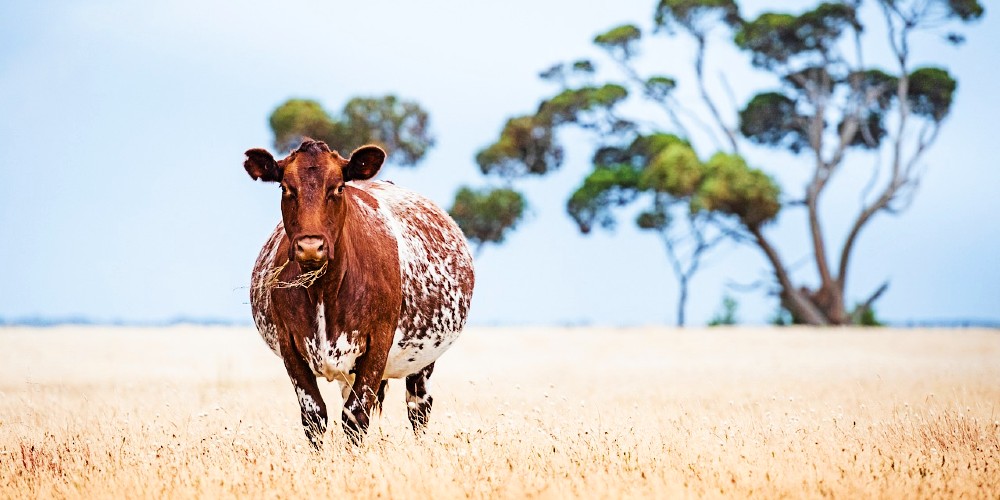
Kansas cattle rancher Kyle Hemmert watches the decline of cattle farmers in Ireland and the Netherlands and sees the future for himself and his fellow ranchers.
“What’s happening in the beef industry is the same thing that’s happened in the sheep industry,” Mr. Hemmert told The Epoch Times. “America peaked at 51 million sheep; today, we have less than 5 million.
“I’m seeing empty pastures in my area,” he said. “People said ‘to hell with it.’”
Bill Bullard, CEO of R-CALF USA, spoke to The Epoch Times about the issue.
“The cattle industry is the last frontier; it’s the last segment of the livestock industry that still has a sufficient level of competition to sustain independent producers,” Mr. Bullard said.
With about 5,000 members, R-CALF represents independent cattle ranchers and is fighting to preserve their independence. But they are facing off against a group of only four major buyers for their cows, new federal initiatives that favor the large packing companies, and climate activism that claims cows emit too many greenhouse gasses and must have their numbers reduced.
“The model that they have applied, first to the poultry industry and now to the hog industry, has been extremely successful for the multinational meat packers that want to vertically integrate the entire industry,” Mr. Bullard said, “and that vertical integration kills competition.”
The cash markets that once existed between buyers and sellers in these industries are largely gone, with farmers becoming either employees or working under contract to packing companies.
“Now, if you want to produce hogs, you do so by invitation from an integrator because you have a contract to produce hogs,” Mr. Bullard said. “They’re applying that, unfortunately, very successful model to the cattle industry right now.”
Rep. Harriet Hageman (R-Wyo.) has also commented on the issue.
“That’s the example of vertical integration that’s already happened in large part with our pork producers and our poultry producers,” Ms. Hageman told The Epoch Times. “And they want to do exactly the same thing with our ranches. They want to basically make our ranchers nothing but paid employees, and the ranches and the real property would be owned by the big packers.”
South Dakota rancher Brett Kenzy told The Epoch Times that the American rancher is a remnant of a “self-reliant, independent, entrepreneurial, hardworking, religious, multigenerational person that used to be very commonplace.”
Ranchers now worry that having so much of the country’s meat production under the control of a handful of corporations will drive many farmers out of business and leave Americans at the mercy of a few global players.
The Miracle of Cows
“The miracle of the cow is the fact that she has four chambers in her stomach, and she can eat grass, which is carbohydrate, and create protein,” Mr. Kenzy said. “They’re the only animal on earth that can do it that efficiently.

“Beef is the most well-balanced source for human beings in terms of vitamins, minerals and protein,” he said, “but that four-chambered stomach, as they’re running it through, they belch methane.”
These methane emissions have put cows directly in the crosshairs of climate activists. Many of the corporations that control food markets have joined net-zero clubs like Climate Action 100+, which pledge to slash greenhouse gas emissions for themselves and their suppliers.
“Rather than just killing off the cattle all at once, this is going to be a controlled implosion of the beef industry,” Mr. Kenzy said. “I think the end goal is ultimately controlling the food supply.”
Cattle ranchers “went through a period from 2015 to 2021 where they could not recover their cost of production,” Mr. Bullard said. “We’ve seen segments of our industry literally drop like flies.”
“Just four decades ago, we had about 1.3 million independent cattle farmers and ranchers that were maintaining mother cow herds and raising calves each year,” Mr. Bullard said. “Due to economic costs, price squeezes, a lack of profitability, and a lack of competition [among buyers], we wiped out 43 percent of them.”
American households have experienced this phenomenon in the form of escalating prices for beef. The average price that American consumers paid for beef increased from $3.89 per pound in January 2020 to $5.10 per pound as of July 2023, according to the Federal Reserve.
“The fact that cattle producers were receiving seriously depressed prices for the cattle, at the same time that consumers were paying super inflated prices for beef in the grocery store, that prompted us to file a national class action suit against the largest four packers that control 85 percent of the fed cattle market,” Mr. Bullard said.
It is only recently that these price increases made their way through to the ranchers that remained in business.
“This year is going to be profitable for the cow-calf man, but for the last six, seven years there has not been profit,” Mr. Hemmert said. “When there’s not profit, it signals to the industry to cut back, quit producing, and there’s been a lot of cow herds that have been sold.”
“It took decimation of the cow-calf industry to make us profitable again,” he said. “That’s kind of sad, right?”
The Problem With Cows
The United Nations Food and Agricultural Organization asserts that emissions from livestock farms are about seven gigatons of carbon dioxide per year, or about 15 percent of all human-induced greenhouse gas emissions (pdf).
“Beef and cattle milk production account for the majority of emissions, respectively contributing 41 and 20 percent of the sector’s emissions,” the U.N. states.
The solution proposed by climate activists is to reduce the production of beef, with a target of 30 percent reduction in cattle herds. Countries like Ireland and the Netherlands have already attempted to introduce laws and regulations to cut herds.
The Netherlands Environmental Assessment Agency released a 13-year, 25-billion-euro plan in December 2021 to reduce emissions by 50 percent by 2030. The plan would cut the country’s cattle, pig, and chicken population by 30 percent through voluntary buy-outs or, if necessary, expropriations by the state of about 3,000 farms.
In May, the European Union green-lit a Dutch plan to spend $1.6 billion to purchase or seize Dutch farmers’ land. This policy led to mass farmer protests under slogans like “No Farmers, No Food.”
In the United States, however, targets to reduce livestock emissions are being set not by government fiat but by a handful of corporate food producers.
In June 2021, Tyson Foods announced that it was “the first U.S.-based protein company to have an emissions reduction target approved by the Science Based Targets initiative (SBTi).”
Tyson is one of the four dominant packing companies in the beef industry; the other three are Minnesota-based Cargill, and Brazilian-based JBS Foods and Marfrig. Together these four companies process about 85 percent of all beef in the United States.
And it is not just the packing oligopoly that is expanding its control into the ranching industry. A similar consolidation and vertical integration is happening within global grocery chains as well.
“Walmart has gone out and bought enormous ranches,” Ms. Hageman said. “They’re raising their own cattle, they’re processing it, and they’re selling it in their stores.”
‘Rich Countries Must Cut Meat Consumption’
The North American Meat Institute, whose members include meat packing companies that account for more than 95 percent of America’s meat and poultry products, launched its Protein PACT Academic Advisory Council in June, which works with its members “in setting greenhouse gas reduction targets to be approved by the Science Based Targets initiative.”
The SBTi, in partnership with organizations like the United Nations Global Compact and the World Wildlife Fund, pledges to “lead the way to a zero-carbon economy, boost innovation and drive sustainable growth by setting ambitious, science-based emissions reduction targets.” Calling itself the “global body enabling businesses to set emissions reduction targets in line with science,” the SBTi states that “companies in the forest, land and agriculture sectors will reduce at least 72% of emissions by no later than 2050.”
Tyson foods stated in its 2021 Sustainability Report that it had a “Science Based Target” of achieving a 30 percent reduction in greenhouse gas emissions by 2030, and that addressing beef production would be key.
Despite the fact that greenhouse has emissions are a global phenomenon, emissions reduction plans typically focus on western countries. A 2022 report by Earth.org stated that in order to meet climate-change targets, “rich countries must cut meat consumption by at least 75%.”
A 2018 study published in Nature (pdf) claimed that beef consumption in western countries would need to decrease by 90 percent.
As cows become a prime target for climate activists, it is perhaps not coincidental that cattle ranchers are also the last livestock farmers who have not already been absorbed by global food conglomerates.
“Cattle is the single largest segment of American agriculture; it sets itself apart from the hog and poultry industries,” Mr. Bullard said. “The hog and poultry industry are primarily controlled by multinational meatpacking conglomerates, and they have the ability to defend their interests, unlike the disaggregated independent family farmers and ranchers scattered across the country.
“They simply don’t have the resources to fight back,” he said. “What the climate change folks have done is pick the low-hanging fruit, and that’s the U.S. cattle industry.”
Global Roundtable for Sustainable Beef
Like with other segments of the world’s economy, the environmental social and governance (ESG) movement has made its way into food production as well. One of the key organizations in this effort is the Global Roundtable for Sustainable Beef (GRSB).
The GRSB is an international organization with representatives from 24 countries, whose mission is “the advancement of sustainability in the global beef value chain.” Its members include three of the four dominant meat packers: Tyson Foods, JBS, and Cargill.
In 2021, the GRSB announced its commitment to “reduce the net global warming impact of beef 30% by 2030 through global sustainability goals.”
“The Global Roundtable for Sustainable Beef is perpetuating this globalism, where the standards are being set, not in the United States, but globally,” Mr. Bullard said. “They are dictating standards to producers, and they are able to enforce those standards by limiting access to the marketplace because GRSB consists of the world’s largest meat packers.
“But the standards are arbitrary in terms of how it affects the quality and safety of the meat that’s produced,” he said.
A Highly Segmented Industry
There are three stages to cattle production, which are often conducted by separate farms, and which have made the industry more difficult to vertically integrate. The first, called the cow-calf producer, maintains a mother cow herd and typically produces one calf each year per mother cow.
The second stage is the background stage, where calves from about six months old are fed a growing ration until they are about 1 year old and weigh about 900 pounds. The third stage are feedlots, where cows are fattened for slaughter, generally by grazing.
“We’re a highly segmented industry,” Mr. Kenzy said. “That’s why we’ve been so hard to capture.”
In the past, the stages of raising cattle featured arms-length transactions in which prices were set by supply and demand, as well as the quality of the ranchers’ cattle.
“The feedlot industry has become really concentrated in itself,” Mr. Hemmert said. “These huge feed yards have made these captive supply agreements with one of the four major packers to get all their cattle.”
USDA Interfering
The Biden administration’s actions regarding consolidation of the beef industry have been mixed.
On the one hand, the U.S. Department of Agriculture (USDA) announced a $1 billion program to fund new processing facilities, including a $962,954 grant to Benson & Turner Foods Inc. to build a cattle and hog processing plant on the White Earth Reservation in Minnesota.
On the other hand, the USDA is currently attempting to mandate that cattle ranchers attach radio-frequency identification tags (RFIDs) to their cattle in order to “track animals from birth to slaughter,” the American Veterinary Medical Association said.
The USDA claims this is for the purpose of tracking diseases, but many ranchers say it will be a prohibitive expense, particularly for smaller farmers.
“The driving force behind it is they want it for exports and they want it to benefit the multinational meat packers,” Mr. Bullard said. “If there’s a disease outbreak in a particular region but they can identify cattle not from that region, they’re able to continue trade uninterrupted, so there’s significant value.
“However, the meat packers don’t want to pay [ranchers] for the added cost of this kind of a program, so they convinced the government to require this to be a mandatory program” that ranchers must pay for, he said.
Others expressed concern that the RFID system will allow the packing conglomerates to impose whatever criteria they come up with on ranchers.
“It’s a way to regulate the production of beef in the name of sustainability,” Mr. Kenzy said, “basically registering all your cattle with the government.
He added that the Global Roundtable will ultimately tell ranchers how to graze, breed, and feed their cattle, rather than the market.
“This really isn’t about traceability or identification,” Ms. Hageman said. “We have a very robust identification and traceability system already in effect and working in the United States, and it’s worked for a long, long time.
“This is another form of surveillance,” she said, “and as we’ve seen by the federal government over the last couple of years, our government really likes to surveil the citizens of this country.
“What ultimately this will lead to is the USDA attempting to dictate operations and management decisions for our individual ranchers,” Ms. Hageman said. “It will also result in the vertical integration of the industry in the same way that they vertically integrated the pork and poultry industries, and it is going to be absolutely cost prohibitive for a lot of our smaller and our independent livestock producers.”
Antitrust Laws Unenforced
Meanwhile, there appears to be little interest within the Biden administration in enforcing antitrust laws in the animal agriculture industry. A relevant law is the 1921 Packers and Stockyards Act, which was written “to assure fair competition and fair trade practices, to safeguard farmers and ranchers, … to protect consumers, … and to protect members of the livestock, meat, and poultry industries from unfair, deceptive, unjustly discriminatory and monopolistic practices,” the USDA states.
“Many people in the USDA abandoned their core mission, which is really protecting our independent producers and our livestock producers, and they have aligned themselves with big business,” Ms. Hageman said.
“We don’t want a monopoly when it comes to food supply, and the fact is that the United States produces the healthiest, highest quality beef of any country in the world,” she said. “You don’t hear about very many instances where there is a problem, and in fact the instances that you do hear about are typically in the processing end of it, not the cattle production end of it.
“Our cattle producers run their operations very well; they take excellent care of their land because they’re dependent on it to make a living,” she said. “They are some of the very best conservationists that there are, in terms of protecting these resources and open spaces.”
Mr. Hemmert, the Kansas cattle rancher, said ranchers can produce more if given the opportunity to be profitable.
“But if you’re not profitable, you’re not going to produce, and your banker is not going to let you,” he said.
Mr. Kenzy spoke of past efforts by the government to decimate a food supply.
“In the 1800s, they killed all the buffalo off in the northern plains, and they did that to eradicate the ability of the Indians to sustain themselves,” Mr. Kenzy said. “And this war on beef, it looks to me like it’s much the same thing.”
The Epoch Times contacted Walmart and Tyson Foods for comment. Walmart did not respond; Tyson food directed us to the reports referenced in this article.
Reuters contributed to this report. Article cross-posted from our premium news partners at The Epoch Times.

Two Storms, One Harvest

Every food crisis in living memory has been a one-shock event. The 2008 price spike was a commodity bubble. The 2020 shortages were a logistics failure. The 2022 grain scare was a war on one exporter’s ports. Each time, the system bent, adjusted, and recovered, and each time the experts assured us afterward that global markets are simply too big and too diversified to fail.
What nobody in Washington seems eager to discuss is that 2026 is shaping up to be something the modern food system has never actually faced. Two independent shocks, one climatic and one geopolitical, are converging on the same harvest cycle at the same time. Not sequentially. Simultaneously.
Start with the weather. The Pacific Ocean is currently building toward what forecasters now openly call a record event. NOAA’s Climate Prediction Center puts the odds of at least a strong El Niño near 88 percent, with roughly two in three odds it reaches “very strong” status, the tier reserved for perhaps three or four events in the entire satellite era. Every major global model now projects a median peak in Super El Niño territory, and most of them project it exceeding the 2015-16 event, which until now held the modern record. Sea surface anomalies were already brushing the super threshold in mid-July, months before these events normally peak. The atmosphere has already shifted into El Niño mode, and the event is forecast to crest in late fall and early winter.
This is not about “climate change.” It’s about the standard cycles of weather, and the cycle we’re currently in is one that has likely devastated societies in the past. We’re better prepared as a society today, but not all Americans are equally prepared.
Serious households have started doing the quiet math on their own. Grocery bills tell part of the story, and the forecast maps tell the rest, which is why long-term food storage has moved from fringe hobby to mainstream line item in the family budget, with established suppliers like Heaven’s Harvest seeing demand from people who five years ago would have rolled their eyes at the idea. That instinct is not paranoia. It is pattern recognition, and the pattern is worth walking through carefully.
Editor’s Note: Heaven’s Harvest IS a sponsor, but the warnings of this article are real and would be written even if we didn’t have a survival food sponsor. With that said, those who take advantage of what they offer can use promo code “Patriot” for 15% off.
The Fertilizer Clock Is Already Running
While the Pacific warms, the second shock has been unfolding in the Strait of Hormuz. The conflict with Iran turned the world’s most important energy chokepoint into a contested waterway, and the consequences reach far beyond the gas pump. Roughly a third of global fertilizer trade moves through Hormuz, and the disruption sent urea prices up 86 percent year over year by March, with a 53 percent jump in a single month.
The World Bank projects energy prices rising about 24 percent in 2026 and fertilizer about 31 percent. By its own accounting, fertilizer prices ran 35 percent higher in the first five months of this year than the same period last year.
Here is the mechanism the nightly news will not explain. Fertilizer is not a grocery item. It is a time-delayed input. The nitrogen a farmer in Iowa or Punjab could not afford to apply this spring does not show up as a problem this spring. It shows up as a thinner harvest six to twelve months later.
The World Bank’s own food security brief concedes that the effects of reduced applications earlier this season “are likely to become visible only later in harvest outcomes.” Translate that from institutional language into plain English and it means this. The damage is already done, it is already in the ground, and we are simply waiting for it to arrive on the shelf.
Now check the calendar. Six to twelve months from the spring planting season lands us squarely in late 2026 and early 2027. Which is precisely when the strongest El Niño in the instrumental record is forecast to peak, bringing its signature droughts to Southeast Asia, Australia, southern Africa, northern Brazil, and South Asia, the very regions that grow the world’s rice, sugar, and oilseeds.
The World Bank warns openly that a strong El Niño “could disrupt multiple crop belts simultaneously” on top of the conflict-driven input costs. Their baseline projection assumes the Middle East disruptions ease by autumn. What in the last two years of Middle East history suggests that assumption is safe?
The System Has No Slack Left
The comfortable answer is that global markets always adjust. But adjustment requires slack, and the slack is gone. Global cereal production is expected to decline from last year’s records even before El Niño does its work. The UN World Food Programme, hardly a den of right-wing preppers, is calling this the most significant disruption to its supply chains since Covid and the invasion of Ukraine, and its supply chain director put the stakes bluntly.
Today’s supply chain challenges are tomorrow’s hunger crisis.
There is also a political dimension that markets cannot price. When food gets scarce, governments do not behave like economists. They behave like politicians. Export bans, hoarding mandates, and panic buying at the national level turned the modest rice shortfall of 2008 into a global crisis, and analysts are already warning that import-dependent nations are the first dominoes.
The 2015-16 Super El Niño, a far weaker event than what is now forecast, threw tens of millions into food stress across Africa and Asia. This one is projected to be stronger, and it arrives with fertilizer already rationed by price and shipping lanes already contested by missiles.
What Joseph Knew
Scripture does not treat preparation for lean years as faithlessness. It treats it as wisdom delivered in advance to those willing to act on it.
Behold, there come seven years of great plenty throughout all the land of Egypt: And there shall arise after them seven years of famine; and all the plenty shall be forgotten in the land of Egypt.
Joseph did not respond to that warning with a hashtag or a committee. He stored grain during the years of abundance, and when the famine came, Egypt stood while its neighbors begged. The lesson is not that famine is certain. It is that the time to prepare is precisely when preparation still looks optional.
Nobody who filled a pantry in a year of plenty has ever regretted it, and nobody standing in an empty aisle has ever been glad he waited for certainty.
None of this calls for panic, and panic is the enemy of sound judgment anyway. It calls for the same unglamorous prudence our grandparents considered ordinary. Keep some cash margin, know your local growers, and put real food in deep storage while it is cheap and available, because the entire arc of this story is that cheap and available is a closing window.
Families looking for a straightforward place to start can visit Heaven’s Harvest and use promo code Patriot for 15 percent off long-term storable food. The forecasts may yet soften, the strait may yet reopen, and we should pray they do. But hope is a fine thing to hold and a foolish thing to eat.
