


- Between lawsuits and voluntary document releases such as the Twitter Files, it’s become apparent that most censorship is being directed by the U.S. government, in blatant violation of the U.S. Constitution
- The U.S. government based some of its censorship decisions on information from an obscure U.K.-based group called the Center for Countering Digital Hate (CCDH)
- June 1, 2023, the CCDH published a report about Twitter Blue, claiming the platform failed to censor 99% of hate posted by Twitter Blue-subscribed accounts. Twitter/X Corp. is now suing the CCDH, arguing the group is “actively working to prevent free expression” and spreading “troubling and baseless claims that appear calculated to harm Twitter generally, and its digital advertising business specifically”
- The Select Subcommittee on the Weaponization of the Federal Government wants to know who funds the CCDH, and how and why this obscure foreign group has been allowed to impede the free speech rights of Americans. To that end, House Judiciary Chairman Jim Jordan, R-Ohio, opened an investigation into the CCDH August 3, 2023
- The U.S. Department of Homeland Security (DHS) may also be relying on the CCDH’s malign fabrications to identify “domestic threat actors,” meaning domestic terrorists. And, while a 2021 DHS report condemns “naming and shaming” domestic “threat actors,” it’s clear that this advice was not heeded, as all CCDH targets have been retaliated against in egregious, and many cases illegal, ways
Ever since the COVID-19 pandemic began, censorship has kicked into high gear, and between lawsuits and voluntary document releases such as the Twitter Files, released by Elon Musk after he took over the company, it’s become apparent that most of this censorship is being directed by the U.S. government itself, in blatant violation of the U.S. Constitution.
In short, government departments and agencies have been outsourcing the censorship to private tech companies through private-public partnerships, but the decisions about who and what to be censored came straight from the top.
In 2021, it also became apparent that the U.S. government was basing some of these decisions on information from an obscure U.K.-based group called the Center for Countering Digital Hate (CCDH). It’s “Disinformation Dozen” report,1 published March 24, 2021, is without question one of the most widely cited “justifications” for censorship. The problem is that this report was itself an example of gross misinformation.
The CCDH claimed 12 individuals were responsible for 73% of vaccine misinformation on social media, including Facebook, yet an investigation by Facebook revealed the so-called “disinformation dozen” were responsible for just 0.05% of all views of vaccine-related content on the platform.2
Yet, even after Facebook set the record straight, the federal government continued to cite the CCDH report as the reason for why they wanted the people listed in it censored by Big Tech.
As just one example, Sen. Elizabeth Warren demanded that Amazon ban my book, “The Truth About COVID,” based on the CCDH’s false statements about me, months after Facebook debunked its claims.
CCDH Campaign to Take Down Twitter
Most recently, the CCDH has turned its attention to Elon Musk’s Twitter, now renamed X Corp. June 1, 2023, the CCDH published a report3,4 about Twitter Blue, claiming the platform failed to censor 99% of hate posted by Twitter Blue-subscribed accounts.
However, its research strategies have not improved over the years. As with the “Disinformation Dozen” report, it appears the CCDH simply chose 100 allegedly “hateful” tweets at random, reported them, and if a tweet wasn’t removed within four days, Twitter/X was judged to have intentionally permitted hate speech.
The report is the latest in what appears to be a dedicated campaign to drive Twitter/X out of business. In February 2023, the CCDH launched a #StopToxicTwitter campaign with the release of another report5 in which the group accused Twitter of “generat[ing] millions in ad revenue by bringing back banned accounts.”
The group called on advertisers to “stop bankrolling the spread of hate and disinformation” by removing their ads. CCDH founder and CEO Imran Ahmed even went on record accusing Musk personally of “undoing” decades of progress on tolerance “with the tacit approval of the advertisers who remain on his platform.”6 Since then, Twitter/X has reportedly lost about half of its ad revenue.7
Elon Musk Sues CCDH
July 31, 2023, Elon Musk struck back by filing a lawsuit against the CCDH,8,9,10 arguing the group is “actively working to prevent free expression” and spreading “troubling and baseless claims that appear calculated to harm Twitter generally, and its digital advertising business specifically.”11
According to Musk, the CCDH engaged “in a series of unlawful acts designed to improperly gain access to protected X Corp. data” — including improperly obtained login credentials — for the purpose of creating a “scare campaign” to drive advertisers away from his platform.
According to X Corp’s legal team, the CCDH’s claims are “false, misleading, or both, and they are not supported by anything that could credibly be called research.”12
According to the complaint, the CCDH cherry-picked “from the hundreds of millions of posts made each day on X” to “falsely claim it had statistical support showing the platform is overwhelmed with harmful content.”

Like the rest of us, Musk also wants to know who is bankrolling the CCDH. In a July 18, 2023, Twitter/X post, Musk reposted Facebook’s dismissal of “The Disinformation Dozen” report, stating, “Who is funding this organization? They spread disinformation and push censorship, while claiming the opposite. Truly evil.”
Two weeks later, the same day he filed his lawsuit against the CCDH, he tweeted out, “Let’s pull the mask off this organization and see who is really behind it.”13
In a letter14 to Ahmed, X Corp’s lawyer, Alex Spiro of the Quinn Emanuel legal firm, states they “have reason to believe” the CCDH is bankrolled by X Corp’s “commercial competitors, as well as government entities and their affiliates,” and that:
“To the extent that CCDH is passing off as impartial ‘research’ material that is in fact being funded in support of an ulterior agenda, your representations are all the more misleading, while reporting of the CCDH’s true economic motives and agenda are imperative.
Accordingly, we are investigating whether CCDH’s false and misleading claims about Twitter are actionable under Section 43(a) of the Lanham Act, 15 U.S.C. § 1125 …”
In brief, section 43(a) of the Lanham Act, 15 U.S.C. § 1125, refers to making claims about goods or services that are false or misleading representations of fact.15
Other CCDH Crusades
The businesses named in the “Disinformation Dozen” report and Twitter aren’t the only ones who have suffered dire consequences as a result of the CCDH’s fabricated “research.” As reported by Unherd:16
“The CCDH has been on similar crusades, resulting in absolutely devastating effects on affected targets. In March 2019, an anonymous internet campaign dubbed ‘Stop Funding Fake News’17 (SFFN) was launched to demonetize a variety of political websites … by directly lobbying companies to remove their advertisements.
Within six months, SFFN succeeded in shutting down Westmonster, a pro-Brexit site founded by Aaron Banks, while damaging the takings of Corbynite media outlet ‘The Canary’ to such an extent, it was forced to make job cuts.
The latter was also investigated by press regulator IMPRESS, due to SFFN alleging it published anti-Semitic content. The probe ultimately found no evidence whatsoever to substantiate that charge18 … In May 2020, SFFN was revealed to be a CCDH asset.”19
Jim Jordan Launches Investigation Into CCDH
The Select Subcommittee on the Weaponization of the Federal Government also wants to know who funds the CCDH, and how and why, exactly, this obscure foreign group was allowed to impede the free speech rights of Americans.

To that end, House Judiciary Chairman Jim Jordan, R-Ohio, opened an investigation into the CCDH August 3, 2023.20 The group has been ordered to hand over records to the Judiciary Committee detailing its interactions with the U.S. government and the executive branch by August 17.21 As reported by the Washington Examiner:22
“’We know from the Facebook Files that the Center for Countering Digital Hate was working with the White House to censor speech,’ a senior GOP congressional aide with knowledge of the inquiry said. ‘But how far did it go? Republicans want to find out, and of course subpoenas are on the table if we don’t get answers.’
Jordan’s letter23 [to the CCDH] … is the latest escalation of the GOP’s efforts to investigate how the federal government has, in some cases, coordinated with the private sector to flag certain speech, including speech related to COVID-19, as ‘disinformation’ or ‘misinformation’ …
‘We are interested in understanding the interactions between the Center for Countering Digital Hate (CCDH) and the federal government in particular, as well as between CCDH and social media companies,’ Jordan wrote in his letter to the center’s CEO Imran Ahmed …
In his letter, Jordan asked the center for communications dating back to January 2015 between itself and employees, contractors, or representatives with the executive branch or social media companies ‘referring or relating to the moderation, deletion, suppression, restriction, demonetization, or reduced circulation of content’ as well as ‘the accuracy or truth of content’ and ‘the attribution of content to the source or participant in a foreign malign or state-sponsored influence operation.’
The chairman also requested a list of employees, contractors, or agents for the center who ‘have communicated’ with tech companies or the government on content moderation — and details on contracts or grants received from the U.S. government on this practice.”
CCDH Report Used to ID ‘Domestic Terrorists’
Most disturbing of all, however, is the fact that the U.S. Department of Homeland Security (DHS) may also be relying on the CCDH’s malign fabrications to identify “domestic threat actors,” meaning domestic terrorists.
This troubling information was discovered by my team in an August 2021 report24 on the DHS website titled “Combatting Targeted Disinformation Campaigns, Part 2” created by the Public-Private Analytic Exchange Program (AEP).
According to the DHS,25 the AEP “organizes teams of analysts from the private sector, academia, and public sector across all levels of government — federal, state, local, tribal, and territorial.” In this case, the team responsible for this report include two members of the FBI, listed only as “Peter M.” and “Laci F.,” someone from the State Department and “Kathryn W.” from the CIA.
Curiously, only those from the private sector are identified with full names. Only the first names and the initial of their last names are listed for the public sector members.
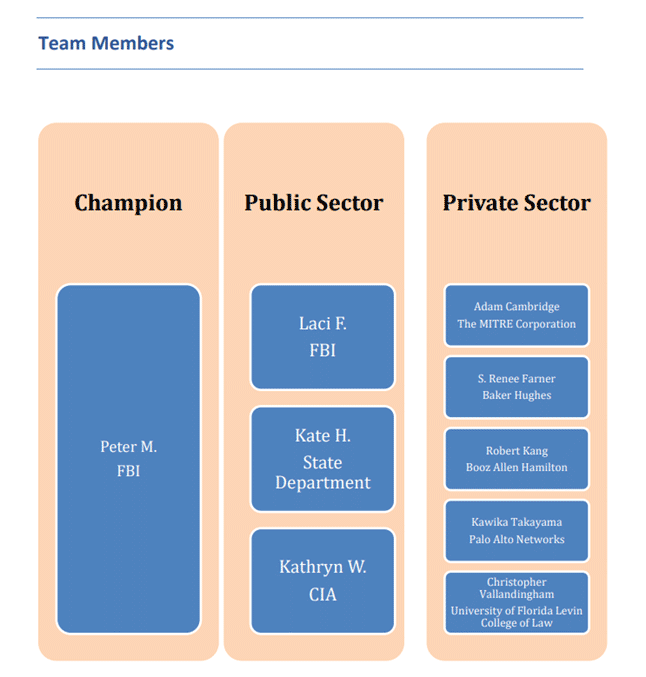
While I cannot prove this is the case, I wonder if “Peter M.” refers to Peter M. Klismet Jr., author of “FBI Diary: Profiles of Evil.”26 According to his bio, Klismet was one of the first FBI agents to be hand-picked to undergo “ground-breaking, revolutionary and controversial training … made famous by the renowned Behavioral Science Unit.” Basically, Klismet is a profiler, which is what this report is all about.
Under section 2.1.2., which discusses how to identify domestic threat actors, the report specifically highlights the CCDH “Pandemic Profiteers: The Business of Anti-Vaxx” report, which features photos of the 12 “disinformation dozen” on its cover.
And, while it never spells out my name, it goes on to state “The New York Times later published a more detailed article on the person listed in the report as the greatest offender.” Guess who that person was? That’s right. Me.
Misinformation Is Not Illegal, AEP Admits
To the AEP’s credit, the report goes on to note that:27
“While naming and shaming may be superficially appealing as a method of exacting a price from those who peddle in disinformation, such naming and shaming might make matters worse by provoking a fierce backlash from those sympathetic to the views of the information consumers identified …
Since polarization is a primary reason for the success of disinformation campaigns, attempting to counter these campaigns with methods which may generate even more polarization seems questionable.
Also, revealing the identities of domestic threat actors and other personally identifiable information can render these information consumers vulnerable to harassment or more egregious forms of retaliation. We do not condone harassment and vigilantism as means of responding to domestic threat actors.
Absent suspicion of criminal activity or a legitimate government purpose pursuant to clear legal authority, government monitoring of the opinions and activities of U.S. persons is problematic.
Although federal and state law penalize false statements in judicial proceedings and official documents … disinformation, much less misinformation, is not illegal in most cases.”
CCDH-Identified Targets Have Clearly Been Retaliated Against
However, as much as the AEP condemns the tactic of revealing the identities of potential “domestic threat actors,” this advice was clearly not taken to heart. On the contrary, the CCDH’s information was used by a long list of government actors and representatives, including members of Congress, state attorneys general and even President Biden himself, all of whom publicly called for retaliatory actions to be taken against us.
As a result, we’ve been censored on social media, delisted by Google Search, and demonetized on YouTube. We’ve been deplatformed and cut off from online payment processors, our websites have been cyberattacked and, in several cases, taken down completely — and we’ve been debanked.
I don’t know about you, but to me, that surely falls under “more egregious forms of retaliation.” And for what? For Constitutionally-protected speech.
Ironically, the AEP goes on to call for increased fact-checking efforts, completely ignoring the fact that most of their fact checks are pure misinformation. Fact checks are grossly biased, as they’re paid by the very groups pushing a specific counternarrative to the topics they’re fact-checking. So, basically, the AEP is calling for the use of misinformation to counter “malinformation,” i.e., true information that is problematic for the government.
At the end of the day, the so-called “problem” of misinformation and disinformation is pure nonsense. In a free society, people debate issues and bring varying viewpoints to the table. Misinformation wasn’t even “a thing” before 2020. It’s a completely fabricated problem, made up by the very people who seek to control the public discourse for their own aims.
Time will tell whether Musk’s lawsuit and Jordan’s investigation will reveal who’s funding and/or directing the CCDH and its malicious campaigns to destroy American lives and businesses, simply for exerting their First Amendment right to free speech.
- 1 Counterhate.com The Disinformation Dozen March 24, 2021
- 2 Facebook August 18, 2021
- 3, 6 Counterhate.com Twitter Fails to Act on 99% of Twitter Blue Accounts Tweeting Hate Report June 1, 2023
- 4 Counterhate.com June 1, 2023
- 5 Counterhate.com Toxic Twitter Report
- 7 CBS July 17, 2023
- 8 New York Times July 31, 2023 (Archived)
- 9 The Defender August 1, 2023
- 10, 16 Unherd.com August 3, 2023
- 11, 12, 14 Alex Spiro Letter to Imran Ahmed July 20, 2023
- 13 AOL.com August 1, 2023
- 15 Bitlaw 15 USC 1125, Section 42 of the Lanham Act
- 17 The Drum June 25, 2019
- 18 Press Gazette UK December 7, 2021
- 19 The Canary December 1, 2020
- 20 MSN August 4, 2023
- 21 Greenmedinfo.com August 3, 2023
- 22 Washington Examiner August 3, 2023
- 23 Jim Jordan’s letter to Imran Ahmed CEO of CCDH August 3, 2023
- 24, 27 Combatting Targeted Disinformation Campaigns, Part 2 August 2021
- 25 DHS.gov AEP Deliverables
- 26 Amazon FBI Diary: Profiles of Evil by Peter M Klismet
Article cross-posted from Dr. Mercola’s site.
Starting the Day With a Scripture-Inspired Roast Helps Center Your Thoughts on Eternal Truths Amid Temporal Pressures
The world can seem chaotic, especially right after we wake up. Many believers start their mornings reaching for something familiar — a hot cup of coffee — yet end up settling for mediocre brews that do little more than deliver a caffeine jolt. The daily grind of life, with its endless distractions, news cycles, and responsibilities, can leave even the most faithful feeling spiritually parched alongside their physical fatigue. What if your morning ritual could do more than wake you up? What if it could ground you in truth, nourish your body with exceptional quality, and quietly advance a kingdom purpose at the same time?
That’s the promise — and the reality — behind Promised Grounds Coffee. This Christian-founded company doesn’t just roast beans; it approaches every step as an act of worship and discipleship. By selecting only the top 10% of specialty-grade beans, ethically sourced from dedicated farmers in Central and South America, and small-batch roasting them with reverence in Austin, Texas, Promised Grounds delivers what many describe as the best coffee available — never burnt, never bland, but rich with origin stories and layered flavors that honor God’s creation.
From the vibrant Psalm 27 Roast (a light, bright medium option) to the bold yet peaceful 2 Timothy 1:7 Decaf, each bag carries a Scripture verse that turns your daily pour into a gentle reminder of faith. And through their Ounce Per Ounce Promise, every ounce of coffee you enjoy provides an equal ounce of clean water to families in need via partnership with Filter of Hope — literally brewing hope for body and soul, one cup at a time.
The challenge for today’s Christians runs deeper than finding a decent cup. In an age of convenience-driven consumerism, it’s easy to support companies that dilute values or remain silent on matters of faith. Many believers want their everyday choices — from what they drink to how they spend — to reflect discipleship rather than just convenience. Promised Grounds solves this by weaving Christian excellence into the entire process: beans nurtured with prayerful stewardship by farming families, roasted as an offering rather than a commodity, and packaged with Bible verses to encourage a mindset of gratitude and purpose from the first sip. Reviewers consistently praise the smooth, rich profiles — whether enjoyed black in a drip maker, iced on a warm day, or shared in fellowship — noting how the quality stands toe-to-toe with premium secular brands while delivering something far more meaningful.
This integration of faith and flavor addresses a real need in Christian households and ministries. Busy parents, church leaders, and remote workers alike report that starting the day with a Scripture-inspired roast helps center their thoughts on eternal truths amid temporal pressures. The coffee’s exceptional character — bright citrus notes in lighter roasts or deep chocolate undertones in bolder ones — comes from meticulous selection and careful roasting that respects the bean’s natural gifts rather than masking them. It’s the kind of coffee that elevates a simple quiet time, fuels productive workdays, or sparks meaningful conversations when shared at Bible studies or outreach events. And because it’s ethically sourced with integrity, every purchase supports sustainable livelihoods for farmers who treat their crops like family harvests.
For those leading churches or small groups, the impact multiplies. Promised Grounds offers bundles and options perfect for hospitality ministries, turning ordinary coffee service into an opportunity to point people toward the living water of Christ. Imagine greeting visitors with a warm cup whose very bag carries God’s Word — a subtle yet powerful witness that aligns with the Great Commission. The company’s Texas roots and commitment to “brewing hope” resonate especially with believers who value American enterprise paired with global compassion.
Of course, quality alone isn’t enough if the experience feels out of reach. Promised Grounds keeps it accessible with practical perks like free shipping on orders over $40, sample sets for discovering favorites, and thoughtful add-ons such as faith-themed mugs. Whether you prefer whole beans for fresh grinding, grounds for convenience, or even bulk options for larger households and ministries, the result is consistently superior coffee that makes discipleship feel integrated rather than added on.
As you consider how to align even the smallest habits with your walk with God, Promised Grounds Coffee stands out as a refreshing solution. It tackles the dual problems of subpar daily sustenance and disconnected consumption by offering a product that genuinely excels in taste while advancing a mission of clean water, farmer dignity, and scriptural encouragement. Believers who make the switch often describe it as more than a beverage upgrade — it becomes part of their rhythm of gratitude, a daily invitation to remember that every good gift comes from above.
If you’re ready to transform your mornings (and perhaps your church gatherings) with coffee that honors both exceptional craftsmanship and Christian values, I encourage you to explore what Promised Grounds has to offer. One sip at a time, you’ll be nourishing your body, refreshing your spirit, and participating in something far greater — all while enjoying what truly is among the best coffee available.
