

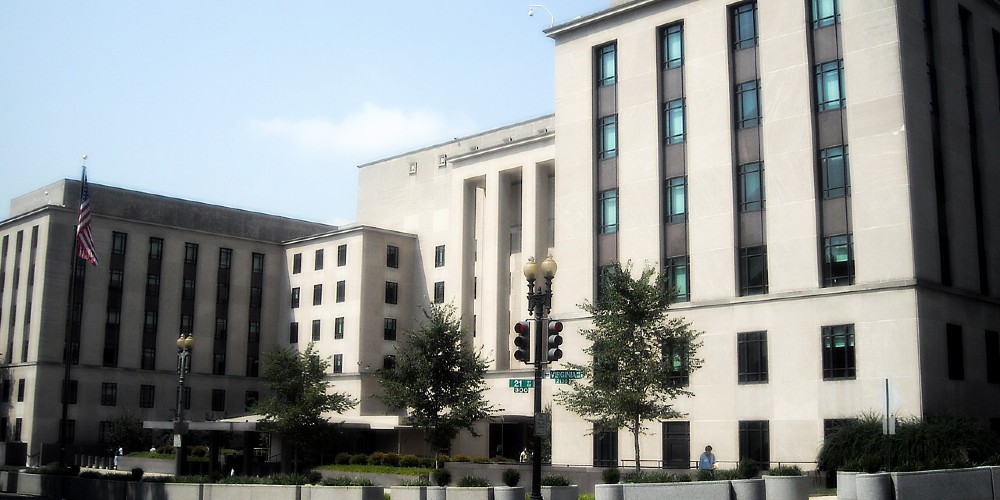
DEI (which stands for diversity, equity, and inclusion to its proponents and discrimination, exclusion, and intolerance to some of its critics) is now spreading to the U.S. State Department. Actually, it’s something of a surprise, given how obsessively identity conscious the Biden administration is, that this initiative didn’t occur earlier. Was that an oversight?
Or perhaps those already working in the State Department prided themselves on how ultracompetitive it is to win a job as a foreign service officer (FSO)—securing such a position is something of an elite accomplishment—and therefore perhaps they tried behind the scenes to preserve State’s long-established meritocratic character.

Be that as it may, Ambassador Gina Abercrombie-Winstanley, who has served as State’s diversity and inclusion officer since April 2021 (and who plans to step aside soon), defended the department’s push for more DEI in the coming months and years in congressional hearings last week. Among other details, Abercrombie-Winstanley noted that more than 80 percent of the State Department’s diplomatic corps currently is white, implying that that percentage may be too high from a DEI perspective.
The common political slogan used to sell DEI initiatives to the public is that its proponents want such-and-such a workforce to “look more like our country as a whole.” On a superficial level, that slogan may seem innocuous and unobjectionable, but on closer examination, it’s problematic. If looks make the difference between an employee doing a good job or a not-so-good job, then looks would be an important factor in hiring. In reality, however, looks by themselves don’t cut it.
As is always the case with DEI, it introduces a battle of the Q’s—quotas on one hand versus qualifications and qualities on the other. Imagine a volatile political situation in a South American country. The American president wants to pursue a policy of maintaining contacts with various political figures and parties in that country without offending any of those parties since they don’t trust each other. That can require very delicate diplomacy. Do you think the Secretary of State or one of his top deputies would say, “Wait a minute, it’s about time we put a black gay person out there to speak on behalf of our country”? Don’t you think it would be better to deploy a FSO who understands the history, economics, culture, tradition, and language(s) of that country—one with a deep feel for personal sensitivities in that country, and someone who has the moxie and wisdom to accurately communicate our government’s intentions while not committing any potentially disruptive verbal faux pas? We certainly don’t want to risk triggering an international incident just so someone can say domestically, “Well, at least our State Department matches the demographic profile of American society.”
What concerns me most about what looks like the Biden administration’s push for more blacks and fewer whites in the State Department is that the president’s proposed budget calls for $76 million to be spent by the State Department in the next year on DEI initiatives. $76 million?! I realize that amount is probably considered pocket change in today’s Washington, but you could hire 500 people to work in DEI at State for $150,000 in annual salary and still have change left over.
Abercrombie-Winstanley says that State wants to be able to provide a precise breakdown of the composition of its workforce by race, gender, ethnicity, status of disability, etc. Pardon me, but why would State need millions of dollars to do this when computers can keep track of each employee’s identity and print out updated profiles of the entire workforce as often as wanted?
Or maybe the plan for the $76 million is to “beat the bushes” and see how many more of various minorities State can drum up through various recruitment and advertising activities. This is the approach that some colleges have taken. They hire a DEI officer whose job amounts to scouring the countryside to locate members of the desired minority group. Then they convince them to enroll in the DEI officer’s college. (Alas, in the college town where I lived for years—not in Grove City, where I taught —the students that were recruited by DEI turned out to be a disaster for the college. They just weren’t able to handle the coursework.)
The question that State will inevitably have to deal with, whether they like it or not, will be whether the people they’re looking for even exist—that is, whether sufficient numbers of members of various minority groups have the professional expertise and personal qualities needed to handle the formidable challenges of a FSO.
Certainly, in this day of Zoom conferences and instant communications, State can find inexpensive ways to send recruiting materials to every college in the land without coming close to spending $76 million. If they want to try to find more qualified minorities, fine, but throwing a lot of money at the problem seems gratuitous.
One problem with the DEI movement is that they’re looking for a quick fix to a longstanding problem. It is true that certain minorities seem underrepresented in important places like the State Department. But what if the desired numbers of truly qualified minorities just aren’t there? We, as a society, need to address the root causes of underqualified minorities. My nominee for first among those root causes is the sorry state of public education in so many of our inner cities. I say that as one who did some teaching in urban schools decades ago, both visiting a number of schools in a substitute capacity and then teaching and counseling at a special inner-city school for dropouts. Frankly, by the time students left those broken schools (finally escaping from them), they were doomed never to acquire the intellectual skills needed for a demanding job like FSO.
If the Biden administration wants to start expanding opportunities for minorities, it should turn its attention to improving education. That means somehow breaking away from its codependence on teachers’ unions and making school choice universal. Fix the schools, and over the next generation, many of the undesirable racial and other disparities in the adult job market will show marked improvement.
Article cross-posted from our premium news partners at The Epoch Times. Image by AgnosticPreachersKid, CC BY-SA 3.0, via Wikimedia Commons.

Two Storms, One Harvest

Every food crisis in living memory has been a one-shock event. The 2008 price spike was a commodity bubble. The 2020 shortages were a logistics failure. The 2022 grain scare was a war on one exporter’s ports. Each time, the system bent, adjusted, and recovered, and each time the experts assured us afterward that global markets are simply too big and too diversified to fail.
What nobody in Washington seems eager to discuss is that 2026 is shaping up to be something the modern food system has never actually faced. Two independent shocks, one climatic and one geopolitical, are converging on the same harvest cycle at the same time. Not sequentially. Simultaneously.
Start with the weather. The Pacific Ocean is currently building toward what forecasters now openly call a record event. NOAA’s Climate Prediction Center puts the odds of at least a strong El Niño near 88 percent, with roughly two in three odds it reaches “very strong” status, the tier reserved for perhaps three or four events in the entire satellite era. Every major global model now projects a median peak in Super El Niño territory, and most of them project it exceeding the 2015-16 event, which until now held the modern record. Sea surface anomalies were already brushing the super threshold in mid-July, months before these events normally peak. The atmosphere has already shifted into El Niño mode, and the event is forecast to crest in late fall and early winter.
This is not about “climate change.” It’s about the standard cycles of weather, and the cycle we’re currently in is one that has likely devastated societies in the past. We’re better prepared as a society today, but not all Americans are equally prepared.
Serious households have started doing the quiet math on their own. Grocery bills tell part of the story, and the forecast maps tell the rest, which is why long-term food storage has moved from fringe hobby to mainstream line item in the family budget, with established suppliers like Heaven’s Harvest seeing demand from people who five years ago would have rolled their eyes at the idea. That instinct is not paranoia. It is pattern recognition, and the pattern is worth walking through carefully.
Editor’s Note: Heaven’s Harvest IS a sponsor, but the warnings of this article are real and would be written even if we didn’t have a survival food sponsor. With that said, those who take advantage of what they offer can use promo code “Patriot” for 15% off.
The Fertilizer Clock Is Already Running
While the Pacific warms, the second shock has been unfolding in the Strait of Hormuz. The conflict with Iran turned the world’s most important energy chokepoint into a contested waterway, and the consequences reach far beyond the gas pump. Roughly a third of global fertilizer trade moves through Hormuz, and the disruption sent urea prices up 86 percent year over year by March, with a 53 percent jump in a single month.
The World Bank projects energy prices rising about 24 percent in 2026 and fertilizer about 31 percent. By its own accounting, fertilizer prices ran 35 percent higher in the first five months of this year than the same period last year.
Here is the mechanism the nightly news will not explain. Fertilizer is not a grocery item. It is a time-delayed input. The nitrogen a farmer in Iowa or Punjab could not afford to apply this spring does not show up as a problem this spring. It shows up as a thinner harvest six to twelve months later.
The World Bank’s own food security brief concedes that the effects of reduced applications earlier this season “are likely to become visible only later in harvest outcomes.” Translate that from institutional language into plain English and it means this. The damage is already done, it is already in the ground, and we are simply waiting for it to arrive on the shelf.
Now check the calendar. Six to twelve months from the spring planting season lands us squarely in late 2026 and early 2027. Which is precisely when the strongest El Niño in the instrumental record is forecast to peak, bringing its signature droughts to Southeast Asia, Australia, southern Africa, northern Brazil, and South Asia, the very regions that grow the world’s rice, sugar, and oilseeds.
The World Bank warns openly that a strong El Niño “could disrupt multiple crop belts simultaneously” on top of the conflict-driven input costs. Their baseline projection assumes the Middle East disruptions ease by autumn. What in the last two years of Middle East history suggests that assumption is safe?
The System Has No Slack Left
The comfortable answer is that global markets always adjust. But adjustment requires slack, and the slack is gone. Global cereal production is expected to decline from last year’s records even before El Niño does its work. The UN World Food Programme, hardly a den of right-wing preppers, is calling this the most significant disruption to its supply chains since Covid and the invasion of Ukraine, and its supply chain director put the stakes bluntly.
Today’s supply chain challenges are tomorrow’s hunger crisis.
There is also a political dimension that markets cannot price. When food gets scarce, governments do not behave like economists. They behave like politicians. Export bans, hoarding mandates, and panic buying at the national level turned the modest rice shortfall of 2008 into a global crisis, and analysts are already warning that import-dependent nations are the first dominoes.
The 2015-16 Super El Niño, a far weaker event than what is now forecast, threw tens of millions into food stress across Africa and Asia. This one is projected to be stronger, and it arrives with fertilizer already rationed by price and shipping lanes already contested by missiles.
What Joseph Knew
Scripture does not treat preparation for lean years as faithlessness. It treats it as wisdom delivered in advance to those willing to act on it.
Behold, there come seven years of great plenty throughout all the land of Egypt: And there shall arise after them seven years of famine; and all the plenty shall be forgotten in the land of Egypt.
Joseph did not respond to that warning with a hashtag or a committee. He stored grain during the years of abundance, and when the famine came, Egypt stood while its neighbors begged. The lesson is not that famine is certain. It is that the time to prepare is precisely when preparation still looks optional.
Nobody who filled a pantry in a year of plenty has ever regretted it, and nobody standing in an empty aisle has ever been glad he waited for certainty.
None of this calls for panic, and panic is the enemy of sound judgment anyway. It calls for the same unglamorous prudence our grandparents considered ordinary. Keep some cash margin, know your local growers, and put real food in deep storage while it is cheap and available, because the entire arc of this story is that cheap and available is a closing window.
Families looking for a straightforward place to start can visit Heaven’s Harvest and use promo code Patriot for 15 percent off long-term storable food. The forecasts may yet soften, the strait may yet reopen, and we should pray they do. But hope is a fine thing to hold and a foolish thing to eat.


How this article is both written and presented is most tragic!
“One problem with the DEI movement is that they’re looking for a quick fix . . .”
First, it is NOT a movement but an organized assault on North America, a subset of the Identity Politics Strategy, but most importantly: communist political minder systems!?
Why oh why does this article’s author, and far too many others, NOT comprehend this?!?!
THIS has zero to do with affirmative action or minority representation of any kind: the DEI systems — or political minder systems —- were first overtly implemented in the DoD/Pentagon by SecDef MARK ESPER, in the Trump Administration! (Trump momentarily retracted his head from his buttocks and finally fired globalist/WEFer Esper —- Atlantic Council, Aspen Strategy Group, etc.!)
This is ALL part of the Great Reset structured plan — none of this pertains to “movements” or spontaneous events, all extrmely well funded and highly efficiently organized, yet the author of this piece is still hopelessly CLUELESS —- and he is not alone in that regard!
“We, as a society, need to address the root causes of underqualified minorities.”
The globalists or commies present a false narrative (as usual) and Mark Hendrickson addresses their false narrative as if ALL their points were valid and honestly presented —- no wonder DEI systems are now in place across North America!
I am truly sorry to see this appear in The Epoch Times — a newspaper I have both long subscribed to and donated to as well!?
[SIDEBAR: A few years back, around 2018 in Washington state, a Referendum 1000 was placed on the ballot which its supporters CLAIMED pertained to “Affirmative Action” yet the verbiage in it seemed to only concern itself with crony hiring?! Thankfully, it was voted down and many of us assumed, wrongly, it was ONLY about corrupt crony political hiring but it turned out it was a strategem to insert specially selected teachers in the public school systems to promote Maoist thought, transgender ideology and adult sex education down to the Kindergarten and pre—K levels!
TPTB were later successful in the 2020 election, passing the Comprensive Sex Education Program, while the governor, Xi Inslee, signed legislation dramatically lowering the standards for public school teachers so the “right people” could be hired to promote this vile stuff —- and that referendum was promoted by the Gates Foundation–funded Advocates For Youth, originally founded by the Rockefeller Foundation in 1980 and called the Center for Population Options, since rebranded! THEY are weasel cunning on many levels and never give up —- clueless types who take them at their word are the reason we are losing!]
“We, as a society, need to address the root causes of underqualified minorities.”
Dude, are YOU stuck in a time warp?! We are not a society, we are under communist rule!
This nation has experienced exponential increases in the offshoring of American jobs, the insourcing of foreign visa replacement workers and millions of illegals — while so–called teachers routinely teach ILLITERACY via the “Whole Language Program”!
You sound like a “Leave It To Beaver” episode —- that was long ago.
I read tons of DEI articles per week and this has got to be the most ignorant and uninformed one yet —- please do research communism and communist systems sometime!?