

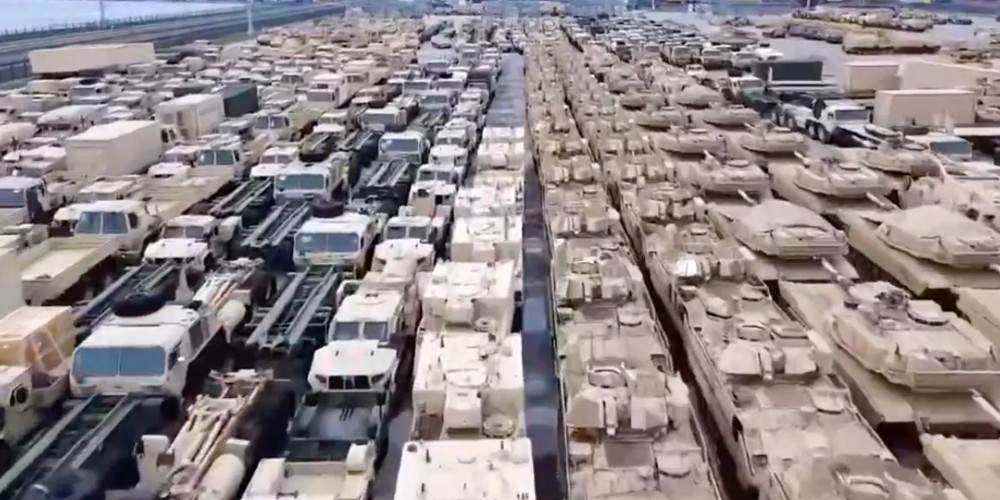
Footage featuring a large amount of American military equipment was captured at a port in Poland, stoking fears that these could be deployed in Ukraine.
The video clip – which had also been shared by a Latvian news outlet – featured an array of tanks, armored personnel carriers (APCs) and military trucks at the northern Polish port of Gdynia. According to the Latvian outlet, the military vehicles belonged to the U.S. Army’s 3rd Armored Brigade Combat Team. The said vehicles were at the port “in preparation for redeployment to the continental U.S.” after serving in Operation Atlantic Resolve” on Feb. 22.
Operation Atlantic Resolve, which has been carried out by Washington since 2014, seeks to bolster American presence in Europe. About 700 combat vehicles, including M1 Abrams tanks – the U.S.’ main battle tank – were deployed to Poland in December 2022.
Neither the White House nor the U.S. Department of Defense has commented on the footage. However, some media outlets from Poland and Ukraine insinuated that these military vehicles could be redeployed – this time in the Ukrainian war zone.
In January of this year, the U.S. said it would send 31 M1 Abrams tanks and eight M88 recovery vehicles to Ukraine. However, it noted that the delivery of these 39 military vehicles would take considerable time. Poland and Germany also pledged to provide a number of Leopard 2 tanks to Ukraine.
Since the Russia-Ukraine war broke out in February 2022, the U.S. and its allies have been providing Kyiv with various types of military aid. These include air defense missiles, multiple-launch rocket systems, tanks, self-propelled artillery and anti-aircraft guns.
Austria, Hungary: NO WEAPONS for Kyiv
While the U.S. continues to send military aid to Kyiv at the expense of its own national security, Austria and Hungary went against the grain and agreed not to send any weapons to Ukraine.
Austrian Defense Minister Klaudia Tanner and Hungarian Defense Minister Kristof Szalay-Bobrovniczky inked the agreement during a Jan. 30 meeting in the Hungarian capital Budapest. The defense ministers reiterated their “clear” position against providing Ukraine with war materiel “to prevent a further escalation.”
“We live in a time of danger,” Szalay-Bobrovniczky remarked. “Continuing that close cooperation is of utter importance.” The Hungarian defense minister added that his country would only supply humanitarian aid to Ukrainian refugees, reiterating that Budapest and Vienna would be on the side of peace.
Meanwhile, Tanner warned that the greatest danger is the war – which now involves hybrid warfare – could spread to the rest of Europe. “The effects are not only enormously felt in Austria, but also in Hungary. Eventually, the routes run through our neighboring country to us,” the Austrian defense minister said. (Related: Austria, Hungary agree NOT to send any weapons to Ukraine (perhaps they wish to avoid being destroyed by Russia.))
Over in Russia, Moscow has repeatedly warned the West that it is prolonging the Russia-Ukraine war by sending weapons and military vehicles to Kyiv. Russian Foreign Minister Sergey Lavrov stressed that Western countries are directly involved in the war through their continued assistance to Ukraine.
Lavrov’s office, the Russian Ministry of Foreign Affairs, underscored that countries part of the North Atlantic Treaty Organization “play with fire” by supplying weapons to Kyiv. It also emphasized that any convoy of arms for Ukraine will become a legitimate target for Russian forces.
Head over to MilitaryTechnology.news for more stories about military aid to Ukraine.
Watch this video about Ukraine’s European allies scrambling to find tanks for the besieged country.

This video is from The Prisoner channel on Brighteon.com.
More related stories:
- Europol fears that weapons sent to Ukraine will end up in the hands of criminals.
- Ukraine aid scam: Only 30% of weapons shipped to besieged country have made it to the front lines.
- U.S. tells Ukraine it cannot provide strategic missiles because American forces simply don’t have enough.
- Where are the tens of billions being spent in Ukraine really going? Analysis dares to ask the tough questions.
- Outdated weaponry sent by US to Ukraine prone to breaking down quickly and will be difficult to repair, expert fears.
Sources include:

Two Storms, One Harvest

Every food crisis in living memory has been a one-shock event. The 2008 price spike was a commodity bubble. The 2020 shortages were a logistics failure. The 2022 grain scare was a war on one exporter’s ports. Each time, the system bent, adjusted, and recovered, and each time the experts assured us afterward that global markets are simply too big and too diversified to fail.
What nobody in Washington seems eager to discuss is that 2026 is shaping up to be something the modern food system has never actually faced. Two independent shocks, one climatic and one geopolitical, are converging on the same harvest cycle at the same time. Not sequentially. Simultaneously.
Start with the weather. The Pacific Ocean is currently building toward what forecasters now openly call a record event. NOAA’s Climate Prediction Center puts the odds of at least a strong El Niño near 88 percent, with roughly two in three odds it reaches “very strong” status, the tier reserved for perhaps three or four events in the entire satellite era. Every major global model now projects a median peak in Super El Niño territory, and most of them project it exceeding the 2015-16 event, which until now held the modern record. Sea surface anomalies were already brushing the super threshold in mid-July, months before these events normally peak. The atmosphere has already shifted into El Niño mode, and the event is forecast to crest in late fall and early winter.
This is not about “climate change.” It’s about the standard cycles of weather, and the cycle we’re currently in is one that has likely devastated societies in the past. We’re better prepared as a society today, but not all Americans are equally prepared.
Serious households have started doing the quiet math on their own. Grocery bills tell part of the story, and the forecast maps tell the rest, which is why long-term food storage has moved from fringe hobby to mainstream line item in the family budget, with established suppliers like Heaven’s Harvest seeing demand from people who five years ago would have rolled their eyes at the idea. That instinct is not paranoia. It is pattern recognition, and the pattern is worth walking through carefully.
Editor’s Note: Heaven’s Harvest IS a sponsor, but the warnings of this article are real and would be written even if we didn’t have a survival food sponsor. With that said, those who take advantage of what they offer can use promo code “Patriot” for 15% off.
The Fertilizer Clock Is Already Running
While the Pacific warms, the second shock has been unfolding in the Strait of Hormuz. The conflict with Iran turned the world’s most important energy chokepoint into a contested waterway, and the consequences reach far beyond the gas pump. Roughly a third of global fertilizer trade moves through Hormuz, and the disruption sent urea prices up 86 percent year over year by March, with a 53 percent jump in a single month.
The World Bank projects energy prices rising about 24 percent in 2026 and fertilizer about 31 percent. By its own accounting, fertilizer prices ran 35 percent higher in the first five months of this year than the same period last year.
Here is the mechanism the nightly news will not explain. Fertilizer is not a grocery item. It is a time-delayed input. The nitrogen a farmer in Iowa or Punjab could not afford to apply this spring does not show up as a problem this spring. It shows up as a thinner harvest six to twelve months later.
The World Bank’s own food security brief concedes that the effects of reduced applications earlier this season “are likely to become visible only later in harvest outcomes.” Translate that from institutional language into plain English and it means this. The damage is already done, it is already in the ground, and we are simply waiting for it to arrive on the shelf.
Now check the calendar. Six to twelve months from the spring planting season lands us squarely in late 2026 and early 2027. Which is precisely when the strongest El Niño in the instrumental record is forecast to peak, bringing its signature droughts to Southeast Asia, Australia, southern Africa, northern Brazil, and South Asia, the very regions that grow the world’s rice, sugar, and oilseeds.
The World Bank warns openly that a strong El Niño “could disrupt multiple crop belts simultaneously” on top of the conflict-driven input costs. Their baseline projection assumes the Middle East disruptions ease by autumn. What in the last two years of Middle East history suggests that assumption is safe?
The System Has No Slack Left
The comfortable answer is that global markets always adjust. But adjustment requires slack, and the slack is gone. Global cereal production is expected to decline from last year’s records even before El Niño does its work. The UN World Food Programme, hardly a den of right-wing preppers, is calling this the most significant disruption to its supply chains since Covid and the invasion of Ukraine, and its supply chain director put the stakes bluntly.
Today’s supply chain challenges are tomorrow’s hunger crisis.
There is also a political dimension that markets cannot price. When food gets scarce, governments do not behave like economists. They behave like politicians. Export bans, hoarding mandates, and panic buying at the national level turned the modest rice shortfall of 2008 into a global crisis, and analysts are already warning that import-dependent nations are the first dominoes.
The 2015-16 Super El Niño, a far weaker event than what is now forecast, threw tens of millions into food stress across Africa and Asia. This one is projected to be stronger, and it arrives with fertilizer already rationed by price and shipping lanes already contested by missiles.
What Joseph Knew
Scripture does not treat preparation for lean years as faithlessness. It treats it as wisdom delivered in advance to those willing to act on it.
Behold, there come seven years of great plenty throughout all the land of Egypt: And there shall arise after them seven years of famine; and all the plenty shall be forgotten in the land of Egypt.
Joseph did not respond to that warning with a hashtag or a committee. He stored grain during the years of abundance, and when the famine came, Egypt stood while its neighbors begged. The lesson is not that famine is certain. It is that the time to prepare is precisely when preparation still looks optional.
Nobody who filled a pantry in a year of plenty has ever regretted it, and nobody standing in an empty aisle has ever been glad he waited for certainty.
None of this calls for panic, and panic is the enemy of sound judgment anyway. It calls for the same unglamorous prudence our grandparents considered ordinary. Keep some cash margin, know your local growers, and put real food in deep storage while it is cheap and available, because the entire arc of this story is that cheap and available is a closing window.
Families looking for a straightforward place to start can visit Heaven’s Harvest and use promo code Patriot for 15 percent off long-term storable food. The forecasts may yet soften, the strait may yet reopen, and we should pray they do. But hope is a fine thing to hold and a foolish thing to eat.

You can’t trust a single word that comes out of the Obamunists of the Biden administration.
This makes me ask the question, If we can sip all these vehicles and weapons across an ocean and back, for an exercise, Why did the government leave all those weapons in Afghanistan?
Would be a shame if these boats sank with all those war tools on board. Kind of stupid having all their eggs in one basket
It looks to me like the Biden Is clearing the way for Russia to take over more countries ahead of Europe.
We aren’t going to send Ukraine our latest M-1 Abrams and allow that technology to fall into enemy hands. Iran is already reverse engineering other US high tech weapons that were sent to Ukraine only to find their way to Iran via Russia.
See military vehicles convoying on my local freeways everyday. Those in the pictures do not look like US military vehicle.
The essential act of war is destruction, not necessarily of human lives, but of the products of human labour. War is a way of shattering to pieces, or pouring into the stratosphere, or sinking in the depths of the sea, materials which might otherwise be used to make the masses too comfortable, and hence, in the long run, too intelligent. Even when weapons of war are not actually destroyed, their manufacture is still a convenient way of expending labour power without producing anything that can be consumed. A Floating Fortress, for example, has locked up in it the labour that would build several hundred cargo-ships. Ultimately it is scrapped as obsolete, never having brought any material benefit to anybody, and with further enormous labours another Floating Fortress is built. In principle the war effort is always so planned as to eat up any surplus that might exist after meeting the bare needs of the population. In practice the needs of the population are always underestimated, with the result that there is a chronic shortage of half the necessities of life; but this is looked on as an advantage. It is deliberate policy to keep even the favoured groups somewhere near the brink of hardship, because a general state of scarcity increases the importance of small privileges and thus magnifies the distinction between one group and another. By the standards of the early twentieth century, even a member of the Inner Party lives an austere, laborious kind of life. Nevertheless, the few luxuries that he does enjoy his large, well-appointed flat, the better texture of his clothes, the better quality of his food and drink and tobacco, his two or three servants, his private motor-car or helicopter — set him in a different world from a member of the Outer Party, and the members of the Outer Party have a similar advantage in comparison with the submerged masses whom we call ‘the proles’. The social atmosphere is that of a besieged city, where the possession of a lump of horseflesh makes the difference between wealth and poverty. And at the same time the consciousness of being at war, and therefore in danger, makes the handing-over of all power to a small caste seem the natural, unavoidable condition of survival.
War, it will be seen, accomplishes the necessary destruction, but accomplishes it in a psychologically acceptable way. In principle it would be quite simple to waste the surplus labour of the world by building temples and pyramids, by digging holes and filling them up again, or even by producing vast quantities of goods and then setting fire to them. But this would provide only the economic and not the emotional basis for a hierarchical society. What is concerned here is not the morale of masses, whose attitude is unimportant so long as they are kept steadily at work, but the morale of the Party itself. Even the humblest Party member is expected to be competent, industrious, and even intelligent within narrow limits, but it is also necessary that he should be a credulous and ignorant fanatic whose prevailing moods are fear, hatred, adulation, and orgiastic triumph. In other words it is necessary that he should have the mentality appropriate to a state of war. It does not matter whether the war is actually happening, and, since no decisive victory is possible, it does not matter whether the war is going well or badly. All that is needed is that a state of war should exist.
Thos article states that the war between Russia and Ukraine started in 2022. Thos is a blatant lie. The war started in 2014!