

With so much darkness around us today, it is easy to lose hope and faith. To be sure, those who wish us ill take pleasure from our pain. However, it is often when we are nearly broken that God lifts us up and provides us peace. This time of year is filled with those moments. Call them Christmas miracles or answered prayers, but they are real and worth remembering.
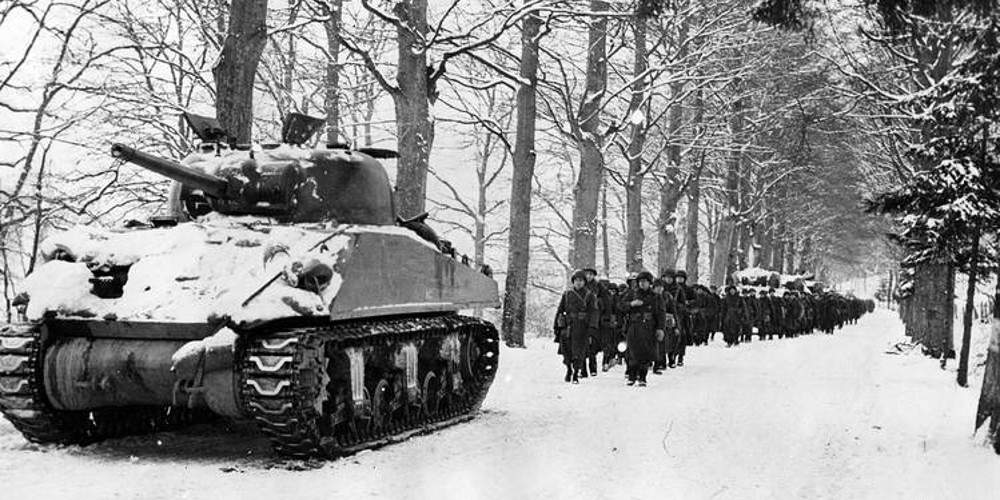
One such story that has always stuck with me is that of Fritz Vincken, who was twelve years old and living with his mother, Elisabeth, in a small hunting cabin in the Ardennes Forest during the worst fighting of the Battle of the Bulge. His father had hidden them in the secluded mountain hut across the Belgian border after the family’s bakery and home were destroyed during allied bombing in Aachen, Germany. While Fritz’s dad baked bread for German soldiers at the front line, Fritz and his mother had little food, except for what they could forage.
On a freezing Christmas Eve night, as they struggled to ignore distant gunfire and prepared a meager meal made from a scrawny rooster and some potatoes, there was a loud knock on the door. Fritz’s heart leapt, believing that it was his father finally returning. Instead, it was three Americans from the 121st Infantry, 8th Division — all suffering from frostbite and one seriously injured.
“My mother knew the penalty for harboring the enemy,” Fritz recalled, “but when she looked into the young Americans’ eyes and saw that one was badly hurt, she opened the door and let them in.” They added some potatoes to the stew for their tired, hungry guests and attended to the American’s gunshot wound the best they could, and because the soldiers spoke no German and the Vinckens spoke no English, they relied on hand signals and broken French for communication.
Then came more pounding from outside. When Elisabeth cautiously opened the hut’s door, she found four freezing Wehrmacht soldiers looking for shelter. “I was almost paralyzed with fear,” Fritz recounted, “for though I was a child, I knew that harsh law of war: Anyone giving aid and comfort to the enemy would be shot.” Had any other person opened the door on that frigid Christmas Eve night in 1944, the killing fields of the Ardennes would almost certainly have claimed more victims.
Instead, Elisabeth took control of the situation, wishing the young Germans a “Fröhliche Weihnachten” and inviting them in for food and rest upon two conditions: (1) that they leave their weapons outside and (2) respect her Christmas guests. “She reminded them that it was Christmas Eve and told them sternly there would be no shooting around here.” While Fritz “stood and stared in disbelief,” the Wehrmacht soldiers complied. She then ran back to the Americans; who had grown nervous, spoke gently in a language they could not understand; and grabbed their weapons, too.
At first the tiny cabin was uncomfortably tense. Then one of the Germans, who had been a medical student, offered to assist the wounded American, noticeably weak from blood loss. The Americans pulled out some coffee grounds and cigarettes from a tattered pack, and one of the other Germans offered some scraps of bread. Fritz added what few ingredients they had to the stew, and his “mother read from the Bible and declared that there would be at least one night of peace in this war.”
“Komm, Herr Jesus,” she prayed, “and be our guest.” “There were tears in her eyes,” Fritz remembered, “and as I looked around the table, I saw that the battle-weary soldiers were filled with emotion.” After dinner the seven soldiers, who had been bitter enemies just hours before, fell into a deep sleep, side by side. When they woke the next morning, they exchanged Christmas greetings and set to work building a makeshift stretcher from tree branches for the wounded American. The Germans advised the Americans to avoid a town that had been taken over by Nazi forces and gave them a map and compass that would get them back to their friends. Elisabeth returned their weapons and prayed, “May God bless and watch over you.” Then the soldiers shook hands and went their separate ways.
For Fritz, his mother had been nothing short of a hero. “The inner strength of a single woman, who, by her wits and intuition, prevented potential bloodshed, taught me the practical meaning of the words: ‘Good Will Toward Mankind.'”
Fritz and his parents survived the war, and because the young boy saw those Americans in his shack as “liberators,” he eventually immigrated to the United States, became an American citizen, and opened up a German bakery of his own in Honolulu, Hawaii. After telling his story to his new countrymen for years, he eventually submitted details of the miraculous Christmas Eve during the Battle of the Bulge to Readers Digest, and a much larger audience learned of the rare peace shared for a few hours amid the cold, bloody landscape of the Ardennes. In retelling Fritz’s experience during a trip to Germany in 1985, President Reagan urged others to do the same, “because none of us can ever hear too much about building peace and reconciliation.”
Amazingly, after Unsolved Mysteries produced an episode in the mid-’90s seeking more details about the little known tale, Fritz eventually reunited with two of the American soldiers before they all passed away. They, too, had always told others of their miraculous Christmas Eve in the middle of battle and wondered what had happened to the boy alone with his mother in the woods. Sergeant Ralph Blank told Fritz, “Your mother saved my life,” and with that comfort, the young boy turned old man said, “Now I can die in peace. My mother’s courage won’t be forgotten, and it shows what good will will do.”
His mother, Elisabeth, often said over the years until her own passing that “God was at our table” during that freezing night in the forest. And Fritz said that the event so altered his understanding of life that he never stopped thinking of “those seven young soldiers, who met as enemies and parted as friends, right in the middle of the Battle of the Bulge.”
Whenever I think of Fritz’s story, I am struck by a remarkable truth: it is always the smallest of acts that end up creating ripples large enough to produce meaningful change. At any point on that Christmas Eve in ’44 during some of the worst atrocities of the war, any one of those seven soldiers could have acted belligerently out of exhaustion, pain, or haste. A mother and her young son speaking unfamiliar words to foreign soldiers could have inadvertently provoked tragedy. A trio of Wehrmacht soldiers, irate at the sight of their enemies taking refuge far from home, could have chosen the same violence and bloodshed that soaked the earth beyond the cabin’s door.
Instead, an unarmed woman brought God into her house and invited those who might have done her harm to share the blessings of Jesus’s birth. Through her resolve and faith, she secured peace. That heroic act not only convinced combatant soldiers to lay down their weapons, but also inspired her son for the rest of his life. He then told of his mother’s courage to countless others who visited his bakery over the next half-century of his life, who, in turn, retold the story and its lesson to countless more. Even the president of the United States in the middle of the Cold War seized upon its importance and shared it with millions of strangers in a quest to transform former enemies into friends.

Faith and small acts of courage do change the world. That is what Christmas reminds us all.

Starting the Day With a Scripture-Inspired Roast Helps Center Your Thoughts on Eternal Truths Amid Temporal Pressures
The world can seem chaotic, especially right after we wake up. Many believers start their mornings reaching for something familiar — a hot cup of coffee — yet end up settling for mediocre brews that do little more than deliver a caffeine jolt. The daily grind of life, with its endless distractions, news cycles, and responsibilities, can leave even the most faithful feeling spiritually parched alongside their physical fatigue. What if your morning ritual could do more than wake you up? What if it could ground you in truth, nourish your body with exceptional quality, and quietly advance a kingdom purpose at the same time?
That’s the promise — and the reality — behind Promised Grounds Coffee. This Christian-founded company doesn’t just roast beans; it approaches every step as an act of worship and discipleship. By selecting only the top 10% of specialty-grade beans, ethically sourced from dedicated farmers in Central and South America, and small-batch roasting them with reverence in Austin, Texas, Promised Grounds delivers what many describe as the best coffee available — never burnt, never bland, but rich with origin stories and layered flavors that honor God’s creation.
From the vibrant Psalm 27 Roast (a light, bright medium option) to the bold yet peaceful 2 Timothy 1:7 Decaf, each bag carries a Scripture verse that turns your daily pour into a gentle reminder of faith. And through their Ounce Per Ounce Promise, every ounce of coffee you enjoy provides an equal ounce of clean water to families in need via partnership with Filter of Hope — literally brewing hope for body and soul, one cup at a time.
The challenge for today’s Christians runs deeper than finding a decent cup. In an age of convenience-driven consumerism, it’s easy to support companies that dilute values or remain silent on matters of faith. Many believers want their everyday choices — from what they drink to how they spend — to reflect discipleship rather than just convenience. Promised Grounds solves this by weaving Christian excellence into the entire process: beans nurtured with prayerful stewardship by farming families, roasted as an offering rather than a commodity, and packaged with Bible verses to encourage a mindset of gratitude and purpose from the first sip. Reviewers consistently praise the smooth, rich profiles — whether enjoyed black in a drip maker, iced on a warm day, or shared in fellowship — noting how the quality stands toe-to-toe with premium secular brands while delivering something far more meaningful.
This integration of faith and flavor addresses a real need in Christian households and ministries. Busy parents, church leaders, and remote workers alike report that starting the day with a Scripture-inspired roast helps center their thoughts on eternal truths amid temporal pressures. The coffee’s exceptional character — bright citrus notes in lighter roasts or deep chocolate undertones in bolder ones — comes from meticulous selection and careful roasting that respects the bean’s natural gifts rather than masking them. It’s the kind of coffee that elevates a simple quiet time, fuels productive workdays, or sparks meaningful conversations when shared at Bible studies or outreach events. And because it’s ethically sourced with integrity, every purchase supports sustainable livelihoods for farmers who treat their crops like family harvests.
For those leading churches or small groups, the impact multiplies. Promised Grounds offers bundles and options perfect for hospitality ministries, turning ordinary coffee service into an opportunity to point people toward the living water of Christ. Imagine greeting visitors with a warm cup whose very bag carries God’s Word — a subtle yet powerful witness that aligns with the Great Commission. The company’s Texas roots and commitment to “brewing hope” resonate especially with believers who value American enterprise paired with global compassion.
Of course, quality alone isn’t enough if the experience feels out of reach. Promised Grounds keeps it accessible with practical perks like free shipping on orders over $40, sample sets for discovering favorites, and thoughtful add-ons such as faith-themed mugs. Whether you prefer whole beans for fresh grinding, grounds for convenience, or even bulk options for larger households and ministries, the result is consistently superior coffee that makes discipleship feel integrated rather than added on.
As you consider how to align even the smallest habits with your walk with God, Promised Grounds Coffee stands out as a refreshing solution. It tackles the dual problems of subpar daily sustenance and disconnected consumption by offering a product that genuinely excels in taste while advancing a mission of clean water, farmer dignity, and scriptural encouragement. Believers who make the switch often describe it as more than a beverage upgrade — it becomes part of their rhythm of gratitude, a daily invitation to remember that every good gift comes from above.
If you’re ready to transform your mornings (and perhaps your church gatherings) with coffee that honors both exceptional craftsmanship and Christian values, I encourage you to explore what Promised Grounds has to offer. One sip at a time, you’ll be nourishing your body, refreshing your spirit, and participating in something far greater — all while enjoying what truly is among the best coffee available.
