

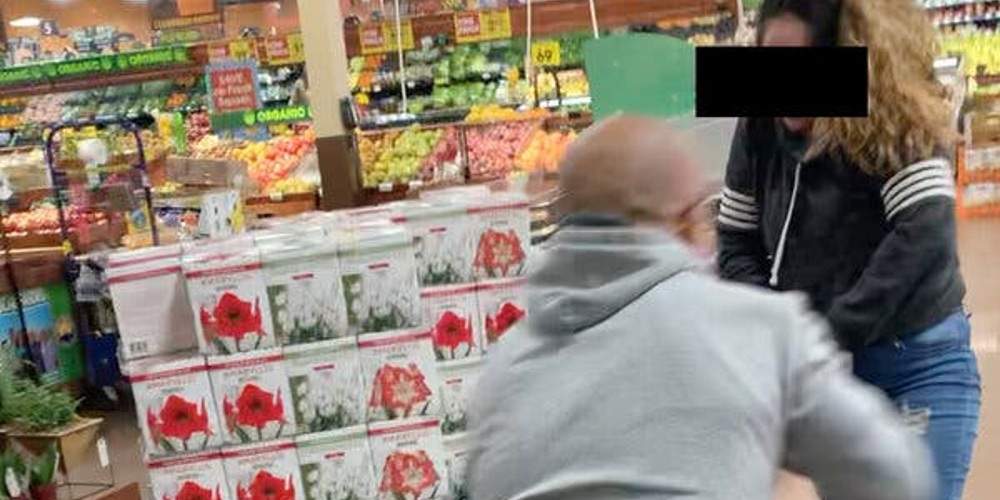
As food inflation worsens, a sense of desperation is seizing the minds of the American people, and some of them are lashing out in acts of violence against workers at grocery stores and other food retail locations. America is now seeing a shocking rise in retail location violence that seems destined to only get worse.
Joe Biden’s catastrophic economic and energy policies have led to a 400% increase in the price of fertilizer, a 100% increase in the price of diesel fuel, supply chain disruptions and food production shortfalls. Even infant formula has been in a supply chain crisis, and the cost of agricultural inputs today means far higher prices in the coming months.
The result is record high food inflation that keeps getting worse. Higher costs of food gobble up higher percentages of discretionary incomes for consumers, hitting low-income consumers especially hard. When food prices rise to the point of requiring 50% of a person’s income just to eat, history tells us that societies break down and lurch into uprisings and revolts.
Now, even the New York Times (via Yahoo News) is covering the trend, reporting that violence against grocery and retail workers is exploding:
In her 37 years in the grocery industry, said Kim Cordova, a union president in Colorado, she had never experienced the level of violence that her members face today.
“What happened with COVID?” said Cordova, president of Local 7 of the United Food and Commercial Workers. “People have changed. Sometimes I wonder if I am living in a Netflix movie. This can’t be real.”
But it is real, just as food inflation is real. Elections have consequences and rigged elections have catastrophic consequences because the criminals who stole the election never had the backing of the American people. So they destroyed the economy, shut down energy infrastructure, set fire to food production facilities and diluted the value of the dollar through haphazard money printing. The result? Fewer and fewer Americans can afford to pay for basic necessities like food.
Grocery chains are tired of being ransacked by criminals, especially when those criminals are protected by left-wing District Attorneys in blue cities where criminals are granted a kind of “left-wing privilege” to loot and steal whatever they want.
“These criminals feel like they own the store,” said Tony Settles, a clerk at a Safeway in downtown Denver.
Now, many grocery workers and grocery chains want to fight back. From that same story:
The union negotiated a contract that ensures workers have the right to defend themselves if a customer attacks them. It is a grim acknowledgment of not only the violence plaguing many facets of American society but the increasing unwillingness of retail employees to keep turning the other cheek to crime in their stores.
This is what happens when you allow criminals to violate the law without consequences – another disastrous “progressive” idea
This is all the result, of course, of what happens when you abandon the idea that criminals should be stopped and arrested rather than allowed to continue stealing. When retail establishments are told that shoplifting is essentially legalized — and that’s exactly the case in many left-wing cities — they are paralyzed and can’t do anything to stop the continued thefts. Even when thieves threaten or attack store employees, retail establishments are told to back down because criminals are granted high privilege in progressive society.
They can do almost anything they want, without any consequences. They essentially exhibit what left-wing propagandists call “white privilege,” but in this case, most of the thieves aren’t white.
As the NYT explains:
From 2018 to 2020, assaults reported to the FBI by law enforcement agencies overall rose 42%; they increased 63% in grocery stores and 75% in convenience stores.
Those numbers will keep rising until retail store owners and employees start defending their lives and their property. This is easily accomplished with firearms, of course, but leftists are also irrationally anti-gun, and they don’t want store managers being armed. They would apparently rather dial 911 and wait around while the cops do nothing and the thieves assault their employees.
“While the political debate swirls about the extent of the crime and its causes, many of the people staffing the stores say retailers have been too permissive of crime, particularly theft. Some employees want more armed security guards who can take an active role in stopping theft,” says the NYT. But once again, “progressives” hate the idea of using security guards, both in grocery stores and in schools. They would rather post, “Gun free zone” signs and pretend that signage stops shootings. This is equivalent to pretending that men can get pregnant. If your beliefs are rooted in fantasy and delusion, you’re not going to have much success dealing with reality. (And no, men don’t have periods and don’t need tampons, either.)
The reality is that as food inflation gets far worse, grocery and convenience store employees are going to face a rising number of violent attacks. We expect to see flash mob looting of grocery stores before the end of this year, and food prices are no doubt going to continue to climb to alarming levels in 2023 and possibly beyond.
In some areas, grocery stores will become war zones
It’s now abundantly obvious that as food prices skyrocket, grocery stores are going to be hit with a wave of violent attackers who are desperate to feed themselves and their families. As the attacks intensify, many food retailers will simply decide to close up shop in high-risk areas. This, in turn, will deprive law-abiding customers access to food, only worsening food scarcity and panic, leading to an expanding wave of desperation and lawlessness.
Perhaps defunding the police in blue cities wasn’t the best idea after all. And voting George Soros-funded DAs into power — who routinely set criminals free instead of charging them — is backfiring badly.

When honest people are starving, they tend to do radical things they wouldn’t normally do. When dishonest people are starving, they go completely off the reservation and are willing to threaten or harm almost anyone to acquire food. We are going to see society collapse into its most animalistic tendencies as this food scarcity crisis unfolds, and the blue cities where most inhabitants reject Christian values and despise morality and ethics are going to be hit the hardest.
Personally, I expect to see many blue cities burning before the end of this year, and 2023 may be even worse. I also expect to see food riots, food rationing and price controls.
Right now, the importance of growing your own food can’t be overstated. My friend Marjory Wildcraft teaches these skills at ICanGrowFood.com, as she’s an expert at growing food when it really counts. Sadly, most Americans don’t know how to grow food. Very few have stockpiled any real food supplies, either, so the “perfect storm” is set for the oblivious masses to be plunged into total panic as food inflation and food scarcity both worsen with shocking speed.
Get more details on all this and much more in today’s Situation Update podcast via Brighteon.com: Brighteon.com/17865dae-f830-40fc-8aca-d6dd5b25e562
Discover more information-packaged podcasts, raw intel reports and interviews each day: https://www.brighteon.com/channels/HRreport
Follow me on:

- Brighteon.social: Brighteon.social/@HealthRanger (my breaking news gets posted here first)
- Telegram: t.me/RealHealthRanger (breaking news is posted here second)
- Truth Social: https://truthsocial.com/@healthranger
- Gettr: GETTR.com/user/healthranger
- Parler: Parler.com/user/HealthRanger
- Rumble: Rumble.com/c/HealthRangerReport
- BitChute: Bitchute.com/channel/9EB8glubb0Ns/
- Clouthub: app.clouthub.com/#/users/u/naturalnews/posts
- Join the free NaturalNews.com email newsletter to stay alerted about breaking news each day.
- Download my current audiobooks — including Ghost World, Survival Nutrition, The Global Reset Survival Guide and The Contagious Mind — at:
- https://Audiobooks.NaturalNews.com/
- Download my new audiobook, “Resilient Prepping” at ResilientPrepping.com – it teaches you how to survive the total collapse of civilization and the loss of both the power grid and combustion engines.
- NATURAL NEWS

Two Storms, One Harvest

Every food crisis in living memory has been a one-shock event. The 2008 price spike was a commodity bubble. The 2020 shortages were a logistics failure. The 2022 grain scare was a war on one exporter’s ports. Each time, the system bent, adjusted, and recovered, and each time the experts assured us afterward that global markets are simply too big and too diversified to fail.
What nobody in Washington seems eager to discuss is that 2026 is shaping up to be something the modern food system has never actually faced. Two independent shocks, one climatic and one geopolitical, are converging on the same harvest cycle at the same time. Not sequentially. Simultaneously.
Start with the weather. The Pacific Ocean is currently building toward what forecasters now openly call a record event. NOAA’s Climate Prediction Center puts the odds of at least a strong El Niño near 88 percent, with roughly two in three odds it reaches “very strong” status, the tier reserved for perhaps three or four events in the entire satellite era. Every major global model now projects a median peak in Super El Niño territory, and most of them project it exceeding the 2015-16 event, which until now held the modern record. Sea surface anomalies were already brushing the super threshold in mid-July, months before these events normally peak. The atmosphere has already shifted into El Niño mode, and the event is forecast to crest in late fall and early winter.
This is not about “climate change.” It’s about the standard cycles of weather, and the cycle we’re currently in is one that has likely devastated societies in the past. We’re better prepared as a society today, but not all Americans are equally prepared.
Serious households have started doing the quiet math on their own. Grocery bills tell part of the story, and the forecast maps tell the rest, which is why long-term food storage has moved from fringe hobby to mainstream line item in the family budget, with established suppliers like Heaven’s Harvest seeing demand from people who five years ago would have rolled their eyes at the idea. That instinct is not paranoia. It is pattern recognition, and the pattern is worth walking through carefully.
Editor’s Note: Heaven’s Harvest IS a sponsor, but the warnings of this article are real and would be written even if we didn’t have a survival food sponsor. With that said, those who take advantage of what they offer can use promo code “Patriot” for 15% off.
The Fertilizer Clock Is Already Running
While the Pacific warms, the second shock has been unfolding in the Strait of Hormuz. The conflict with Iran turned the world’s most important energy chokepoint into a contested waterway, and the consequences reach far beyond the gas pump. Roughly a third of global fertilizer trade moves through Hormuz, and the disruption sent urea prices up 86 percent year over year by March, with a 53 percent jump in a single month.
The World Bank projects energy prices rising about 24 percent in 2026 and fertilizer about 31 percent. By its own accounting, fertilizer prices ran 35 percent higher in the first five months of this year than the same period last year.
Here is the mechanism the nightly news will not explain. Fertilizer is not a grocery item. It is a time-delayed input. The nitrogen a farmer in Iowa or Punjab could not afford to apply this spring does not show up as a problem this spring. It shows up as a thinner harvest six to twelve months later.
The World Bank’s own food security brief concedes that the effects of reduced applications earlier this season “are likely to become visible only later in harvest outcomes.” Translate that from institutional language into plain English and it means this. The damage is already done, it is already in the ground, and we are simply waiting for it to arrive on the shelf.
Now check the calendar. Six to twelve months from the spring planting season lands us squarely in late 2026 and early 2027. Which is precisely when the strongest El Niño in the instrumental record is forecast to peak, bringing its signature droughts to Southeast Asia, Australia, southern Africa, northern Brazil, and South Asia, the very regions that grow the world’s rice, sugar, and oilseeds.
The World Bank warns openly that a strong El Niño “could disrupt multiple crop belts simultaneously” on top of the conflict-driven input costs. Their baseline projection assumes the Middle East disruptions ease by autumn. What in the last two years of Middle East history suggests that assumption is safe?
The System Has No Slack Left
The comfortable answer is that global markets always adjust. But adjustment requires slack, and the slack is gone. Global cereal production is expected to decline from last year’s records even before El Niño does its work. The UN World Food Programme, hardly a den of right-wing preppers, is calling this the most significant disruption to its supply chains since Covid and the invasion of Ukraine, and its supply chain director put the stakes bluntly.
Today’s supply chain challenges are tomorrow’s hunger crisis.
There is also a political dimension that markets cannot price. When food gets scarce, governments do not behave like economists. They behave like politicians. Export bans, hoarding mandates, and panic buying at the national level turned the modest rice shortfall of 2008 into a global crisis, and analysts are already warning that import-dependent nations are the first dominoes.
The 2015-16 Super El Niño, a far weaker event than what is now forecast, threw tens of millions into food stress across Africa and Asia. This one is projected to be stronger, and it arrives with fertilizer already rationed by price and shipping lanes already contested by missiles.
What Joseph Knew
Scripture does not treat preparation for lean years as faithlessness. It treats it as wisdom delivered in advance to those willing to act on it.
Behold, there come seven years of great plenty throughout all the land of Egypt: And there shall arise after them seven years of famine; and all the plenty shall be forgotten in the land of Egypt.
Joseph did not respond to that warning with a hashtag or a committee. He stored grain during the years of abundance, and when the famine came, Egypt stood while its neighbors begged. The lesson is not that famine is certain. It is that the time to prepare is precisely when preparation still looks optional.
Nobody who filled a pantry in a year of plenty has ever regretted it, and nobody standing in an empty aisle has ever been glad he waited for certainty.
None of this calls for panic, and panic is the enemy of sound judgment anyway. It calls for the same unglamorous prudence our grandparents considered ordinary. Keep some cash margin, know your local growers, and put real food in deep storage while it is cheap and available, because the entire arc of this story is that cheap and available is a closing window.
Families looking for a straightforward place to start can visit Heaven’s Harvest and use promo code Patriot for 15 percent off long-term storable food. The forecasts may yet soften, the strait may yet reopen, and we should pray they do. But hope is a fine thing to hold and a foolish thing to eat.

Sad to think that imbecile Biden supporters voted for this. At least the dead imbecile Biden supporters, anyway. 857 days until the election. If we survive. America First. UULTRAMAGA.
Will you stop with the sinful idolatry????
STOP VOTING, TARDO. If you’re still falling for that scam, YOU’RE INSANE.
Supreme Moron gaffing biteme said, “I did that!”
Trump/DeSantis 2024!
Typical this stuff always and I mean always starts with a shortage of toilet paper. It happens everytime.